Does the selected shoulder plane have a 'best friend' in terms of selected elbow position?
I'm working a rotated shoulder turn, which I believe is the TGM term for shoulders turning 90* to the spine, and correct me if I'm wrong, is the shoulder turn with the steepest pitch/plane.
Given this shoulder turn, is there a better or more efficient elbow position and would one be better for hitting versus swinging?
Does the selected shoulder plane have a 'best friend' in terms of selected elbow position?
There are “Plane Angles” and “Shoulder Turns” but not ‘Shoulder Planes’. I think that you’re trying to ask: “Is Elbow Location at Impact related to Swing Plane Angle?” The answer is “yes”, when using TGM procedures.
Quote:
I'm working a rotated shoulder turn, which I believe is the TGM term for shoulders turning 90* to the spine, and correct me if I'm wrong, is the shoulder turn with the steepest pitch/plane.
Given this shoulder turn, is there a better or more efficient elbow position and would one be better for hitting versus swinging?
The Rotated Shoulder Turn is acquired and controlled by adjusting Pivot components. Turning the Shoulders at 90 degrees to the spine is giving preference to the Pivot to direct, rather than the Hands and Flying Wedges to direct, the Clubhead along the Delivery Line.
With Pivot Controlled Strokes, the Body adjusts its positions to rotate the center of gravity of an orbiting mass (Clubhead) on a path that allows the Clubhead to collide with the Ball. The "natural" Swing Plane for Pivot controlled Full Strokes is the Elbow Plane. Therefore, your Elbow, when using a Rotated Shoulder Turn, will most likely (but not necessarily) be located somewhere along a line that passes through the Ball and the point on your body where your Right Elbow touches your side. With Pivot Controlled Strokes, it is common to have the Right Forearm off-Plane and the Clubshaft to be On-Plane during Impact. Or, consider a "Left Arm Only" swinger, who adjusts and exaggerates his pivot components to drag the Clubhead on a path which intersects the Ball.
TGM uses the Right Shoulder and/or the Structure of a Power Package, so that when the #3 Pressure Point traces the Plane-Line, the Right Elbow is directed (automatically) On-Plane during the Stroke (Back and Down) and thus, the Right Forearm will be On-Plane during the Impact Interval and before and after as much as possible.
This Procedure allows the Golfer to Control the Golf Club on varying Plane Angles and still control all three paths of the Clubhead for a three dimensional Impact. This procedure requires the Pivot to comply with the Path of the Hands.
If you don't like the TGM Procedure, then the direction and path of the Right Elbow must be controlled by some other means if the Golfer wants an On-Plane Right Forearm during the Impact Interval. 99% of all Golfers use Pivot Controlled Swings. Some have On-Plane Right Forearms at Impact because they swing their Right Forearm and Golf Club on the Elbow Plane, and some don’t. Still, it’s only part of the whole story.
Using a Turned Shoulder Plane will cause your Right Elbow to move to a specific Location and cause an Automatic “Snap Release” of the Accumulators once you have an On-Plane Right Shoulder during Start-Down and Power Package to transport the Right Elbow and Accumulators. The swing becomes almost entirely Automatic. Just remember to breathe.
If using the right shoulder - how does one incorporate the #4 Left side Accum.?
The #4 Accumulator (Left Arm) is carried across the Chest during the Backstroke (to about 45 degrees). It is now Accumulated. It is Stored in this position, along with the Power Package. The Downstroke Delivers the #4 Accumulator to the Release position.
During Delivery, The Left Arm moves Down the Chest together with the Power Package, but it does not move away from the Chest (Which triggers it's Release). As the Shoulders continue their Rotation and become open to the Target, the Hands become in-line with the Ball. Then the Left Arm will Blast off the Chest; Release. The In-line position of the Left Arm, #4 Accumulator, is when both Arms are Straight.
Quote:
6-M-1 DOWNSTROKE SEQUENCE ....
For maximum Power, the position of must be taken with that will allow Delay of the Release until all Components, except the Right Foot and Right Shoulder, have reached, or passed the Line-of-Site-to-the-Ball per 6-B-1-C. Then the Accumulators must move very rapidly toward their “In-Line” Position. But none should actually arrive (lose all their Lag and Drag until well after Impact. Also see 6-H-0.
My mistake on wording... I meant to write selected shoulder turn and the Rotated is my choice based off mt pattern. I find my best feels are with pitch elbow so I was wondering there was as correlation, but I do find that If I let 4 go early without enough pa1, I get into a push position.
I wonder if you could clarify what and.or when a stroke is considered pivot controlled. As a hitter, do we not pivot by loading pa1 and bending the right arm? Since I'm looking to set my arms in my backswing using my left shoulder, I would be considered using a PC backstroke?
My mistake on wording... I meant to write selected shoulder turn and the Rotated is my choice based off mt pattern. I find my best feels are with pitch elbow so I was wondering there was as correlation, but I do find that If I let 4 go early without enough pa1, I get into a push position.
I wonder if you could clarify what and.or when a stroke is considered pivot controlled. As a hitter, do we not pivot by loading pa1 and bending the right arm? Since I'm looking to set my arms in my backswing using my left shoulder, I would be considered using a PC backstroke?
Wow, you're all over the place.
How do you get the Right Shoulder to Backstop the Right Arm Thrust?
Quote:
I find my best feels are with pitch elbow so I was wondering there was as correlation,
You can't "Thrust" with a Pitch Elbow. Hitters Elbow Position is at the Side so that it becomes Aligned for pushing during Release.
Quote:
but I do find that If I let 4 go early without enough pa1, I get into a push position.
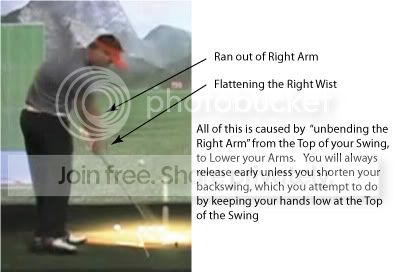
Does the Clubshaft become "in-line" with your Right Forearm after ball Separation? It is, if you release early, otherwise you'll miss the ball or severely "Top" the Ball. That's a problem with Pivot Controlled Stroke Procedure. "Over-acceleration" causes the Early Release, your right elbow is out of alignment and you run out of right arm before the ball is stuck, and the Clubhead can't reach the Ball without flipping your Right Wrist. You are Pulling Down From the Top with Your Left Arm. I bet that your starting to narrow your stance and playing the ball back a little. Further adjustments won't correct the situation, but they will make you erratic on the golf course. One day great the next day, not so good.
Quote:
I wonder if you could clarify what and.or when a stroke is considered pivot controlled.
The use of a Rotated Shoulder Turn is further evidence of using the Pivot to control the path of the Clubhead. I'm not dissing you. It takes a hell of an Athlete and Hand-Eye coordination to swing like you do.
Pivot Controlled Strokes are those that hurl the Clubhead at the Ball compared to Hands Controlled which directs the Right Elbow into the Release Zone. You're monitoring the Pivot rather than monitoring the Hands.
Quote:
As a hitter, do we not pivot by loading pa1 and bending the right arm?
You can load the Power Package with a Non-Pivot Stroke.
Pivots occur naturally when the Shoulder Turn, in order to keep Turning, causes other Pivot Components to move.
Swingers Bend the Right Elbow like a "Preacher Curl"...Hitters Bend the Right Elbow like a Right Arm "Cable Pull".....
Quote:
Since I'm looking to set my arms in my backswing using my left shoulder, I would be considered using a PC backstroke?
Homer Said: 7-12
Quote:
. A Pivot is only superficially correct that fails to maintain alignments or allows the player to get “out of position”.
You will need a Recovery Period, to reset Alignments, before you begin Startdown, in order to direct the Right Elbow into the Release while it's moving simultaneously down, out and forward.
Once you Start a Pivot Controlled Procedure (it's extremely difficult to Switch) you complete the swing by monitoring the Pivots direction Control of the Clubhead.
The #4 Accumulator (Left Arm) is carried across the Chest during the Backstroke (to about 45 degrees). It is now Accumulated. It is Stored in this position, along with the Power Package. The Downstroke Delivers the #4 Accumulator to the Release position.
During Delivery, The Left Arm moves Down the Chest together with the Power Package, but it does not move away from the Chest (Which triggers it's Release). As the Shoulders continue their Rotation and become open to the Target, the Hands become in-line with the Ball. Then the Left Arm will Blast off the Chest; Release. The In-line position of the Left Arm, #4 Accumulator, is when both Arms are Straight.
Seems like the pivot and the left side have to do a lot of the work no - not just the right?




 Hybrid Mode


