
|
shoulder plane and elbow position
Two posts in the same week!... i'm on a role.
Does the selected shoulder plane have a 'best friend' in terms of selected elbow position? I'm working a rotated shoulder turn, which I believe is the TGM term for shoulders turning 90* to the spine, and correct me if I'm wrong, is the shoulder turn with the steepest pitch/plane. Given this shoulder turn, is there a better or more efficient elbow position and would one be better for hitting versus swinging? |
Quote:
Quote:
With Pivot Controlled Strokes, the Body adjusts its positions to rotate the center of gravity of an orbiting mass (Clubhead) on a path that allows the Clubhead to collide with the Ball. The "natural" Swing Plane for Pivot controlled Full Strokes is the Elbow Plane. Therefore, your Elbow, when using a Rotated Shoulder Turn, will most likely (but not necessarily) be located somewhere along a line that passes through the Ball and the point on your body where your Right Elbow touches your side. With Pivot Controlled Strokes, it is common to have the Right Forearm off-Plane and the Clubshaft to be On-Plane during Impact. Or, consider a "Left Arm Only" swinger, who adjusts and exaggerates his pivot components to drag the Clubhead on a path which intersects the Ball. TGM uses the Right Shoulder and/or the Structure of a Power Package, so that when the #3 Pressure Point traces the Plane-Line, the Right Elbow is directed (automatically) On-Plane during the Stroke (Back and Down) and thus, the Right Forearm will be On-Plane during the Impact Interval and before and after as much as possible. This Procedure allows the Golfer to Control the Golf Club on varying Plane Angles and still control all three paths of the Clubhead for a three dimensional Impact. This procedure requires the Pivot to comply with the Path of the Hands. If you don't like the TGM Procedure, then the direction and path of the Right Elbow must be controlled by some other means if the Golfer wants an On-Plane Right Forearm during the Impact Interval. 99% of all Golfers use Pivot Controlled Swings. Some have On-Plane Right Forearms at Impact because they swing their Right Forearm and Golf Club on the Elbow Plane, and some don’t. Still, it’s only part of the whole story. Using a Turned Shoulder Plane will cause your Right Elbow to move to a specific Location and cause an Automatic “Snap Release” of the Accumulators once you have an On-Plane Right Shoulder during Start-Down and Power Package to transport the Right Elbow and Accumulators. The swing becomes almost entirely Automatic. Just remember to breathe. |
If using the right shoulder - how does one incorporate the #4 Left side Accum.?
|
Quote:
During Delivery, The Left Arm moves Down the Chest together with the Power Package, but it does not move away from the Chest (Which triggers it's Release). As the Shoulders continue their Rotation and become open to the Target, the Hands become in-line with the Ball. Then the Left Arm will Blast off the Chest; Release. The In-line position of the Left Arm, #4 Accumulator, is when both Arms are Straight. Quote:
|
My mistake on wording... I meant to write selected shoulder turn and the Rotated is my choice based off mt pattern. I find my best feels are with pitch elbow so I was wondering there was as correlation, but I do find that If I let 4 go early without enough pa1, I get into a push position.
I wonder if you could clarify what and.or when a stroke is considered pivot controlled. As a hitter, do we not pivot by loading pa1 and bending the right arm? Since I'm looking to set my arms in my backswing using my left shoulder, I would be considered using a PC backstroke? |
Quote:
How do you get the Right Shoulder to Backstop the Right Arm Thrust? Quote:
Quote:
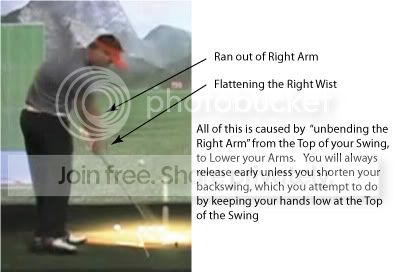 Quote:
Pivot Controlled Strokes are those that hurl the Clubhead at the Ball compared to Hands Controlled which directs the Right Elbow into the Release Zone. You're monitoring the Pivot rather than monitoring the Hands. Quote:
Pivots occur naturally when the Shoulder Turn, in order to keep Turning, causes other Pivot Components to move. Swingers Bend the Right Elbow like a "Preacher Curl"...Hitters Bend the Right Elbow like a Right Arm "Cable Pull"..... Quote:
Quote:
Once you Start a Pivot Controlled Procedure (it's extremely difficult to Switch) you complete the swing by monitoring the Pivots direction Control of the Clubhead. |
Quote:
Hey D, you're on fire these days. Great info and effort. Im thinking: -first sentence above assumes 10-15-B Delayed, no? Using 10-15-A Standard Hip Action, the Hips lead and pull the shoulders in both directions. Its "Hula, Hula" not just "Hula". Not so common anymore but I think Luke does this. You know all this and more, I realize, it was you that introduced me to Hip Action. Just clarifying things for the folks following along at home. -dont know what you mean by "Cable Pull" exactly, but one point that Lynn corrected in my Hitting Stroke and/or perception of things, might relate to this. Namely, an elbow saw or piston like right arm fold , while displayed in the Alignment Golf DVD by V.J. during the chipping, hinging discussion, is really verging on a Push Basic Stroke. One variation available to us in terms of Elbow Position, but recommended for short shots only. These little shots can of course also be executed using a less piston like Punch Elbow with an associated increase in Fanning in the Fanning/Bending mix. Per 10-3-C PUSH. "From an "up-and-out" Elbow Position, which keeps the Hnads always between the Elbow and Ball.............heavy pushing action........This is essentially a Hitting procedure for less than full power. .............It produces an automatic Vertical Hinging. Moved "cross lIne" it produces an automatic Angled Clubface Hinging." Some omissions for brevity by me. I had mistakenly been morphing a more linear, less fanning right arm into my full swing startup, thinking this was the Hitters ideal. Not Keereckt. Wrong-o. Per 10-3-A PUNCH. "From a "down- and-at-the-side" Elbow Position whether the Elbow is touching the Body or not, a straight-line Right Hand Punch is delivered through Imapct (6-E). Per 6-C-2-A and 7-19. Except with a 10-3-C (Push), the Right Forearm must have a "Fanning" type of motion, not a "Linear" Push Stroke type of motion (10-3-C). So to my mind anyways, the swingers and hitters elbow positions (and therefore their Major Basic Strokes and associated Right Forearm Takeaways) can if you so choose have more in common than they do differences. The Pitch Elbow vs a Punch Elbow that touchs the side of the body, for instance, necessitating a similar though not exactly the same RFT, Fanning and Bending wise. Coming into the ball as well. Smaller pulley wheel too? Later release of #2? Still doing some thinking on these but Im thinking the answer is yes. And now for something shocking........what if the Right Arm didnt Fan but rather was Fanned? By the Pivot in Startup! Leaving the Right Arm to simply bend, actively, on its own. You need a Pivot in Startup! Golf is a motion, dont freeze things up, lock things down. Its a dance and one you hopefully do like no one is watching. Let er go. -In terms of the difference between Pivot controlled Hands and Hand Controlled Pivot, I submit the following. The "always under plane", "distructive" shoulder turn takeaway that Mr Kelley refered to, is a Pivot that takes the hands with it in the direction that it, the pivot is going (Back). The correction for this does not necessarily imply a different pivot per say but rather the addition of Plane Line Tracing by the Hands. Ultimately resulting in the Pivot going its way (Back) while the Hands go their, separate way (UP) on the backswing. A far superior method to a Pivot controlled Hands procedure that attempts to have the Shoulders make the Arms arrive at Top on the appropriate Arm Plane. A way too steep turn of the shoulders resulting and unnecessary. So Pivot goes Back , Hands go Up. Two different directions of movement. Divide and prosper. Start down is a somewhat different deal where, assuming a Turned Shoulder Plane and Axis Tilt etc, the Right Shoulder takes the Power Package down the TSP, they ride it together the Right Shoulder providing the initial power until the Hands accelerate away from the Shoulders and continue down plane on their own power. Thanks for all the great posts of late Daryl. Are you playing any, these days? Ob |
Quote:
Yep. Delayed. An Almost "must do" procedures for Swingers; but, I do preset my Hips out of the way of the Backstroke like Hogan and Brian Gay with a set-up procedure. Quote:
Quote:
Quote:
Quote:
Quote:
|
Hey Slicer McGolf,
I have an experiment for you to try. It will give you a very late release. It's just so that you can feel what your missing. :laughing9 Practice Swing: Read instructions first. Backstroke Procedure, Address, with the Club, Arms only, Extend your Left Arm straight while using your Right Arm, like doing a right arm curl, to raise your Left Arm and club to the top of the swing and to hold your left arm against your chest. Let this motion pull your pivot into a coil. It will begin to move your hips as you get to the top. Downstroke Procedure, Keep pulling the Left Arm against the Chest and start the downswing. Do not release the right biceps muscle. Let go of the right biceps muscle to release the Left Arm as late (as very Late) as you can into the Release Zone. Feel the Release Sequence of a Late Release. You can hit Ball this way. It's in no way the proper way to Swing a Club, but it's fun to feel the Coil and the togetherness on the downswing and the Super Late explosive Release. |
Sorry Daryl,
My questions did get a little scattered there and maybe I shouldn't have brought up anything about hitting because I don't feel my action is hitting. Your feedback was great because the 2 areas that i'm concerned with are losing both the bent right arm and bent right wrist too early. here's a vid of the drill you asked me to try. http://widedivots.com/video/swing/1782/attempts |
| All times are GMT -4. The time now is 11:39 PM. |