The critial alignment is the left arm flying wedge.
What I think you mean, the left wrist being 'flat' visually at release is not actually flat, but slightly arched.
There is no need for 'bend' at release if the proper definition of 'flat' is understood. bent = left arm flying wedge out of alignment flat = left arm flying wedge in alignment.
Take your left hand and grab a bottle/glass or water and lift it up to drink. That is a flat left wrist.
Ed,
He's talking about a Double Left Wrist Bend and how to perform a Non-Automatic Release of #3.
I agree about the Left Arm Wedge. To me, Flat is Flat. Visually, lay a Level on it Flat. Flat Left Wrist, Bent and Level Right Wrist, Uncock and Roll the Power Package on Plane. Flat.
Hmm? The Wrist Throw (Right Wrist) is a Flat Left Wrist Procedure. This, I think, is a "Purists" point of view. (ask 12 pc Bucket for a definition of "Purist" )
The amount of Bend in the Left Wrist (10-2-B Grip) depends and coordinates with Right elbow Location. Flatter Swing Planes have the Right Elbow Closer to and in front of the Right Hip and need Wrist Bend. Right Elbows on a Turned Shoulder Plane are Located Slightly away from the Body and Closer to the Belt Buckle and need a Flat Left Wrist.
With a Level and Bent Right Wrist, relocating the Right Elbow left vs. Right and Closer vs. away from the Body, which is simply relocating the Right Elbow to Flatter and Steeper Planes will show that the Left Wrist Bend Changes without changing the Bend in the Right Wrist.
Clubhead Vs. Clubface:
Changing the Left Wrist from Bent to Flat demonstrates that the motion spins the Clubshaft and Changes the Clubface. This is a Clubface Motion. I think that this is Zero #3 Accumulator. Two Barrel.
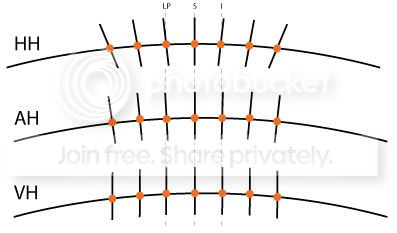
The #3 Accumulator is a Clubhead Motion (Flat Left Wrist). It is a Flying Wedge Roll that Changes the Location of the Clubhead. This is why Horizontal Hinging has greater Clubhead Travel than Angled Hinging and why Vertical Hinging has very little Travel. This is #3 Accumulator Power that will be added to the Residual #2 Velocity Power. Three Barrel.
HH has greater clubhead travel - so would it be moving faster or slower... resistance vs. speed from face rotation. AH/VH has less travel and a slower rotation, so does the face move faster or slower with rotation/closure? we know what it does to curvature.
HH has greater clubhead travel - so would it be moving faster or slower... resistance vs. speed from face rotation. AH/VH has less travel and a slower rotation, so does the face move faster or slower with rotation/closure? we know what it does to curvature.
Accumulators move the Center of Gravity of the Clubhead. Hinging controls the Club Face by rotating the Primary Lever around one of three Hinge Axes; Vertical, Horizontal, or Angled. Release Interval, Stroke Length effect Clubhead Speed.
So, though one Hinge may appear to have more Clubhead travel than another because of how the #3 Accumulator is used (Right Elbow Path through the Release Interval), the Sweet-spot has the same Travel. Meaning that from start-up to Finish, the Clubhead Travels the same distance regardless of Hinge Action.
But I dont get the sweet spot not traveling with the clubheads travel.
Travel is dependent on Hinge Type but only via the #3 Accumulator angle, the angle at the left arm and club when seen from DTL. The more angle the more travel. You can zero out #3 by going in line like we do when putting say with less send resulting. In this case the travel associated with all Hinge Actions would be the same.
But, Im thinking that if the clubhead travels so does the sweet spot, no? Although sometimes I do feel like Ive left my sweet spot behind, some place.
But I dont get the sweet spot not traveling with the clubheads travel.
Travel is dependent on Hinge Type but only via the #3 Accumulator angle, the angle at the left arm and club when seen from DTL. The more angle the more travel. You can zero out #3 by going in line like we do when putting say with less send resulting. In this case the travel associated with all Hinge Actions would be the same.
But, Im thinking that if the clubhead travels so does the sweet spot, no? Although sometimes I do feel like Ive left my sweet spot behind, some place.
oohh...sorry...I made a correction to the post.
Pressure Points sense the CG of the Clubhead. Accumulators Speed up the CG of the Clubhead. Accumulator Pressure adds Mass to the Clubhead. Hinging controls the Clubface Rotation.
Slicer Mcgolf was asking if the greater club head travel distance with a Horizontal Hinge created a faster moving Clubhead than an Angled Hinge with its comparatively shorter Clubhead travel distance.
A Hinge isn't an Accumulator. Hinging is Clubface motion.
In an Automatic Release: No, but the Clubhead moves faster because it uses an additional Accumulator (#3 in a sequenced Release). Not because of Face Rotation.
Quote:
So, basically, Accumulator #3 Hand Motion (4-D-0) is “Clubface Control,” “Rhythm Control,” and “Roll Power Control” of the Right Elbow (7-3). Study 2-G and 7-20.
AND
The Accumulator #3 motion must be accommodated in the Impact alignment or it will (with great loss of Power) produce a Quitting of the Hand Motion and/or a Quitting of the Overtaking action in an effort to avoid Pulled Shots.
The above "quotes" basically say, that the #3 Accumulator Roll should "Overlay" the Hinge Action. (Occur at exactly the same time). In other words, if you Start the Roll too early (Elbow Plane) then you're gonna need three right hands to drive the club through the ball so you don't quit and/or pull the ball off the golf-course. You'll "Roll" then "Hinge". But you won't do it for long because only poor shots result so you'll give up Rolling or Hinging or Both.
In a Non-Automatic Release: No, because Accumulators #2-3 are Simultaneous. The Clubface Rotates around the Center of Gravity of the Clubhead, not "A Hinge Pin" perpendicular to the Horizontal Plane. The #3 Accumulator is negated.


 )
)


 Linear Mode


