I look forward to your capsule summary. I hope that you will address the following issue in particular.
You stated-: "Of course, the same thing is happening with the Right Arm: It is being Pulled by the Body, its rotation and the ultimating Centrifugal Force. But, it is easy for the player's Right Hand to mistake this Pull - against the Lag Pressure it generates -- as a Push."
If I understand you correctly, Hogan had a body-generated swinger's action, whereby the downswing pivot action essentially provides the swing power. I envisage the downswing pivot action pulling the entire power package assembly (left and right arm flying wedges) at the start of the downswing, so that the right arm/forearm merely has to supply sufficient isometric muscle force to maintain the right arm flying wedge intact during the early/mid downswing. Then, when power accumulator #4 and then #2 release, the right arm/forearm needs to supply enough muscle force to maintain the constantly bent right wrist/right hand firmly against the grip/left thumb so that the golfer can provide constant extensor action throughout the downswing and also constantly sustain clubhead lag and prevent club throwaway.
I would also be interested in your opinion as to whether a Tom Tomasello-style "right arm throw" action is suitable for right arm-swingers, who do not use the downswing pivot action to release power accumulator #4. Tom Tomasello stated that in an "arm swinger's" action, the body simply gets out of the way so that the arms can swing freely across the front of the body. In that scenario, I can envisage the the right arm/forearm being actively responsible for the release of power accumulator #4 - by the right palm pressing against the left thumb at PP#1 and pushing the entire left arm forward. In that sense, I can envisage the "right arm throw" action causing the release of power accumulator #4 via an active "push"' action, and the release of power accumulator #2 via a secondary "pull" action on the clubshaft (the right forearm/arm pushes the left arm forward at PP#1 => the left hand pulls the grip => the club passively releases via a centrifugal action). The question then becomes - does the right arm/forearm also cause an active release of power accumulator #1 in a right arm swinger's action, or is the right arm swinger's action still a triple barrel (4:2:3) swing action?
You wrote-: "What I see, Hogan squared his clubface just before entering the impact zone when his right hand seem to turn into a palm down position. It can be seen when his shaft is, more or less, in parallel to the ground position."
When you state that the clubshaft is parallel to the ground, then you must surely be referring to the delivery position. You then imply that Hogan's clubface is square at this position with the right palm facing the ground. I do not see that phenomenon in Hogan's swing. Do you have a single photo showing that Hogan's clubface is square to the swingarc when his clubshaft is in the delivery position?
From my perspective, Hogan would have wanted to avoid that scenario because he had a hooking problem and he apparently wanted his clubface to be slightly open throughout the early/mid downswing. Jim McLean makes this point in his DVD series analysing Hogan's swing.
Here is a photo of Jim McLean mimicking Hogan's swing action when his clubshaft is at the delivery position.
The dotted yellow line shows that the clubface of Jim McLean's club is slightly open at this time-point. Jim Mclean stated that Hogan deliberately maintained a slight cupping of the left wrist throughout his downswing so that he could keep the clubface slightly open to the clubhead swingarc.
If the clubface was square at this time-point in the downswing, then the back of Hogan's left hand (which is parallel to the clubface) must be facing slightly groundwards. I have never seen a photo of Hogan at this time-point in his downswing with the back of his left hand facing groundwards. If anything, it always seems to face slightly skywards.
You also wrote-: "The hip turn that starts the downswing (i.e. left side of the body action - remember Hogan's image of elastic tape glued to his left hip ?) is a pulling motion that can create by itself the left wrist cock. Supposing that Hogan used his right arm/elbow/forearm/hand to support the hit, he had to convert the left wrist cock lag into a right wrist hinge lag."
I don't think that you understand Hogan's swing action from a TGM perspective. Power accumulator #2 is loaded during the backswing and that establishes the left wrist cocking angle of =>90 degrees. When the left wrist cocks up during the left arm's lifting/counterclokcwise rotation movement, the right elbow folds and the right wrist hinges back into a bent right wrist position. Therefore, the bent right wrist situation is established during the backswing. Once established, the bent right wrist is never released during the downswing, even when the right elbow straightens in the late downswing, and even when the left wrist uncocks as power accumulator #2 is released.
I would also be interested in your opinion as to whether a Tom Tomasello-style "right arm throw" action is suitable for right arm-swingers, who do not use the downswing pivot action to release power accumulator #4. Tom Tomasello stated . . .
I have written countless posts on the various Release Triggers, including the Right Arm Throw and its Shoulder Turn Throw Combination. I will continue to address selectively specific questions regarding the Triggers, but not in a 'Tomasello' context. His teachings, however widely chronicled, are vastly misunderstood, as evidenced by your question framing them in the context of Right Arm Swing.
In any event, this is not the appropriate thread for such discussions. For those interested, Bagger Lance has established a Right Arm Swing thread precisely for that purpose. http://www.lynnblakegolf.com/forum/s...ead.php?t=5617 And a few clicks will lead others to numerous 'Tomasello' threads.
Thank you in advance for understanding.
P.S.
Originally Posted by Jeff
The question then becomes - does the right arm/forearm also cause an active release of power accumulator #1 in a right arm swinger's action, or is the right arm swinger's action still a triple barrel (4:2:3) swing action?
By definition, except as Clubshaft support per 10-19-C, the #1 Accumulator (Muscular Thrust) is always passive in a Swinging Action (Centrifugal Force). That is true whether the Swing is with the Left Arm or the Right.
I believe Hogan qualified his “three right hands” statement with the following paragraph.
“On a full shot you want to hit the ball as hard as you can with your right hand. But this is only half the story. HIT THE BALL AS HARD AS YOU CAN WITH BOTH HANDS. The left is a power hand, too. If you hit hard with only the right and let the left go to sleep, you will not only lose much valuable power, you also will run into all the errors that result when the right hand overpowers the left. YOU MUST HIT AS HARD WITH THE LEFT AS WITH THE RIGHT. “ (Lesson 4 page 99)
In the paragraph above he appears more concerned with the left not doing its job (going to sleep) and being overpowered by the right rather than being worried about a deficient right hand. He also wanted the “…right hand in a position to perform its share of the work but no more than its equal share”. (Lesson 1 p24). Here again he appears more concerned about the right hand dominating rather than it being deficient.
Given equal strength in both hands, if he desired the power of three right hands he must have also desired the power of three left hands (“the left is a power hand, too.”) so that the right hand did not dominate and in order to achieve his objective, which was to “HIT THE BALL AS HARD AS YOU CAN WITH BOTH HANDS.”
I believe Hogan qualified his “three right hands” statement with the following paragraph.
“On a full shot you want to hit the ball as hard as you can with your right hand. But this is only half the story. HIT THE BALL AS HARD AS YOU CAN WITH BOTH HANDS. The left is a power hand, too. If you hit hard with only the right and let the left go to sleep, you will not only lose much valuable power, you also will run into all the errors that result when the right hand overpowers the left. YOU MUST HIT AS HARD WITH THE LEFT AS WITH THE RIGHT. “ (Lesson 4 page 99)
In the paragraph above he appears more concerned with the left not doing its job (going to sleep) and being overpowered by the right rather than being worried about a deficient right hand. He also wanted the “…right hand in a position to perform its share of the work but no more than its equal share”. (Lesson 1 p24). Here again he appears more concerned about the right hand dominating rather than it being deficient.
Given equal strength in both hands, if he desired the power of three right hands he must have also desired the power of three left hands (“the left is a power hand, too.”) so that the right hand did not dominate and in order to achieve his objective, which was to “HIT THE BALL AS HARD AS YOU CAN WITH BOTH HANDS.”
Well if he wanted 3 left hands he would have written that. His swing changed quite a deal after this book and probably due to an endless search for a better swing. Golf digest or some other mob offered hogan money to reveal all later on in his life but in the end he backed out apparantly due to the money reward being to little.It would seem hogan found much more after he wrote this book but its a good starting point.
Jeff, I am not sure how to upload photos on this Forum. Call me a PC laic and you won't be far from the truth if I knew how to do it from my PC collection I'd give the evidence of my way of thinking for you.
There is a ton of photos of post-accident Hogan that support what I've written (such as e.g. the photo from Jules Alexander site to which I included the link above with). Jim McLean's version from the BH Collection is not even close to the original. Please look even at the photo you put in your post - pay special attention to where the V on the right hand grip is pointing - there is a huge difference still visible (although the Hogan's photo is of bad quality).
Before-secret Hogan wanted to deliver the clubface as open as possible since he believed it could tame his hooks. It did not work, as we all know. Post-secret, and specially post-accident Hogan appeared to do a completely reverse thing (which seemed to be totally counterintuitive) - to square the clubface earlier and maintain it square as long as possible (delayed post-impact swivel and swinging left with an angled hinge); the whole question is if you are able to do it with only left arm pulling...I do not believe it is so easy and so efficient comparing to the right forearm support while swinging the club around...
Jeff, I am not sure how to upload photos on this Forum. Call me a PC laic and you won't be far from the truth if I knew how to do it from my PC collection I'd give the evidence of my way of thinking for you.
There is a ton of photos of post-accident Hogan that support what I've written (such as e.g. the photo from Jules Alexander site to which I included the link above with). Jim McLean's version from the BH Collection is not even close to the original. Please look even at the photo you put in your post - pay special attention to where the V on the right hand grip is pointing - there is a huge difference still visible (although the Hogan's photo is of bad quality).
Before-secret Hogan wanted to deliver the clubface as open as possible since he believed it could tame his hooks. It did not work, as we all know. Post-secret, and specially post-accident Hogan appeared to do a completely reverse thing (which seemed to be totally counterintuitive) - to square the clubface earlier and maintain it square as long as possible (delayed post-impact swivel and swinging left with an angled hinge); the whole question is if you are able to do it with only left arm pulling...I do not believe it is so easy and so efficient comparing to the right forearm support while swinging the club around...
Cheers
Dariusz
Great pictures and insight and just a reminder that I am sure HK states somewhere in the book That a player on Elbow Plane and a lot of no3 angle would need an earlier release point which is a possibity that Hogan figured out
and those pics hint at this.
Maybe Jeff will find that passage in the book and post it
It is very easy to link to photos so that they appear in your text message. There should be a series of formattiing choices at the top of this window, and the one choice is a mountain with a yellow colored sky. If you hover your mouse arrow above that "picture" it should state "insert image". You simply have to click on that "insert image" link and insert your url link.
If you cannot find the "extra" formatting options, got to UserCP => click on "edit options" => got to miscellaneous options at the bottom, and then choose "standard editor".
Regarding that Jules Alexander photo, it doesn't show the clubshaft at the delivery position. The clubshaft is already well into that part of the downswing called the "release swivel" phase and during this phase of the downswing, the left hand and clubface will undergo a 90 degree rotation into impact. During that 90 degree rotation phase, the back of the left hand will swivel so that it faces the target and it will also face groundwards if the golfer is hitting down on the ball. It is perfectly normal for the clubface, and back of the left hand, to be facing slightly groundwards during the release swivel phase of the downswing - and this applies to all good golfers, and not only Hogan.
I think that you would benefit greatly if you did what I did 2 months ago - become an avid student of TGM. It has changed my understanding of the golf swing in many ways, even though I still have a lot to learn. Then, you wouldn't write-: "to square the clubface earlier and maintain it square as long as possible (delayed post-impact swivel and swinging left with an angled hinge); the whole question is if you are able to do it with only left arm pulling...I do not believe it is so easy and so efficient comparing to the right forearm support while swinging the club around..." I think that you have an incomplete/ wrong conception of the golf swing. A swinger may "pull" the club longitudinally with the left arm, but the right forearm and PP#3 control the clubshaft to ensure that it is on plane during the downswing, while the left hand controls the clubface through impact. I don't believe that a golfer should ever "hold" the clubface square as long as possible. In HK's terms, that represents "steering", which is a significant mistake. The clubface should always come into impact with a slightly open clubface, and a good golfer controls its rate of closure through impact/followthrough via a hinging action, which is under the control of the back of the left hand, but biomechanically operant at the level of the left shoulder socket. Any post-impact swiveling action occurs after the followthrough phase of the swing.
Here is a post-accident photo of Hogan posing - to demonstrate how he wanted the clubface to be slightly open when it reached the delivery position.
If you have "evidence" that Hogan changed his approach to deal with his lifelong hooking problem very late in his career, then could you please i) quote Hogan stating that he deliberately chose to close the clubface earlier in his downswing; and ii) explain how an earlier clubface closure action would be a good anti-hooking strategy.
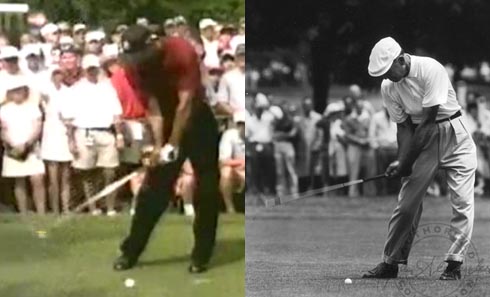
Here is link to a slo-mo swing video of Tiger Woods's swing, and you will be able to study the movement of the back of his left hand and clubface during the release swivel action.
This photo comparison shows that both Tiger and Ben had the back of their left hand facing slightly groundwards at this stage of the release swivel action (when viewed from a similar off-center camera angle) and that the clubface is not square yet to the swingarc.
I believe that the clubface must always approach the ball slightly open at the time of first ball impact in standard shots.
It is very easy to link to photos so that they appear in your text message. There should be a series of formattiing choices at the top of this window, and the one choice is a mountain with a yellow colored sky. If you hover your mouse arrow above that "picture" it should state "insert image". You simply have to click on that "insert image" link and insert your url link.
If you cannot find the "extra" formatting options, got to UserCP => click on "edit options" => got to miscellaneous options at the bottom, and then choose "standard editor".
Regarding that Jules Alexander photo, it doesn't show the clubshaft at the delivery position. The clubshaft is already well into that part of the downswing called the "release swivel" phase and during this phase of the downswing, the left hand and clubface will undergo a 90 degree rotation into impact. During that 90 degree rotation phase, the back of the left hand will swivel so that it faces the target and it will also face groundwards if the golfer is hitting down on the ball. It is perfectly normal for the clubface, and back of the left hand, to be facing slightly groundwards during the release swivel phase of the downswing - and this applies to all good golfers, and not only Hogan.
I think that you would benefit greatly if you did what I did 2 months ago - become an avid student of TGM. It has changed my understanding of the golf swing in many ways, even though I still have a lot to learn. Then, you wouldn't write-: "to square the clubface earlier and maintain it square as long as possible (delayed post-impact swivel and swinging left with an angled hinge); the whole question is if you are able to do it with only left arm pulling...I do not believe it is so easy and so efficient comparing to the right forearm support while swinging the club around..." I think that you have an incomplete/ wrong conception of the golf swing. A swinger may "pull" the club longitudinally with the left arm, but the right forearm and PP#3 control the clubshaft to ensure that it is on plane during the downswing, while the left hand controls the clubface through impact. I don't believe that a golfer should ever "hold" the clubface square as long as possible. In HK's terms, that represents "steering", which is a significant mistake. The clubface should always come into impact with a slightly open clubface, and a good golfer controls its rate of closure through impact/followthrough via a hinging action, which is under the control of the back of the left hand, but biomechanically operant at the level of the left shoulder socket. Any post-impact swiveling action occurs after the followthrough phase of the swing.
Here is a post-accident photo of Hogan posing - to demonstrate how he wanted the clubface to be slightly open when it reached the delivery position.
If you have "evidence" that Hogan changed his approach to deal with his lifelong hooking problem very late in his career, then could you please i) quote Hogan stating that he deliberately chose to close the clubface earlier in his downswing; and ii) explain how an earlier clubface closure action would be a good anti-hooking strategy.
Jeff.
Jeff, thanks for helping me with uploading photos possibility, however, I still do not know how to upload a photo from my PC (I do not want to upload using URLs since I do not possess a web site with already uploaded photos). But never mind...
I am not going to debate with you or any of the Forum members in a TGM language since my knowledge is very limited so far.
Neverteless, I can easily answer your 2 questions using ordinary terms:
i) quote Hogan stating that he deliberately chose to close the clubface earlier in his downswing
I cannot do it since I believe it is one of the important puzzles of Hogan's secret that he did not want to reveal to anyone.
ii) explain how an earlier clubface closure action would be a good anti-hooking strategy
It's very easy. In case of pivot guided swings the most efficient motion is to subdue the clubface movement to the body turn; when your clubface is already square to the arc before entering the impact zone no further action is taken in order to close the clubface, because your brain already knows it is square; you, as a Doc, should know much better than me that everything happens in our brain - if your brain "sees" the clubface as closed and, simultaneously, your brain "wants" to hit the ball straight, it won't allow your hands to close the clubface and will force them to be completely passive during the impact zone.
Do an experiment yourself - address the ball with a severely closed clubface with an attempt to hit the ball straight forward - you will see how hard (or even impossible) is to hook the ball in such a scenario. What will happen is that you subconsciousnessly hit the ball with a more open clubface that it was at address and most likely (depending on your swing characteristic) you'll obtain a fade pattern. No CP, CF or other forces will be ever able to overcome your subconsciousness.
I think that Hogan discovered this phenomenon and he gave us some clues while saying: "if you think that a given thing in your swing will help you - do exactly opposite thing and you'll obtain what you want
Cheers
P.S. the comparison between Hogan and Woods on those 2 pics of yours is wrong - first, the angles are different, second, they are not in the same moment of the swing. Lastly, look carefully at Hogan's clubface - it is square to the arc already (the whole face of the club is visible).





 if I knew how to do it from my PC collection I'd give the evidence of my way of thinking for you.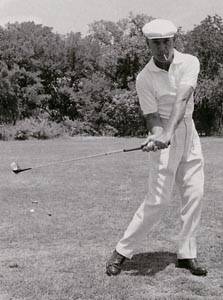


 Linear Mode


