Your participation if anything is consistent...positions without much substance which generally gravitate to personal attacks. Can you please point us to your knowledge base so we can better appreciate your journey.
Hg
If you can't understand the geometry of what i stated in this thread regarding the topic then i can't help you.It seems so obvious to me that the positions of hogan changed dramatically over the years so WITHOUT MUCH SUBSTANCE is your opinion
And i would call that a personal attack on me but no problem since my knowledge base is playing for a living and dismantling my own swing numerous times and reconstructing.
Goodluck
Mike, a square-to-the-arc clubhead means that the clubface is perpendicular to the swing arc. The forearm rotation clockwise during backswing opens the clubface in relation to the arc; the same rotation but anti-clockwise brings it to the square position during downswing and closes it in the follow through.
Now, depending on the release type, some golfers brings the clubface square earlier and some later just before impact. The same may happen after impact - some golfers maintain the clubface square after impact (those who swing left with a late swivel) and some close it rapidly just after impact together with a crossover of their forearms (early swivel).
Hogan delivered his clubface square already before entering the impact zone and maintained it square long after impact what is one of very suspected "culprits" of his overhuman accuracy and repeatability.
Cheers
Thanks for your post- you described the concept of square well enough for me to grasp it. Obviously, I'm assuming that when we say "clubface square to the arc" we mean the leading edge (as clubface loft would create a whole different set of problems). Also, if as you describe- that before, during and after Hogan's impact his leading edge was square to the arc- then we are merely saying that he had (in TGM terms) angled hinging- correct? (Since during impact I imagine angled hinging as having the leading edge staying square to the arc.)
Horizontal hinging and vertical hinging would only have one point where the leading edge is square to the arc through the impact period. So given your post you're implying that angled hinging has a superior accuracy and repeatability- which doesn't make sense to me. Food for thought!
__________________
Life Goal- Developing a new theory of movement based on Brain Science
Interests - Dabbling with insanity
Hobbies- Creating Quality
I think that you are correct to bring up the issue as to whether the clubface being square to the arc during the immediate post-impact period represents angled hinging. I would agree with you on this point. Do you also think that the clubface remains square to the clubhead arc for the entire duration of the followthrough, until the finish swivel action commences? I also presume that the timing of the beginning of the finish swivel action (and therefore the duration of the followthrough phase of the swing) varies from golfer-to-golfer. Do you think that Hogan had a followthrough phase that was shorter, or longer, than usual?
Finally, Dariusz also wrote-: "Hogan delivered his clubface square already before entering the impact zone and maintained it square long after impact what is one of very suspected "culprits" of his overhuman accuracy and repeatability."
That sentence implies that Hogan's clubface was square to the clubhead arc well before impact. Surely, that cannot be true with respect to TGM teaching, which implies that the clubface must be slightly open at the time of first ball contact, and square at the exact moment of ball-clubface separation for the ball to go straight? That TGM concept means that the clubface must approach the ball with an open clubface in the few inches prior to impact, and that it cannot already be square to the clubhead arc before entering the impact zone. What do you think?
Finally, in terms of hitting the ball consistently/reliably straight, is there evidence that horizontal hinging is better/worse than angled hinging (ignoring the fact that horizontal hinging predisposes to a draw at the end of its straight ball flight, while angled hinging predisposes to a fade at the end of its straight ball flight)?
I think that you are correct to bring up the issue as to whether the clubface being square to the arc during the immediate post-impact period represents angled hinging. I would agree with you on this point. Do you also think that the clubface remains square to the clubhead arc for the entire duration of the followthrough, until the finish swivel action commences? A) your still assuming angled hinging and not horizontal and vertical and B) I would say depends - anything is possible- so doesn't have to. I also presume that the timing of the beginning of the finish swivel action (and therefore the duration of the followthrough phase of the swing) varies from golfer-to-golfer. Do you think that Hogan had a followthrough phase that was shorter, or longer, than usual? A) varies from golfer to golfer and B) it's that point where the hands get opposite the middle of the chest - where both arms are straight- so depends on the relative amount of pivot rotation in relation to arm movement.
Finally, Dariusz also wrote-: "Hogan delivered his clubface square already before entering the impact zone and maintained it square long after impact what is one of very suspected "culprits" of his overhuman accuracy and repeatability."
That sentence implies that Hogan's clubface was square to the clubhead arc well before impact. Surely, that cannot be true with respect to TGM teaching, which implies that the clubface must be slightly open at the time of first ball contact, and square at the exact moment of ball-clubface separation for the ball to go straight? That TGM concept means that the clubface must approach the ball with an open clubface in the few inches prior to impact, and that it cannot already be square to the clubhead arc before entering the impact zone. What do you think? Depends on the type of hinging being used- I wouldn't see it as a problem or anti TGM.
Finally, in terms of hitting the ball consistently/reliably straight, is there evidence that horizontal hinging is better/worse than angled hinging NO (ignoring the fact that horizontal hinging predisposes to a draw at the end of its straight ball flight, while angled hinging predisposes to a fade at the end of its straight ball flight)? Horizontal hinging does not predispose to a draw.
Jeff.
My quick comments above- too tired to post more now.
__________________
Life Goal- Developing a new theory of movement based on Brain Science
Interests - Dabbling with insanity
Hobbies- Creating Quality
Thanks for your post- you described the concept of square well enough for me to grasp it. Obviously, I'm assuming that when we say "clubface square to the arc" we mean the leading edge (as clubface loft would create a whole different set of problems). Also, if as you describe- that before, during and after Hogan's impact his leading edge was square to the arc- then we are merely saying that he had (in TGM terms) angled hinging- correct? (Since during impact I imagine angled hinging as having the leading edge staying square to the arc.)
Horizontal hinging and vertical hinging would only have one point where the leading edge is square to the arc through the impact period. So given your post you're implying that angled hinging has a superior accuracy and repeatability- which doesn't make sense to me. Food for thought!
Mike, thanks for your post.
I can only say one crucial thing for your consideration - as you TGMers call it - angle hinging (that means keeping the clubface square to the arc) brings more repeatability and consistency because it may eliminate (or better said, may limit) the timing issues and subdue the clubhead motion to the pivot much better.
Imagine this - your body is "equipped" with four distal parts - your legs and your arms. Let's concentrate on arms now - if the arm/forearm/wrist/hand action during the short period of impact zone is independent on the body pivot it must bring timing issues into play much more. Therefore, any of players using Henry Cotton's crossover release or your TGM horizontal hinging (i.e. when the toe passes rapidly the heel at impact) must recon on a good timing much more than a golfer with a square-to-the-arc clubface in the impact zone.
Cheers
__________________
Dariusz
Last edited by Dariusz J. : 06-18-2008 at 07:39 AM.
Finally, Dariusz also wrote-: "Hogan delivered his clubface square already before entering the impact zone and maintained it square long after impact what is one of very suspected "culprits" of his overhuman accuracy and repeatability."
That sentence implies that Hogan's clubface was square to the clubhead arc well before impact. Surely, that cannot be true with respect to TGM teaching, which implies that the clubface must be slightly open at the time of first ball contact, and square at the exact moment of ball-clubface separation for the ball to go straight? That TGM concept means that the clubface must approach the ball with an open clubface in the few inches prior to impact, and that it cannot already be square to the clubhead arc before entering the impact zone.
Jeff.
Jeff, my friend, you need to understand one basic thing - when a clubface is moving squarely to the swing arc it will be very very sligtly open in relation to the ball (or to the target line) at first contact, because the swing arc goes like this. I am surprised you thought that square-to-the arc means a square to the target line position at impact. The swing arc goes from inside to the inside and the ball is lying in front of you.
Thus, it is not against any teaching principles (I do hope also not against TGM principles) because it would mean that such teaching principles ought to be changed as soon as possible.
As regards your other post - my old and fat body has a lot of physical limitations as well. However, I can verify if I can be more consistant (on my level of playing) with one swing concept comparing to the other.
Thus, I do not see any reasons why you should resist to dig in the real dirt, not only in the dirt from the library.
Let's examine this issue of the clubface's relationship to the clubhead swingarc more closely.
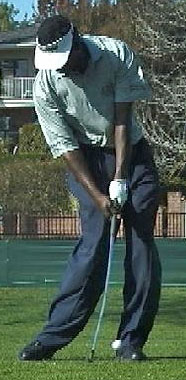
Here is a photo of Vijah Singh at impact.
One can see that his left wrist is flat and that the back of his left hand is facing the target. Note that the clubshaft has forward shaft at lean at impact and that is has not yet reached its low point (when it should be vertical to the ground). So, the question becomes - where will the clubface, and the back of the left hand, be facing at the club's low point?
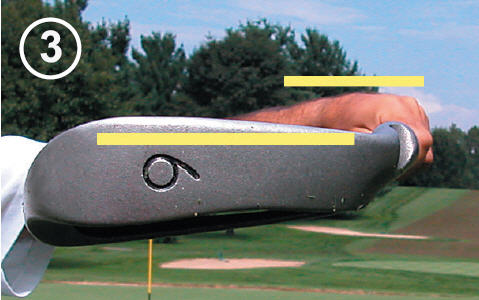
I presume that you agree that a neutral grip will mean that the back of the left hand is parallel to the lower edge of the clubface (or lower clubface grooves if the lower clubface edge is rounded) - as demonstrated by Brian Manzella in this photo from an article that he wrote.
Thirdly, I will presume that you agree that all clubs have a slight degree of hookface-offset built into the club.
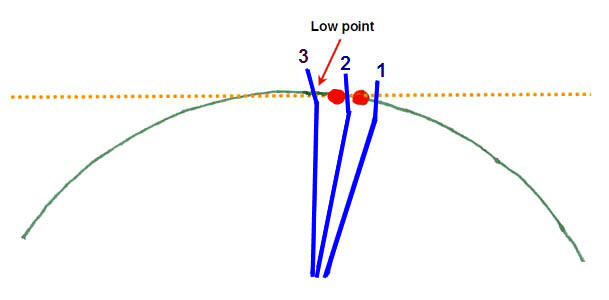
OK. So, consider my argument. Here is a diagram showing the movement, and orientation, of the clubface through the impact zone.
The green curved line represents the clubhead arc (as seen by a golfer - when viewed from above). The dotted orange line represents the ball-target line and the intended direction of ball flight of a straight shot. The red dot represents the ball. The blue lines represent the clubshaft and its offset hook-faced clubface.
Let's presume that the low point of the clubhead arc (and therefore deepeset part of the divot) is 4" ahead of the ball position.
Point 1 is a representation of the clubface approaching the ball with a slightly open clubface. At this point, there is forward clubshaft lean because the clubhead has not reached its low point, and the hosel of the clubshaft is still moving downwards and outwards and forwards. At this point. the clubface is slightly open to the ball-target line, and also minimally open to the clubhead arc of travel.
Point 2 is the time-point of ball-clubface separation. If the ball remains in contact with the clubface for approximately 4/1,000th of a second, then the clubface will travel about 0.88" further (from the point of first ball contact) before ball-clubface separation happens. At this time-point, the clubface needs to be square to the ball-target line for the ball to go straight towards the target. However, the clubface will not necessarily be perfectly square to the clubhead arc at this time-point - because it presumably depends on the amount of hook-face offset built into the club.
Point 3 is the low point of the clubhead arc, and it is 4" ahead of point 1 (as measured linearly along the ground). It is at this point on the clubhead arc, that the hosel of the clubshaft is going to start moving forwards, upwards and inwards. At this time point, the clubshaft must be vertical to the ground, and if it is vertical to the ground, and the club has a hook-faced offset clubface, then surely the clubface must be slightly closed to the clubhead arc at this time-point. That also means that the back of the left hand must be facing slightly left of the target at the low point of the clubhead arc (if it was facing the target at impact).
After point 3 (during the followthrough phase of the swing), the clubface will surely become even more closed to the clubhead arc, and the back of the left hand will face even more leftwards relative to the target) if the golfer is using horizontal hinging, and not closed to the clubhead arc if the golfer deliberately uses angled hinging.
Finally, regarding the "fact" that horizontal hinging predisposes to a straight ball flight with a tendency to fall to the left at the end of its ball flight - I got that perception from Tom Tomasello's swing video lessons in the gallery. He demonstrated that the ball tends to roll to the left after landing when using horizontal hinging, while the ball tends to roll to the right when using angled hinging. I have presumed that the end of the ball flight is not straight (even if the clubface is square to the target at the time of ball-clubface separation) due to draw spin imparted by horizontal hinging, and slice spin imparted by angled hinging. Am I wrong?
Dariusz
You wrote-: "angle hinging (that means keeping the clubface square to the arc) brings more repeatability and consistency because it may eliminate (or better said, may limit) the timing issues and subdue the clubhead motion to the pivot much better."
First of all, angled hinging only keeps the clubface square to the clubhead arc after impact, and not pre-impact (during the release swivel phase of the swing). Secondly, from a swinger's perspective, horizontal hinging can be perceived to be the more natural hinging action, while angled hinging requires an additional deliberate effort (to keep the clubface square to the inclined plane and clubhead arc) during the followthrough. Therefore, I could imagine a person rationally arguing that a horizontal hinging action will be a more consistent/reliable hinging action for a swinger (while angled hinging is more natural for a hitter).
You also wrote-: "I am surprised you thought that square-to-the arc means a square to the target line position at impact." I didn't make that mistake! See my post to Mike above.
Finally, although I enjoy "digging dirt" in the library, I also go to my local golf practice facility 2-3x per week for 3-4 hour sessions of "digging in the dirt" Hogan-style.
You wrote-: "angle hinging (that means keeping the clubface square to the arc) brings more repeatability and consistency because it may eliminate (or better said, may limit) the timing issues and subdue the clubhead motion to the pivot much better."
First of all, angled hinging only keeps the clubface square to the clubhead arc after impact, and not pre-impact (during the release swivel phase of the swing). Secondly, from a swinger's perspective, horizontal hinging can be perceived to be the more natural hinging action, while angled hinging requires an additional deliberate effort (to keep the clubface square to the inclined plane and clubhead arc) during the followthrough. Therefore, I could imagine a person rationally arguing that a horizontal hinging action will be a more consistent/reliable hinging action for a swinger (while angled hinging is more natural for a hitter).
You also wrote-: "I am surprised you thought that square-to-the arc means a square to the target line position at impact." I didn't make that mistake! See my post to Mike above.
Finally, although I enjoy "digging dirt" in the library, I also go to my local golf practice facility 2-3x per week for 3-4 hour sessions of "digging in the dirt" Hogan-style.
Jeff.
That's great to hear that you practice, Jeff ! next time try Tomasello's concept and swing with a dominant right arm throwing out and down and report your feelings. I am anxious to hear your OBJECTIVE opinion after.
OK, I am not familiar with TGM language that much and if angled hinging means a square-to-the-arc clubface ONLY after impact, it's not the same as the concept of having the clubface square during the whole impact zone (i.e. pre-impact part as well). However, I have a feeling (please correct me if I am wrong) that a person who tends to use angled hinging post-impact, must square the clubhead earlier before impact as well. Common sense tells us so.
Ah, one more thing - for a slight moment in time, do not think in swingers/hitters category and admit what scenario minimizes timing issues more.
BTW, why do you think that all clubs have so strong offset clubfaces ? Remember that Hogan's clubs not only were with zero offset but also bent open a few degrees. Consider the same diagramme without offset factor and you'll see the difference.
Moreover, in a perfect scenario of a rotary swing motion in-to-in, the divot will be slightly curving left, showing exactly the way the swing arc is going, not because the clubhead is already closed or in a process of closing, but just because it remains square-to-the-arc.
Jeff,
I agreed with all your points except for these:
1) You could call that grip neutral if you want- I'd just call it bad. But certainly assuming one used it- then yes at low point it would be facing left.
2) Horizontal hinging does not have a draw bias. You can slice, fade, draw, hook using horizontal hinging as it really depends on the clubface relationship to clubhead path.
__________________
Life Goal- Developing a new theory of movement based on Brain Science
Interests - Dabbling with insanity
Hobbies- Creating Quality
You also wrote-: "Horizontal hinging does not have a draw bias. You can slice, fade, draw, hook using horizontal hinging as it really depends on the clubface relationship to clubhead path."
I cannot understand this point. Why would one use horizontal hinging if one deliberately wanted to fade/slice the ball? Secondly, consider a golfer who wants to hit the ball as straight as possible. I presume that you agree that he must have a slightly open clubface at the time of first ball impact, and a square clubface at the time of ball-clubface seperation. So, what type of hinging action would result in a perfectly straight ball flight (with no tendency to fading/drawing) if the clubhead arc is perfectly symmetrical to the ball-target line and the clubface is square to the ball-target line at the exact moment of ball-clubface separation?
Dariusz
I have attempted the Tomasello "right arm throw" action on many occasions. I have found that it only works well when I use an "arm swing" style rather than a "body-swing" style, where the rotating torso drives the swing ala Hogan. Any attempt to blend the two (swinger's "pull" action secondary to a downswing pivot action powering/releasing power accumulators #4 and #2 and a hitter's "push" action due to an active right arm throw action powering/releasing power accumulators #4 and #2) results in switting, which is very problematic in terms of generating a smoothly executed clubhead swing path.
You also wrote-: "However, I have a feeling (please correct me if I am wrong) that a person who tends to use angled hinging post-impact, must square the clubhead earlier before impact as well."
I don't exactly know what you mean by squaring the clubface earlier by impact? Are you referring to squaring it to the ball-target line or to the clubhead arc? Either way, I think that the clubface should never be squared before impact, and the clubface must always be slightly open to the ball-target line and the clubhead arc in the few inches before the clubface impacts the ball - whether using angled hinging or horizontal hinging.
By the way, I realise that all clubs have variable degrees of offset, but I have never seen a zero-offset club that didn't have a hook-face relationship between the clubface and the clubshaft. Are you claiming that Hogan's club's clubface was not hook-faced relative to the clubshaft - even if they had zero offset?
Do you have a photo of Hogan's clubs?
Finally, I agree that the divot should always be going left after the low point of the clubhead arc - because it reflects the clubhead arc/path that moves inside, upwards, forwards after the low point. However, the clubface has a variable degree of rotation relative to the clubhead's arc during that part of the followthrough (after the low point), depending on whether the golfer uses angled versus horizontal hinging. The first part of the divot reflects the clubhead's movement outwards, downwards and forwards prior to it reaching the low point of its arc, and that part of the divot must be directed minimally right of the target.
Jeff.
Last edited by Jeff : 06-18-2008 at 01:10 PM.
Reason: add additional comment




 Linear Mode


