First of all, Thank you Jeff for asking some very interesting questions regarding TGM - in this thread as well as in others.
And even though the endless belt analogy has some merits, I certainly agree that concepts that are close to the real thing are better than those who are farther away.
But angular acceleration isn't what this is about. Angular acceleration is often regarded as one of the most differentiating factors between swinging and hitting, and is possible one of the most misunderstood concepts in golf.
Angular acceleration does not increase the speed of whatever is being rotated. Angular acceleration doesn't do anything but change the direction while conserving energy. It is only longitudinal force that can increase the club spead. Or shoud I say: "Geometrically Orienteted Linear Force" - G.O.L.F
In a pure swing, the swing center is shifting. It is always moving a little ahead of the rotation center. Rotation of left shoulder joint is key here. I personally believe that the role, position and movement of the left shoulder joint is underestimated in TGM as far as swinginging is conserned.
This shifting of center is creating a longitudinal force component in addition to the centripetal force component of the "pulling string". The pulling string is used to pull & rotate at the same time. The longitudinal force component is what increases speed. The centripetal force component only takes care of the circular part and doesn't produce speed.
Think of David Leadbetters illustration when he spins a little something attached to a tiny rope. He has to move his hand in a circle to pick up speed.
Only longitudinal force produces work. And work is required to increase the speed. It is the longitudinal force of the swing that increases the clubhead speed. Or should I say: Geometrically Oriented Linear Force: G.O.L.F.
And Newton has explained why there is no other way.
It is possible to do a pure swing and a pure hit from the same top position, and have the same club alignment at impact and basically the same speed too. These facts are strong indications that the two stroking methods basically containes the same amounts of angular acceleration (the part that caused the rotation) and longitudinal acceleration (the part that increases the speed). One of them would miss the ball othervise.
I don't think the water skiing analogy works without water drag. It is the water drag that enables the skier to go in another direction than the boat, and this is a sort of overtaking action. As long as the skier is coming up from behind he will have larger speed than the boat - even relative to the course the boat is going. But the skier will have largest speed when he goes in the direction that is most different to the boat - when he comes back from a far left, is straight behind the boat and aiming far right. The true analogy to golf here is, I believe an overtaking action. A transfer of energy from boat to skier. A skilled and heavy skier will significantly slow down the boat. Some of the energy will be wasted to water shuffling, but some of it will accelerate him to the right.
If the boat went in circles, and managed to keep with up the skier, he could be straight behind the boat aiming far right and picking up speed all day long.
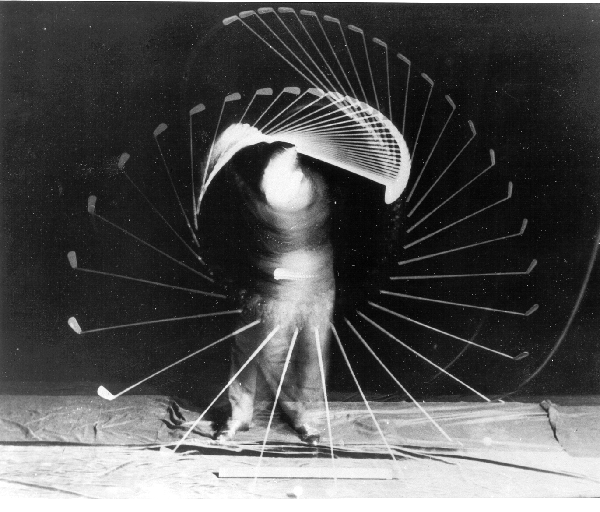
Looking at the Bobby Jones sequence, the swing seems to have a very steady linear force as the club is acellerating gradually.
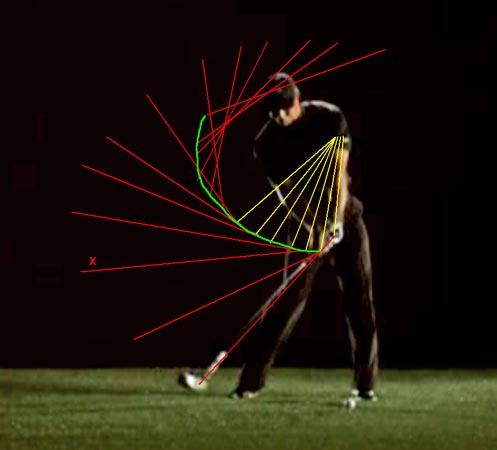
Looking at Tiger's swing, something interesting seems to be happening around 9 o'clock in the downswing. Is the clubhead slowing down for a brief moment? Is he manipulating the geometry in order to increase the G.O.L.F from that point and through the ball?
Bernt - thanks for posting your opinion. I am always interested in reading other people's opinions, because I may learn something "new" that will change my mind about an "issue". Unfortunately, I first have to understand another person's opinion before I can change my mind, and I cannot understand many points that you seem to be expressing.
To start, you wrote-: "Angular acceleration does not increase the speed of whatever is being rotated. Angular acceleration doesn't do anything but change the direction while conserving energy. It is only longitudinal force that can increase the club spead. Or shoud I say: "Geometrically Orienteted Linear Force" - G.O.L.F."
I am not sure what you mean by longitudinal force. Consider nm golfer's mathematical explanation. He stated that the hands are always changing direction and speed at every moment of the downswing. Do you regard that as a longitudinal force, a G.O.L.F force? Secondly, he stated that if the hands are pulling the grip end of the club in the same direction that the hands are moving, and at the same speed as the hands are moving, that the clubhead end of the club would be angularly accelerated at every fractional time-point of the downswing, and that the cumulative effect of many thousands of time-points of angular acceleration inputs would cause the clubhead end of the club to progressively speed up. In other words, he is seemingly implying that angular acceleration doesn't only change the direction of the clubhead's movements, it also causes the clubhead end of the club to speed-up. Do you disagree? Secondly, nm golfer's mathematical explanation doesn't state anything about "conservation of energy" because there is not a "fixed" amount of energy in his hand/clubshaft system. The hands can constantly receive additional energy throughout the downswing from a variety of power sources (eg. release of power accumulator #4).
You also wrote-: "In a pure swing, the swing center is shifting. It is always moving a little ahead of the rotation center."
Could you please define "swing center" and "rotation center". I cannot develop a mental picture of your developing argument. You further wrote-: "This shifting of center is creating a longitudinal force component in addition to the centripetal force component of the "pulling string". The pulling string is used to pull & rotate at the same time. The longitudinal force component is what increases speed."
You seem to be implying that there is longitudinal force component that causes the increase in clubhead speed. What is this longitudinal force component and where is it operant in the PingMan machine's swing? If you are implying that the left shoulder socket is moving left-laterally in space, while the left arm rotates from the fulcrum point of the left shoulder socket point, and you are implying that the constant movement of the left shoulder socket in space represents the longitudinal force, how can the hands "know" what percentage of their force of forward movement comes from the movement of the left shoulder socket in space versus the rotational movement of the left arm?
Could you please explain what you see in Tiger's swing at 9 o'clock?
From my reading of the TGM book, I gather the impression that HK believed that the club released in the downswing because of a change in direction of movement of the hands from a straight line path to a curved path, and that the endless belt model explains the release phenomenon. Conceptually, the endless belt model theorizes that the club will travel at the same speed as the hands until the hands enter the pulley section of the endless belt model. Then, as the hands turn around the pulley, the club will accelerate relative to the hands and this represents the release phenomenon. However, this conceptual model is dependent on there being a straight line path movement of the hands in the early/mid downswing followed by a curved hand path later in the downswing, and "reality" doesn't seem to confirm this fact. If one looks at the hand path of professional golfers, their hand path is always curved and there is no straight line section. Here are two examples.
Bobby Jones strobe photo.
Tiger Woods photo
I used the slow motion Nike commercial swing video of Tiger Woods to produce this image. The red lines represent the clubshaft. The yellow lines represent the left arm (and I only plotted the left arm's location in the later downswing so as not to have too many lines cluttering the image). The green line is a hand-drawn line that plots the sequential movement of the hands over time. Point X is the point when release of the club is definitely apparent, although there is seemingly a small degree of release earlier.
Note that the hand path in both these images is near-circular, and there is no straight line path. Therefore, "reality" doesn't support HK's endless belt concept as explaining the release phenomenon.
Surely, a much better explanation is this mathematical model, which demonstrates that the club develops angular acceleration at all time points in the downswing when the pull on the grip is at an angle to the COG of the clubshaft.
Jeff,
Reading the posts here is like having a Homer Kelley nightmare for me, in other words- I see the same lack of clarification here that Kelley has in his book in regards to linear speed and angular speed and the lack of clarificaiton or definitions. Since the post essentially is about angular acceleartion I think it would be important to define angular acceleration and also show me in the Bobby Jones swing above- where this exists.
Thanks,
Mike O.
__________________
Life Goal- Developing a new theory of movement based on Brain Science
Interests - Dabbling with insanity
Hobbies- Creating Quality
I don't have a precise knowledge of physics, so my use of the term 'angular acceleration' may be incorrect. However, if you look at the hand arc and clubhead arc in the Bobby Jones photo, and look to see how much the hands move per unit time relative to the clubhead movement per unit time, the clubhead is moving a greater distance than the hands - and the clubhead movement per unit time is increasing progressively as the downswing evolves (even though hand speed remains relatively constant). Therefore, I perceive that the clubhead is developing angular acceleration and that this represents the release phenomenon.
I don't have a precise knowledge of physics, so my use of the term 'angular acceleration' may be incorrect. However, if you look at the hand arc and clubhead arc in the Bobby Jones photo, and look to see how much the hands move per unit time relative to the clubhead movement per unit time, the clubhead is moving a greater distance than the hands - and the clubhead movement per unit time is increasing progressively as the downswing evolves (even though hand speed remains relatively constant). Therefore, I perceive that the clubhead is developing angular acceleration and that this represents the release phenomenon.
Jeff.
Jeff,
Sorry for the bluntness in advance but you're four pages into your own thread dealing with angular acceleration among other things in search of the "truth" and you state "I don't have a precise knowledge of physics, so my use of the term 'angular acceleration' may be incorrect." That's problem number one! Iin finding the "truth" you need to precisely define what you are talking about. With the internet- it's not that difficult to look up the definition. Here is Wikipedia's definition- "Angular acceleration is the rate of change of angular velocity over time. In SI units, it is measured in radians per second squared (rad/s2), and is usually denoted by the Greek letter alpha."
While the clubhead in the Bobby Jones photo is acquiring Angular acceleration (you can measure the radians or degrees between the end of each shaft near the clubhead and see that from one to another the distance is increasing)- however that's only part of the release factors. As it's the linear speed of the clubhead that is the real intent of the release and the clubhead can be picking up clubhead linear speed with an extension of the swing radius and at the same time have no increase in the angular acceleration of the clubhead.
Here is the definition of angular velocity from Wikipedia: "In physics, the angular velocity is a vector quantity (more precisely, a pseudovector) which specifies the angular speed, and axis about which an object is rotating. The SI unit of angular velocity is radians per second, although it may be measured in other units such as degrees per second, degrees per hour, etc."
As you indirectly stated by comparing the differences between the hands and the clubhead movements- it's important to identify which part of the club that you are talking about and what type of speed/velocity/acceleration that you are talking about when having these discussions. For example in regards to the Bobby Jones photo the end of the clubshaft and the clubhead are picking up angular acceleration but the grip end of the shaft is not picking up angular acceleration. However, it's the clubhead speed not the angular velocity or angular acceleration of the clubhead that I think is the essential issue and those are not directly related.
The way you've answered the post above in the quote- it appears that you're implying that the relationship of the hand motion versus the clubhead motion has something to do with the angular acceleration formula of the clubhead - which is doesn't in the strictest sense.
You say "and the clubhead movement per unit time is increasing progressively as the downswing evolves" - here again you can't tell if you are talking angular velocity of the clubhead or the linear speed of the clubhead or angular acceleration of the clubhead? Three completely different things- 1) for angular velocity ignoring COAM- extending the radius has no effect on it - as opposed to 2) the clubhead linear speed which is greatly influenced by an extension of the radius. For example you could have a situation where you have angular deceleration yet with an extension of the radius an increase in the linear speed of the clubhead.
__________________
Life Goal- Developing a new theory of movement based on Brain Science
Interests - Dabbling with insanity
Hobbies- Creating Quality
I was mixing angular acceleration with radial acceleration in my last post.
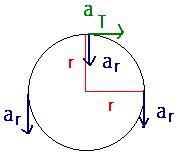
Here's a pretty good description of radial and linear acceleration / tangential acceleration. Tangential acceleration is similar to linear acceleration in the sense that it works in the same direction that the subject body is moving. The only difference is that tangential acceleration changes direction all the time. This is by the way illustrated by the notation "AT" in the figure below, indicating that linear acceleration is also tangential acceleration. This was writting for alpine skiing, but it is valid for the golf swing too:
Quote:
It probably comes as no surprise that acceleration plays a large role in cross country skiing. Rounding a corner, or rather trying to round a corner, while skiing down hill can often lead to disaster. On the other hand, decreasing acceleration (or deceleration) can also cause problems. Imagine a skier accelerating only to be tripped by a hidden tree root. The skier's acceleration would greatly decrease as the ski stopped on the root, and there is a possibility for injury.
One type of acceleration experienced by skiers is linear acceleration. This acceleration is simply the final velocity minus the initial velocity divided by the difference in time. Constant acceleration = (V f -Vi)/(Tf-Ti) . This means that if a skier starts from rest and 2 seconds later the skier is traveling 4 m/s, the skier is accelerating at 2 m/s 2 .
Circular acceleration is another aspect of skiing. There are two components of this acceleration, radial and tangential. Below is a circle with some of the radial and tangential acceleration vectors drawn in.
Comment from me:
This could be a golf swing - but for a split second only. Unfortunately, the direction is similar to a left handed golf swing. But my comments are right handed.
The radial acceleration will always be 90degree to where the club head is heading and the tangential force will always be in the same direction as the club head is moving. The "rope" - using a rope handling technique will always be pointing in the same direction as the sum of the two vectors Ar and At. By applying torque to the swing (something that is heavily used in a hit, and is possibly also unavoidable in parts of a "pure" swing), the "rope" will be a virtual rope, and it could easily be anchored far outside the left shoulder.
As long as there is some lag in the swing, and as long as the swing is picking up speed - the rope will be offset to origo. And this offset is lag to the primary lever. Lag doesn't have to be limited to the relation between arm and club either. It can also be related to the relation between the whole primary lever and origo.
1) Early in the downswing the ratio of tangential vs total force is relatively big. When there's a huge angle between left arm and the clubshaft, a lot of tangential force is applied to the club head. And a lot of the resistance, or weight that we feel is because the club is picking up speed.
2) Later in the downswing the ratio changes towards more radial force (force that doesn't increase speed). A lot of the resistance we feel now is from this radial force.
3) Within this frame of reference, clubhead lag is to a very large degree the ratio of tangential vs total force. With a 100% pure rope handling technique, the shaft orientation vs origo (at any time) is probably a decent indicator of this ratio.
4) Clubhead lag seems to be referring to the secondary lever most of the time. But the offset between Origo and the center of the pulling action (which could be left shoulder joint) represents lag to the primary lever assembly. You can still have lag pressure in the swing even though the clubface has caught up with your hands. Not that I recommend it though.
Original explanation continued:
Quote:
Radial acceleration can be found by dividing the velocity squared by the radius. Radial acceleration = v2 /r . Radial acceleration occurs because of a change in direction of the velocity. From the formula above it is easy to see why it is harder for a skier to make a turn with a small radius than a turn with a large radius. Due to the fact that the radius is in the denominator, the smaller the radius the greater the acceleration and the larger the radius the smaller the acceleration is.
Tangential acceleration = d|v| / dt. Tangential acceleration is what causes a skier to change speed while rounding a corner. The tangential acceleration plus the radial acceleration are equal to the direction of the acceleration vector.
Bernt - thanks for posting your opinion. I am always
I am not sure what you mean by longitudinal force. Consider nm golfer's mathematical explanation. He stated that the hands are always changing direction and speed at every moment of the downswing. Do you regard that as a longitudinal force, a G.O.L.F force?
As a few other terms I used in the post, I could certainly have picked a better one. I should have used the term tangential force, ref my other post above.
I agree that the hands are always changing direction and speed. In addition, the hands transfer radial and tangential forces.
Quote:
Secondly, he stated that if the hands are pulling the grip end of the club in the same direction that the hands are moving, and at the same speed as the hands are moving, that the clubhead end of the club would be angularly accelerated at every fractional time-point of the downswing, and that the cumulative effect of many thousands of time-points of angular acceleration inputs would cause the clubhead end of the club to progressively speed up.
I was confucing "angular acceleration" with radial acceleration. Sorry about that.
I basically agree with the above, but I think it makes sense to decompose angular acceleration. Angular acceleration is created by radial acceleration and tangential acceleration. But it is only the tangential component that increases the swing speed.
There are basically two ways of generating tangential acceleration.
1) By applying torque (as in trying to bend the shaft)
2) By partly pulling the club in a direction that has a tangential component as well as the radial component.
Quote:
Secondly, nm golfer's mathematical explanation doesn't state anything about "conservation of energy" because there is not a "fixed" amount of energy in his hand/clubshaft system. The hands can constantly receive additional energy throughout the downswing from a variety of power sources (eg. release of power accumulator #4).
You also wrote-: "In a pure swing, the swing center is shifting. It is always moving a little ahead of the rotation center."
"Swing center" was another one of my ill-defined terms. Unfortunately, I don't have a good expression available at the moment. But what I mean is that the total force applied to the club (tangential and radial force) is not pointing at the rotation center. An offset is required to generate a portion of tangential force. This offset could be the location of left shoulder vs. head/neck which is likely to be the rotation center.
But may I restate that radial force only changes direction and conserves the velocity energy that has been transmitted to the clubhead so far in the swing.
Quote:
You seem to be implying that there is longitudinal force component that causes the increase in clubhead speed. What is this longitudinal force component and where is it operant in the PingMan machine's swing?
The pingman machine has its mechanical left arm attached to a mechanical shoulder. This shoulder is rotating arount the center of rotation, so that an offset is created.
Quote:
If you are implying that the left shoulder socket is moving left-laterally in space,
It is moving in an arch. How close this arch is to a circle probably varies from golfer to golfer. But the point is that the pulling must stay "ahead" of the swing center to increase speed. There i said it again. I meant center of rotation. "Swing center" is probably an equally correct phrase. But since I've already abused the term "swing center" i will try to let that rest at least in this thread.
But regardles of swing technique, somewhere in the body, torque must be applied. In a pure swing, torque is applied to rotate the left shoulder. And this torque enables the left shoulder to generate radial and tangential acceleration up on the club by simply pulling the arm.
Quote:
how can the hands "know" what percentage of their force of forward movement comes from the movement of the left shoulder socket in space versus the rotational movement of the left arm?
I don't understand this question.
[quote]
Could you please explain what you see in Tiger's swing at 9 o'clock?
QUOTE]
When the clubhead is around 10 o'clock, it is loosing speed beween two frames. If the illustration is correct. 10 o'clock as seen from our side, that is. I'm wondering whether there's some downstroke loading going on.
But it could as well be just an inaccuracy in the illustration.
Here is a copy of VJ's Impact Circle photo from his book.
Jeff.
Edit: Unfortunately I am not able to present it as anything else but a link.
I do not like the impact circle consept, because it makes it seem like the rotation centre of the golf swing is at the left shoulder. Which it woould be if the sholder was kept still.
I've added some "momentum" to the drawing.
The centre of rotation is IMO close to the golfer's nose or neck.
The curved arrow around the golfer's head is momentum created by the rotating body and applied to the left shoulder. This momentum results in a pulling force on the left arm and further on the left club. This force is illustrated with the red arrow above the golfer's shoulder.
Since the sholder is offset to the centre of rotation, the pulling force from the shoulder can be decomposed in a component that is purely radial and another component that is purely tangential. That would be the yellow arrows by the clubhead.
The small arrow at the golfer's right hand is some of the force from extensior action. This could also be described as torque applied to the left arm, which is required to deal with clubshaft vs left arm lag.
You don't have to apologize for being blunt. I encourage all forum members to attack my arguments rigorously without restraint, because I believe so strongly in the Popperian falsification principle. My ideas/opinions are only valid to the extent that they cannot be falsified, and I don't know if they can be falsified if people don't vigorously challenge my opinions.
When I stated that my knowledge of physics-terms could be inexact, then it doesn't mean that I am knowingly using those "terms" imprecisely. My understanding of the term "angular acceleration" is totally compatible with the Wikipedia definition. However, I believe that angular acceleration doesn't always refer to a point-object moving around a "fixed" point in a circular motion, but it can also apply to a linear structure (eg. clubshaft) moving around a fulcrum hinge point (eg. hands) which is itself in motion. In nm golfer's mathematical explanation, he is referring to the clubshaft when he talks about angular acceleration, and not solely the clubhead. When I stated that one can see the clubhead progressively moving a greater distance per unit time during the release phase, and that this represents angular acceleration, I really meant that the clubhead is a "marker" for the rate of angular acceleration of the clubshaft, which means that the grip end of the club must be experiencing the same degree of angular acceleration as the clubhead end (because they are both simply point-locations on the same clubshaft).
I therefore don't understand your comment-: "For example in regards to the Bobby Jones photo the end of the clubshaft and the clubhead are picking up angular acceleration but the grip end of the shaft is not picking up angular acceleration."
You also made the following statement-: ""As it's the linear speed of the clubhead that is the real intent of the release and the clubhead can be picking up clubhead linear speed with an extension of the swing radius and at the same time have no increase in the angular acceleration of the clubhead."
I cannot understand your opinion - from the perspective of nm golfer's mathematical explanation of the release phenomenon. You seem to be implying that the clubhead (which is merely a point-location on the clubshaft) can pick up linear speed due to an extension of the swing radius without any angular acceleration of the clubshaft. When you refer to "swing radius" I presume that you are talking about the distance between the left shoulder socket and the clubhead. If my understanding is correct, then I think that you may have your logical argument back-to-front. The swing radius can only increase (in the presence of a left arm of constant length) if the 90 degree angle between the left arm and clubshaft changes toward a 180 degree situation (left arm and clubshaft become more in-line). That happens as a result of the release phenomenon - which is due to the clubshaft acquiring angular acceleration during the release phase. If one accepts my reasoning, then this other statement of yours doesn't make sense - "For example you could have a situation where you have angular deceleration yet with an extension of the radius an increase in the linear speed of the clubhead." How can the swing radius be increasing if angular acceleration of the clubshaft is decreasing.
It is true that we are mainly interested in the linear speed of the clubhead at impact, but I think that the linear speed of the clubhead is derived to a large extent from the fact that the clubshaft is angularly accelerated during the release phenomenon.
Jeff & BerntR, Seems to me that you guys are sticking with
the premiss that the left shoulder is offset to the center of
rotation. This is true, in most cases, with the shift and turn
concept. With the Hogan move, that V.J. Present, the left
shoulder is already even or ahead of the ball at the top of
the swing so that Hogan could have a left shoulder impact
circle center. On pg. 83 of "The Final Missing Piece" V.J.
says: "Review sequences of Hogan's sing in figure 43. From
this vantage point, the white spot above his right hip pocket
actually moves backsward or away from the target at the
start of his downswing. If the hips had moved forward to
start the downswing, this white spot would also move
forward or at least stay in the same position'. The pictures also
indicate that the left was at the ball at the top of the swing.
With shift and turn in the downsing, I can see many of your
points. But using V.J. and Hogans pictures from V.J.'s book to illustrate
what happens in a shift and turn method can certainly be confusing.
V.J. pointed out that his book not a method. It is an explanation of one Man's method.




 Linear Mode


