Thrust is Physics. Example, think of a Straight Line Delivery Path of the Hands which extends beyond the Plane line, but the motion, Geometry, as it goes around the pulley of the Endless Belt creates an Arc of Approach that is on line.
Monitor your Plane Line or your Arc of Approach and you are monitor Geometry, but monitor Your Delivery Path and you monitor both, because the Thrust is also on Plane.
Monitoring the Plane Line or Arc of Approach being Tracing, Geometry. Monitoring Delivery Path of the Hands, Thrust, Aiming Point, Physics. Is that what you mean? Lynns tracing vs throwing a stone, straight line at the aiming point. Both achieving the same Delivery Line of the clubhead.
Im still confused about Thrust though. If it is on plane , straight line towards the Aiming Point for Arc of Approach, is it "cross line" in that it passes the plane line, or just points at the plane line? Words fail me again.
Monitoring the Plane Line or Arc of Approach being Tracing, Geometry. Monitoring Delivery Path of the Hands, Thrust, Aiming Point, Physics. Is that what you mean? Lynns tracing vs throwing a stone, straight line at the aiming point. Both achieving the same Delivery Line of the clubhead.
Im still confused about Thrust though. If it is on plane , straight line towards the Aiming Point for Arc of Approach, is it "cross line" in that it passes the plane line, or just points at the plane line? Words fail me again.
I'd submit that cross line TO POINT . . Assuming the hands are leading the clubhead . . .and they travel in an arc they are going to be working back up and in on plane while the club is still working down out and forward . . .
Look a the pic D posted . . . Hogan's hands have "disappeared" from the pic and hidden by his body but the club is still "out" . . . Hogan "planed" the club better than anybody ever has IMO. Beautiful stuff . . . keep in mind he hit all 18 greens and 14 fairways in that Shell deal.
I'd submit that cross line TO POINT . . Assuming the hands are leading the clubhead . . .and they travel in an arc they are going to be working back up and in on plane while the club is still working down out and forward . . .
Look a the pic D posted . . . Hogan's hands have "disappeared" from the pic and hidden by his body but the club is still "out" . . . Hogan "planed" the club better than anybody ever has IMO. Beautiful stuff . . . keep in mind he hit all 18 greens and 14 fairways in that Shell deal.
I saw the code "MO" but I'm unsure what you want me to dooo? Please explain how you have determined that Hogan "planed" the club better than anybody ever has - Oh ya! it was the accident or the putting- gotcha!
__________________
Life Goal- Developing a new theory of movement based on Brain Science
Interests - Dabbling with insanity
Hobbies- Creating Quality
I'd submit that cross line TO POINT . . Assuming the hands are leading the clubhead . . .and they travel in an arc they are going to be working back up and in on plane while the club is still working down out and forward . . .
Look a the pic D posted . . . Hogan's hands have "disappeared" from the pic and hidden by his body but the club is still "out" . . . Hogan "planed" the club better than anybody ever has IMO. Beautiful stuff . . . keep in mind he hit all 18 greens and 14 fairways in that Shell deal.
I agree. Hogan did keep the shaft on plane long after Impact. It's so good, I'll bet his Right Forearm is on-plane also. If someone has a picture of Hogan from in front, from the Target side looking at the Golfer, we may see this to be true.
I'd submit that cross line TO POINT . . Assuming the hands are leading the clubhead . . .and they travel in an arc they are going to be working back up and in on plane while the club is still working down out and forward . . .
How can one end of the club be moving up when the other is moving down? Do you mean the Thurst is down, out forward?
How can one end of the club be moving up when the other is moving down? Do you mean the Thurst is down, out forward?
I tend to see it the same way, given a couple assumptions:
- left wrist remains flat. I think bending/arching may mess up the geometry
- left wrist returns to vertical at impact. I'm not sure of the geometry if the left wrist is still turned at "low point", then rolled/hinged afterwards
And probably all of your discussions are predicated on a "properly" executed stroke so the above point may not be relevant
But I'm not sure of the geometry as the left wrist moves from level to uncocked after impact. ie does the primary lever actually lengthen after impact? if yes, then maybe, just maybe, one end of the club can move down as the other end moves up.
Then again, I really don't know what I'm talking about.
Youve got lots in common with the rest of then 3putt. None of us non pros really know what we're talking about. We are all just searchers along the line of compression.
All of this is the antithesis of Steering the face square to the target and hitting Up, which begets a bending left wrist. In an similar manner the flat left wrist is also a byproduct but of correctly aligned geometrical force. If we keep thrusting Down , Out and Forward post low point, though our hands and clubhead are traveling Up, In and Forward.......good things happen. Getting to both arms straight , Follow Through is so key.
Lynn has said that most of us are missing the Down and since we are on an inclined plane therefor the associated Out.
Ive been wondering about going from level to fully uncocked too and the implications to the plane angle. Im currently thinking of it as being an on plane uncocking of #2, a decrease in the Accumulator #3 Angle rather than a plane angle shift. That the Hands and the On Plane Right Arm ensure the plane angle is maintained via adjustments to the Pivot and the #3 Angle. Hands to Pivot.
From the glossary: The G.O.L.F. definition of the PIvot is "A multiple universal-joint assembly between the Stationary Head and the Stationary Feet holding the Clubshaft "On Plane" by positioning and adjusting the Lever Assembly, through the #3 Accumulator, as directed by the right forearm."
So when our esteemed friend Bucket makes the assertion that Hogan held his Plane Angle through Impact better than anyone else, he to mind anyways, is suggesting that his Hands are creating this situation but via adjustments to the Pivot and therefore the #3 Angle. Mr Hogan had one heck of a practical PIvot. Homer wrote the book on it, de coded it.
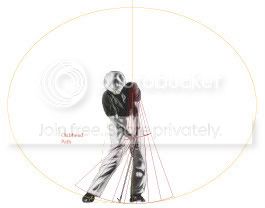
This isn't the most accurate illustration but I think it may support what Bucket's claim.
The Clubhead is at Impact Location and is continuing downward to Lowpoint while the Hands have already began moving Up and In On-Plane.
There is more to this. Please notice that Hogans Right Arm is Bent at Impact Location. Thrust (Acceleration) will remain Downplane until his Right Elbow Straightens. Therefore, Thrust continues Downplane as the Hands are moving Up and In On-Plane.
Thrust continues after Impact and Separation to Both Arms Straight. Thrust continues even though the Ball is gone.
Quote:
1L-15 The Club starts up-and-in after “Low Point” but thrust continues down plane during the Follow-Through.
I see what you mean now. Would this only be possible with a bowed left wrist? A bowed left wrist at impact and then some (albeit horizontal) lever extension as it flattens. Is this what you mean? This is "a way" of doing things. Not necessarily "the way" as some of this is derived from Hogans grip type for instance. A little bit of insurance against Throwaway in his left wrist.
For all of us though. Per 1-L-15 The club starts up and in after "Low Point", but the Thrust continues Down Plane during the Follow Through.
So no active thrust or swinging of the hands to the left or where ever. No real actual "cutting" left with the hands, though they do move Up and In (left). You wont look like Hogan if you do that. Hogan got there with his Pivot Im thinking, under the direction of his Hands.
Agreed on the thrust thing and both arms straight at Follow Through. Like totally.
Here is the photo you requested. This is slightly past Follow Through, both arms straight. His left arm is just starting to bend but look at those wedges! Still in tact. What hinge is that? Angled maybe like he is trying to not hit the cameraman with the ball maybe. Disregard the foot line, is he pointing at the plane line? Has he bent it to the right around the cameraman maybe?
We'll never know i guess. You'd need to know what lens the cameraman was using. Wide angle lenses causing parallel lines to converge more in appearance.




 Linear Mode


