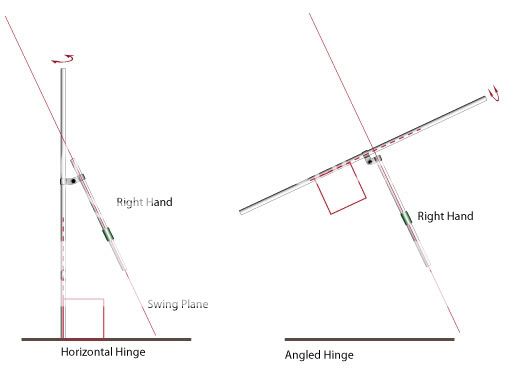
I see where you are going, Daryl. The last figure descibes the rotation of the Left Arm Flying Wedge in a horizontal hinging procedure. The LAFW rotates on a plane that is on right angles to the inclined plane.
But it is the on-plane rotation* that is the big deal. The rotation that happens on the inclined plane. The plane the clubhead moves on. That's the plane we have to look at when we consider hand speed and clubhead speed, and RPM vs MPH.
The rotation of the LAFW is just a secondary rotation in the golf stroke. Amongst other things it causes the club to rotate around its own sweeet spot. It is an important enabler for what we want to achieve on the main stage. The RAFW rotation enables us to add club rotation by uncocking (turning) and recocking the Left Wrist (accumulator #2) and by simply turning (accumulator #3). These two releases produces on-plane club rotation without producing on-plane arm rotation. And that's what makes the huge difference between club rotation and left arm rotation in the golf stroke.
* A rotation that is on plane has a rotation axis that goes straight through the plane.
I see where you are going, Daryl. The last figure descibes the rotation of the Left Arm Flying Wedge in a horizontal hinging procedure.
That is perfectly True. You understand that.
Originally Posted by BerntR
The LAFW rotates on a plane that is on right angles to the inclined plane.
No.. The LAFW rotates on one of three associated Planes. Horizontal, Vertical or Angled.
Originally Posted by BerntR
But it is the on-plane rotation* that is the big deal. The rotation that happens on the inclined plane. The plane the clubhead moves on. That's the plane we have to look at when we consider hand speed and clubhead speed, and RPM vs MPH.
* A rotation that is on plane has a rotation axis that goes straight through the plane.
No..That's a Swivel, not a Hinge.
Hinging:
It is said that Hinging controls the Clubface alignment. It controls the Clubface Alignment to an associated Plane. Hinging is not what squares the Clubface for Impact.
Horizontal Hinge: causes he Clubface (and Left Arm Wedge) to rotate on a Horizontal Plane
Angled Hinging: causes the Clubface (and Left Arm Wedge) to rotate on an Angled Plane
No.. The LAFW rotates on one of three associated Planes. Horizontal, Vertical or Angled.
Different words, and your way of saying this is perhaps more in line with TGM. But the point is that the LAFW is vertical to the swing plane at low point and parallel to the inclined plane somewhere in the upstroke. And the Hand club is supposed to be on plane at all times. At least for a swinger.
Nevertheless it's the rotation of arm and club on plane that matters when we discuss RPM and MPH.
This thread really good!
helps me rethink about rhythm.
I just know that the rate of my pivot turning on the incline plane ideal should be the same rate of rotation of the clubshaft in a counterclockwise direction on the downswing.
It often isn't and can be a bit slower or faster than the pivot RPM. How it mismatches together(can be done on purpose) can be used to hit a fade or draw.
Hmm? RPM refers to the Plane of the Left Wrist Cock, not the Wrist Cock. The Wrist Cock occurs in a Vertical Plane. RPM occurs in the Horizontal Plane.
How many Revolutions per Minute is the Clubhead completing?
How many Revolutions per Minute is the Left Wrist completing?
Daryl,
Not sure why you haven't acknowledged Bernt's explanations of different RPM's for the left arm versus the clubshaft. I think he explained it clearly enough - If you have any left forearm rotation/upper arm rotation on the downswing - it will create greater RPM for the clubshaft than the arm.
It's important to understand Homer Kelley's context when he writes - this RPM discussion is similar to his writing's on wristcock or other concepts. When he describes wristcock as a vertical motion - doesn't mean that the left wrist is always vertical to the ground and it's motion is always vertical to the ground - becuase obviously it's not vertical to the ground and therefore it's not always making it's cocking motion vertical to the ground. If it did then yes the RPM's would be the same for the clubshaft and the arm - however in the real golfer the left wrist is rotating throughout the stroke (in relation to the ground). Look at 2K#4 and 2K-#5 - for on plane left wrist motion or vertical wrist action. Similarly 7-18 2nd paragraph discussing hand and clubhead RPM's the same - ASSUMING you are looking at an endless belt example 2-K#6.
He's writing in a certain context - part of that context is the fact that the biggest problem he saw was clubhead throwaway (different RPM's for the hands and the clubshaft given the most basic flail drawing). Much as he had said - in regards to hinge action - "no one does these things "perfectly" - perfectly meaning exactly horizontal or angles, or vertical - perfectly isn't used in regards to "optimal".
I feel it's important to understand the relevance of Homer Kelley's writings yet at the same time understand real issues/happenings as Bernt is noting in regards to noted differences in RPM's.
__________________
Life Goal- Developing a new theory of movement based on Brain Science
Interests - Dabbling with insanity
Hobbies- Creating Quality
Daryl,
Not sure why you haven't acknowledged Bernt's explanations of different RPM's for the left arm versus the clubshaft. I think he explained it clearly enough - If you have any left forearm rotation/upper arm rotation on the downswing - it will create greater RPM for the clubshaft than the arm.
It's important to understand Homer Kelley's context when he writes - this RPM discussion is similar to his writing's on wristcock or other concepts. When he describes wristcock as a vertical motion - doesn't mean that the left wrist is always vertical to the ground and it's motion is always vertical to the ground - becuase obviously it's not vertical to the ground and therefore it's not always making it's cocking motion vertical to the ground. If it did then yes the RPM's would be the same for the clubshaft and the arm - however in the real golfer the left wrist is rotating throughout the stroke (in relation to the ground). Look at 2K#4 and 2K-#5 - for on plane left wrist motion or vertical wrist action. Similarly 7-18 2nd paragraph discussing hand and clubhead RPM's the same - ASSUMING you are looking at an endless belt example 2-K#6.
He's writing in a certain context - part of that context is the fact that the biggest problem he saw was clubhead throwaway (different RPM's for the hands and the clubshaft given the most basic flail drawing). Much as he had said - in regards to hinge action - "no one does these things "perfectly" - perfectly meaning exactly horizontal or angles, or vertical - perfectly isn't used in regards to "optimal".
I feel it's important to understand the relevance of Homer Kelley's writings yet at the same time understand real issues/happenings as Bernt is noting in regards to noted differences in RPM's.
Great point, thanks.
The other little issue with the drawing is that the club always lays flat on the inclined plane , cocks up and down on the inclined plane , but the left arm is not on the Inclined Plane given any #3 Angle. The left arm and the Inclined Plane are only one and the same for the so called "theoretical left shoulder plane" , which is what seems to depicted here. For the more golf like plane angles the golf club does not cock in the direction of the left arm or the left shoulder. Meaning that blue Left ARm Flying wedge does not attach to the left arm and shoulder throughout the entire swing. At top it lays on the Inclined Plane, between the two arms. When the Left Wrist rolls off the Inclined Plane the Left ARm Flying Wedge does the same. At impact , through the ball they are as drawn.
I think. Its a head scratcher I know.
Could this be another reason for the use of the word "basic" in "basic rpm's"?
Daryl,
Not sure why you haven't acknowledged Bernt's explanations of different RPM's for the left arm versus the clubshaft. I think he explained it clearly enough - If you have any left forearm rotation/upper arm rotation on the downswing - it will create greater RPM for the clubshaft than the arm.
I didn't acknowledge "Bernt's explanations of different RPM's for the left arm versus the clubshaft" because it's irrelevant.
Strap a board to your left Arm, Wrist and Clubhead. If they all stay against the board (Aligned) through the Impact Interval, they traveled at the same RPM. Strap the board to your left forearm, wrist and Clubhead and they travel at the same RPM.
Mike, do you "Understand"? RPM is not Turn and Roll. The Primary Lever stays Aligned regardless of the Turn and Roll. Maintaining the same RPM is necessary for Hinge Action but RPM is not Hinge Action. If the Left Wrist is Bent through Impact, I can still Hinge the Left Wrist however, the Clubface will be somewhere else. We need a Flat Left Wrist (RPM) so that anything the Wrist does, the Clubface will do likewise, and not something else.
Quote:
The point to be learned here is that the Club, because of the Flat Left Wrist, must always travel at the same RPM as the Arms and reproduce the Hinging inherent in the selected Lag Loading procedure (10-19) per 4-D, 9-2 and 9-3, regardless of Clubhead Extension velocity. See 2-P and 7-18.
Thank you sooo much for the gracious Primer on the Left Wrist Vertical Cock and Uncock geometry - MPH. Why don't hold onto that thought while you learn about Horizontal Bend and Arch - RPM.
Maybe I'll buy you a "Taly" for your birthday. It's an RPM trainer. Right?
The other little issue with the drawing is that the club always lays flat on the inclined plane , cocks up and down on the inclined plane , but the left arm is not on the Inclined Plane given any #3 Angle.
OB
Daryl's drawing wasn't focused on the inclined plane, but the drawing is still relevent to it. The bottom edge of the triangle (clubshaft) is lying on the inclined plane from release to follow-though. The other lines are not related to the inclined plane, but are related to the plane of the left wristcock motion.
He could make it fancier to show the inclined plane/sweetspot plane, but I'm pretty happy with the artwork.
__________________
Bagger
1-H "Because of questions of all kinds, reams of additional detail must be made available - but separately, and probably endlessly." Homer Kelly










 Linear Mode


