Who doesnt shift planes in Total Motion? Im thinking that ideally you start with the right elbow and hands on the shaft plane (what we call the elbow plane) and get back there at impact. The more minimal the shift the more consistent. But I cant think of anyone with zero shift. Moe came close but he had an almost zeroed out #3 angle too. Perhaps this was his secret? Basic and Acquired are a different story, there you can find zero shifts.
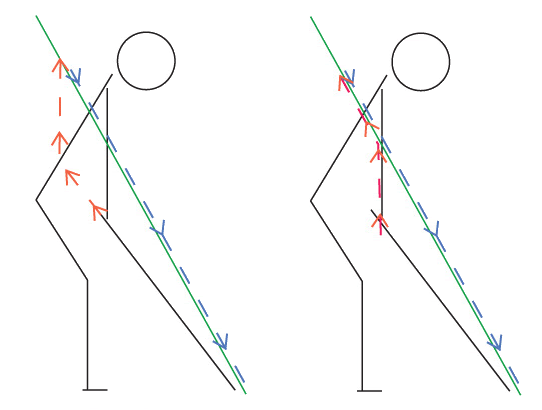
The Drawing on the Left illustrates a Single Shift Procedure. The hands and club travel
up the Elbow Plane and then Shift to a Steeper Plane and continue to the Top of the Backstroke.
From the Top, they Travel a straight Path to the ball.
What would you call the illustration to the Right where Extensor Action and the Checkreign of the Left Arm
raise the Power Package to the Turned Shoulder Plane during the Backstroke, and then from the Top,
the Hands and Club Travel a straight Path to the ball?
The Drawing on the Left illustrates a Single Shift Procedure. The hands and club travel
up the Elbow Plane and then Shift to a Steeper Plane and continue to the Top of the Backstroke.
From the Top, they Travel a straight Path to the ball.
What would you call the illustration to the Right where Extensor Action and the Checkreign of the Left Arm
raise the Power Package to the Turned Shoulder Plane during the Backstroke, and then from the Top,
the Hands and Club Travel a straight Path to the ball?
Daryl,
I assume that in your Illustration #1, the Sweetspot executes the Single Shift. And, that it does so via the Right Forearm and its On Plane Execution of the Major Basic Stroke (7-3) and Plane Line Tracing (12-5-3 / #37-#39).
To your question: Does the Sweetspot execute the same Shift in #2? Your directional arrows indicate that is the case. If so, then the golfer has executed the same Single Shift but has varied his procedure.
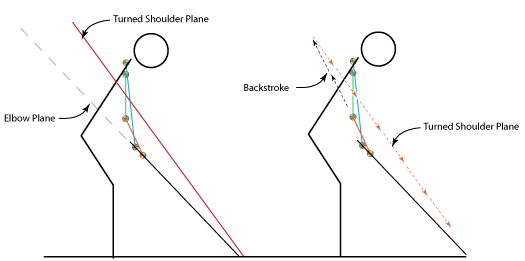
The illustration in my previous post was quickly drawn to illustrate that the Elbow Plane isn't the only
plane available at start-up. Below, more accurately illustrates and describes the purpose of the
Right Forearm Takeaway.
The Right Forearm Takeaway path is illustrated on the right. No shifts. Both, the Backstroke and Downstroke have Straight Line Paths.
The Left Arm Checkreign with Right Forearm Takeaway will FORCE the Forearm and Clubshaft Up the Plane that the Right Forearm defined at Address.
Quote:
7-3 The On Plane Right Forearm shows the precise up-and-down direction it and the Clubshaft must take throughout the Stroke (2-J-3).
The Right Forearm Takeaway will insure a three dimensional Start-up and offers the best chance of achieving a Three Dimensional Impact.
As it goes up, it comes down.
Quote:
2-F But precision is lost unless Start Up is Three Dimensional parallel to the Three Dimensional Impact, i.e. the Clubhead moves Backward, Upward, and Inward – On Plane – INSTANTLY AND SIMULTANEOUSLY. See 3-F-5.
The #3 Pressure Point should Trace the Straight Base Line of the inclined Plane during Start-up.
Quote:
7-23 For a Line “Equivalent”, the Hands from Takeaway to The Top AND BACK AGAIN, sense the Clubshaft as a wheel SPOKE tracing a straight line extension of the selected Delivery Path. So the player envisions – is consciously aware of – a straight line wheel TRACK motion (rather than its rotation) toward and on through the Ball.
The Shoulder Turn Takeaway leads to a Plane Shift.
Quote:
10-6-B TURNED SHOULDER This reference point is primarily the point reached by the Right Shoulder after a Flat Backstroke Shoulder Turn. But any other controlled Shoulder Turn can also provide an acceptable reference point. See 10-13-0. This Plane Angle has far better performance characteristics than any other because any Plane Angle Shift is very hazardous. This procedure does not refer to the disruptive Shoulder Turn Takeaway – which is always too “Flat” and/or too “Low” making a Plane Angle Shift mandatory and usually unintentional and unsuspected. Study 7-3 and 10-24-F.
Also . . . . look at how Lee Buck matches the shaft lean set at address at impact . . . . reckon he could control his distances any good?
The Elbow and Turned Shoulder Planes are two different animals. Apples and Oranges.
The Elbow Plane is a fixed Plane. For a Clubshaft to be on an Elbow Plane, it simply points
to where the Right Elbow would touch your Body.
The Turned Shoulder Plane angle can vary from player to player
and club to club. It is defined by the Right Shoulder getting
onto a plane and while Moving Down Plane will Locate the Right
Elbow onto the same plane for Release. If the Clubshaft at
Impact has the same angle as that defined by the shoulder and
Right Elbow, then it and the Hands are on the Turned Shoulder
Plane. The Right Forearm Wedge functions to get the Clubshaft to be at that same angle.
The great thing about the Turned Shoulder Plane is that it not only locates the Right Elbow On Plane,
but it locates the Right Elbow correctly Forward On Plane to the perfect release point. If the Right
Shoulder wasn't directly behind and driving the Right Elbow to that location, you'll need a compensation
to get the Elbow so far forward or use the Elbow Plane and add a compensation.
The Elbow and Turned Shoulder Planes are two different animals. Apples and Oranges.
The Elbow Plane is a fixed Plane. For a Clubshaft to be on an Elbow Plane, it simply points
to where the Right Elbow would touch your Body.
The Turned Shoulder Plane angle can vary from player to player
and club to club. It is defined by the Right Shoulder getting
onto a plane and while Moving Down Plane will Locate the Right
Elbow onto the same plane for Release. If the Clubshaft at
Impact has the same angle as that defined by the shoulder and
Right Elbow, then it and the Hands are on the Turned Shoulder
Plane. The Right Forearm Wedge functions to get the Clubshaft to be at that same angle.
The great thing about the Turned Shoulder Plane is that it not only locates the Right Elbow On Plane,
but it locates the Right Elbow correctly Forward On Plane to the perfect release point. If the Right
Shoulder wasn't directly behind and driving the Right Elbow to that location, you'll need a compensation
to get the Elbow so far forward or use the Elbow Plane and add a compensation.
Agreed, some players appear to shift to the elbow plane because of the significat head and torso drop (old Tiger swings). I do not consider this to be the elbow plane but might appear to be if one were to draw lines on the screen video. The elbow plane is clearly identified in the book (where the elbow meets the waist).
Agreed, some players appear to shift to the elbow plane because of the significat head and torso drop (old Tiger swings). I do not consider this to be the elbow plane but might appear to be if one were to draw lines on the screen video. The elbow plane is clearly identified in the book (where the elbow meets the waist).
I don't know . . . . are there really many players that actually get to Impact on the Turned Shoulder Plane . . . . I mean look at the pics . . . . I know there are plenty that get on it at some point but typically get to the Elbow Plane thru the ball. I mean I could be a doofus about drawing lines and junk. But if you look at Turned Shoulder Plane pics in the book . . . .not many are there at Impact IMO.
I don't know . . . . are there really many players that actually get to Impact on the Turned Shoulder Plane . . . . I mean look at the pics . . . . I know there are plenty that get on it at some point but typically get to the Elbow Plane thru the ball. I mean I could be a doofus about drawing lines and junk. But if you look at Turned Shoulder Plane pics in the book . . . .not many are there at Impact IMO.
I agree. It's rare to find a golfer on the Turned Shoulder Plane.






 Linear Mode


