Can someone please explain the application of Acc 2-3,the books states 2 before 3,thats well and good but to me it all has to be done in the one action.At the point in the downswing to impact,I find it impossible to seperate indeed ,thats the basis of my question,in essence,why should we even try,isnt it just as easy to improve that section by treating it as one componant keeping in mind that its the full swing im refering to here.
Please dont just fob this question off by saying something like read the book!,I beleive this is a very if not the most important segment of swing...
Looking forward to valuable input....Thanks in advance
I think the key is the sequence, you can't roll before you unhinge, and yes I've seen people do it!! Especially when you visually confirm the accumulators coming in-line with slow motion training is the sequence important.
__________________ Hitting the Ball is the easiest part of the game-hitting it effectively is the most difficult. Why trust instinct when there is a science."1-G.
I think the transer power of the # 3 is voodoo magic! I have also wondered how it "knows to roll." When I hammer on plane # 3Acc roll seems to be programmed to transfer the velocity # 2 Acc. Kinda like playing hot potato! It is amazingly smooth...and fast. Does it have something to do with divergent vectors? The feeling I have worked hard to cultivate is the left wrist throwing out by the right shoulder once the club head is outside the arc of my hands. In essence this produces the DOWN (on an inclined plane you get OUT for free!) What produces that roll is a mystery to me...all I know is that it is not a manual manipulation on my part! Great question!
I started a similar thread on the topic of PA#3 release in the advanced section.
Okie - Regarding the magic of PA#3's roll action, you wonder what makes the left hand roll into impact.
I suspect that the major factor is the movement of the right palm. At the delivery position. the right elbow is still bent at a right angle and the right palm faces more-or-less in the direction of the ball-target line. Then, during the release swivel phase of the downswing, the right elbow straightens and that causes the right forearm to paddlewheel into impact so that the right forearm is behind the shaft at impact and the right palm faces the target at impact. That means that the right palm moves through a 90 degree rotation during the release swivel phase of the swing, and that phenomenon should roll the left hand over (= release of PA #3). On page 73 of the 7th edition, HK states-: "The "On plane" Right Forearm ALWAYS establishes and maintains the correct clubshaft-left arm angle through release and impact".
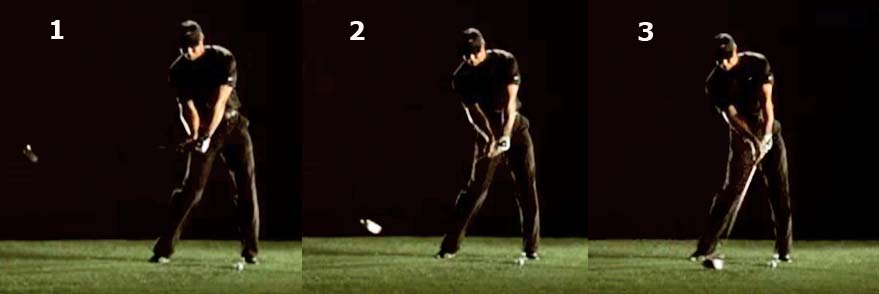
I produced the following series of images to supplement my previous post.
The sequence of the three images shows how the on-plane movement of Tiger Woods' right forearm during the release swivel phase of the swing causes the right palm to rotate into impact - thereby causing the left hand to roll into impact (release of PA#3)
I produced the following series of images to supplement my previous post.
The sequence of the three images shows how the on-plane movement of Tiger Woods' right forearm during the release swivel phase of the swing causes the right palm to rotate into impact - thereby causing the left hand to roll into impact (release of PA#3)
Jeff.
This thread has the potential to be a great thread.
You guys have by far a much greater knowledge of this MACHINE than I and I really value your input,I have asked this question on other sites with very poor response.
I think that this area of the swing is greatly overlooked by so many,most guys are trying to look good in the B/swing and the high finish that they dont pay nearly enough attention to this area.
Jeff,your comments really bring home "the magic of the R /forearm" in my mind,I am putting a lot of attention into learning this section and their componants,but being an average joe Im treating this section as my "station23" not trying to seperate the ACCs #2-#3 but treating them as one for easier understanding(for me)
Slightly off topic,the great pics of tiger,if you have a look at the travel of the hands between each thigh plus also the comparitive distance travelled by clubhead in relation to each other is there a corelation with the kinetic chain in golf swing?
Thanks again for great input guys
I started a similar thread on the topic of PA#3 release in the advanced section.
Okie - Regarding the magic of PA#3's roll action, you wonder what makes the left hand roll into impact.
I suspect that the major factor is the movement of the right palm. At the delivery position. the right elbow is still bent at a right angle and the right palm faces more-or-less in the direction of the ball-target line. Then, during the release swivel phase of the downswing, the right elbow straightens and that causes the right forearm to paddlewheel into impact so that the right forearm is behind the shaft at impact and the right palm faces the target at impact. That means that the right palm moves through a 90 degree rotation during the release swivel phase of the swing, and that phenomenon should roll the left hand over (= release of PA #3). On page 73 of the 7th edition, HK states-: "The "On plane" Right Forearm ALWAYS establishes and maintains the correct clubshaft-left arm angle through release and impact".
Jeff.
The straightening of the rear arm is of great importance, imo, when talking about the relationship between acc 2 and 3.
As you stated above, being on plane to begin with. But let´s not forget about which loading the player is intending to use and thereby where the rear elbow is positioned.
This would affect if the release is sequenced or simultanious.
__________________
Golf is an impossible game with impossible tools - Winston Churchill
You wrote-: "As far as my mention of the KINETIC chain,it was merely a question in relation to a kinetic link on Manzella.s kinetic chain vid where the lower body reaches a point where it allows the upper body to "catch-up" so to speak to keep or maintain the kinetic link....my comments where more of a query more than anything specific...just an observation tis all...and my friend Im not saying Im right...Cheers."
Do you have a link to BM's video on the kinetic chain?
I have read the thread on his website re: kinetic chain and I couldn't find one informed post.
I have two questions for anybody who believes that snapping the kinetic chain is essential for the club to release in a golf swing.
1) How does the club release in the Iron Byron' swing where there is no kinetic link, and only a central arm rotating in space at a finite speed with no sudden deceleration prior to impact?
2) When I perform a left-handed single arm swing by simply swinging my left arm at an uniform speed across the front of my body (after allowing the clubshaft to acquire a 90 degree angle relative to the straight left arm at the top of the swing), I can easily/naturally/automatically/passively get the club to release in a natural manner without moving my body in space (in a kinetic link pivoting manner). How do I achieve the goal of releasing the club in a natural manner without any kinetic link phenomenon and without decelerating my left arm?
The straightening of the rear arm is of great importance, imo, when talking about the relationship between acc 2 and 3.
As you stated above, being on plane to begin with. But let´s not forget about which loading the player is intending to use and thereby where the rear elbow is positioned.
This would affect if the release is sequenced or simultanious.
Amen corner,Im not really concentrating on a particular "loading" as yet,but yes the straightening of the trailing forearm is most important,I call him a late boarder on station23.lol..in my drill I am mainly concentrating on complete shoulder turning and adding pa#2 then I add pa #1.This drill is only at 1/4 speed pretty much aquired motion.Again,Im not saying this is for every one,but Im improving by using this method.......I think that Homer said something about not caring where the ball goes when your practicing drills,That is worth keeping in mind


 B. J. Hathaway, G.S.E.B., M.C.I.



 Hybrid Mode


