2-C-0 LINEAR FORCE The ball will respond to non-linear (angular) force exactly the same as to linear forces only if the application produce forces equally linear to the ball but not necessarily linear to anything external to the ball.
Briefly stated, it is necessary to find a way to compress the ball through a particular point along a particular line, and maintain this compression through the same particular point along this same particular line straight line, through the entire arc of the Impact Interval, and with geometrical precision for consistent control. Study 2-K and 2-N.
To maintain compression at a particular point that point, then, must rotate around the same center that the rotating force does. Not just the physical center of the ball nor the gravitational center – just the point of compression. In other words, the original contact points of the Clubface and ball must remain in contact throughout the entire Impact Interval. This is possible only if the motion – or arc – is uniform. Therefore there must be a perfectly centered action – or a compensating manipulation.
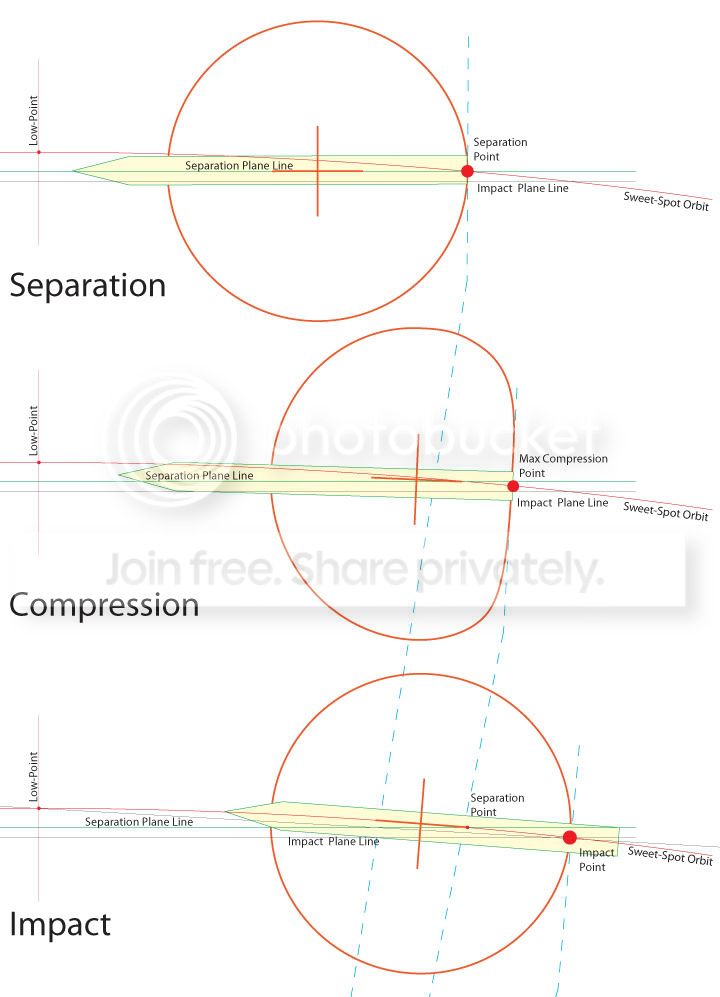
The Illustration below, depicts the Hinge mechanism Sustaining the Line of Compression. These are Top Views, looking down on the Ball from the Players perspective. The Blue dashed line depicts the normal to the plane closing of the clubface.
The yellow arrow band depicts the line of compression at Impact, and is the "Straight Line" that HK refers to in section 2-C-O. The Normal Face to Orbit Path holds the Ball against the Clubface through the Impact Interval. The illustration, Blue dashed Clubhead/Clubshaft depicts normal closing of the clubface. Hinging causes the Clubface and Ball to rotate around the Impact Point. As long as the Impact point remains in contact with the Clubface, the Line of Compression will be sustained until the ball fully separates from the Clubface.
The Illustration depicts "Closing" and applies equally well to both Angled and Horizontal Hinging because Both of these Hinges, as well as "No Hinge" closes the Face the same amount. Although no Hinge will close the Clubface normally, it does not follow that the Impact Point remained in contact with the Clubface. So normal closing of the face to the Sweetspot Orbit is not Hinging and only Hinging can sustain the Line of Compression.
Horizontal Hinging rotates the Clubface and Ball around the Impact Point on a Horizontal Plane Only, and thus eliminates Layback inherent with Angled Hinging and "No Hinging". Layback causes a loss of compression on a line perpendicular to the Sweetspot Plane and thus, tilts the spin Axis.
To simplify all of this for D Plane people, it means that Hinging causes the Clubface and Ball to rotate around the Big Red Dot.
Daryl,
Can you add the effect due to the vertical component of the plane?
As I see it you have laid the path on the ground. did you?
But for horizontal hinge the club face is vertical but the club head is on plane. OK? The vertical element is made up by the "dual" component and the residual #2 still uncocking. ok? but in angled hinge neither comes into effect because of the on plane clubface. Just as a rough estimate. for a 45* plane angle the vertical and horizontal clubhead arc would be the same. Does this make sence to you?
That's correct. All of the lines and orbit have been transferred to the ground. Otherwise, the parallel lines would converge as one line including the sweetspot orbit.
If you can explain what you're looking for, I may be able to draw it.
That's correct. All of the lines and orbit have been transferred to the ground. Otherwise, the parallel lines would converge as one line including the sweetspot orbit.
If you can explain what you're looking for, I may be able to draw it.
I am still back at post #1. this appears to be a normal view of a vertical plane with its lower edge colocated with the golfers plane line. I am still trying to determine what the directions and rotations are as pictured and if they contain elements due to shaft flex and torque. then I have to think hinge type but the horizontal hinge has to be dual horizontal. Those are the elements for the photo ?? So I thought a sketch containing those elements might help? Maybe they arn't and would just be extra work. If U think there of no help here don't draw them. I'll just think about it for awhile.
I can use the Photo in post #1 and draw the important Force Vectors if that's what you mean.
The Horizontal Hinge, whenever we use the term "Horizontal Hinge" we're always referring to the "Dual Horizontal".
Concerning the Shaft in Post #1, I'm almost sure that the shaft wasn't pre-stressed but neither was it whipped ahead of the hands with a backward bent shaft we so often see. The Clubhead appears to be very stable through Impact although if you look carefully at the Top and Bottom of the Clubhead and the Face Grooves, they appear Level to the Ground. So I suspect some Clubhead Droop.
Thank you for the kind sentiments and I share them with you and members of LBG.com as well. It's a great pleasure to participate on your Website and discuss these great contributions that yourself and Homer Kelley have brought to the Golf World.
I'm thankful that you learned and are willing to sacrifice to share your knowledge of the Golfing Machine. Homer Kelley would be very proud of your efforts and accomplishments. Although he knew additional material would become available and add to the already immense knowledge in the book, only someone with a complete comprehension of the material and dedication, as you, can go beyond and improve it. I'm very happy that it culminates into your "Alignment Golf" School. There are no short cuts around the Golfing Machine; one must go through it.
I'm learning. I have a few more years of struggle ahead of me. Fortunately, it's a guided struggle. Your leadership has made and continues to make that possible.
Once I have a better understanding of TGM, I'm going to apply to your "Alignment Golf School". Why should everyone else have all the fun?




 Linear Mode


