I remember 10-5-E is a pull...stance line to the right; base line to the left...I might be wrong.
__________________
If you cannot take the shoulder down the clubshaft plane, you must take along some other path and add compensations - now, instead of one motion to remember, you wind up with at least two!
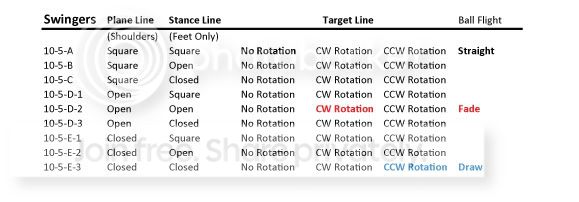
Plane Line and Stance Line. The tick marks represent changes in Ball Location due to Rotating the Plane Line.
Here are the Nine Combinations of Plane, Stance and Target Line. I've have three figured out. I can't get the other ones with a full pivot. I need some help.
Per 10-12, I thought the Stance Line didnt effect the clubhead path but rather served to restrict the pivots motion in one direction. Closed restricting the downswing, Open restricting the Backswing. I know this is contrary to the common perception of things. But the Plane Line governs the clubhead path, no?
Also shouldnt there be a column for clubface alignement or do you keep it a constant in the above? How about Angle of Attack and trajectory, spin etc via ball position?
Per 10-12, I thought the Stance Line didnt effect the clubhead path but rather served to restrict the pivots motion in one direction. Closed restricting the downswing, Open restricting the Backswing. I know this is contrary to the common perception of things. But the Plane Line governs the clubhead path, no?
Yes. That's how I imagine it.
Quote:
Also shouldnt there be a column for clubface alignement or do you keep it a constant in the above? How about Angle of Attack and trajectory, spin etc via ball position?
Sorry, I should have wrote (Clubface Alignment) under "Target Line". Swingers Rotate the Target Line to align with the Clubface at its Forward, Normal or Aft Locations, Hitters Rotate the Grip to align the Clubface square to the Target Line at its Forward, Normal or Aft Locations.
I know this is a little off topic but that video that Daryl has in his signature line still gives me chills and I must've seen it 30-40 times already. Awesome!!!
Swingers Rotate the Target Line to align with the Clubface at its Forward, Normal or Aft Locations, Hitters Rotate the Grip to align the Clubface square to the Target Line at its Forward, Normal or Aft Locations.
Sorry dont follow you. What is the Target Line? Why are Swingers and Hitters different? Please point me to the appropriate chapter in the book. Thanks.
Im thinking the Plane line governs clubhead path, Face Angle governs initial Line of Flight of ball. Again, I know this is contrary to what we read elsewhere.
I love this sort of thing though, this is whats its all about. I wish there was a "shot makers corner" around here where we could discuss Machine Adjustments for various shots. This thread is a good starting point I think.
Sorry dont follow you. What is the Target Line? Why are Swingers and Hitters different? Please point me to the appropriate chapter in the book. Thanks.
Im thinking the Plane line governs clubhead path, Face Angle governs initial Line of Flight of ball. Again, I know this is contrary to what we read elsewhere.
I love this sort of thing though, this is whats its all about. I wish there was a "shot makers corner" around here where we could discuss Machine Adjustments for various shots. This thread is a good starting point I think.
Starting Point??
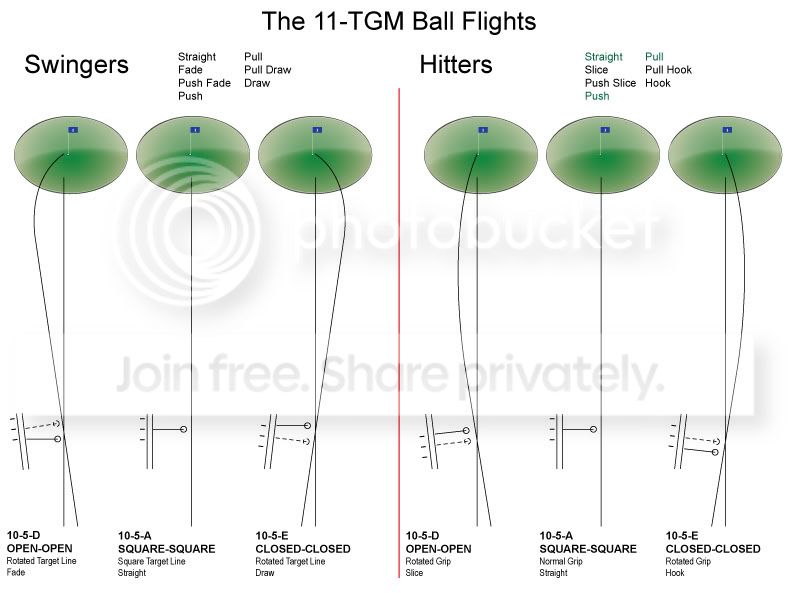
Most golfers couldn't even guess at the number of Flight paths. The so called best and brightest in the world believe there are only nine and probably no more than a dozen TGM experts that know of eleven. Now you do too. I think it's a pretty good start.
Target Line: Draw a line from your ball before you strike it to where you eventually want the ball to come to rest after you strike it. That's the Target Line. In the illustrations, the "Target Line" is the Straight Line from the Ball to the Flagstick.
It took me about a year, maybe two, on my own to understand the following. I hope you have better luck. If you need help, I can give you explanations by the numbers.
Quote:
7-2 GRIP TYPES Each Grip Type employs a different Hand-to-Basic-Plane relationship (2-G) and can be applied to any Basic Grip – by Hitters only – Active Lag Pressure (6-C-2-0). Because for Impact Clubface alignment control, Hitters should rotate their Grip but not their Plane Line at Address (3-F-5, 7-'8'), while Swingers should rotate their Plane Line but not their Grip (7-1, 6-B-3-0). For Swingers the results of Ball Location changes on any one Plane Line are the opposite of those for Hitters. Unless, of course, there is Hand manipulation – intentional or unintentional. Then both procedures will have Hitting alignments and Ball response. And be Ball-related rather than Body-related.
The Hand relationship is invariably established at Impact Fix (7-'8') with
1. the Left Arm and the Clubshaft in-line (4-D, 6-B-3-0-1)
2. the Right Forearm “On Plane” (7-3, 6-B-3-0-1)
3. the back of the Flat Left Wrist and the Lag Pressure Point (6-C-2-0) BOTH facing down the Angle of Approach (2-J-3). Otherwise, per 7-3, both must face down the Right Forearm Impact Fix Alignment (Alternate Target Line) regardless of the true Angle of Approach (2-J-3, 7-5).
4. move the Stance Line and adjust the Knee Bend, the Waist Bend and the #3 Accumulator Angle (per 6-B-3-B) until the Left Wrist is Flat, Level and Vertical (4-0, 7-'8') with the Clubface “Soled” and aligned per 2-J-1 and 7-6. The effect of Opening and Closing the Plane Line is discussed in 2-J-3-B and 6-E-2-2. Study 6-C-2-A and 10-23-0.
For the “True” Hitter, Moving the Ball back (Hook alignment) or forward (Slice alignment) – always with the Clubface aligned to the Target Line per 2-J-1 – gives straightaway initial direction (2-B). Opening the Clubface (Slice Grip) or Closing the Clubface (Hook Grip) at your normal Impact Fix, produces Pushed Slices and Pulled Hooks and so require a compensating Target Line adjustment to make it square to the changed Clubface alignment.
For the “True” Swinger, “Opening” the Plane Line (10-5-D) until it is square to the Clubface alignment at the new “Aft” location, will produce a “Fade.” With the Ball moved Forward, “Closing” the Plane Line (10-5-E) square to the Clubface alignment at the new location, will produce a “Draw.” The Curve of the their paths, after the straightaway initial direction, will be proportional to the divergence of the Plane and Target Lines. Herein, “Path” terms (Ball Path etc.) refer to total Ball behavior, whether or not it remains straightaway. “Line” terms (“Target Line” etc.) refer to the straightaway direction of Aim.
Quote:
7-5 PLANE LINE The Stroke selected under 7-4 needs two basic alignments – its direction and its angle. Most important is its direction. This is leading up to the point to be considered here which is the relationship of these three everpresent elements – (1) the Base Line of the Inclined Plane (2) the Line of the Stance (3) the intended Line of Flight of the Ball. But also study 2-G, 2-J-2 and 7-2.
The Plane Line is located where the Horizontal Plane and the Angled Plane intersect. The Target Line intersects them as either Square, Open or Closed to the Plane Line but always along the Resultant Force Vector. See 2-C and 10-5. Very important additional information regarding the Inclined Plane is presented in 2-F, 2-J and 2-N and under Component 6.
Quote:
10-5-0 GENERAL These classifications are based on the combinations of positions described by the identifying dual-term names. The first term in each combination refers to the Plane Line – the second term refers to the Stance Line (Feet only) and denotes the relation of each Line to the Line of Flight. Three possible Plane Lines are presented but the three possible Stance Lines for each are discussed with the Square Plane Line only, because parallel Stance and Plane Lines are the basic Variation of each group of positions. Any “Line” rotated – even slightly – to the left of parallel to the Target Line (CCW), is in “Open” position – rotated to the right (CW), it is in its “Closed” position. Use the appropriate dual-term names in the Stroke Pattern for Variations not listed herein. Study 2-F, 2-N, 7-2, 7-10 and 8-3.
Parallel Stance and “Delivery Line” (2-J-3), particularly with 10-14-B (Slide Hip Turn), is not only an acceptable equivalent for this entire classification but, per 10-12-0, is especially effective in preventing “Round Housing” in the effort to avoid Hip and Right Elbow collisions – in both directions. Delivery Lines can be “On Line” or “Cross Line” (2-J-3) – Inside-Out or Outside-In. All must be executed as Plane Lines with their individual Inclined Planes. You can see the Angle of Approach blur of the Clubhead during On Line procedures but there is no Angle of Approach in an Angle of Approach procedure. Shifting from any one Plane Line to any other – however slight – results in a Bent Plane Line (4-D-0), that genetic deformity of unscientific Golf, with its Bent Left Wrist Syndrome (3-F-7-A, 4-D-0). Whatever the symptoms, the cure is Alignment Geometry and Educated Hands.
The relations among Plane Line, Angle of Approach and Ball Location, are constant per 2-N. Changing one changes all three and usually, Plane Angle as well. But not necessarily the Clubface alignment (2-J-1). All can be synchronized by “Laying the Clubshaft on the Line” (the selected Plane Line) during the “Parallel to the Ground” (2-F) portions of the Stroke. For additional information see 2-G for Basic Clubface Action, 2-F for Basic Clubshaft Action and 2-N for Basic Clubhead Action.
Thanks Daryl, Im a really going to learn some important stuff from this.
This is a topic that is so critical to advanced golf and yet it hasnt seen the light of day in everyday golf instruction. Common thinking holds that the clubhead path determines the initial line of flight of the ball and the ball then curves back to where the face is pointing. Conversely, strangely as we get closer to the green most people subscribe to the opposite (and correct) set of principles and point the face of their sand wedge at the hole and then cut it or per Pelz consider the putters face angle not putter path as the critical determinant in the initial direction of their putts.
Quote:
Per 1-L-16 The Plane Line controls the Clubhead Line of Flight. Clubface alignment controls the Ball Line of Flight.
If you've ever tried to curve a shot around an obstacle, you know that pointing the face at the hole normally sends the ball into the obstacle immediately. Homer, I think, is saying that the clubface determines the initial line of flight and the ball curves in accordance with the bent plane line or Delivery Line of the Clubhead. So point the face wide of the obstacle and bend the Plane Line away from the Face angle to produce the curve needed.
Daryl, can we slowly flush this all out? Step by step?
Quote:
Per 7-2. ......"For the “True” Hitter, Moving the Ball back (Hook alignment) or forward (Slice alignment) – always with the Clubface aligned to the Target Line per 2-J-1 – gives straightaway initial direction (2-B). Opening the Clubface (Slice Grip) or Closing the Clubface (Hook Grip) at your normal Impact Fix, produces Pushed Slices and Pulled Hooks and so require a compensating Target Line adjustment to make it square to the changed Clubface alignment."
Forgetting True Swingers for a bit and dealing with Hitters and manipulated hands Swingers alignments, can you incorporate the quote above into a drawing similar to your 10-5-A , removing the flag maybe and showing how the ball would react for each procedure. Im thinking this will show the various flight characteristics in a more comparable manner. One ball going straight to the middle of the green, one falling to the right side and short etc. Would a pull, draw go longer and left?






 Linear Mode


