
|
Pa3
I'm trying to get my head wrapped around this concept.
my understanding is that pa3 is the rotation of the left arm with flat wrist which leads to the selected hinge action. To increase the speed in this motion, we would want the rotation of the left arm to travel longer and faster, so the length of this travel would be the #3 angle, right? From DTL, can this be seen as how much the shaft is behind the left arm on the vertical plane at parallel 3? In practicing today, I am looking to get the shaft steeper on the backswing so my feeling was to zero out any pp3 on the takeaway past parallel 1. From here, I found that I could regulate this #3 angle (PA3) and ball striking had a sound it hasn't had in a while. I could feel that rhythm seemed much easier to control. In looking at the pictures, I found that the shaft returned closer to the original inclinded shaft plane at impact. Did I have any of the TGM concepts wrong here? |
Hi Mcgolf,
Man, that's a lot of knowledge for 12 posts. Where have you been? Quote:
Quote:
Less #3 Accumulator for Faster Clubhead Speed because of the shorter release interval. Greater #3 Accumulator Angle needs faster Hand Speed to compensate because of increased drag. If you have it then ok. Match the #3 Accumulator Angle to your Hand Speed. More #3 Accumulator with faster Hand Speed increases "Mass" more than Slower Hand Speed with Less Accumulator #3. From Down-The-Line 'Parallel 3' means that the Clubshaft is Parallel to the Ground and the base of the Inclined Plane. So, the Shafts are identical. However, using maximum #3 Accumulator Angle, your Hands will be farther ahead toward Impact. It makes less of a difference with Double Wrist Action and almost no difference with Single Wrist Action. Your Shaft, in contrast to the Left Arm, is How Much Your Hands Are Turned which is a Plane issue, not an Accumulator 3 issue. That sounds a little like a a Flip Release. Quote:
Quote:
Quote:
Quote:
Did I have any of the TGM concepts wrong here?[/quote] No, everything seems pretty close. I think that you're on the right track. :) Hey Mcgolf, I'm just giving you a hard time. :laughing9 But all kidding aside, the Clubshaft should remain on-plane during the Stroke from release to Both Arms Straight, at least. The Amount of #3 Accumulator Roll is the same no matter how much or how little you use. Your Left Wrist always rolls from On-Plane to Vertical at Ball-Separation. Travel distance does change. I think that it takes a lot more speed and strength to hit the ball from an Elbow Plane with a lot of #3 Accumulator than from a Turned Shoulder Plane with less #3 angle. |
Hey McGolf, how are ya eh?
Not sure if I follow you completely but to confirm some terminology: The number 3 Angle is the angle formed by the left wrist and club. The more angle the more clubhead speed, the more clubhead travel associated with any left arm rotation. To zero out #3 is to fully uncock the left wrist, making the left arm and clubshaft inline. Here a rotation of the left arm will result in a pure rotation of the clubhead, zero travel. Its another lever, again. We zero out #3 in putting if we grip the putter in the life line of the left hand, for instance, to deaden the send associated with any left arm rotation. Or in Chip Basic if we so choose. Ob |
Ok, maybe I'm a little confused. If I am looking DTL, and the shaft is parallel to the ground at Parallel 3, the club can be parallel to the ground but not necessary parallel to the baseline or even toe line (since its close). It could be angled backwards meaning that the butt of the club points down the First base line. Would PA3 left forearm rotation not potentially make this club travel a farter distance into impact and therefore have potential for more speed?
There are pictures of a TOP-down view of Gary player, where the shaft is at P3 but the shaft points across the targetline. I have always had the clubhead too far inside at parallel 1 and instantly had a ton of PP3, which by the time I got back to p3, I was tossing it all away. I found that the right side of my right palm (just south of the pinky finger) was coming off the club. By finding a new pressure point here against my left hand, I could STLOC a little longer. I toyed with RFA takeaway today with some EA but I find the feelings foreign. The 'no pp3' takeaway gets me on a better plane line and better pictures... here are the goods: http://widedivots.com/video/swing/1731/nsjune8 OB! things are great! How was last week with the clinic? I heard from some of my old boys at Abbey that LB put on a great show. |
Thanks for your help Daryl,
I've been floating around here a little bit, just not alot of posts. more reading and watching. I find this to be the best TGM resource out there and the explanations are great. |
Quote:
Nice motion there, McG. Real nice. You're a playa, its obvious. Couple of thoughts from a guy who can wag inside and arch it at Top. - did you see the Gary Player video where he comments on Tigers takeaway and arched left wrist at Top? He made some nice points in regard to Hogan and Tiger in regards to all of this. "if you do this going back , you'll do this coming down" , showing a left hand arching and then bending, throwaway. Similar to your PP3 loading and tossing away note, maybe. Its all unwanted horizontal wrist motion in when its purely vertical motion Homer Kelley recommends. -the club at the 3rd parallel is on plane if it is parallel to the plane line unless you are using the Angle Of Approach (Hitters) which would require you to be parallel to the Angle of Approach (a straight line drawn between the point of impact and low point, more out to right field for balls played further back of low point). Im not sure about Gary Player, he may have been playing a hook for distance, maybe? Cross line and a closed plane line. Dont think he was a hitter. Was it a driver swing? -ideally PP#3 is an indirect pressure point. That is to say that it is not like the other pressure points which you thrust upon directly but rather a (the only) pressure point that senses the Lagging nature of the clubhead. To thrust against it is by definition to throw away. -wagging the club hard and under plane going back can create a ton of pressure against the #3 PP for sure, but its still under plane and remember that for a swinger the #3 PP moves down onto the first knuckle when the club is at End. For a Hitter the #3 PP remains the point of contact of between grip and the first joint in the right index finger unless the Hitter goes past Top to End which means he is loading for some Drag Loading, arrow from quiver, swingers type Startdown. So if are a swinger that you goes to End dont get too intoxicated with that feeling of loading the first joint in the index finger going back.........its the wrong PP#3 and probably associated with a wag move under the plane. It may feel like a powerful load but its off plane. "As you go back so shall you come down" a wag going back leading to a toss coming down. For me this under plane move also causes an arched left wrist at Top or End that discourages left wrist cock, promotes a sweep release etc. -yah, VJ and Freddie have the right hand come off too. Me too sometimes. Everything except the PP3. A subconscious anti right hand roll over move maybe. They leave the only thing they need on the grip , the PP3. Firming up the grip pressure in both hands can actually limit the right hands contribution to the over swivel I find. Firm grip , flexible wrists really helps me. Ideally its the left forearm and not the right that does any rolling, swivelling , but only in Release or Finish not through impact. When Im really on my game it feels like the right wrist stays frozen in its bent, RFFW manner and the left forearm rolls it back onto the inclined plane in Finish. Maybe just a feel and not a real, that for me works. A separation of tasks between the two sides. Sean Casey came over and said hi to us when we were at Glenn Abbey. That morning would have been a show for anyone watching. Probably looked more like dance instruction than a golf lesson. When Lynn says he teaches Motion, he isnt joking, but man does it work. Did you know Sean Folley hangs out a bit with Lynn on tour? I introduced them to each other at OCN in Orlando a couple of years back. Small world. |
That clears things up, thanks OB and Daryl. I have always struggled with pp3 getting too loaded and acting like a PA giving me some awesome throwaway.
I also found that by playing around with a pitch elbow rather than a punch or push (which is what I felt), I could reduce the need to get rid of pp3. For those yellow bookers.. or bucket if you're around...?... does pitch elbow reduce pp3 throwaway? When I get right down to it, it does begin with an arching/bowing of the left wrist which gets the club working under handplane right off the bat. |
Am I correct in saying that the #3 angle is between the left arm and clubshaft at impact where the #2 angle makes this less (more acute) when the left wrist is cocked? Since pa2 goes inline at impact, there is no angle, so its all #3?
|
Quote:
Quote:
It's easier said than done. Its easier with a Straight line Delivery Path while aiming toward the Inside Aft Quadrant of the Ball. BECAUSE, the Elbows need to stay Close Together until Release Can Roll the Right Forearm Wedge. The Right Elbow at the Top of the Swing should be Pointing Downward and be well below the left arm and that Alignment should be maintain until release. Look at the closeness of his elbows in frame 1&2, compare to frame 3. Look at Frame #3 carefully and see where the Bend is Pointing. If I had Frame #2.5 the Bend in his Right Elbow would be pointing at us. So understand that the #3 Accumulator Roll IS the Right Forearm Wedge Roll into Impact. AND, that it begins Rolling Milliseconds after the Uncocking of the Left Wrist begins. 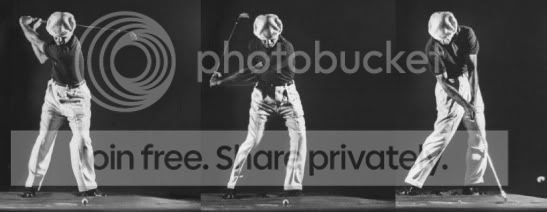 I recommend "Basic Motion" and "Acquired Motion" drills until this becomes ingrained. The Best way to learn and feel this motion is to bend your right wrist and wrap it so that it can't move. Bend a Large spoon (Don't tell your wife) and tape it to the back of your right hand and forearm. Then do small short swings with your right arm. It will teach you almost everything about the Automatic Roll. your Right elbow will change positions because your wrist can't roll. With both hands on the club, your #4 Accumulator must Release to allow your Right Elbow to Change Location. You can't let the Power Package get Stuck. This happens when, during Release, the Upper arms cling to the Torso through the remainder to the Release and Impact Interval. So, the Right Elbow will straighten but not Roll. Yoda gave me a Drill that Allows and Teaches the Power Package to move freely and not get stuck, and it shows just how powerful the #3 Accumulator Release Roll actually can be. That's when I first heard Compression. It's outlined Below. Do this Drill after the Spoon Drill above. Drill
During this drill, you'll notice how free the upper arms become and you'll feel the roll whipping through. The Roll begins when your Right Forearm is about 90 degrees to your Shoulders and Ball Contact is made before your Hands reach the Center of your Sternum. People that Unbend the Right Forearm during the Downstroke may not be able to produce an Automatic Roll of the #3 Accumulator because oftentimes Unbending the Right Forearm during the downstroke means that the Right Upper Arm gets Stuck at your Side. If So, use a Pre-Roll Procedure, by Arching the Left Wrist During the Downstroke. Then, use a Straight Line Delivery Path and you won't need to Flip through Impact. This is the Difference between a Right Arm Swinger and A Left Arm Swinger. During this Action, the Right Arm Swinger does not Allow the Left Elbow and Arm to move away (Blast Off) because his Right Upper arm gets stuck. So he either Bends his Left Wrist or Bends his Left Elbow. And so, the Right Elbow becomes the Center of the Clubhead Arc. I hate to take photos from other websites. The photo sequences are just to show someone with a Power Package that Doesn't get Stuck. I don't make any other claims about his swing. But Look at the Release of the #4 Accumulator. It's a rare thing these days. Picture #4 is Storage, pics 5&6 are delivery, 7,8,&9 are Release and Picture #10 is Fully Released. You need to compare the Upper Left Arms between Moe and Hogan. Hogan got stuck sometimes. Moe did not. BUT, both had High Hands at the Finish which is one indication of a Free moving Power Package through Release. But, you can get High Hands in other ways too I suppose. 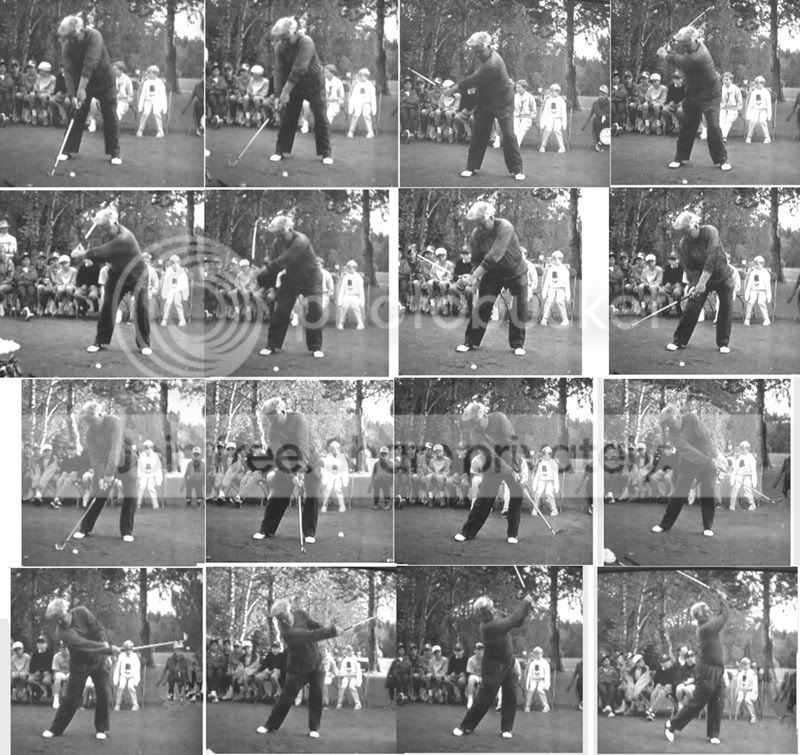 |
I just comming back into golf after a severe backinjury with operation 16 month ago. With painkiller (morfin) I can play 9-12 holes but on the range I can hit abt 120 balls wihtout any tabletts. So I have decided to let the rest of the season be a "rangeyear".
Now one thing I´m training is PA3 and sofar I tested it 4-5 times, and with irons I get long straight shot mostly and it feels very nice and I get the feeling that I will be able to master this but with woods it´s slicing all the time when I tries to utilites th PA3. So any tips? I´m going to train according to the tips above, but I dont know if the will cure the slicing probem |
| All times are GMT -4. The time now is 12:18 AM. |