
|
Woods vs. Irons
Is there a fundamental difference between a stroke made with an iron vs one with a wood?
My motivation for asking this question is that I have the wood/hybrid game of a solid single digit handicapper. And the iron game of a nervous 25 handicapper. What struck me a few weeks back was TV commentary at The Players that David Toms was a "sweeper" of the ball. Is that comment based on anything real/demonstrable or just convenient colour commentary? I have always seen myself as a "sweeper" - rarely break a tee, generally shallow divots, etc. I'd like to explore if this characterization is legitimate or if I am simply rationalizing what is really a faulty pattern or execution with my irons. I'd enjoy a discussion on this topic. Thanks. |
Interesting questions 3Putt.
I think that there is ideally what Homer termed a "Sameness" amongst wood and iron swings , amongst all swings really , speaking very generally. The differences primarily attributable to the relative lever length and corresponding changes to ball location vis a vis low point. That said iron swings are typically a little shorter and there are specialty shots or procedures typical for some clubs more than others. Teeing a ball in front of low point for a long ball or holding off a little punched approach for instance. Machine adjustments to your bread and butter , everyday , basic motion. The answers to your questions can be explained nicely via the Geometry of the Circle. Balls played further back of low point will tend to have a steeper Angle of Attack. Homer defined Snap , Random Sweep and Full Sweep Release types which also effect the Angle of Attack when employed intentionally or otherwise. Your shallow angle of attack is without doubt a (geometric) result of your procedure. Shorter levers switch ends easier than long ones. A short iron will square up quicker , easer than a long iron. Manufacturers adjust for this fact by designing shorter clubs to sit square further back of low point , what Homer termed "hooked face". With their built in back of low point address position and the associated steeper Angle of Attack, shorter irons really like to be hit down on. Some current drivers are designed to square up for balls played forward of low point ....."slice face" I guess you could call it. With a designed in negative Angle of Attack if thats the right terminology. These "straight away" positions are unique to each manufacturer or each model of club and can only be determined through trial and error. A player using the Aiming Point Procedure can move his Aiming Point back and forward along the Arc of Approach to alter the manner in which his club switches ends. YOu can aim at a point several inches prior to contact along the Arc to trick yourself into squaring the face of a driver up faster, for instance. There's a lot that can go into the geometry of a shot but put plainly an iron is designed to be played back of low point and therefor its arc or clubhead path is still Down and Out to low point through and after Imact. Disparity between Path and FAce determining ball curvature. But this is a learned thing and contrary to the "seems as if" false logic of Steering the iron's Clubhead towards the hole through Impact ......which'll give you those divots that point left of the hole, if you make a divot. |
Sorta difficult to answer because your interpretation of 'fundamental difference' may be different from mine. I do think there are fundamental differences..but again, that's my interpretation of what a 'fundamental difference' is.
We hit down with irons for the most part. Perhaps if you're hitting a 2-iron teed up pretty high you can hit upwards on the ball and strike it well. But, that's very rare. So with irons...we hit the ball first and continue to have the clubhead go down further until it reaches the low point. In essence, with irons we want the ball *behind* the low point...pretty much always (there's always an exception to the rule, but I wouldn't worry about it much). With the driver, because it's teed up, we can hit down, hit up or hit 'flat.' In fact, I think with the modern titanium driver...because the hot spot is up so high on the club compared to the old persimmon and metal drivers...we probably shouldn't hit much more than -2* down or it starts to become counterproductive and hard to gain consistency. I think hitting up on the ball isn't easy to do time after time either. So, 'somewhere around flat' is probably a decent rule of thumb to live by. The PGA Tour average is -1.3* with the driver, so that is 'somewhere around flat.' So with that, the ball position with the driver can be behind the low point, in front of the low point or right at the low point. Typically the driver backswing will be longer than say a 7-iron swing. There are some other tendencies as well. 3JACK |
does anyone know if lynns dvd is a must have, Thank you
|
Quote:
|
thank you very much.
|
My “thinking” mind gets the geometry of the ball played back of low point (up plane). My “feeling” or intuitive mind has a different image.
If you can imagine the “ball on a string” analogy being whirled in a perfect orbit. Once the orbit is adjusted (tilted and moved) such that it intersects with a ball lying on the ground - like an iron shot - the perfect orbit is suddenly and violently destroyed. On paper, sure you can draw a perfect geometry. But in the real world does not the ground interfere, especially on hardpan or firm ground? So my “feeling” mind does not want to have the clubhead orbit collide with the ground. Even if this feeling is misguided on many levels (I figure maintaining the proper geometry is most crucial for the small number of milliseconds between impact and separation, not after the ball is long gone) it nonetheless is etched in my subconscious Furthermore, I perceive an iron shot as having to be much more exacting. Contact the ground just before the ball and the shot is miserable and costly. The same degree of poor execution on a wood will result in an off-centre contact but likely a less penal result, even for woods played off the ground. Again, my “feeling” mind does not want the clubhead to collide with the ground first, so there is perhaps a tendency to subconsciously gravitate to thin contact – at least the outcome is more palatable. This post has touched on the mental side though my problems (I sort of see my iron problems as “Yips”). Any comments on how to figuratively wipe the slate clean and re-program? I’ve got to admit, I’m slowly starting to panic!!! |
Quote:
You know how I mentioned the "hooked face" nature of irons? Progressively more hooked faced as they get shorter given that they are designed to be played further and further back of low point. Well if you address them up near low point , with a face rotated open to square it to the line you have effectively added loft to the club AND removed a lot of the DOWN in the Angle of Attack. You are set up for a clean pick off and a ball that will fly higher and shorter than normal. As well your clean pick off will in fact be more exacting , demand more precision than a ball played further back at its "straight away" position. Hitting down on an iron makes the contact easier to replicate , its a luxury (less) available to us for long irons say. You can get this feeling of "covering" the ball, trapping it , squishing it ..... it'll will seem like you are trying to squish the ball against the ground (which wont really happen given loft). One way to practice this is to put a golf magazine a few inches prior to the ball . Trying to hit the ball without striking the magazine first will encourage you to hit down on the ball. Keep working on getting the ball further back in your stance with the shorter irons (ideally back to their "straight away position) and keep sneaking the magazine in closer and closer to the ball. You will have to employ "Grip Rotation" see 7-2 as you move the ball back. As you move your Hands back along the ARc your Left Hand should turn accordingly (it doesnt stay pointed at the target or where ever, it points more and more to the right progressively as you move the ball and Hands further back in your stance). You will need to Rotate the Grip by opening your hands and rotating , spinning the club counter clockwise to square the face to the target line. More and more Rotation as you move the ball further back. This will combination of a square face and down and OUT to Low Point clubhead path will promote, create a draw shot. But not a big draw though as the steeper Inclined Plane of the shorter irons reduces the Divergence between Path and Face and the increased loft and Angle of Attack create more backspin than "side spin" so to speak. In reality its really what Homer called "tilted back spin" rather than "side spin" and backspin. YOu cant spin a ball along two axis at the same time. With the shorter irons there's less tilt to the axis so you dont really need to fear the draw spin tendency too much, but it is there. Huge draws suggest more Divergence than planned for. This is the recipe for "nuking" a mid or short iron I believe , muscular force helps but this is the geometry being employed. I lose about 10 yards or so with a sand wedge when I play up in my stance. As far as your concerns about lowering your clubhead into the dirt prior to contact , research Impact Fix. Imagine the divot as something that is a product of the manner in which you set up , not something you go down and after with your swing. Its a "machine adjustment" set according to the ball position. A product of the relationship between the length of your Radius and the distance from the Center of the Radius to the Ground. Like the ball on a string idea you mention , imagine the Left Arm as a string extending from your Left Shoulder to your Hands. With the string stretched out so its taught (Extensor Action) and your Left Wrist held Level and your Hands and Arms in their desired Impact alignments YOU CAN SET YOUR LEFT SHOULDER ( THE CENTER OF THE RADIUS) IN ITS IDEAL IMPACT POSITION with the Radius of your Arm Swing precisely measured, set for perfect contact. This Impact Fix procedure will ripple through your entire body: waist bend, knee flex , the on plane right Forearm, the location of your head, your gaze at the ball, looking straight out of your eyes rather than down your cheeks , square eye line etc etc. If you return to impact in the same manner blammo. You get the divot, the down , the out , the circular orbit etc. As an aside chipping yips I believe are often a result of having the ball positioned too far up in the stance. Your body sways over try to get ahead of the ball , a subconscious compensation for the ball being in the wrong place. Its a weird business, as if your brain knows something your conscious mind doesnt (that the ball needs to be hit down on). Never thought about it for longer iron shots but .......it wouldnt surprise me. Hard pan? Move the ball up for a cleaner pick off if you must ....if you're hitting off a cart path say. But it'll demand more precision and will fly higher and shorter. Seve used to hit flop shots with his 2 iron for fun. He'd move the ball up near low point , lay the blade wide open, swing a little flatter to take out some of the Down etc. Try it out. They fly to the right, short , high , fade and take a huge sharp bounce to the right on landing....... similar to what a hacker gets when he doesnt want it. Both employ a similar methodology. One intentionally, one not. One set of physics and geometry, one ball response. |
Quote:
|
Misery loves company
I guess no one is immune.....from mikeweir.com June 1/11, Mike's blog
"I think it's safe to say that my elbow injury caused me to develop some bad habits and one of those was my fear of going down after the ball. I was sort of anticipating the pain that might occur if I hit the ground and as a result, I started to swing with almost a reverse C, with my weight moving backwards instead of into the ball. I just did this gradually and over time, it just got worse and worse." |
Quote:
In your first response you mentioned the release type. This is a really foggy area for me. I don't really have a grasp of release types and triggers, let alone know which variations I employ. Do you have any additional comments on the release of irons vs woods. I can only describe what I feel. For woods, there is no conscious thought. Release just happens. I feel as if I trust centrifugal force and go along for the ride. If I had to guess, I'd say a sweep release. For irons, it seems to be a sharper/crisper/more abrupt delivery as opposed to going along for the ride of the orbiting clubhead. I periodically arrive at impact with an (over) bent right wrist/right arm (having to make a god-awful compensation just to get the clubhead in the vicinity of the ball) And a glancing blow severely right, not a shank but a severely open clubface. That "wilted feeling of a blocked shot" Again, back to my question. Why so easy with woods and so difficult with irons. Thanks 3putt |
Quote:
So if you had a stick sticking out of that hole in the butt cap, you need to release so that you maintain your left arm wedge alignment . . . you have to move your hands (#3 and #2) in a way that would get that stick to slap you in the ulna bone as you go to full lever extension (fully uncocked) . . . kinda like doing a volley ball dig . . . sounds like your club is never "encountering" the pulley portion of the endless belt . . . look at Hogan and where the "flash light" in the butt cap would be shining . . . also imagine he's popping a volley ball up in frames 3-4-5. Also note in the first frame . . . there's not this big "Ben Doyle" angle present . . . the the angles are releasing/expanding . . . not holding on.  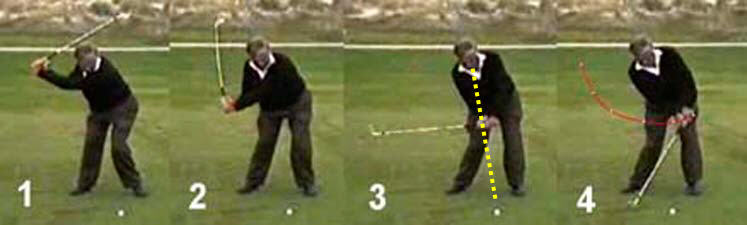 Note where Doyles flash light would shine!!! . . . Note how he is tilting backward . . . Hogan tilts his shoulders obviously but he is way more forward and MOVING FORWARD . . . not tilting back . . . Doyle's light never shines back at him . . . off plane motion . . . hanging on . . too much shaft lean . . . hook swing . . . maximum participation pattern has given the machine a bad name. |
Hey Bucket I'm not that familiar with what Mr Doyle teaches. Does he get to that late Release point by "holding on"' to number 2 angle? I like the notion that the Hands are just clamps and the Wrists are tension free, add some extensor action for Structure. Holding on is not possible this way. That's why I don't like that deal where people pose at a late release point........ You have to freeze your wrists to cop that pose. Not what you should do when really swinging.
Interesting Hand Path there ......not truly straight line but really straight relatively speaking. |
I can't tell if the camera angles are similar enough for me to make my observations, but a couple thing jumped out at me when looking at these. Firstly, in frame one of Hogan and three of Doyle, their hands are at the right thigh. so with that similar hand position, what I noticed was a more Pitch-y Elbow and more Acc. 2 with Doyle, and Hogan's Left Knee being more toward the target than Doyle. Then going to frame 2 of Hogan and 4 of Doyle, Hogan's hands are inside his left thigh at Impact with his flashlight pointing to his left hip or just outside, where Doyle's hands are on his left thigh prior to Impact and his flashlight still way outside of his body. There could be something to all this, there could not be, but all I'm saying is those Hogan frames are the ones I'd more likely make into posters and hang on my walls :laughing9
|
Quote:
Another Eddie Cox deal . . . Are those "compressed angles" really that effective or is it a result of "lag (accumulator lag) envy"? |
Quote:
I dunno. I got a Hogan grip myself , thumb on top but maybe Ted would comment. His left hand is turned. Wish I could retrain the thing to get a little stronger. Just saying that without the turned left hand grip type those would be some weird positions yes but with .............its a different story. Shaft lean becomes #2 angle too. #2 angle is the same as Right Wrist Bend. Cats chasing dogs. Water running running up hill. I got some Bobby Clampett film I should put up . A practice swing with a driver that looks just like Mr Doyle there and then the actual stroke with a more six oclock shaft lean. From Carnoustie last year at the Senior Open. Crazy beautiful stuff, but if he'd actually hit the driver with that amount of shaft lean it'd be fore right, given his grip type. Is this all something to do with the Ben Doyle version of the Aiming Point? The Impact Hands Location taken to an extreme with all clubs and sometimes begetting a super strong left hand grip to make it work , face wise? Great for shorter irons maybe? I dunno. Id love to get a lesson from Mr Doyle though. WAy off topic now, there are people on this board who have had many a lesson from Lynn, Ben , Alex, Jeff, Greg, Tom , Ted ...... We tend to bite our tongues on the differences out of respect. Which is due, but there are differences. |
Aiming point in front of the ball like Ben would be an acceptable variation under 6-E wouldn't it?
If you went further on into his swing I feel the flashlight would also point at his belly along with a more pronounced roll. |
Quote:
http://www.youtube.com/watch?v=u6Tb8MDtPsg http://www.youtube.com/watch?v=IFA_7wbfnmU&NR=1 http://www.youtube.com/watch?v=cI9h2...eature=related clubface to the ground??? http://www.youtube.com/user/bendoyle...17/r_d08dBe5mc |
Quote:
Yes typically for shorter sticks though. Longer lever's might have the Aiming Point on the other side of the ball, several inches prior to Impact along the Arc of Approach. Finding your clubs ideal Aiming Point requires trial and error and is dependent upon the length of the lever, hand speed , release type, the hook face nature of your club etc etc. Lynn fit me for my driver's Aiming Point which is several inches prior to the ball along the ARc. Right on the ground underneath where the leading edge of my Driver hovers at Address. Thats what Im looking at , thrusting towards although I dont want to fat it of course. Man that trick works for me. My wedge has the Aiming Point on the other side of the ball......by an inch or so. Dont use that one very much, just use the ball instead. Talking Aiming Point here as opposed to the Impact Hands Location. A spot along the Arc which replaces the ball, a spot which you Aim your Thrust at as opposed to the visual of the Hands returning to their Fix position. Both are precisely located per the lever length and situation at hand, neither is a "one spot fits all" or " the more forward the better" deal. There's a big difference between the two. Using Homers terminology as he intended, nobody should have an Aiming Point over their left toe for instance, unless their left toe is laying on the Arc of Approach and they intend to thrust the sweetspot at it. Impact Hands location over your big toe? Maybe. Im pro Doyle, no disrespect intended. He was the first A.I. which was not easy. I blame Bucket for this. He's cast some sort of magic spell on me again, damn. |
I am sure no disrespect is intended by anyone toward Mr. Doyle. I think Yoda would agree with your analysis. Many believe that Ben and also Bobby Clampett have "aiming point" wrong. Maybe they do.
But the book states that the aiming point concept can change depending on invididual hand speed, either aft or forward. So if you stated an "aiming point" near the left foot, is that necessarily incorrect? That is, in fact, forward of the ball. Also, frame one and two of the Ben swing is classic "spoke" straight line from the top right to the ball. He surely isnt doing a wheel rim procedure. Hogan, by contrast, swings to the end and then an Arc/straight line movement. I am always struck by how far off the right foot Hogan is on the downswing, and the down toward the ground thrust. Amazing. Obviously far more powerful that Ben's action(Doyle that is). (in fairness that is not Ben in his prime when he played a tour event). I interchanged the "Ben's" there, but too lazy to change it. |
Is he teaching that third student to "re sheath the sword" at Finish? I do that sometimes on little cut pitches, not sure why. Hmmmm.....
|
Quote:
To miss out on Homers actual Aiming Point Procedure is a loss. Its the alternate procedure to Tracing, a geometrical equivalent but with decidedly more DOWN and OUT in feel and in real too. Thrust being cross line, Down and OUt to Both Arms Straight. Moving the Aiming Point fore and aft manages the way longer clubs/levers switch ends, square up slower. Very useful things that the Impact Hands Location doesnt address. For the record Mr Doyle, as the first A.I., had the insurmountable task of interpreting Homers crazy book of riddles to the masses. He did an amazing job and left a map for the rest of us to follow and refine. Respectfully. |
OB,
That anlysis makes perfect sense. Perhaps you can answer a question for me: If your using the swinging procedure, and taking the club back to "end", under an Arc/straight delivery path (as stated in the swingers section of Capter 12), once you get on the "spoke" straight line path what is the specific thrust and or aiming point direction after the hands pass the point where they no longer point at the ball? (obviously, they only point at the ball so long). Or, more simply put, is it actually the hands going in a straight line toward the ball, or the clubhead using lag and monitoring with the #3 pressure point toward the inside aft portion of the ball? what s the visual line after you have taken it toward the ball? |
looks like to me he teaches that to everybody . . . doing that the club never encounters the pulley until LAAAATE. If at all . . .
|
Ill take a stab at it. Spear at it.
Quote:
Anybody got Yoda's lifeline? Chip, thanks by the way. I dont wish to be vague but to answer these questions I'd say: -What would the corresponding answers be if the procedure in question was a throwing of a stone at the golf ball from your golf posture, from Top? Top removing the Arc associated with the move of the Hands from End to Top. Now that would be an Active Right Arm I know , making it Hitting or Right Arm Swinging in golf terms, not 12-2 Swinging per say. But even then with passive Right Arm Swinging the Right ARm is Thrown. Similar to Hogan's book where he describes the baseball player sidearming a ball to first base. (The first base thing could be amended to be Down and OUt at the golf ball or Aiming Point to be more correct, I believe. But he got the OUT part right and the Forward making him 2 for 3 on Three Dimensional Impact). -per 1-L-15 "The club starts up-and-in after Low Point but thrust continues down plane during the Follow Through." Meaning the Thrust continues Down Plane and towards the Base Line after Impact up to and including Both Arms Straight. There's just way more Down to be had than most people realize, conceptualize. Not sure if this answers your questions ..... Cheers. |
The answer is almost identical to what yoda told me at cuscawilla a couple of weeks ago.
Nicely done. To quote "there is no up in the golf machine". And, it works! I had gotten so obsesed with that doyle type impact position, i had started from impact fix. Correcting me to midhands/classic also made a dramatic improvement in the ball striking. Took the man all of five minutes to get that straightened out. Like others, wish i had know about this in the 70's! |
Quote:
|
Quote:
|
Quote:
|
The late Release does add power and Hogan's swing is so beautiful but its not for everybody. Where would Steve Stricker be today if he'd gone back home three years ago to work on Snap Release?
For the Swinger #2 Angle Throwout is Velocity Power. 4,2,3 with 2 providing most of the snot. Imagine throwing a club down the fairway .....first with a longitudinal spear chucking action, then with a whirling radial. The last one goes way further. #2 Throwout and Throwaway are not the same!!!!!! Homer was not anti Throwout!!!!!! The longitudinal acceleration delays Release , CF Throwout, but Throwout is what its all about. See Release Triggers. Like a three stage rocket ......its all about getting that third stage in the right place at the right time going a certain speed so it can then do its thing. Most guys dont have enough Longitudinal, they throwout radially too early , its far less common but too much longitudinal is a problem too. If the ski boat never takes the corner (radial) the skier never gets thrownout , never gets going any faster than the boat speed. Straight line, longitudinally, they accelerate together with no cf throw out forces in play, then the boat takes the corner and the skiers speed accelerates sharply, Radially. Ive got my lab coat here but I dont think the Hands can really go straight line for any length of time but......some paths are straighter than others and have less CF throwout forces in play during Longitudinal. Mr Doyles Hand Path for instance is a straight ish one. Stopping at Top helps I believe. Mr Yoda does this as well and I dont think its because he's 600 years old. Hogan floated from End to Top and then went straightish line with the Hands. He's getting his skier aligned behind his boat or on the other side of the direction of throwout. I did some doodles on this a while back maybe Ill put em up some day for everyone to have a laugh. The other consideration is the move from the Pivot Center to the left shoulder as Center of the Arm Swing during Release, in my diagram the radius gets longer in the process......like a bike switching gears. Got my goggles and pocket protector on now too. I dunno , its a crazy game, a nutty book and its played by a bunch of lunatics. Anyone who's reading this is nuts. |
Lunatics for sure.
But back to Doyle. If you are continually teaching folks for 30 years who are flipping the crap out of it and coming in clubhead way in front of the hands, I can see why he would use his method. I doubt many folks over cook it to get in his front shaft leaning position. Hell it took me two years of constant practice and monitoring to keep from flipping from the top. Now if i can just get it down to the ball without flipping it before visiting the pine box ill be happy. I think the hip action is the key. Plus more visits to Cuscawilla. |
| All times are GMT -4. The time now is 09:39 AM. |