
|
Ball Location Adjustments
Following is a diagram to help explain Ball Location and it's affect on Plane Angle. Basically, the farther back from Low-Point the Ball is Located, then the Steeper the Plane Angle.
Homer Kelley's method is geometrically correct and allows Low-Point to remain at the Left Shoulder. In addition, it automatically adjusts the Angle of Approach. 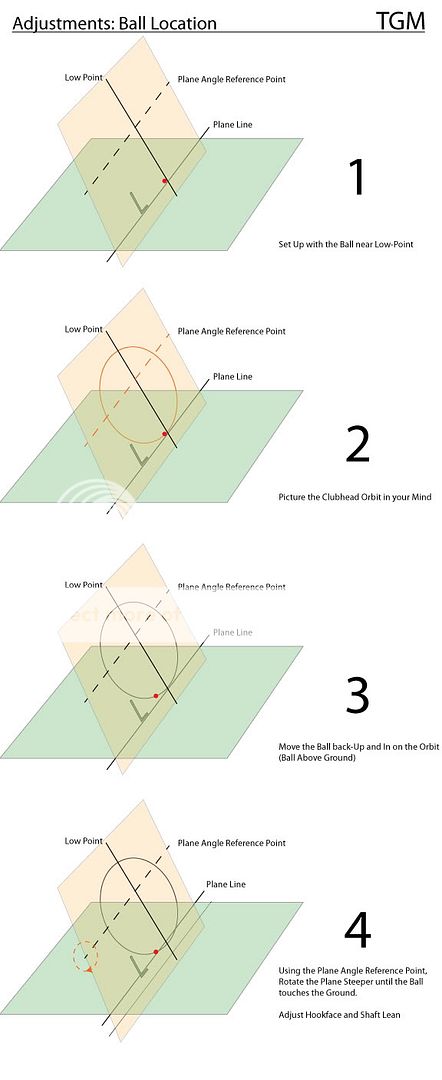 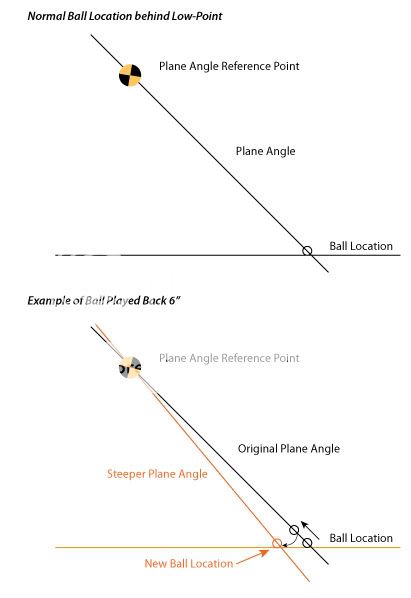 Notice that the original Plane Line, inscribed on the surface of the Inclined Plane is still present. Step 4. It's below ground. ---------------------------------------------------------------------------------------------------------------------------------------------------------------------------------------------- Geometry of the Circle: The implications of these "Alignments" are significant. As the Plane Angle Steepens for any given Club Length, the Club length decreases, which requires increased Hookface (Adjustment), which increases the Clubface Closing Ratio, which corresponds to the wider Angle of Approach of the aft Ball Location. This means that for any ONE Plane Angle for any given Club, there is only ONE Ball Location that Hinge Action can produce Straight-away Flight without disturbing Low-Point Location. Plane Angle, Ball Location, Hookface (closing Ratio) are inextricably related. Change one and you must change the other two to produce Straight-Away Ball Flight. |
Woh, I have always assumed that when the ball is played further back (up plane) that made the low point further down in the ground but that the plan angle would not change. :eyes:
|
Quote:
|
Hey D, man you got some computer drawing skills.
What if after 3 you lowered your center , left shoulder or whatever to the get the club on the ground? Thereby maintaining the shaft angle, lie angle, plane angle and moving the base line plane line under ground.....which would via address alignment only create a divot? That'd be another option right? |
What is Hook-Face?
Get a Hockey Stick.
In my video of "Right Forearm Participation" I'll demonstrate all of the essential alignments. It's too difficult to explain on paper because you have to see how the Right Forearm Angle of Approach seeks out Low-Point and not the Ball. |
Waiting for DMAN
Quote:
ICT |
Quote:
|
Quote:
|
Quote:
Shock absorbers may come in handy as well. |
Quote:
|
Quote:
Daryl Meets The Three Stooges Combination Horror and Comedy! :laughing9 |
Confession
Quote:
Will that change things between us D? :) ICT |
Quote:
The distance between us. |
Daryl,
If meeting the three of us is going to be the best day of your year, your expectations are already way too high. City is improving his golf motion greatly and after a few short hours with Yoda, he may be the whole show. Kev's growth in TGM and his ability to synthesize and communicate is just plain stunning. You won't believe my nice new headcovers. |
Quote:
Then, you'll see your new head covers as a wise investment. :laughing9 |
Note taking
Quote:
Patrick |
Quote:
Right Forearm Participation also Includes: Right Forearm = Clubshaft Control Hinging Swivel Downstroke Acceleration Sequence Pulley and the Straight line Delivery Path of the Endless Belt 15 minutes. |
D , you really prefer that to Left Hand = Clubface, Right Forearm = Clubshaft?
Its doable, I chip like that sometimes but Homer tried it out and ended up assigning clubface control to the left hand. |
Quote:
Kevin |
Quote:
Left Hand = Clubface #3 PP = Clubhead Right Forearm = Clubshaft |
Quote:
Makes sense. Thanks. |
| All times are GMT -4. The time now is 01:05 AM. |