
|
proper PP#4 feel
I have lost the proper PP#4 feel lately......trying the glove under the left armpit doesn't seem to work for me.......then read some of the archives at Lynn Blake forum.....seems that I was simply pressing my left arm against my chest.....WITHOUT pivoting my upper body and hips.........the proper feeling of tightness at the left armpit is PIVOT BASED....I was losing the connection of the left arm to the pivot.......lose the connection ....lose the swing.
|
I would rather say: Loose the synchronisation and you loose the swing. The connection can be tight or loose or almost absent as long as you manage to swing your arms with the pivot and not swing your arms around the pivot.
|
Quote:
After review, it seems to me with rotated shoulder turn the PP#4 can be felt at the top of the swing......this would be for a lagging startup at adresss, however in the past few weeks I have been experimenting with impact fix for swingers and that involved a turned shoulder and PP#4 felt at address. It was working well until I got "tired" and started to have zero pivot. I now see why some players go between lagging takeaway and impact fix start up. Some days its just easier to reach "impact conditions" in the backswing rather than adjust it during address. It is my belief that one needs more precise alignments to be at impact fix than non-adjusted address. |
Connection maybe a better term for minor stroke involving the left armpit with zero pivot.
|
What if you thought about things along these lines?
If you keep the connection , the hanky tucked under the left arm pit, then the Hands will be moving at the same RPM as the Pivot. Only. But if you let the Pivot provide the initial turning power and then the Left Arm in turn accelerated away from the Pivot , "blast off" would not the Hands be all the faster for it? There's more to that sequence of events in the golf swing but given that logic where should the hanky be when a golfer is at Follow Through, both arms straight? I'd say on the ground. Loading the #4 and hard is a good thing but you have to let it open up or fire. I realize this is a contentious topic but thats the basic logic I apply to it. |
I completely agree.
|
Quote:
|
Quote:
|
I agree about the hanky dropping. It has to drop if you complete the motion. The question is perhaps: When should the hanky drop? I think it should drop later (with regards to where the ball is) the more shallow shaft angle you have at impact. Thus earlier for TSP-ers than for EP-ers.
|
What if impact was at exactly the same location for elbow plane and turned shoulder plane singers? Would the handkerchief then fall at the same location after impact?
|
I am not a TSP expert but I have to let the Left Arm fly earlier when I TSP than when I EP. I think the flatter inclined plane you use through impact the longer you can keep some of your PP#4 pressure. So I believe that an EP-er would typically drop the hankerchief later than a TSP-er. But you should know better than me how this works from the TSP side of things.
|
Well, maybe if we consider that the #4 Accumulator stores potential power? Then we can consider storage, delivery and its Release.
It's labeled the #4 Accumulator because it's the least one used in Golf. No wonder, because it's the most difficult one to learn. Quote:
Quote:
|
I believe it is written that Acc #4 is the master accumulator.
I don't agree that it's Accumulator #4 is the one that's least used. IMO it's the strongest and the most used one. I think Homer would have been more clear about that if he hadn't been blinded by his lever system which is totally unfit to model how the pivot produces power through the left arm. PP#4 is certainly the weakest pressure point but it aint pp#4 that makes Accumulator #4 fly. |
Quote:
|
Daryl,
This isn't about method. This is about geometry. If you feel a strong pull through your left arm when you swing - and I'm sure you do - there will be a significant part of the Accumulator #4 release that is caused by that pulling. Since your left shoulder is always pulling from a location that is ahead of the swing center this pulling doesn't only produce cf throwout but also has a linear component that speeds up the clubhead directly. |
You’re a little confused. When I swing the Club, I need Extensor Action to prevent the Left Arm from collapsing inward under the Load of the Pivots Force.
The Left Arm will stay pressed against the chest if the Right Shoulder moves at the same speed as the left shoulder around the Pivot Center. Unless the Left Arm is released from the chest, the Centripetal Center will not be established at the Left Shoulder and the Club will not be thrown out by Centrifugal Force. This Action is Triggered and typically, we use a Right Shoulder Throw to Release the Left Arm from the Chest. The problem that most golfers and some professionals have is that they don't understand the Trigger and cannot perform the Action. Then, they are forced into substituting the Left Shoulder for the Pivot Center in order to Release the Clubhead into its own Orbit. Witness anyone who holds the head behind the Pivot Center at the Release Point and have their Left Shoulder in the Center of their Stance at Impact. Their Left Shoulders formed a dual function of Pivot Center and Left Arm Stroke Center. That's exactly what happens in your so called "Geometry", not mine. While the "One" is being taught......  oh ya, here we go again..... Look:  One of the true Masters of the Game 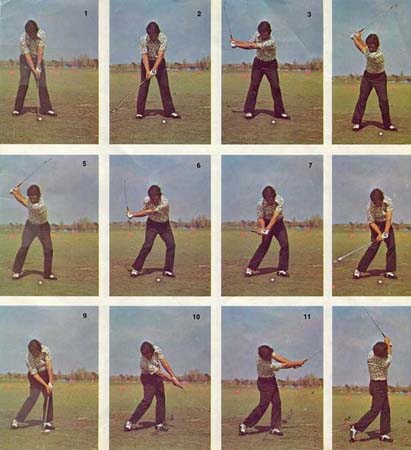 An Honest Swing Ok, this guy knows a thing or two...Does anyone know who this guy is? Must be TGM.  |
You're probably correct that I am confused. From time to time. But not about this.
Your cardinal error is that you believe the centripetal center is established at the left shoulder. That will happen only if you stop turning your shoulders and you will lose a lot of lag pressure in the proccess. Somehow I don't think that's what you're doing. All these drawings that places the left shoulder as a center is terribly terribly misleading. It completely nullifies what you can achieve from torquing the shoulders around your swing axis. In a human made golf stroke, the shoulder turn will always stay around 90 degree ahead of the club at impact - and on better golfers it will be even more since the shoulders tend to be a little open at impact. 90 degrees of rotational lag (the shoulder moving back as the club is moving left etc) is ideal as long as you only consider the left side of the body. This is something you can easily feel if you do some air swings with the left hand on the club only. |
Since air swings are mentioned, I think it's about time to let Kevin come in and make you two friends again.
|
Quote:
|
Quote:
|
Quote:
That is one of the best demonstrations of what 'connection' really is. Austin's 'flammer' training aid - the hands and chest relationship as a result |
If I were to concentrate on something other than the # 3 PP..,
Quote:
What I really don't get sometimes, is why we don't reverse engineer this thing by demanding of ourselves maximum LAG felt in the # 3 PP and then stacking the components to support that event. I don't have the skill to take my mind out of my hands. I feel like I'm missing a big point or two here, so go ahead and just say it. I don't mind. :) Are you saying that the connection guarantees you feel the proper LAG? I don't think so but I'm willing to be re-educated. We all have differing physiques and tempers, so to speak, within the myriad of shots we are challenged to play, so I guess I'm saying that feeling # 4 is lost on me. ICT |
City. I believe not enough attention is paid to them importance of the #4 PP and that includes me. It has taken me a very long time to fully understand that the upper left arm must be connected to the chest in front of/on top of the left breast. Having the upper left arm alongside the left breast is just pure trouble.
|
| All times are GMT -4. The time now is 05:50 AM. |