
|
Hinging
 |
How can you tell?
|
Based on the fact that the ball has rotated backwards and is higher at separation than impact, per 2-C-3 it would be a lob shot.
|
All shots will have backspin - unless topped. COG of a clubhead under the COG of a ball = lift and with the loft = backspin.
|
Trojan Horse
Quote:
Your 'agenda' grows increasingly more obvious. Add something substantive to your baiting tactics . . . Or leave. :naughty: |
Lynn,
A poor attempt at humor and I will erase my post. My vote is still for none of the above. |
Tongue-Fu!
Quote:
By executive decree . . . Your post stands. :salut: |
Hmm...
There seems to be an increasing degree of layback here. So I guess we're talking about an angled hinge here. If I believed someone could drive a ball with vertical I would have perhaps suggested that one, because ball compression looks good and I can't see any closing. Since we don't see the hinge pin it is impossible to see whether the swing arch throught the ball is pure. It looks like the club is already laid back. But the head doesn't seem to go up, does it. It looks a bit slicin' under the ball to me, but that could be due to the COG of the clubhead being so far behind the shaft that the layback in the first picture is just a shaft layback and not a COG layback. |
I enlarged the Photo 20x and outlined the ball and drew some lines to better observe the Impact.
 Things I've noticed: This is only a face view. I would need a Top View to observe the Line of Compression coming into horizontal alignment with the center of gravity orbit. "Kick" plays a huge roll in Ball Response. The upward rotation in frame 3 is 99% Kick. Go Homer. The Ball did not roll up the face of the inclined striker The Impact Point stayed glued to the clubface The Clubhead dropped 1/8" from Impact to separation The Impact Point is lower at Max Compression than at Impact - down the Sweetspot Orbit - Ok - check Bulge at Max compression flows up and down almost equally but the flow below center occurs in a much shorter time frame. It has twice the compression in the same amount of time. The Word "Callaway" became compressed You can observe side bulge by noticing how the word "Callaway" curved at Max Impact The Clubface has closed a massive amount. By massive, I mean more than a "Hinge" should be able to produce. ??? The Clubface has Titled Backwards but it doesn't look like Layback. It looks like shaft torque. Kick, etc. The Layback occurs while the ball is moving away - resilience - is that enough? no: Angled Hinge should show tilt at max compression, this picture doesn't show that The Ball is -wow- stationary. The center of the ball simply doesn't want to move. The front of the ball has no clue whats going on at the back of the ball. The Compression below the center of Ball is far greater than above the Center Where is 12 pc Bucket when you need him? is he in Jail again? |
Great Post
What else do we know. Club head speed?. A real golfer or a Iron Byron thingy?
Thanks Daryl |
Sustain the Line of Compression
Quote:
The yellow arrow band depicts the line of compression at Impact, and is the "Straight Line" that HK refers to in section 2-C-O. The Normal Face to Orbit Path holds the Ball against the Clubface through the Impact Interval. The illustration, Blue dashed Clubhead/Clubshaft depicts normal closing of the clubface. Hinging causes the Clubface and Ball to rotate around the Impact Point. As long as the Impact point remains in contact with the Clubface, the Line of Compression will be sustained until the ball fully separates from the Clubface. The Illustration depicts "Closing" and applies equally well to both Angled and Horizontal Hinging because Both of these Hinges, as well as "No Hinge" closes the Face the same amount. Although no Hinge will close the Clubface normally, it does not follow that the Impact Point remained in contact with the Clubface. So normal closing of the face to the Sweetspot Orbit is not Hinging and only Hinging can sustain the Line of Compression. Horizontal Hinging rotates the Clubface and Ball around the Impact Point on a Horizontal Plane Only, and thus eliminates Layback inherent with Angled Hinging and "No Hinging". Layback causes a loss of compression on a line perpendicular to the Sweetspot Plane and thus, tilts the spin Axis. 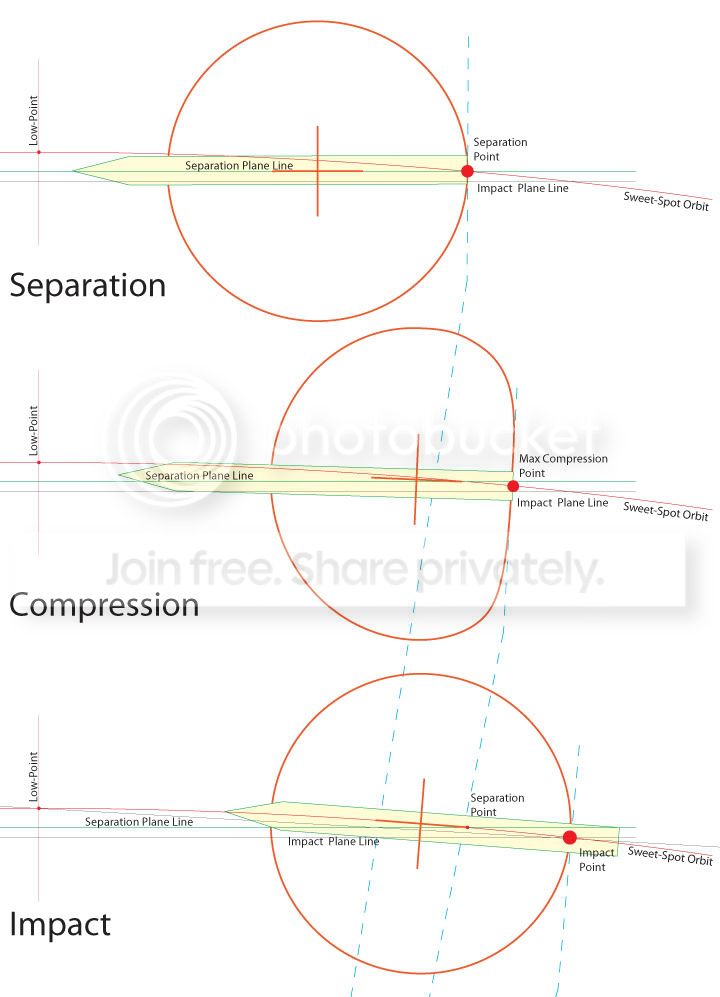 To simplify all of this for D Plane people, it means that Hinging causes the Clubface and Ball to rotate around the Big Red Dot. |
Daryl,
Can you add the effect due to the vertical component of the plane? As I see it you have laid the path on the ground. did you? But for horizontal hinge the club face is vertical but the club head is on plane. OK? The vertical element is made up by the "dual" component and the residual #2 still uncocking. ok? but in angled hinge neither comes into effect because of the on plane clubface. Just as a rough estimate. for a 45* plane angle the vertical and horizontal clubhead arc would be the same. Does this make sence to you? The Bear |
That's correct. All of the lines and orbit have been transferred to the ground. Otherwise, the parallel lines would converge as one line including the sweetspot orbit.
If you can explain what you're looking for, I may be able to draw it. |
Quote:
The Bear |
I can use the Photo in post #1 and draw the important Force Vectors if that's what you mean.
The Horizontal Hinge, whenever we use the term "Horizontal Hinge" we're always referring to the "Dual Horizontal". Concerning the Shaft in Post #1, I'm almost sure that the shaft wasn't pre-stressed but neither was it whipped ahead of the hands with a backward bent shaft we so often see. The Clubhead appears to be very stable through Impact although if you look carefully at the Top and Bottom of the Clubhead and the Face Grooves, they appear Level to the Ground. So I suspect some Clubhead Droop. |
A Special "Thank You" To a Special Guy
Quote:
I am thankful for his decades of commitment to his own search for Golfing Truth; I am thankful for his many posts in which he patiently -- most of the time! -- explains TGM 'fundamentals' to newbies along the path; I am thankful for his many posts in which he confronts the frontiers of his own knowledge . . . and expands them; I am thankful for his wonderful drawings in this and other threads; Most of all . . . I am thankful to count him as a personal friend, one I can reach out to and know that he'll be there. Daryl is a special guy. Thank you, sir, for your long-tern support and many wonderful contributions to Lynn Blake Golf! :salut: |
Hi Lynn,
Thank you for the kind sentiments and I share them with you and members of LBG.com as well. It's a great pleasure to participate on your Website and discuss these great contributions that yourself and Homer Kelley have brought to the Golf World. I'm thankful that you learned and are willing to sacrifice to share your knowledge of the Golfing Machine. Homer Kelley would be very proud of your efforts and accomplishments. Although he knew additional material would become available and add to the already immense knowledge in the book, only someone with a complete comprehension of the material and dedication, as you, can go beyond and improve it. I'm very happy that it culminates into your "Alignment Golf" School. There are no short cuts around the Golfing Machine; one must go through it. I'm learning. I have a few more years of struggle ahead of me. Fortunately, it's a guided struggle. Your leadership has made and continues to make that possible. Once I have a better understanding of TGM, I'm going to apply to your "Alignment Golf School". Why should everyone else have all the fun? Thank you, Daryl |
| All times are GMT -4. The time now is 01:07 PM. |