
|
Path/Plane Assistance
Howdy Everyone,
The last month has served as my introduction to learning "The Golfing Machine". Although I know my basics (such as the three imperatives/essentials, hinge actions, flying wedges, etc.), I am having difficulty analysing my own pattern/stroke/swing and identifying mechanical faults. I was hoping you guys could provide assistance. Before I describe the issues I am experiencing, I feel that I should provide a summary of my situation. I am 25 years old, 6'4", have above average athletic ability (based on other sports, not necessarily golf), and currently play off a 3.7 handicap (although, I haven't played much golf in the last three years). My goal is to progress as far as my abilities will allow. The current issues I have with my pattern/stroke/swing revolve around consistency. I am satisfied with the distance that I strike the golf ball (although, who is going to say no to more distance?), so I would really like to focus on increasing accuracy and decreasing the severity of my misses. My current pattern/stroke/swing can be seen on my YouTube channel posted below. I will try to upload additional videos with various angles (including down-the-line) in the near future. www.youtube.com/cummib My misses are primarily pulls with the divots pointing left (i.e. out-to-in path) and I appear to have an over-the-top move at the start of the downswing. I make an effort to exaggerate the in-to-out path on the downswing, but the results can be inconsistent and it feels more like a compensation than a solution. I have a feeling that my pivot may be the root cause, but I'm sure you TGM gurus will know better than me. Any help will be GREATLY appreciated. Thanks! |
plane-stance lines
Lay plane and stance lines (dowels?).
Trace and look, look, look The Bear |
Quote:
I am slightly confused on the correct way to trace the plane base line. I know that the right forearm and right forefinger are meant to point at the plane base line, but are they meant to point at it whilst moving in an arc or should it feel like it is moving in a straight line? I watched the video lesson that Lynn did with Colin, but am still unclear. |
Quote:
To your question on plane . . . your arc is going to be more acute (sharper) depending on the plane angle you select if you imagine your hand covering a line on the ground. Ideally you'd like to stay on the same arc the whole time back and through. The steeper the plane angle the more close the "arc" or "line" will be closer to "straight" back. Your head stays centered nice got super lag . . . Sounds like you need to get your concepts right on why the ball flies as it does. The ball for the most part is going to START OUT WHERE THE FACE IS LOOKING AND CURVE AWAY FROM THE PATH. The face is generally worth about 85% of the start line NOT THE PATH. Hard to say without a down the line but it looks like you could "use the ground" LONGER . . . try to move your pivot longer where you feel like you're going to hit pushes. Keep the pivot going and it will keep the face from rolling as fast. Good swing. |
Nice swing.
Id agree with Buckets suggestions and would add that if your divots are pointing left then you do need to fix your club head path too. Research "Startdown Waggles". Since golf is played on an Inclined Plane the clubhead does move in to out as it approaches the ball! This will produce the straight divot! (which actually has a little arc to it) Trying to hold the clubheads path in a straight line is "Steering" and non planar. Keep swinging out till your divots go straight. Get into 2-C-0 until you understand the correct impact geometry and the difference between it and all three forms of Steering. Much of the book will open up for you after you get the correct impact geometry sorted out. |
Just for fun, what are the results if you start your swing...
Quote:
Welcome. Patrick |
Thank you all for replying, I really appreciate it.
Quote:
Quote:
Quote:
Quote:
I agree in regards to the pivot. However, I don't know how to execute it correctly. I have tried the drills in "Alignment Golf" but it hasn't worked for me. This was my downfall whilst trying "Stack and Tilt" as well, as I was unable to slide my hips laterally. Quote:
Quote:
Quote:
Quote:
|
Quote:
I've uploaded another video to YouTube (www.youtube.com/cummib) which contains several swings from today with different angles. The only thing that I worked on was the clockwise rotation (i.e. turning) of the right forearm on the take-away. Everything else is what naturally feels comfortable. The divots still point slightly to the left. |
Quote:
Your right, divots right down your plane line. 2 choices. Fix it or compensate. Get some plane lines and stance lines on the ground and start small and slow. Maybe an AI will make it easier. The Bear |
The beginning and the end
Hop on Youtube and look at a few professional golfers - I randomly looked at Charlie Hoffman, Charles Howell, and Ryo.
You are definitely coming over the top at the start down and that means the hips don't need to slide forward as much on the downswing. The end result is this: In your finish position your butt is back - hasn't moved forward as much it should have. From the face on perspective, if you trace the right leg from the foot up - you see a nice curve until you get to the waist and then the curve stops and as you continue to trace - the line moves towards the target. Look at pro players on youtube and notice from right foot through the upper body it's one big consistent curve. That's because the hips end up closer to the target - because they had to slide more during the start down - for the right elbow to clear the hips - since they are on plane starting down - instead of you going off plane and the right elbow going around the right hip. Tip #1 - understand where you need/want to finish. That will influence the entire movement. Tip #2 You may notice that same lower body upper body "kink" when you look at your set-up - can you see how the lower body is straight up and down or leaning back and the upper body is leaning forward? Hips need to move forward a touch at address/ impact fix - that'll be a nice reminder for you. That's a start - you'll need to fill in the gaps (get rid of the other unseen items that make your current movement work) to make it all work together. Besides the swing - at your level it's important you play with better players, improve your course management, and most importantly begin to move away from what got you to where you are today - that is - consistency of movement. You now need to become the artist - where every shot is different, every swing is different - based on the shot at hand. By that I mean, you are hitting it low into the wind, right to left high and low when the shot calls for it, left to right high and low when the shot calls for it - all of those may require different grips, grip pressure, etc. etc. depending on what feels right for you. You have to be willing to "let go" initially, since you won't have the confidence doing that on the course compared to "one swing". Maybe you are not at that level yet - but it's an important aspect of getting to the next level when the time is right. You see - a key aspect of movement is about one predicting the future - making assumptions - based on previous experiences. That makes Memory a tool for predicting the future. The more you can diversify, i.e. enlarge your experiences - the more you expand your memories - and the better you become about predicting the future - the better control you have over your movement and movement predictions. |
Quote:
Mike says you are over . . . . not sure how you can tell that from face on . . . . but you could be a reckon. Put the DTL up. You do some nice stuff. |
Over the Top
BC,
Pivot: You're pulling down with your arms and shoulders and then you start your hip turn. You will always come over the top with that combination. You have two choices. Stop pivoting or stop pulling with your arms and shoulders. |
1 Attachment(s)
Startdown Waggles are the best drill for the over the top problem to my mind. The best video on them is in the Premium Address Routine Video with Ted Fort. It'll cost you about 20 bucks but is well worth it. On the range I do two of them for every pull shot and then fire one off quickly without any added thinking. Those things work.
Here is a great photo of Hogan employing a Hip Slide with a Delayed Hip Turn. Notice how his left hip has slid over to above the outside of his left foot. http://www.lynnblakegolf.com/forum/a...d=128019414 6 |
Quote:
P.S. Watch out for the Canadian - he's dangerous!:eyes: |
Quote:
Hi Mike, Good call on the "over the Top" move. Now, about that "predicting the future" thing. :) |
Quote:
|
Quote:
This would be my analysis . . . His downswing is slightly over his backswing handpath . . . no biggie . . . he may be over just a lil' bit . . . but to me the fix is . . . MORE HIP TURN . . . HAND PATH NEEDS TO BE DEEPER . . . THEN HE CAN SWING HIS HANDS OVER THE BACKSTROKE HANDPATH BUT NOT BE "OVER THE TOP". LOOK AT THE TOP OF THE SWING. ALIGNMENTS ARE NICE IN THE POWER PACKAGE AND THE CLUBFACE LINES UP NICE WITH THE LEFT ARM. Turn the hips more feel like the hands never come up because you already know how to swing them up. If you fix the backstroke the down stroke will fix itself. Where your hands are at the top if you turn at all they are going to get pulled out and over. But you only get them over the backstroke handpath slightly which is really good. So if you get them deeper you can make the same move and still stay on the original planeline/angle. You ain't no over the top wiper . . . you just need to fix your backstroke and you're GOLDEN. Here are two "extreme" examples . . . you're obviously not as "up" as Furyk . . . but this will give you an illustration. Note from where Furyk is at the top if he "spins" or turns and drags his hands out . . . you'd have never heard of him. He has to swing his arms down SUPER FAST (release #4 the fastest) so he doesn't come over. On the other hand Mr. Hogan is much more "deep" . . he does swing his hands over his backstroke handpath but he is so deep that he doesn't end up "over" he ends up right on plane. A couple of other things to notice are the differences in the knee bend (allowing the hips to turn). Hogan has MUCH MORE hip turn and the right knee has straightened where Furyk hasn't straightened much at all. As far as your "startdown" . . . looked pretty nice to me . . . you just need a different place to "startdown" from . . . turn your hips on the b.s. and feel like your arms never get above your belt . . . film it and see what it looks like.    |
Quote:
Very nice motion. It's hard to judge from the video, because you are on a downhill lie, but your ball position may need some adjustment, looks a bit back. I agree that your hip turn is a place to look. Feel like that right hip moves straight back. right hip back, right forearm up I assume from the notes on your clip that you mostly play a fade, and if you are working on the turn/roll of a swinger's move, you may want to weaken the grip a bit, and then release it more fully. As long as the pivot keeps moving, you can release it as hard as you want with a Hogan style grip, and still hit a nice fade. With the grip position you have now, if you really focus on the finish swivel, you'll hook it. You're playing more of a block fade now than a released fade if you get my drift. Either can work, but if you are using a swinger's startup swivel, you need a swinger's full roll. Turn feel determines roll feel, so when you open the door going back, you need to close it on the way through! |
Quote:
|
Quote:
The PIvot and the Hands do not travel in the same direction in Startup. Or the Backswing. In Startdown they do, in the ideal given a "ground up" sequence deal, but not the Downstroke or Release most likely . Its a long story. |
A big thank you is in order to everyone who took the time to view my swing videos and reply to this thread. I wasn't expecting this magnitude of assistance but I really do appreciate it. I have a lot of information to digest, so I'll post back shortly with some further questions (and possibly photos/videos if it stops raining here).
|
It has been a miserable day (weather wise) here today. It is cold and has been raining heavily as well. Unfortunately, this means I was unable to practice on the range/course. However, the rain did ease slightly so I decided to record some swing videos whilst hitting "birdie balls". The only changes I have made (so far) are on the backswing with increased hip turn and flatter hand path. Am I on the right track?
Before: http://www.youtube.com/watch?v=g5R6wWHl_D4 After: http://www.youtube.com/watch?v=pb7LQK3kupg |
Nice going (Bucket, Ob) you've taken a pretty nice swing and turned it into Stack and Tilt. :naughty: Now, BC will be an elbow plane swinger for life. :laughing9
 |
Quote:
dude!!!! AWESOME WORK!!! Have a look at the before and after videos and compare where your left arm is when parallel to the ground . . . AWESOME WORK. Impressive man!!! You got some talent. I really really like it. Next step . . . . get you a mic stand or something that will allow you to make swings with something sticking on your head. Get your head to stop chasing and coming up so fast. That is some beautiful work dude! |
Quote:
 hmmmmmmmmmmmmmmmmmmmmmmmmmmmmmmm |
This is IMPRESSIVE!!!! You are a talented dude . . . now keep your head centered . . . don't let it come up and chase the ball. NICE man!!! See you Later "over the top" . . . which you really weren't in the first place . . . you just gave yourself more space to make your move and not get your hands out over the plane. SWEET!
BEFORE . . . . . 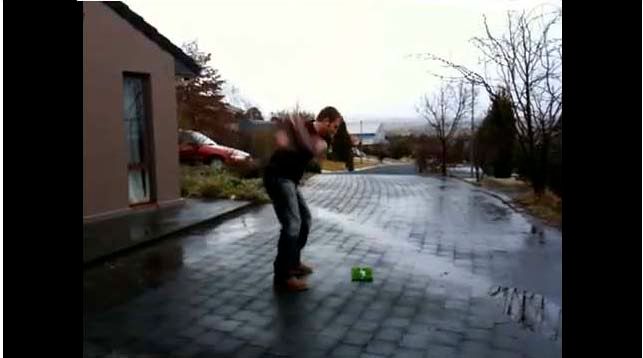 AFTER . . . . . 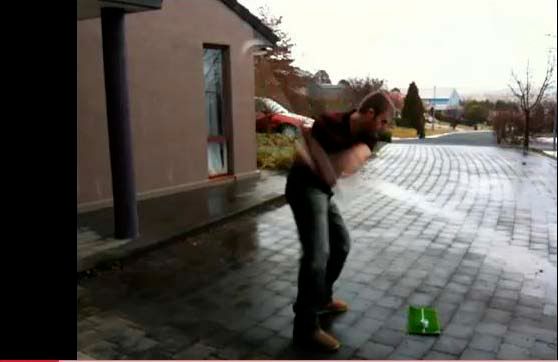 |
Quote:
isn´t S&T´s motion within the yellow book?:crybaby: :laughing1 |
Quote:
If you feel like your swing is getting too long with that added Right Hip Turn for some shots, you can employ 10-15-B Delayed Hip Action. Where the Hips turn a predetermined amount only and then semi lock. This will stop the Shoulders turning at a preselected place , tighten the left side tension and set the stage perfectly for the Hips to initiate the Downstroke Shoulder Acceleration. (Which is the main purpose of the Startdown Waggle drill). Something you do quite naturally but the Slide is going to ramp it up a bit as it takes out the slack in your left side. Like everything in TGM these are not " moves" or "positions" but Alignments. You dont just turn your right hip any old amount , you turn it just enough so it can achieve its primary purpose (allowing the right elbow to pass on the backswing without sending it to the outside , "roundhousing". And no more than is necessary to allow you to turn your shoulders the desired amount based on your own personal flexibility. Too much is just as bad as too little. Most guys these days tend towards the latter and freeze the Right Hip and the pivot in Startup in an effort to set up immediate tension for power reasons but see their right elbow avoid a collision with the "Stuck" Right Hip by "roundhousing" the elbow and Hands to the outside of the Inclined Plane. This ground- up "pulling" in Transition is Swinging, Drag Loading per 10-19-C, if you have the book. If you dont , please get it. It'll save you a lot of grief trying to research these terms. |
Quote:
The book addresses in great detail, the TSP with an On-Plane delivery of the #3 Pressure Point, Flat Left Wrist, Straight Base Line of the Inclined Plane and Stationary Head; in other words, quite foreign to Elbow Plane Swingers. It's too bad because the Elbow Plane is a very difficult swing to master and takes an enormous amount of time and effort to become truly proficient. The Standard Patterns in the Yellow book are easier to master and will give almost any golfer a lifetime of pleasure on the golf course. |
Quote:
Did somebody slip some clorox in your crackpipe again? |
Quote:
|
Quote:
Ya, it took him 18 hours to go from a swing that needed one modification to one that needs too many to count. I'm sure he'll be grateful once he starts playing with his new swing. |
Quote:
How can you argue with the improvement in the alignments in those pictures? In the before swing he was inches away from a wipe . . . in the after he's in position to deliver the club down out and forward on plane. The only thing that was changed was the depth of his handpath . . same startdown . . . just from a point that allows the golf club to move on plane with his motion??? You are coming unglued. YOU CAN GET WITH THIS . . . . OR YOU CAN GET WITH THAT . . . . |
Quote:
 |
I like his changes. VEry impressive.
But for his own good, it cant be to his mind anyways just "flatter with more hip turn". He needs to know the Alignments or else he'll be forever searching. One days "flatter" is another days too flat. Some poor soul once said something like: " The secret to golf is that a one day wonder lasts for five days , so after three days you'd better starting looking for your next one day wonder." |
Well, it certainly wasn't my intention to ignite an argument by uploading swing progression videos that implemented Bucket's suggestions. The fact of the matter is that I only have a basic understanding of TGM (however, I am slowly learning and always ensure that I look up suggested references in the book), so I found Bucket's post most helpful as he thoroughly guided me through the modifications that he believed my swing required. I am in no way implying that his suggestion is better than anyone elses, it's just that it was an easier process to implement for testing.
With the above being said, I played my first round of competitive golf in three years today and decided to take Bucket's suggestions straight to the course (which is usually a terrible idea without significant practice). I actually played to my handicap for the front nine holes (which was a surprise considering I haven't even practiced my short game or calculated yardages). However, I couldn't complete the back nine holes due to heavy rain and the rest of my group calling it quits (which I was quite disappointed about). Anyway, I spent another hour hitting balls in the rain and can honestly say that my accuracy has improved and my divots are pointing along the target line (or slightly to the right). Whether this is simply the honeymoon period or not is up for debate, but at least for the moment it's an improvement. I made a similar thread on the ISG (I Seek Golf) forums, which is where Paul Hart (who is the closest AI to my location) regularly posts. It looks as if Paul would prefer a more upright swing as well, so these changes may just be temporary if I end up being taught by Paul. Ultimately, I sincerely appreciate all the suggestions given to me. I'm even more appreciative if the suggestions are validated with good results. :) |
Quote:
Second . . . don't pay any attention to me and Daryl . . . this is what we do constantly . . . plus he has a crush on me. What was the ball flying like? low/high? which way was it curving? How much? What were your misses doing? Any pattern? Let's see the face on video with the handpath change . . . next step fix the hips/head chase . . . Why does it rain everywhere you go? Are you some kind of Minister of Darkness and Evil Deeds? |
I disagree Daryl has a crush on Mike O.
BC85 The thing I was alluding to about Alignments is important, so I want to explain it a bit. Your talking flatter vs upright etc so I got to. The "flatter" Bucket reco'd to you does not mean flatter is better or anything. It was designed to help you to achieve a proper Alignment at Top something that Paul would concur with Id bet. In brief: If you are swinging and using the ground up Downstroke Sequence of 6-M-1 (which you do quite naturally and wonderfully but with the added Hip Slide will be even more dynamic now, Hogan like) the left foot pulls the left knee which pulls the left hip which pulls the RIGHT shoulder down plane which pulls the Hands down plane. The only way the Right Shoulder can pull the Hands downplane is if they are both on the same INclined Plane at Top (only)!! This is the definition of the Turned Shoulder Plane. If your Hands are above this Turned Shoulder Plane then a turn of the Right Shoulder will bring your Hands over the top of the plane automatically. Everything in TGM is Alignment based. Too flat is just as bad as too upright. Flatter is not better. Bucket got you on the Turned Shoulder Plane and your downstroke showed its benefits. The Startdown Waggles I reco'd are done from the Turned Shoulder Plane ideally as well. The Hip Slide will Tilt the Axis of your Shoulders and lower your Right Shoulder which makes taking it down the Inclined Plane easier. In the end your Shoulders will feel like they are traveling different paths on the way back and down and they are. Flat back and then Down Plane. The Standard Shoulder Turn, weird but man does it work. Why? Alignments again. I'd work on your Flying Wedges at Address next. They an important Alignment if ever there was one. |
Quote:
Quote:
Quote:
Quote:
|
I managed to get to the second hole today before the heavens opened up and continued to rain heavily for the next three hours. It was bad times. Anyway, I managed to get a couple of new swing videos recorded (see below). I can't take much from today, as trying to hold onto the club was like trying to hold onto a bar of soap. The misses tend to be thin or blocked fades/slices. I am also having trouble applying the changes to the full swing to the partial swings.
http://www.youtube.com/watch?v=FwzmpOBJigw |
| All times are GMT -4. The time now is 03:38 PM. |