
|
Question about plane
So I was looking at the Amazing Changes section. It looks like the line drawn is the turned shoulder plane.
So the question is this. Is the goal to get the hands clubshaft and the right shoulder to stay one this plane in the down stroke? Then at impact should the clubshaft, hands, right forearm, and right shoulder be on this plane? Thanks |
Essentially you want the "longitudinal center of gravity" (imaginary line that would be from sweet spot to grip where PP3 is) laying on the face of the plane the whole time . . . so for discussion purposes just imagine or actually have a plane board . . . you want the shaft (really sweetspot/longitudinal COG) laying on the board the WHOLE time. Now that being said there is going to be some shifting as a result of how your body works and right elbow. But you want this shifting ideally to be MINIMAL . . . particularly the closer you get to the ball and past it. Otherwise you disrupt #3 angle and have tons of ramifications that result. So basically you want to move your components in a fashion that allow you to stay on the selected plane angle with minimal shifting going on . . . whether that be the elbow plane or TSP or eyeball plane or whatever . . . your choice . . .but move your components in compliance with the plane and the hand path that results.
|
4 Attachment(s)
Attachment 1991
Attachment 1992 Attachment 1993 Attachment 1994 So is this off plane because my hands are lower than the turned shoulder plane at impact? And should the sweet spot travel up the turned shoulder plane on the back stroke? |
Quote:
Looks pretty good you come down the TSP and shift to elbow . . . good way to do it . . . do you have frames after that? You don't have some kind of whacky looking shift out and over . . . Like to see where the club and hands exit on the thru side. |
Quote:
Here's Mike O's feedback - You're going to see shifts- you're not going to get better by trying to stay on one plane- probably going to get worse. You want to maintain the clubshaft/sweetspot relationship to the plane line- understand the shifts but don't view them as inferior procedures. Not that you asked but the mechanical issues with your impact photo are - the right forearm is too high, inadequate hip slide/rotation (hips are "square"), the right foot is "flat". That's a result of other issues- loss of lag, or other issues- so I wouldn't work directly on the feel of the forearm location, nor the hip or footwork- they are affects of something else. However, when you find that something else- you'll see a different elbow, hip, foot "look" at impact. Anyway - food for thought. The first "issue" I would look at is your mat - get something where you can hit a more descending blow on a "fluffier" lie- otherwise you could be creating a swing that throws the clubhead in order to prevent you from hurting your wrists on the mat at impact. Regardless of whether you are a plus 2 or a 15 handicap or somewhere in-between- that's what I see. |
Quote:
OK stankbutt . . . .I take issue with it's OK to shift the plane angle if you "as long as any shifts still allow the sweetspot/clubhead feel to maintain it's relationship to the plane line." We had this discussion befo . . . if you raise the handle up . . the face angle magnet dealie (face vector) is out to the right . . . if you lower it down it's to the left . . . You can trace a straight plane line and still hit the ball crooked as if somebody hired you to run a bank. #3 disruption = potential direction issue regardless if you can trace a line better'n you trace a doctor's signature on prescriptions for Ox or flea and tick deterant. I would certainly pay attention to any advice Mikey has on wrist hurting . . . or hair removal from palms. |
What’s up with this East Coast Mumbo-jumbo Witch-doctor analysis? :laughing9
Grasp the grip of the club and hurdle it down the fairway. Notice that the Grip and Clubhead revolve end over end in the same plane. The club doesn’t wobble down the fairway. That's the principle behind the Plane and Clubshaft Control. Each Plane Shift can introduce a wobble. The Club wants to stay on Plane. The Clubshaft Likes the Plane. The Clubshaft is the Plane. Ndwolfe81 is double shifting but the Golfclub doesn’t care which plane angle you choose to swing. It’s more efficient if your Clubshaft can stay on the same plane throughout the stroke. His Clubshaft and Right Forearm are on-plane at Impact. The Elbow Plane. Ndwolfe81 has built-in double-shift. He doesn’t have a Rigid Power Package to maintain a no-shift during the Backstroke or Downstroke. Straightening his right elbow during the Downstroke causes the shift from the Turned Shoulder Plane back to the Elbow Plane the same as over-bending the Right Elbow at the Top causes the Upward Shift. Don't believe me? Simply swing the Club without your Right Hand on the Club. You won't Shift Planes. Swing the Club without Straightening your Right Elbow during the Downswing and you won't Shift Planes. Therefore, keep a rigid Power Package. The Principle behind the On-Plane Right Forearm is that it can direct and support the Clubshaft during release through Impact to Both Arms Straight. It’s the easiest way to maintain Clubshaft Control throughout the Stroke. The Right Arm Flying Wedge. The Right Shoulder can support the Right Forearm up until Release. Then, the Power Package continues On-Plane while it unfolds (straightening the Right Elbow) and releases the Accumulators. Note that any plane shift is only possible if the #3 or #2 pressure Point is maintaining a relationship to the Pivot. If the #2 or 3 Pressure Point maintains a relationship to the Plane Line (Tracing), then no shift would occur and the Right Elbow would not Straighten during the Downstroke until Release. |
Quote:
Yes, you should set-up at the appropriate plane angle that you'll be coming back into at impact- but during full swings you'll see shifting planes during the swing. Please follow your wife's, doctor's and my advice and get back on the medication - we're begging! |
Gentlemen, fellow Stankbutts , I sense ndwolfe's question remains unanswered.
Namely, given the advice to take the right shoulder down plane or at the ball in Start Down, should the right shoulder (shaft , right foremarm) be on the inclined plane at impact? Any amount of #3 angle or right arm bend would make this impossible no? What gives? |
Can you set up at impact fix with everything on plane? Yes.
There's the answer. The left arm is not on plane (#3 accum) by definition. The right forearm is, with a little bend left in the elbow. (Impact is to occur before maximum extension.) The definition of the Flying Wedges. If the right shoulder does not move down on plane, it must move somewhere else, which requires compensation. ndwolfe is not moving the right shoulder down the plane angle. It could be the right hip is in the way. |
Quote:
How many fools come down the same plane they set up on? If you don't come down the same plane you set up on . . . when do you define what plane you IS on? Mon' Back . . . doo doo brain. Hey . . . did you get the new Molly Cyrus album yet? |
Quote:
|
Quote:
Unfortunately, some of us (not Loren) are confused about the differences between Plane Angle, Plane Reference Points, Clubshaft Control, etc. I won't name anyone. |
Quote:
|
Quote:
Where should the right shoulder be at impact and release? |
Quote:
Thanks Stanker I'm kind of surprised you're saying the ball wouldnt know the mechanical advantage or structure of the right forearm being on plane. More mass, more structure, more leverage, etc. Ill throw you a mulligan on that one if you want. I dont think you meant that the way im reading it, anyways. If the right shoulder moves down the TSP in Startdown but it aint on the TSP at Impact........... has it shifted its plane of motion, (again)? Im not saying that it should be on the TSP at impact, but it is an interesting question from ndwolfe. |
Quote:
|
Still kinda lost
Thanks for all the help.
I'm still kinda of lost, mainly because the photos in the amazing changes section. The plane is always the turned shoulder plane that people are on thoughout the downstroke and impact. That makes me think that Ted and Lynn are trying to get students on that plane during downstroke, release point and impact. I would think they must feel this is the best choice. I spent 3 hours with Lynn a couple years ago but we didn't get to use the video system. If we would have been able to then I would prolly be much more clear about these planes. I know tgm isn't one set way, but why would the plane in the amazing changes section always be the turned shoulder plane? I want the plane that gives me most compression and is easiest for me to get a forward leaning clubshaft at impact. |
Quote:
Thanks Loren. I hate to belabour the point, but when you say "everything" I dont think you are including the right shoulder to which ndwolfe alludes. You are of course, correct in that the right shoulder should not be on the inclined plane at Fix. In Startdown perhaps, if you so choose. Its seems as if the Right Forearm and the Right Shoulder cant travel the inclined plane together if there is any elbow bend. They may take turns on it but not together. You could I suppose get the right shoulder and the RFFW on the inclined plane at Fix but only with a perfectly straight right arm. A death move or should I say death alignment, unless you are putting maybe. |
OK stankbutts how's this then.
Quote:
Quote:
|
Visual Aids
4 Attachment(s)
Here's some pics of BG...does this help:)
|
hmm
I wonder why the guys in the amazing changes section are all more on the TSP?
Would they be better ball strikers if they shifted planes to the elbow plane a bit before impact? |
Quote:
2-H SHOULDER MOTIONS The point may be made that it is impossible to inscribe perfect circles while the center is in motion – that is the turning Shoulder. The straight line requirements of the Compression Point are satisfied as long as both the Vertical and Horizontal Centers move precisely in unison. Direction control remains stable because both Centers are also moving in a circle – that is, the circumference of the Shoulder Turn.Looks like this right here . . . 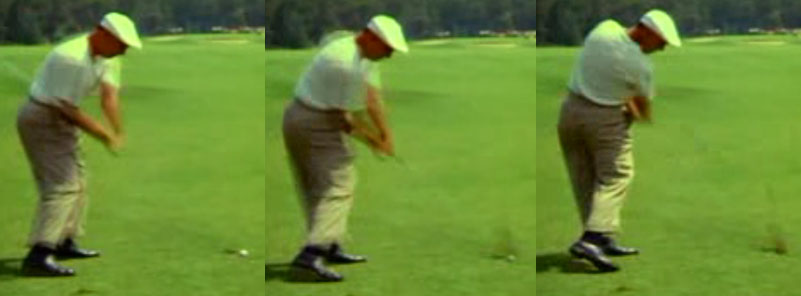 |
Quote:
I didn't name names and I thought that it was obvious to anyone that your name doesn't belong on it.:laughing9 I give you 4 Yodas for your posts in this thread.  |
Avoid running out of right arm
Quote:
Anyone know a reason to go lower than that? UPDATE: Trigger delay. |
Isn't the turned shoulder plane named because the right shoulder gets on plane at the top of the swing and goes down plane as far as possble into impact?
|
Quote:
Regarding the TSP angle, it's because Homer Kelley thought that the turned shoulder plane was far superior because "any plane shift is dangerous". He associated the elbow plane with pivot-controlled hands and warned against the shoulder turn takeaway as always too flat, or low making a plane shift mandatory, likely unintentional and unsuspected. It is for this reason the right forearm takeaway is preferred, described as mandatory. The turned shoulder plane is defined as "that reference point reached by the right shoulder after a flat backstroke shoulder turn. With whatever body position (accounting for waist bend) the plane passes through, the right shoulder and hands are precisely AT the right shoulder level at the Top (See Brian Gay's), regardless of plane angle or shoulder turn. But any other shoulder turn can also provide the acceptable reference point." Shoulder turn and plane angle are two different things. The plane angle is referenced by elbow, hands or various shoulder turns. The Standard shoulder turn is a flat backstroke and an on-plane downstroke. In the 7th edition the preferred variation was changed to Rotated shoulder turn, the normal path at right angles to the spine, which can locate a turned shoulder plane angle but doesn't have to. The downstroke may shift to whatever plane angle is chosen. That looks like what ndwolfe is using. I think we're struggling a bit with why your hands are too low at impact regardless of plane angle. Not enough axis tilt, right shoulder a little out instead of down. Check the clubshaft at parallel to the ground. It's slightly off plane there. Look to the pivot. Good looking swing, by the way. |
Quote:
O.B "Thank you Daryl, my gosh 4 Yodas, well I dont know what to ........ Kanye West " Excuse me O.B. , Im very happy for you and all and Ill let you talk all you want later BUT.............Beyonce had the best POST of ALL TIME" |
Quote:
Interesting. Brian Gay's shifts his plane angle (minimally) from the TSP to the Elbow Plane but his Right Shoulder continues moving down the TSP. Never thought about this before. So his "shoulder plane" doesnt shift in the down stroke but his plane of motion, the plane his pressure points ride, his sweet spot plane does shift. |
Quote:
|
Quote:
|
Quote:
|
Well, it's in there, with a Slide hip turn.
The rotated shoulder turn says to use a shiftless hip turn. And under shiftless hip turn it says "tends toward a soft stroke with emphasis on accuracy. It can produce an on plane downstroke shoulder turn only with the rotated shoulder plane angle." (As defining a turned shoulder plane angle versus transport only?) Something does not compute. I think shiftless hip turn is not always required with rotated shoulder turn. Only when using it for transport-only as in 10-13-B. Awkward wording. Unclear in both the shoulder turn and the hip turn. It's in the thread on 7th Edition Changes but hasn't been discussed. I'd stick with Standard shoulder turn, flat back, on-plane down. TSP angle. 'specially at my age. |
So Why?
If most tour players are double shifters then why is it that Lynn and Ted always have the TSP drawen in the amazing changes section?
And why in most photo are the hands, right forearm, sweetspot/clubshaft and right shoulder pretty much on it? They must feel like that is a better downstroke plane, all the way to impact. And I guess they don't think shifting down to the elbow plane is worth while? Is that the case? |
Quote:
|
Quote:
Im like you, I prefer the Standard 10-13-A as taught by Yoda. Flat back and On Plane in the Downstroke. My second choice would be Rotated going back and then On Plane in the Downstroke. Either way given the necessity for sequencing 6-M-1 and staying On Plane, the Right Shoulder takes the bent right arm and the intact, fully loaded, non leaking Power Package down the Inclined Plane. To re engineer this; in order to accomplish this, the right shoulder must be on the Inclined Plane in Startdown which necessitates Axis Tilt, a Hip Slide in transition, ideally done with a delayed Hip Turn which clears a path for the right elbow. Im going around in circles, sorry. Quote:
In my 6th edition its says that "Downstroke use (of the Rotated Shoulder Turn) is normally confined to the Shiftless Hip Turn". Im thinking that given that Axis Tilt is a fairly advanced technique and designed specifically to get the Right Shoulder closer to the Inclined Plane so it can move down it, a golfer wouldnt normally bother shifting unless he intended to use the On Plane Shoulder Turn. I also think that managing your waist bend so the Rotated Plane is on the Inclined Plane is less than ideal for full shots. Perhaps Homer was alluding to this? For short shots, putting say, Rotated is the simple way to go, you wouldnt want to Flat back then On Plane when putting! Here, if you wanted to, you could manage your waist bend, upper spine bend etc to get the Rotated Shoulder Turn moving On Plane (Pivot to Hands, Shoulder Stroke). No need to shift the Hips of course. Arc or Angle of Approach for putting vs full shot considerations here too. Hitting the back of the ball instead of the inside quadrant etc. |
Quote:
Perhaps the confusion lies in the belief that there ideally is one singular "Plane" or one fixed Inclined Plane angle? While this may true intellectually and indeed practically for short shots, "The" Inclined Plane can and does Shift or change angles for longer shots. I cant think of golfer who hasnt shifted plane angles for full shots. Given the manner in which we define the plane anyways. (JIm Hardy's definition being a different kettle of fish, the plane of the shoulders vis a vis the left arm being one and the same etc). From a DTL point of view, the angle formed where the Plane (picture it as a four sided rectangle along which the clubshaft or the more correctly a line between the #3 PP and the Sweetspot, travels at all times) meets the ground (the Base Line, Target LIne) can change. The club's lie angle defines the starting plane angle assuming you dont want to come into the ball toe up or down. The right forearm , or right Forearm Flying Wedge is said to be on this Plane Angle when the Right Elbow is on plane. So "The" Inclined Plane or "The Plane" does not preclude changes in the plane angle, "shifts". Also, Per 1-L-18 Machine Concepts. "Changing the Plane Angle has no effect on the Plane Line". Implicit in this is that Tracing the Plane Line accurately is far more critical than complying with a specific pattern of plane shifts. See Trevino, Furyk etc. There used be a really nice animation on this site that described this. If I can find it in my files Ill send it to you. It will make things clear as words sometimes fail us when describing geometry. Yoda would, I believe, prefer the TSP in Startdown so that the Right Shoulder can get on the Inclined Plane and take the Power Package down that plane towards the ball initially. But this does not imply that he wants the clubshaft, right forearm, hands, #3 pressure point , sweetspot etc to stay on the TSP all the way to Impact. The fog will lift when you can imagine the Inclined Plane's angle changing as it shifts from a higher angle to a lower one. From say the TSP to the Elbow plane. Its the same plane of glass or plasic or whatever with different, shifting angles where it meets the ground. That is "The" Plane. |
right elbow
Sorry to be off topic but I wonder if loading of the right elbow is an alternative to winding up in the backstroke with regard to power source.
|
Quote:
|
Quote:
Swingers load the wrists. The elbow is in a different position between those two and the pressure on the meaty part of the right index finger is in a different place, aft of the shaft for the former, top of the shaft for the latter, optionally shifting to aft of the shaft by impact. They cannot be interchanged. One is an axe-handle technique, the other is a rope pull technique. |
| All times are GMT -4. The time now is 01:27 AM. |