
|
Level Hips
A first class div 1 college golfer, is taking lessons from
an instructor in Atlanta, Not Ted Forte. His instructor will not work on the backswing until issues are worked out on the pivot. His instuctor would like level hips on the backswing and a straighting left leg into impact. Does the Hula Hula favor slanted hip or level hips. I alwalys felt that slanted hips was the program. I asked a friend who is and instuctor at Ledbetter, and she said, always level hips. I don't buy that. What are your thoughts. |
Quote:
|
Quote:
Would it be correct to believe we are learning "Right Anchor" with the MacDonald Drills? Thank You, Kevin |
Quote:
EDIT: found the illustrations here http://www.lynnblakegolf.com/forum/s...ad.php?p=39845 I think the last one shows it pretty well, and those hips look slanted to me. |
Quote:
Kevin |
Quote:
More difficult to turn the hips level and maintain a steady head . . . a question for the instructor would be WHEN does the left leg get straight? The knee action pretty much controls the hip slant and also has implications on the slant of the shoulder turn which have implications on the hand path . . . . so basically all that stuff has far reaching implications on components and plane angles . . . . |
Feet
Thanks fellows for your response. The instructor is foucusing
more on foot action than knee action. My sense is that the focus should be more about knees than feet to get the pivot correct? |
If memory serves me, in Lynn's first telephone conversation with Homer Kelley he inquired about the relative merits of a straightening left leg vs a saggy left knee.
Homer, not being one to recommend a particular way, wouldnt give him a straight answer. He kept saying things like "well thats up to you", "if you want a more level hip turn through the ball then dont straighten it up". Im paraphrasing here. Me, Im thinking that there should be no active knee action, motion. So no leg or knee drive taking the weight outside the left foot. Everything below the waist should be a Hip Motion or the result of it. With the possible exception being the feet lifting and lowering. Knudson came to the conclusion that Hogans perfectly flat balanced left foot at Finish was his greatest asset. And so he began a quest that took him 18 months to finally attain a flat left foot at Finish. In the end, the solution he said was simple. The left foot must be set outside the left shoulder at Address. Hogan as you will remember had a pretty wide stance too and Knudson believed that was the reason. With the left foot directly below the left shoulder you cant get left without rolling it over. Knudson had a bunch of practical insights like this in regard to the pivot. Sorry Im rambling again. Id guess level ish hips on backswing , slant on through swing, given right anchor and axis tilt. I dunno. Final answer. Survey says....... |
Informative post OB, thanks! I am currently working on keeping my left foot flat...it rolls a bit.It took me a while to figure out that what the hips do (or actually fail to do) is key. However I never considered Knudson's idea on the relationship of the left foot to low point. In fact I have worked diligently to match my left shoulder to the inside of my left foot, so that I can reference ball position in relation to low point using my stance. So Knudson beleived that the left foot should be positioned target-side of low point? Interesting wrinkle, thanks for sharing.
|
Quote:
 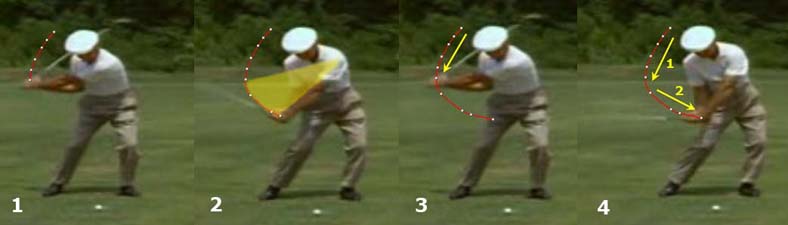  Look at the difference in the amount the knees go forward and the hips as well. http://www.youtube.com/watch?v=rIBHnO6nSq4 http://www.youtube.com/watch?v=jJJQ5Z2be8w In some swings the left knee does get outside of the left ankle . . . In all swings generally there is some straightening of the right knee and flexing of the left even when the knee action is double anchor. So the question becomes what knee action is best for my pattern? Knee action is a big piece in controlling the tilt of the hips and in turn controling the plane of the shoulder turn . . . in both directions. You note the different knee action of Snead and Hogan thru the ball. Sneads left knee gets straighter faster and thus his hips don't go as far forward with the hips as Hogan. The amount of rotation in the hips and shoulders are going to differ as well and thus they have different hand paths as a result.   |
Quote:
|
Quote:
But what if.......we viewed the Pivot (Zone 1 power) as being comprised of a top section, the Pivot Center and a bottom section , the Hips. Now the Pivot Center stays centered of course and the Hips if you so choose can Tilt the Axis with a Hula , Hula flexibility and move to and fro laterally. In this manner the legs could be said to have the singular purpose of steadying the Pivot Center , their movement being supportive, foundational, anchor like as opposed to powerful. As if they balanced or offset the cantilever like motion of the hips. In this way, rare though it is, a flat turn of the hips in the backswing would create Right Anchor and a more tilted turn of the hips in Finish would create a straightening left leg. I bet the legs would still look pretty dynamic this way, powerless though they would be. Hands to Pivot, Pivot to Legs if you will. Hope we are in the Lab right now. This is what I am incubating right now anyways, having been a knee driver for 30 some odd years. |
MikeO and O.B. Left & Bucket, I think that the questions that
you are offering are the explanaitions that the instructor should be giving to the student. They would certainly help the student unstand what he is trying to do. Seems that the instructor wants to improve the pivot but the why and how to seem vague. Thanks, I will pass it along. |
Quote:
Hope it helps Okie If you are interested Knudson had a couple of other foot related, pivot insights. He really believed strongly in what we would term the three Stations: Address, Top , Finish. When playing for score he said he only thought of attaining a balanced finish, which for him had the left foot flat and the body in perfect balance, facing the hole exactly (he believed the ball went where his core pointed). Here is the trick, to attain his Finish he would get a student to pose at Finish to determine how comfortable it was all the while adjusting the splay of the left foot. All of our feet are splayed differently and so he reasoned that we all need our own particular amount of left foot splay at address. Just enough to let us get a comfortable Finish. Any less and our bodies wont want us or let us get there without some compensation.....saggy knee, spin out etc etc. The other main one was to drag the right foot slightly towards the left through the shot. Its ensures getting left as you cant drag it if it is weighted. The amount of drag being flexibility dependent. By dragging the right foot the aging, inflexible golfer can have the Finish of young man. I dont know whether he sought Hogans advice on these things or not. He didnt say. But Hogan did do a little right foot drag himself. George's was very pronounced in later years. Its sounds weird at first but try it and see if it gets you left and firms up your left side automatically. It does for me anyways. So load up a flat foot or see something else further up the chain react in compensation. The central command center doesnt want to load an unstable base. Trying to fix the saggy knee or whatever is pointless, it only sends the problem somewhere further up the chain. Fix the bottom end of the Machine where it attaches to the ground. Anchor the Machine. |
Quote:
Kevin |
Thanks Kev
For me, with my left foot addressed rather square to the Base Line, I cant hold my Finish for a long time, even if Im just posing, without some stress on my left calf and knee. So my body wont let me do it, risk a knee twist for a real golf shot. It protects me by spinning the left foot and bending the left knee. When I stand normally, my feet are splayed out a fair bit, British Army style. We're all a bit different. Two feet held square to the line is kind of in vogue these days, ok for some maybe but Tiger for one is now a little more splayed with the left according to Golf Digest. I like the Knudson deal for determining how much you should do it. The right foot I guess would be the same deal but with different objectives, intentions. I like Mikes "to what end" observation above. |
Quote:
Kevin |
Kevin, how about an explanation of the goal post drill. You showed it to me, would be nice to have a written explanation as it can really help the underplaners.
|
I was wondering about that too. Im thinking maybe a double Chief Dan George "how" and some pivoting but might be wrong. "Come out of the pro shop with your hands in the air at shoulder height". Is that it?
|
Wwyd
OB is close! :)
This is Lynn's deal, if I goof on the explanation, I hope someone will jump in and correct me. I posted in this thread, because I felt OB's ideas on flaring the left foot were a HUGE help with this drill. It is VERY basic: Simply stand with your hands up, like OB said, and turn left to the target with level shoulders and keeping the goal posts. Feel how your weight shifted to your left foot, and your right foot came up on it's toes with your right knee facing the target? PERFECT finish position, it's that easy. It gets you to finish without thinking about your impact alignments. If you are not very flexible in the hips, a problem of mine, it's very difficult to hold this finish if your lead foot is perpendicular to the target line. Flare the left foot and you can hold the finish much easier. Be careful, for some of us, if the left foot is flared too much, it's difficult to move your right hip out of the way of the power package on the back stroke. You need to find the middle ground where you can both turn on the back stroke, and stick your finish. From Homer Kelley: 12-3-0 MECHANICAL CHECKLIST FOR ALL STROKES This is a Section by Section (Chapter 8 ) checklist to improve the execution of the Stroke and reduce the Twelve Sections to a three station Total Motion (6-P-0). They are: A. The Address (8-0/1/2/3); B. The Top (8-6); C. The Finish (8-12). That is – be prepared as possible before Start Up (3-F-5), as precise as possible through The Top (6-E) and as smooth and complete as possible through Impact to the proper position at The Finish (2-N). See 6-M-0. To the degree that every step is improved, to that degree is the Total Motion improved. - I am simply trying to regurgitate the teaching of the MASTER YODA. Please correct me if I have posted any incorrect information. Whenever I teach now, it's WWYD, what would Yoda do? When I nail it, my students are very happy! :golfing_banana: Kevin |
1 Attachment(s)
Im going from memory but in the Hogan Mystique coffee table book, didnt Ken Venturi says something about Hogan making a conscious effort to attain a similar look to what Kev is describing with his elbows? Elbows pointing down and a 90 degree elbow bend. Here is Hogan displaying his left side goal post and a comfortable looking finish that he could probably hold for ever. Flat and fanned left foot too. Coincidence?
http://www.lynnblakegolf.com/forum/a...d=125298551 9 |
Quote:
Kevin |
Quote:
Also that goal post deal is a big indicator of what happened thru the ball (unless it's faked at the end). Look at the elbow here . . . down . .  Look at the elbow spread here . . . they spread so the dude doesn't crash the clubhead into the ground because he's disrupted the radius due to throwaway.  If Hogan is goalpost . . . this is foul pole position . . .   Check out Hogan Hinging vs. Vjay Swiveling . . . look at the resultant elbow positions . . . check out where his hands appear in frames 8, 9, 10 and 11 in the sequence vs. the above pic of vjay . . . is it any wonder why Vjay practices so much? Hogan controls the plane and the face . . . the face is not flashing and the the longitudinal center of gravity is laying on the plane the WHOLE WAY THOUGH from delivery to follow thru . . . beautiful. Much of Hogan's motion IMO is how well he moved the club on-plane. Efficency=beauty . . . check how his hand path is matching up down and thru . . . plane shifts are hazardous . . . minimal shifting going on here. Check frame 9 . . . wedge alignments back up and in on plane. The integrity of his Right Forearm Flying Wedge still maintained as the hands disappear thru his body but the clubhead is still out . . . no slingy swiveling thru the ball . . on-plane hinging. This is how a golf club looks being moved down out and forward back up and in on plane . . . awesome. Done with a busted up set of wheels to boot. 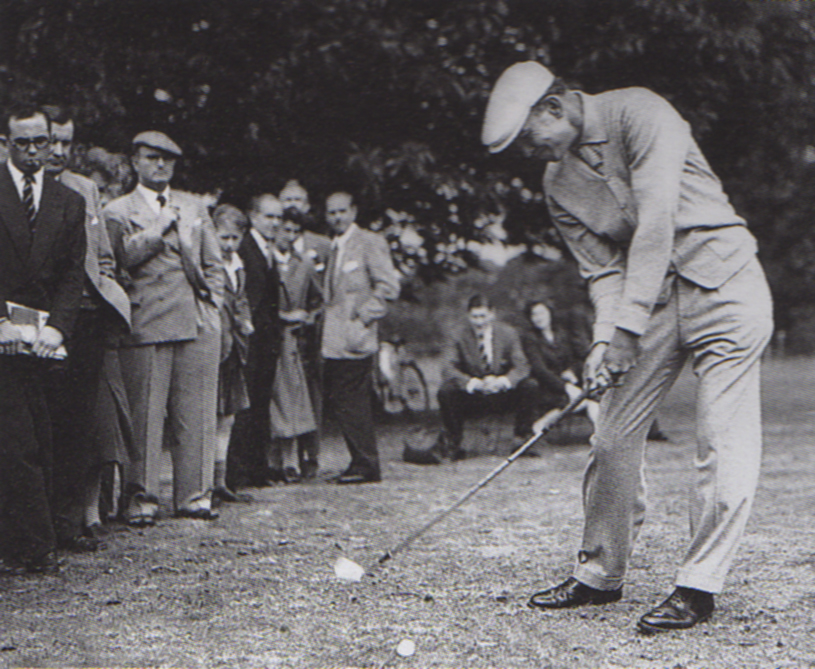  |
Bucket, you are absolutely AMAZING! Thanks for another great post!
Kevin |
Great pictures of Hogan. The key to this drill for me has been the on plane movement of the club from followthrough to finish.
I never focused on this part of the swing before, what a huge difference it makes. |
Quote:
|
Thats great GF but the thanks belongs to George Knudson who's game was in large measure an homage to Mr. Hogan.
Knudson was very Pivot centric, hence the belt buckle facing the hole exactly business. I believe that though he taught Pivot to Hands, his hands in his own swing were "educated", in our terms. I dunno. Either way his insights into the Pivot are truly amazing. Who knows, maybe he had a little help or inside info from his practice partner, Hogan. They'd travel together occasionally. Ive read of them going down to Seminole together in the late winter to ready themselves for Augusta. Who knows? If only George had written a Hogan book. I bet Lorne Rubenstein knows a few stories. He co wrote Knudson's book and was quite close to him, I believe. Here is an excerpt from The Natural Golf Swing, by George Knudson. Some of it will seem familiar to us, some in stark contrast to what we might subscribe to. But an interesting and informative account from a man who was a true seeker, very thoughtful and played with the best. Sadly, he left us far too early. http://www.flipkart.com/natural-golf...ow#previewbook Click on the "look inside the book" . |
Bucket
I love your "Efficiency = beauty", thing. I dont fully understand the strange hold Hogan's motion has over me. Perhaps this is it. With a fair dose of Lag, the secret of golf. Balance too. Heck, the guy had it all. In frame 11 it looks like we see Hogans elbow appearing behind his body. Is that a bit of chicken wing? Like maybe he is playing a little hold off here? What do you think? Im thinking that for a driver say, you'd see his hands before his elbow. Elbow positions revealing release types again? Or should I say "overtaking types"? I dunno. One thing is for sure if it is his elbow, he is doing it intentionally or it is symptomatic of something else he is doing intentionally. |
Ok O.B. Thank you and George Knudson. I still have to give you credit for bringing it to this forum. This website is my only golf resource so if I don't hear it here it doesn't exist. Too much bad info out there in golfdom
|
Quote:
  YAWSEERRZZZZZ . . . . . Look at the exit here . . . .  |
Yowzer
What shot shape do you think David Graham hit on that shot? Push draw? Do you think he was tracing a closed plane line?
|
1 Attachment(s)
Here's a guy with a great swing too, although he was hitting here. The Cuscowilla Hitta. The camera angles are little different so we cant read too much into the comparison, but I'd be happy with either of these actions. Very very happy. Like play every day happy.
Interesting elbow observation Bucket, maybe thats why I tend to the overswivel sometimes? My left elbow is pointed to far down like David Graham. My left goal post is bent. Hmm. http://www.lynnblakegolf.com/forum/a...d=125323045 1 |
Quote:
Look at Hogan beginning in Frame 7 - 12 . . . that is an on plane golf swing . . . look at frame 8 and 9 . . . can you imagine the plane board there . . . note how the right forearm flying wedge is just riding the plane back up and in . . . compare that to D. Graham in frame 4. Look how Hogan's wedge and hands have disappeared around his body on-plane but the club is still out there where you can see the club. Awesome . . . .but look at graham . . . the wedge is done . . . he's showing you the butt cap. Not that that isn't a valid way to swing . . . but he's shifted the plane line out. Notice what the face does and how straight the right arm is and how away from him it is. Graham evidently was a great ball striker . . . but Hogan's action certainly has the mechanical advantage. |
Quote:
|
Quote:
Thanks Brosuph. I've learned something from this. Ive never swung on a plane board. Homer advised that we all should do it and that we'd be surprised by what we discoverd. Ive tried benches, ropes, Explanars but never a full fledged plane board. Maybe Ill hit Home Depot this afternoon for some plastic and some 2x4's. My wife will really be busting my balatas over this one. In my second lesson with Lynn he said "ok show me a little cut shot". Then he said something like "interesting, that was a perfectly straight shot and a nice normal swing" . I used to get lessons from a pro who really wanted to see the hands appearing long before the left elbow from a DTL point of view in Finish. I'm thinking now that this promoted my David Graham type overswivel (and most likely off plane as you mention). That the left elbow ideally supports the on plane motion of the hands, as it does in the backswing. The right elbow opposite the#3pressure point's knuckle or the first joint at Top. If you had an "Up" The LIne point of view of the backswing you'd see the right elbow appear in much the same manner as Hogan and Lynn are displaying, no? Lynns goal posts in their formative stages, mirror images? Wait a minute, do you load the #3 again in Finish? Knuckle or joint depending on whether you eat corn dogs or not? But with the left elbow supporting, opposing? Never thought about this. My head hurts. |
Quote:
|
1 Attachment(s)
Doctor Bucket.
Here is my specimen for your analysis. You'll notice the ball leaving sharply to the right and low. A flipped, thrown away shank. Me at my worst. I hate these mats. http://www.lynnblakegolf.com/forum/a...d=125338719 9 |
Quote:
|
1 Attachment(s)
Yup that looks steep to me too. It was a wedge though and on a day that I hit shank after shank off of those mats. Didnt do it when I took to the course though. Im wondering if I was subconsciously taking out some of the Down to protect a sore left wrist on those things. They are concrete hard.
Lynn was in Scotland and I sent the film of this session to Luke for some help. We talked over the phone for about a half hour one evening. He recommended a lagging takeaway and some float loading. Crazy stuff from a hitter eh? You cant float and throwaway at the same time, basically. It got me out of my predicament and fast. Luke has one heck of a good eye! Played some good golf the next day. Im still trying to get my impact alignments to where they should be but they're way better than what Im showing in these photos. They were good when I was pure hitting but Im trying to adopt a little more of a rope handle, free flowing less wooden motion although Im still Right Arm Throw. In fact adding some throw out action helped my impact alignments a lot. Im rope handle hitting now I guess. I dunno. PS I have no idea what the heck Ive got in my pockets. Looks like a tribute to Moe Norman or something. Ihttp://www.lynnblakegolf.com/forum/attachment.php?attachmentid=1988&stc=1&d=125341576 5 |
| All times are GMT -4. The time now is 12:18 PM. |