LynnBlakeGolf Forums

LynnBlakeGolf Forums (http://www.lynnblakegolf.com/forum/index.php)
-   The Golfing Machine - Basic (http://www.lynnblakegolf.com/forum/forumdisplay.php?f=16)
-   -   Homer's Way (http://www.lynnblakegolf.com/forum/showthread.php?t=6836)

joe curtis 07-27-2009 02:43 PM

Homer's Way
 
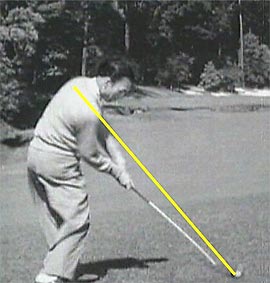
Homer selected to use a Zero Shift on the Turned Shoulder Plane.

First, why did he choose to do this? and Second:

Why in recent times do TGM trained instructors not select to teach and utilize this procedure more often? Usually we see most people with some shift, but why not work a student more towards a zero shift on the turned shoulder?

Daryl 07-27-2009 03:43 PM

Quote:

Originally Posted by joe curtis (Post 66256)
Homer selected to use a Zero Shift on the Turned Shoulder Plane.

Where does he say this?

joe curtis 07-28-2009 01:11 PM

it is the way he played.golf. he did not state how he played in the book.

Daryl 07-28-2009 02:38 PM

Quote:

Originally Posted by joe curtis (Post 66285)
it is the way he played.golf. he did not state how he played in the book.

Oh, sorry. I never saw him play.

Daryl 07-28-2009 06:37 PM

Quote:

Originally Posted by joe curtis (Post 66256)
Homer selected to use a Zero Shift on the Turned Shoulder Plane.

First, why did he choose to do this?

I could go on forever, but here are a few thoughts.....There are dozens more.

Because in a Hands Controlled Pivot, the #3 Pressure Point is Aimed Directly at the Ball or Aiming Point. It's a Straight Line Thrust, Un-wavering Lag Pressure, from the Top to Release. It's the Only Way that the #3 Pressure Point can Trace a Straight Plane Line from the Top to the Finish Swivel and direct the Power Package to the perfect Release Point. Because doing so is the Only Way for the Hands to Control what the Pivot should do. The Pivot Can't comply with a Plane Shift: the Pivot will take over the Hands.

If the Hands and Club Shift to a second plane, such as the Elbow Plane, all of the Pressure Points get jumbled up. Meaning that they Radically change Pressures during the Shift. That's a no-no. Get a very Tight Grip. That's why you see Golfers like Sergio, at the Top, prepare, by, at Startdown, Drop the Clubshaft to an Elbow Plane Angle BEFORE their hands start Down.

The Rigid Power Package can SERVE only one Plane Angle per Swing. If you Switch Planes then you must use a Non-Rigid Power Package. If you use a Non-Rigid Power Package by letting one or more components race ahead of another, then you will need to spend more money on Golf TIPS Magazines.


Quote:

Originally Posted by joe curtis (Post 66256)
and Second:

Why in recent times do TGM trained instructors not select to teach and utilize this procedure more often? Usually we see most people with some shift, but why not work a student more towards a zero shift on the turned shoulder?

TGM Trained Instructors? :)

"Many are called, but few are chosen."

joe curtis 07-28-2009 09:23 PM

Yea, TGM trained in any sort, associated or non associated with TGM LLC., current AI or not. Ben Doyle is a big one that comes to mind that wants a double shift.

Why not ideally work a player to a zero shift procedure, yet it seems more customary to adjust the pattern in compliance with or around the associated shifts.

"TGM Trained Instructors :)" = why the smiley, leaves for needed explanation and or implication

Daryl 07-28-2009 10:09 PM

Quote:

Originally Posted by joe curtis (Post 66294)
Yea, TGM trained in any sort, associated or non associated with TGM LLC., current AI or not. Ben Doyle is a big one that comes to mind that wants a double shift.

Why not ideally work a player to a zero shift procedure, yet it seems more customary to adjust the pattern in compliance with or around the associated shifts.

"TGM Trained Instructors :)" = why the smiley, leaves for needed explanation and or implication

I agree with ya Joe. Zero Shift minimum at least on the Downstroke.

Professional Athletes spend 10-15 years under excellent guidance and proven methodology before turning Pro. Yet despite the similarities in training programs and coaching, some programs and coaching stand out among the crowd and are more sought out than the others.

On the other hand you have Golf. A new system is invented every year that hits the front cover of golf magazines. What does that tell you about a sport that's been around for 200 years.

The TGM uncompensated stroke pattern is not simple or easy to learn. It's probably the most difficult in Golf. The best instruction and understanding will get ya a 2 Barrel Swing. A 3 Barrel Swing needs more practice and precision. Years.

Who wants to bother with that?

99.9% of all TGM Instructors studied TGM so that they could understand the Methodology. Who said they could teach it? Who said that they understand TGM? The 2 week school that they paid to graduate from? The organization they pay annual dues to stay licensed or members in good standing?

I've only found a few who understand TGM, and I've been studying Twenty-five years. At twenty years I didn't understand anywhere near as much as I understand today. That's just understanding, not application. I still think I only understand half as much as I should about TGM and then there are true students of the Game that know a hundred times more than me that merge TGM with other disciplines and Golf Research.

How much knowledge should you have to teach TGM? I think it needs to be comprehensive. Know it and be able to perform it.

:) I called Ben Doyle about four years ago.
Ben: "how much TGM do you know?".
Me: "a lot".
Ben: "Tell me about 10-19-C?".
Me: "I don't have the book memorized."
Ben: "Then you don't know TGM."

Yoda 07-29-2009 07:49 AM

Ben Bit
 
Quote:

Originally Posted by Daryl (Post 66296)

:) I called Ben Doyle about four years ago.

Ben: "how much TGM do you know?".
Me: "a lot".
Ben: "Tell me about 10-19-C?".
Me: "I don't have the book memorized."
Ben: "Then you don't know TGM."

Priceless.

Thanks, Daryl.

smoke218 07-29-2009 08:25 AM

A soldier's manual is a thick little green bible that explains everything a soldier needs to know to help himself and his brothers in arms during combat. During peace time, the soldier is asked to prepare himself by training and studying the basic skills from within his soldier's manual. The soldier is made to train until he knows his soldier's manual inside and out by hard; and when the soldier does, the soldier is made to train over and over again as the training becomes completely mundane to the soldier. This is how I will learn to know The Golfing Machine.

Yoda 07-29-2009 09:14 AM

In Training Mode
 
Quote:

Originally Posted by smoke218 (Post 66307)

A soldier's manual is a thick little green bible that explains everything a soldier needs to know to help himself and his brothers in arms during combat. During peace time, the soldier is asked to prepare himself by training and studying the basic skills from within his soldier's manual. The soldier is made to train until he knows his soldier's manual inside and out by hard; and when the soldier does, the soldier is made to train over and over again as the training becomes completely mundane to the soldier. This is how I will learn to know The Golfing Machine.

Exactly right, smoke. I remember well the day my own journey began. Little did I know where it would lead!

Below are a couple of threads I started a while back that may help. Please excuse the occasional run-on words that are the product of our search engine (and not the original posts).

http://lynnblakegolf.com/forum/showt...t=memorization.

http://lynnblakegolf.com/forum/showt...t=memorization.

And remember, we here at LBG are with you every step of the way. Good luck!

ronaaronson 07-29-2009 12:58 PM

Why the turned shoulder plane
 
Quote:

Originally Posted by joe curtis (Post 66256)
Homer selected to use ... the Turned Shoulder Plane.
First, why did he choose to do this?

According to 10-13-D, the right shoulder moving towards impact precisely on the preselected downstroke clubshaft plane establishes and supports the power package alignments -- the ideal way for the shoulder to move. But for the shoulder to move down the clubshaft plane during the downswing, it should already be on this plane at the start of the downswing, no? Well, the right shoulder will be on the downswing plane by definition when swinging the club on the turned shoulder plane. Zero Shift + Turned Shoulder Plane = Fewer Complications

O.B.Left 07-29-2009 02:51 PM

Which champion golfers kept the club on the shaft plane for a full swing? That is pretty flat isnt it? I can see it after a shift back to the TSP or for a short shot.

sawblade 07-29-2009 04:58 PM

multi shift
 
Doesn't Mr Garcia shift to the hands plane?

Yoda 07-29-2009 09:42 PM

From The Top
 
Quote:

Originally Posted by sawblade (Post 66328)
Doesn't Mr Garcia shift to the hands plane?

I would say from Turned Shoulder vertically to Elbow Plane.

:golf:

12 piece bucket 08-06-2009 04:22 PM

Quote:

Originally Posted by O.B.Left (Post 66327)
Which champion golfers kept the club on the shaft plane for a full swing? That is pretty flat isnt it? I can see it after a shift back to the TSP or for a short shot.

The shaft plane at address don't mean shhhhhhhhhhh . . . .

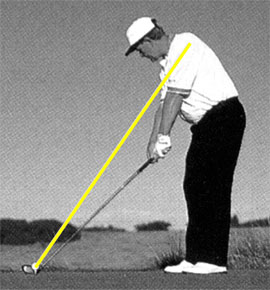
Remember Mr. Kelley said you could clown the backstroke . . . the REAL plane is probably defined at Start Down . . . Then you can figure out what kinda shifting and junk is going on. All this junk about spot lining and crap . . . come on . . . who REALLY gets the face looking right at the target that's 100 plus yards away. Plane Angle shifts are HAZARDOUS and EXTREMELY HAZARDOUS THE CLOSER YOU GET TO PAY DIRT. Mr. Jack Nicklaus didn't match the shaft plane . . .


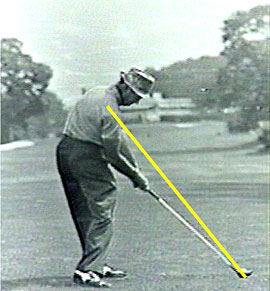
Hogan probably matched the Elbow Plane as good as anybody to ever lace 'em up.


Snead shifted it out and whipped it down to the Elbow Plane


12 piece bucket 08-06-2009 04:46 PM


On Plane? Where?

12 piece bucket 08-06-2009 04:47 PM

Langer On Turned Shoulder Plane?
 

12 piece bucket 08-06-2009 04:57 PM

Nicklaus TSP?
 

Daryl 08-06-2009 08:23 PM

Nicklaus TSP? Elbow-ish; in this photo.

O.B.Left 08-06-2009 11:14 PM

[quote=12 piece bucket;66622]The shaft plane at address don't mean shhhhhhhhhhh . . . .

Plane Angle shifts are HAZARDOUS and EXTREMELY HAZARDOUS THE CLOSER YOU GET TO PAY DIRT. Mr. Jack Nicklaus didn't match the shaft plane . . .
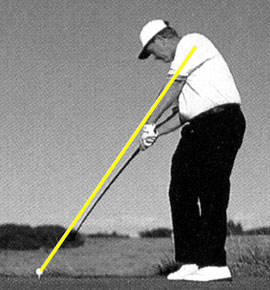


Let me refrase this. Who doesnt shift planes in Total Motion? Im thinking that ideally you start with the right elbow and hands on the shaft plane (what we call the elbow plane) and get back there at impact. The more minimal the shift the more consistent. But I cant think of anyone with zero shift. Moe came close but he had an almost zeroed out #3 angle too. Perhaps this was his secret? Basic and Acquired are a different story, there you can find zero shifts.

Daryl 08-07-2009 02:02 PM

Quote:

Originally Posted by O.B.Left (Post 66636)
Who doesnt shift planes in Total Motion? Im thinking that ideally you start with the right elbow and hands on the shaft plane (what we call the elbow plane) and get back there at impact. The more minimal the shift the more consistent. But I cant think of anyone with zero shift. Moe came close but he had an almost zeroed out #3 angle too. Perhaps this was his secret? Basic and Acquired are a different story, there you can find zero shifts.

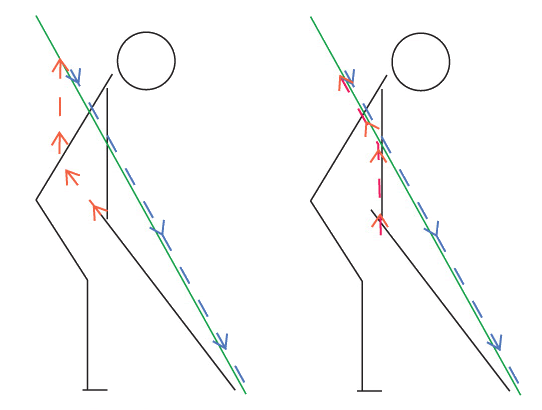
The Drawing on the Left illustrates a Single Shift Procedure. The hands and club travel
up the Elbow Plane and then Shift to a Steeper Plane and continue to the Top of the Backstroke.
From the Top, they Travel a straight Path to the ball.

What would you call the illustration to the Right where Extensor Action and the Checkreign of the Left Arm
raise the Power Package to the Turned Shoulder Plane during the Backstroke, and then from the Top,
the Hands and Club Travel a straight Path to the ball?

Yoda 08-07-2009 10:50 PM

Sweetspot Plane Shifts
 
Quote:

Originally Posted by Daryl (Post 66654)

The Drawing on the Left illustrates a Single Shift Procedure. The hands and club travel
up the Elbow Plane and then Shift to a Steeper Plane and continue to the Top of the Backstroke.
From the Top, they Travel a straight Path to the ball.

What would you call the illustration to the Right where Extensor Action and the Checkreign of the Left Arm
raise the Power Package to the Turned Shoulder Plane during the Backstroke, and then from the Top,
the Hands and Club Travel a straight Path to the ball?


Daryl,

I assume that in your Illustration #1, the Sweetspot executes the Single Shift. And, that it does so via the Right Forearm and its On Plane Execution of the Major Basic Stroke (7-3) and Plane Line Tracing (12-5-3 / #37-#39).

To your question: Does the Sweetspot execute the same Shift in #2? Your directional arrows indicate that is the case. If so, then the golfer has executed the same Single Shift but has varied his procedure.

If not, then what Shift, if any, takes place?

:salut:

Daryl 08-07-2009 11:48 PM

The illustration in my previous post was quickly drawn to illustrate that the Elbow Plane isn't the only
plane available at start-up. Below, more accurately illustrates and describes the purpose of the
Right Forearm Takeaway.
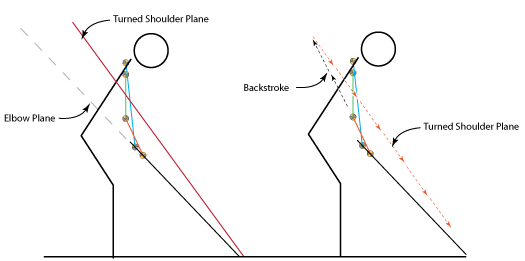


The Right Forearm Takeaway path is illustrated on the right. No shifts. Both, the Backstroke and Downstroke have Straight Line Paths.

The Left Arm Checkreign with Right Forearm Takeaway will FORCE the Forearm and Clubshaft Up the Plane that the Right Forearm defined at Address.

Quote:

7-3 The On Plane Right Forearm shows the precise up-and-down direction it and the Clubshaft must take throughout the Stroke (2-J-3).
The Right Forearm Takeaway will insure a three dimensional Start-up and offers the best chance of achieving a Three Dimensional Impact.
As it goes up, it comes down.

Quote:

2-F But precision is lost unless Start Up is Three Dimensional parallel to the Three Dimensional Impact, i.e. the Clubhead moves Backward, Upward, and Inward – On Plane – INSTANTLY AND SIMULTANEOUSLY. See 3-F-5.

The #3 Pressure Point should Trace the Straight Base Line of the inclined Plane during Start-up.

Quote:

7-23 For a Line “Equivalent”, the Hands from Takeaway to The Top AND BACK AGAIN, sense the Clubshaft as a wheel SPOKE tracing a straight line extension of the selected Delivery Path. So the player envisions – is consciously aware of – a straight line wheel TRACK motion (rather than its rotation) toward and on through the Ball.

The Shoulder Turn Takeaway leads to a Plane Shift.

Quote:

10-6-B TURNED SHOULDER This reference point is primarily the point reached by the Right Shoulder after a Flat Backstroke Shoulder Turn. But any other controlled Shoulder Turn can also provide an acceptable reference point. See 10-13-0. This Plane Angle has far better performance characteristics than any other because any Plane Angle Shift is very hazardous. This procedure does not refer to the disruptive Shoulder Turn Takeaway – which is always too “Flat” and/or too “Low” making a Plane Angle Shift mandatory and usually unintentional and unsuspected. Study 7-3 and 10-24-F.


12 piece bucket 08-08-2009 08:08 AM

So . . . do any of these dudes arrive on the TSP?

Also . . . . look at how Lee Buck matches the shaft lean set at address at impact . . . . reckon he could control his distances any good?

mb6606 08-08-2009 08:14 AM

Quote:

Originally Posted by Daryl (Post 66631)
Nicklaus TSP? Elbow-ish; in this photo.

Pick #13 the club is clearly coming down the TSP???

Daryl 08-08-2009 10:33 AM

Quote:

Originally Posted by 12 piece bucket (Post 66687)
So . . . do any of these dudes arrive on the TSP?

Also . . . . look at how Lee Buck matches the shaft lean set at address at impact . . . . reckon he could control his distances any good?

The Elbow and Turned Shoulder Planes are two different animals. Apples and Oranges.

The Elbow Plane is a fixed Plane. For a Clubshaft to be on an Elbow Plane, it simply points
to where the Right Elbow would touch your Body.

The Turned Shoulder Plane angle can vary from player to player
and club to club. It is defined by the Right Shoulder getting
onto a plane and while Moving Down Plane will Locate the Right
Elbow onto the same plane for Release. If the Clubshaft at
Impact has the same angle as that defined by the shoulder and
Right Elbow, then it and the Hands are on the Turned Shoulder
Plane. The Right Forearm Wedge functions to get the Clubshaft to be at that same angle.

The great thing about the Turned Shoulder Plane is that it not only locates the Right Elbow On Plane,
but it locates the Right Elbow correctly Forward On Plane to the perfect release point. If the Right
Shoulder wasn't directly behind and driving the Right Elbow to that location, you'll need a compensation
to get the Elbow so far forward or use the Elbow Plane and add a compensation.

mb6606 08-08-2009 11:39 AM

Quote:

Originally Posted by Daryl (Post 66694)
The Elbow and Turned Shoulder Planes are two different animals. Apples and Oranges.

The Elbow Plane is a fixed Plane. For a Clubshaft to be on an Elbow Plane, it simply points
to where the Right Elbow would touch your Body.

The Turned Shoulder Plane angle can vary from player to player
and club to club. It is defined by the Right Shoulder getting
onto a plane and while Moving Down Plane will Locate the Right
Elbow onto the same plane for Release. If the Clubshaft at
Impact has the same angle as that defined by the shoulder and
Right Elbow, then it and the Hands are on the Turned Shoulder
Plane. The Right Forearm Wedge functions to get the Clubshaft to be at that same angle.

The great thing about the Turned Shoulder Plane is that it not only locates the Right Elbow On Plane,
but it locates the Right Elbow correctly Forward On Plane to the perfect release point. If the Right
Shoulder wasn't directly behind and driving the Right Elbow to that location, you'll need a compensation
to get the Elbow so far forward or use the Elbow Plane and add a compensation.

Agreed, some players appear to shift to the elbow plane because of the significat head and torso drop (old Tiger swings). I do not consider this to be the elbow plane but might appear to be if one were to draw lines on the screen video. The elbow plane is clearly identified in the book (where the elbow meets the waist).

Daryl 08-08-2009 11:59 AM

Quote:

Originally Posted by mb6606 (Post 66696)
Agreed, some players appear to shift to the elbow plane because of the significat head and torso drop (old Tiger swings). I do not consider this to be the elbow plane but might appear to be if one were to draw lines on the screen video. The elbow plane is clearly identified in the book (where the elbow meets the waist).

Mb,

Agreed.

12 piece bucket 08-08-2009 08:45 PM

I don't know . . . . are there really many players that actually get to Impact on the Turned Shoulder Plane . . . . I mean look at the pics . . . . I know there are plenty that get on it at some point but typically get to the Elbow Plane thru the ball. I mean I could be a doofus about drawing lines and junk. But if you look at Turned Shoulder Plane pics in the book . . . .not many are there at Impact IMO.

Daryl 08-08-2009 09:49 PM

Quote:

Originally Posted by 12 piece bucket (Post 66708)
I don't know . . . . are there really many players that actually get to Impact on the Turned Shoulder Plane . . . . I mean look at the pics . . . . I know there are plenty that get on it at some point but typically get to the Elbow Plane thru the ball. I mean I could be a doofus about drawing lines and junk. But if you look at Turned Shoulder Plane pics in the book . . . .not many are there at Impact IMO.

I agree. It's rare to find a golfer on the Turned Shoulder Plane.


All times are GMT -4. The time now is 10:24 AM.