
|
Master Accumulator Art
This illustration depicts the Swingers Release Sequence and Accumulator Overlap. Notice that the #3 Roll starts and ends within the #2 release travel and that the #2 release travel occurs within the #4 Release travel.
Birds-eye view of Golf Stroke.  |
Field of Dreams
You lost me on the diagrams. Need more lableling I guess. What is that quarter (90 degree) circle at Homeplate? Is that the new Yankee Stadium on the right (more room on the third base side for A-rod's ego)?
|
Quote:
It's "Art". :laughing9 Did Pablo Diego José Francisco de Paula Juan Nepomuceno María de los Remedios Cipriano de la Santísima Trinidad Ruiz y Picasso use labels? This is looking down on the golfer from above. The big black circle is your head. The little one is the Ball. The blue arc is #4 Acc travel. The red arc, #2 and the green arc #3. The dashed line is your head looking at the ball. It's the line of sight to the ball. The Black thin angled line is your left arm and clubshaft at impact. I did this because we're always saying how the accumulators release in order, yet we rarely talk about that they occur within each other. #3 starts after #2 release begins but it is also spent before #2 is spent. #2 release starts after #4 release but it gets spent before #4 gets spent. Did not the Artist capture the reality of its simplicity in merely a few colored lines? :laughing9 This painting sold for 95 million dollars, three years ago. And I used THE SAME COLORS. :laughing9  |
Dipping your bush in the Bucket
Are you sure that is not a 12 Piece Bucket self-portrait?
|
Quote:
|
Daryl - you wrote-: "#3 starts after #2 release begins but it is also spent before #2 is spent. #2 release starts after #4 release but it gets spent before #4 gets spent."
Why do you believe that #3 is spent (completely released) before #2 is spent. What is your definition of a spent #3 and a spent #2? You also state that #2 gets spent before #4 is spent. I thought that #4 is spent at low point. Jeff. |
Quote:
#3 stops swiveling when the Left Wrist is Vertical to the Ground, which is Technically 10-2-B with a Forward Leaning Shaft at Impact (even if the Left Wrist appears to not be Vertical, the Right Wrist is Vertical and Level). Swivel on the Backstroke and on the downstroke you swivel-back-to-the-Hinge. Any further Closing of the Clubface is Hinge Action Pivot Roll (otherwise your divots would look really funny - a straight thin line parallel to the plane line). So the Impact Interval Ends the Acceleration of #3. #2 is Fully Uncocked at "Lowpoint" and the Law of the Flail states that Fully Uncocked is the Point at which #2 begins deceleration. So Lowpoint Ends the Acceleration of #2. When does #4 stop Accelerating? #4 decelerates when the Left Arm stops accelerating away from your chest which is "Both Arms Straight" or further hopefully, if possible. :salut: So, The Acceleration of #3 (Swivel plus residual #2)is in addition to the accelerating #2 and which is in addition to the acceleration #4. And, the acceleration of #4 is what Releases #2. The Release of #2 creates centrifugal force which Releases #3. It's like throwing a ball while running on a moving train. :laughing9 |
Daryl,
Thanks for commenting. I can accept your endpoints for a spent #2 and #3, but not #4. You write-: "When does #4 stop Accelerating? #4 decelerates when the Left Arm stops accelerating away from your chest which is "Both Arms Straight" or further hopefully, if possible." You "seemingly" believe that the left arm is accelerating to the end of the followthrough. I cannot understand that point. In a pivot-driven swing, the inert left arm gets all its swing power from the pivot-drive. In other words, the pivot-drive catapults/blasts the left arm off the chest wall towards impact. I believe that the left arm must start decelerating the further it gets away from the chest wall - because I know of no other force that can keep the left arm accelerating during the late downswing (near-impact) and during the post-impact followthrough phase of the swing. Here is a graph from the TPI researchers showing that the left arm decelerates prior to impact. 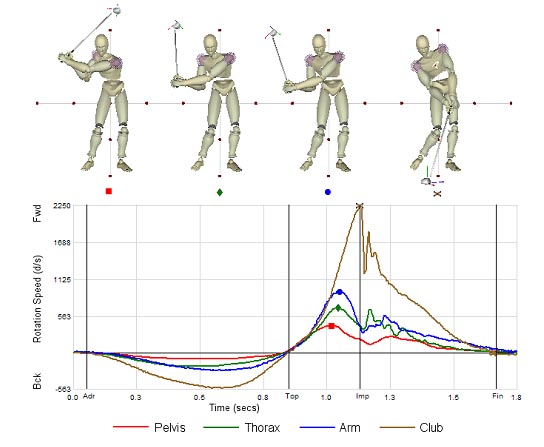 Here is a photo from the Nike commercial swing video of Tiger Woods swing (taken at 4,000 frames/second). 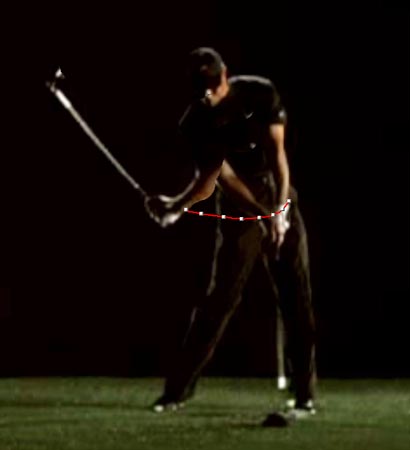 Each white dot (showing the left hand motion) represents 1/400th of a second. The white dots gets closer together just prior to impact - which suggests that the left arm slows down slightly prior to impact. Jeff. |
The TPI researchers show you what most Golfers do. They are measuring Speed, not Acceleration Forces. They don't show you what most golfers should be doing. That's a problem with these researchers. They don't know about the possibilities and the Options. They take measurements and tell you what they are. Those kind of people will tell you to swing harder. They will tell you to over-accelerate and they don't even realize that over-acceleration is the problem. The researchers who supported "The Search for the Perfect Swing" didn't know either. Homer Kelley knew. :)
TPI are like the 'washing machine repairman'. Ask them why it doesn't work, and they reply 'because it's broke'. :laughing9 Jeff, forget about the cameras and pictures for a minute. The Hips are leading and powering the Right Shoulder which pushes the Left Shoulder which pulls the left arm. Pivot Train. The initial Blast off the chest of #4 happens because of Right Shoulder Thrust became less than the Velocity it produced. Over acceleration will blast the arm away from the chest too soon every time. Homer Kelley said "Instant Hip Acceleration", he didn't say 'do it so fast that your left arm blasts off of your chest pre-maturely'. :naughty: Thrust is the "Rate of the Acceleration" not the "Acceleration" (which is the rate of Velocity). SO, the Thrust moving the Left Shoulder dictates the Rate that the Left Arm will accelerate and requires only that the Pivot train keep moving, even without accelerating itself. The hips pull the Shoulders through the Impact Interval and beyond at a steady speed to provide an increase in Mass. The Left Arm may have started at Zero MPH at the Top of the Swing and reached its maximum speed in MPH at or just after impact, but it is still an Accelerating Force that doesn't diminish until the Hips Stop Pulling and Leading the Shoulders. The Clubhead should reach its maximum speed three feet after impact, or at least that’s what you should be trying to do. That's the #4 Accumulator. :salut: If you don't have that, then you're just simply going around in a circle. It's not how fast you move your Hips...it's How Far you Move Them. :happy3: Do the TPI Models look like this guy? :( Your TPI model is using a Hand Throw from the End of the Backstroke (A very Questionable procedure):naughty: . Even the Model has 'stopped the Pivot' to avoid a pulled shot. :confused1 And he's just a simulation. Geez. :laughing9 My guy uses a Shoulder Throw followed by a Wrist Throw. :)  Additionally, Consider this. When a baseball Pitcher throws a pitch,,,,,the ball keeps accelerating because the pitchers rate of acceleration (Mass) at release was increasing. The Ball is slowest MPH when it leaves the Pitchers hand and fastest in MPH when it crosses the plate. Hmm? I wonder what the TPI researchers would say to that?? :laughing9 I bet that they would tell him to 'Back up a Bit'. :laughing9 |
Daryl
We "seemingly" operate in parallel mental universes and we therefore see "reality" very differently. I think that the TPI graph represents an expert golfer who uses a pivot-driven swing action with optimum kinetic sequencing. It is certainly not a hand throw action that starts from the top of the swing. The left arm is moving at the same speed and rate of acceleration as the shoulders (rate of acceleration = slope of the graph) in the early downswing, because the power package remains intact in the early downswing. The left arm only eventually moves faster than the shoulders/hips in the mid-late downswing when the hips/shoulders decelerate due to natural forces - and that represents the release of PA#4. You state-: "Thrust is the "Rate of the Acceleration" not the "Acceleration" (which is the rate of Velocity). I disagree. In my mental universe, "acceleration" is the rate of change of velocity (change in velocity per unit time) and the slope-angle of the TPI graphs reflects the degree of "accleration". The phrase "rate of acceleration" only has meaning to me if the slope of the graph changes significantly in slope-angle during the acceleration phase of the downswing. That shouldn't happen in a good golfer - as reflected by those TPI graphs. You write-: "The hips pull the Shoulders through the Impact Interval and beyond at a steady speed to provide an increase in Mass." Where is your "evidence" that the hips and shoulders are moving at a steady speed through impact? You state a steady speed is required to increase "mass". What "mass"? You write-: "The Clubhead should reach its maximum speed three feet after impact, or at least that’s what you should be trying to do. That's the #4 Accumulator." I disagree. I agree that the clubhead should be reaching its maximum speed at impact (or just after impact) but that is not conceptually equivalent to the release of PA#4. Clubhead speed is dependent on the speed of release of PA#4 and PA#2, and it is also dependent on the principle of COAM. Increasing speed of the clubhead requires energy that is derived from the left upper limb in a swinger's action, and according to the principle of COAM the left arm must slow down when the clubhead speeds up (in the absence of additional energy input in the late downswing). I am not aware of any force that is inputting further energy into the moving left arm/clubshaft unit during the late downswing. Jeff. |
Jeff, I hope this reply finds you well. Obviously, you're confused. Concerning your last paragraph: If the Right Wrist remains Level and Bent throughout the Backstroke and Downstroke and leads the Club into impact, then how does the Uncocking Left Wrist Increase the Speed of the Clubhead greater than that which has already been provided by the Right Forearm? It's not a trick question.
You didn't need to go through all of that research just to find out that most pro's have hands decelerating before impact. You could've just asked me. If you want to use the pro's for research in how to compete on tour, I'm all for it. But if you think that by studying the way the pro's swing that you'll uncover a secret, then good luck and when we meet on the other side, you can tell me all about it. If you want to believe that the only way to swing is by dumping all of the energy on the ball at an impact location then go ahead. Impact is incidental. But explain why some golfers have the club twisted around their bodies at the end of their swing. Is that Fall-out? :laughing9 Quote:
Quote:
Quote:
|
Daryl
You wrote-: "I hope this reply finds you well. Obviously, you're confused. Concerning your last paragraph: If the Right Wrist remains Level and Bent throughout the Backstroke and Downstroke and leads the Club into impact, then how does the Uncocking Left Wrist Increase the Speed of the Clubhead greater than that which has already been provided by the Right Forearm?" I have no idea what you are talking about! In a swinger, the club release phenomenon occurs passively due a centrifugal action (law of the flail - law of the double pendulum swing model). The right forearm does not apply any swing power or actively influence the club release action. You write-: "So Jeff, did he just say to blast the Left Arm off of the Chest at the Beginning of the Downstroke? Where is that? I must be misreading the Downstroke Sequence. I changed the text to red so that it won't take you too long to find it." I never stated that the left arm must be blasted off the chest wall at the beginning of the downswing. I stated that the left arm gets passively blasted off the chest wall when the pivot action subsides and that usually happens in the mid-downswing. Here is a video of Hogan's PA#4 release - note at what point in the downswing Hogan's left arm starts to move away from his chest wall. http://www.youtube.com/watch?v=loJJ0qmDQxY Here is a more precise rendition of the timing of Hogan's PA#4 release. 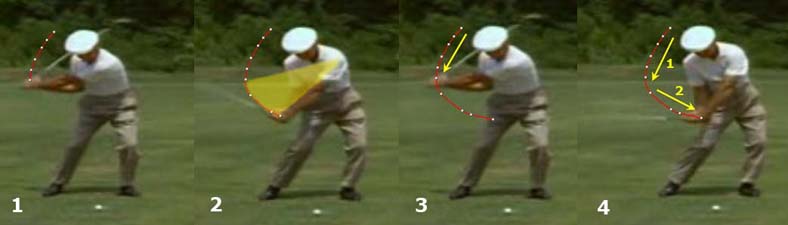 It is my opinion that Hogan's PA#4 is being released in the yellow colored zone (image 2). Jeff. |
Quote:
Quote:
#4 is Body power and as long as the Pivot is leading and pulling the Left arm, then the left arm (body power) is still contributing. If it gets "passively blasted" off the chest wall when the pivot action subsides, then perhaps it wasn't pushed off the Chest but rather it Accelerated away from the Chest as in Momentum Transfer. The pivot is providing centripetal acceleration which induces and sustains that throwout (centrifugal). Quote:
Quote:
My Illustration is correct.:) My ART lives. |
Daryl
You wrote-: "I claim that the #4 Accumulator is still seeking its in-line condition while the #2 Accumulator has already become in-line. And because it's seeking its in-line condition, #4 is still Active after #2 has been spent as long as the Pivot train is still operating." What is your definition of the in-line condition of PA#4? At what point in the swing does PA#4 reach its in-line condition, and where in the TGM book does Homer define that in-line condition? You also wrote-: "Extensor Action should be used to prevent the Left Arm from Releasing too early." Where in the TGM book does Homer state that extensor action should be used to prevent an early release of PA#4. Here is a perfect example of a swinger's action - using PAs 4:2:3 in the optimum sequence. There is no right forerarm action or extensor action in his swing, and he has no problem with releasing PA#4 too early. http://www.youtube.com/watch?v=uUTk7m5PozQ Jeff. |
Quote:
Sometimes you'll see golfers let go of the club with their right hand after impact or unbend or flip with their right hand in an attempt to prevent the right arm from restricting Left Arm Acceleration after both arms straight. |
I found the Quotes:
This is from the 1st Edition Quote:
Quote:
|
Daryl,
How do you interpret the statement "in line with the shoulders"? In a previous thread on PA#4, a number of forum members defined that in-line condition as being met when there is a 90 degree angle between the chest wall and the left arm at the left shoulder area. I have a serious problem with the idea that the pivot is still driving the left arm during the left hip clearing action - when the pivot drive direction is left and inside. I can only perceive a pivot drive being useful from a swing power perspective when the left arm/left hand/club is being driven down-and-out-and-forwards towards the ball. You also wrote-: "Sometimes you'll see golfers let go of the club with their right hand after impact or unbend or flip with their right hand in an attempt to prevent the right arm from restricting Left Arm Acceleration after both arms straight." I think that a swinger may allow the right hand to leave the club, or straighten, post-impact because they have run-out-of-right arm. In the standard followthrough (using a horizontal hinging action), the left hand is moving inside and left very fast immediately post-impact. If the right shoulder has not moved sufficiently far/fast downplane in the late downswing, it may be extremely difficult for the golfer to keep the right wrist bent (and the right palm firmly attached to the grip) all the way to the end of the followthrough (when drag loading) - especially when the club is moving very fast through impact (eg. Driver swings of Phil Mickelson, VJ Singh and Fred Couples). Jeff. |
Quote:
Quote:
Quote:
Have you seen this? http://www.youtube.com/watch?v=QL_6M_xZvq0 |
Daryl,
I cannot locate 10-3-O #25. I note that 12-3-O #25 simply states "extensor action - rhythm". The 6-B-4-O photo looks like the club is at low point, or just beyond low point. I am very familiar with the Hogan video. Jeff. |
Yes Jeff. Rhythm. It only looks simply stated. Look it up.
No Jeff. 90 degrees to the Shoulders. Are your shoulders parallel to the plane-line at impact? You've seen the video? Why don't you see the Pivot swinging his arms - while still at full extension - until the clubshaft is parallel to the ground after follow through. Could the Power of his Pivot (Pivot Power) be continuing to lead and move the shoulders. Body Power? = #4 Accumulator as long as the Left Arm is against the chest. Are you even reading the Book or are you so arrogant to believe that you capture the concepts, fully understand their meaning so comprehensibly that you are able to apply them by only reading them? You know what they call someone who's just graduated medical school? ......They call him "Doctor". Give me a break. You know as well as I, that reading "it", understanding "it", and being able to apply "it" are very different types of knowledge. |
Quote:
|
Quote:
#2 is zeroed out when the wrist has been FULLY UNCOCKED. #3 angle is arrived at when the wrist is in it's LEVEL condition and that angle is strived to be rolled through impact to avoid a plane shift. #4 is fully released when the angle between the left arm and left shoulder is 90 degrees. |
Quote:
That's Picasso's girlfriend. It's a portrait of her in 1941 when the Germans invaded France. Notice the claws on her. Almost a Hundred Million bucks for that painting. |
Quote:
|
Quote:
|
Quote:
|
Quote:
|
Quote:
:notworthy |
| All times are GMT -4. The time now is 01:43 AM. |