
|
Aiming point for a swinger
A hitter aims the thrust somewhere on the planeline but how do we swingers use the aiming point concept?
Thanks |
Aiming Point Technique For Hitters and Swingers
Quote:
Fundamentally, the Hitter's Right Arm Muscle Power supplies an Active Thrust of that Point to Drive the Golf Club via the Left Wristcock. In contrast, the Swinger's Momentum Transfer Centrifugal Power renders the Right Arm Passive (except for Extensor Action and Lag Pressure) and with it, also the #3 Pressure Point as it actuates the Left Wrist Roll. Study 10-11-0-3. Bottom line: The Aiming Point Technique for Hitters involves both Aiming and Thrust of the #3 Lag Pressure Point. For Swingers, it is Aiming only. Study 6-C-2-A. :) |
I think that a swinger can use the aiming point concept to affect the club release point (release of PA#2).
If one aims the hands at a point behind the ball, then it induces a more circular shape to the upper half of the U-shaped hand arc and a sweep release (because the force inducing release is operant at every moment the hands move in a circular arc direction). By contrast, if one aims the hands ahead of the ball it induces a more straight line shape to the the upper half of the U-shaped hand arc and a straight line hand grip pull (in-line with the longitudinal axis of the clubshaft) doesn't induce an early release. However, the hands have to suddenly change direction after the hands reach right thigh level and this induces a late release. I think that this aiming point concept affects the release because the force inducing club release is dependent on i) the degree of change in direction of the hands as they move down the hand arc and ii) the change in hand speed at the exact moment that the hands change their directional movement and thereby the direction of the grip-pulling force. The force inducing a release (which some people label a centrifugal force) will be greatest if the hands suddenly change direction from a straight line path to a circular-shaped hand arc with a small radius and if the hand speed at that exact moment is at its maximal value. Jeff. |
At the Pulley Wheel -- Active or Passive?
Quote:
The Swinger, via the Pivot, pulls the butt end of the Club with the #2 Pressure Point (last three fingers of the left hand) directly toward the Plane Line. The exact point at which the left hand pulls changes every split second due to the circular nature of the Hands' true Delivery Path. This as opposed to the Straight Line Delivery Path of the Thrust (as defined by the #3 Pressure Point - Ball relationship). The Hitter's Active Pressure Point #3 drives the Left Wrist Uncock at the Pulley Wheel Encounter. The Swinger's Passive Pressure Point #2 allows Centrifugal Force to do the same thing. |
Quote:
|
Program It . . . Then Do It
Quote:
Just Pull. That was Homer Kelley's advice to me in January 1982, and it is my advice to you now. Remember, at the Backstroke's End (10-21-C) and with Standard Wrist Action (10-18-A), the Clubhead Lag Pressure Point has now Loaded onto the Top of the Shaft (10-11-0-3 / 10-2-A). It will not revert onto the Back of the Shaft -- if then ( 10-2-B) -- until the last split second of Impact. And by the time you Feel this, the Ball will be many yards down the Fairway. Let Centrifugal Reaction (6-N-0) take care of the rest. Centrifugal Force wants the correct orbiting of the Sweetspot to take place. It wants to align the Club Face, Head and Shaft for Impact. But, we override Nature's Own through our Steering, Quitting, Bobbing and Swaying (the Four Snares 3-F-7-A/D). Train diligently in the Twelve Sections of the Stroke (Chapter Eight and the Mechancial Checklist of All Strokes / 12-3). Do your best to ingrain the precision alignments that exist only in The Golfing Machine. But somewhere in here, folks . . . You've got to "turn it loose and trust it" (1-L). Accept your present level of skill . . . And enjoy the Game. :) |
Quote:
Crystal! Thanks a lot! |
Yoda - you wrote-: "The Swinger, via the Pivot, pulls the butt end of the Club with the #2 Pressure Point (last three fingers of the left hand) directly toward the Plane Line. The exact point at which the left hand pulls changes every split second due to the circular nature of the Hands' true Delivery Path. This as opposed to the Straight Line Delivery Path of the Thrust (as defined by the #3 Pressure Point - Ball relationship)."
You seem to be implying that the hand arc of a swinger will be circular while a hitter's hand arc will not be circular (due to the straight line thrust of PP#3 towards the aiming point). However, it would seem to me that swinger's and hitter's hand arc path will be equally circular if they use the same aiming point - because they are both aiming their PP#3 at the same aiming point. The only difference is the fact that the hitter is driving PP#3 as well as aiming PP#3. However, the straight line driving thrust of PP#3 doesn't make the hands actually move in a straight line direction because the hands are merely the peripheral end of the left arm which is suspended from the left shoulder socket, which means that the left hand must move in a circular manner. However, the actual hand arc path is not perfectly circular because the left shoulder socket is moving in space during the downswing giving the hand arc a more elliptical/U-shaped shape. Here is the hand arc of Sergio Garcia's swing - which I believe is 10-23-B (but can look like 10-23-A from a frontal view) 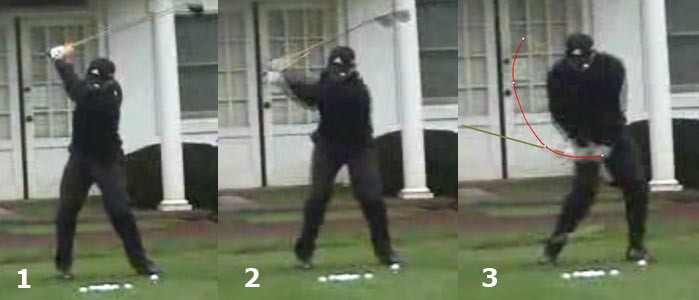 Here is the handarc of my friend Scott who is a hitter.  I think that their handarcs look very similar because they are both being subjected to the straight line aiming point technique. Jeff. |
Elbowing To the Front of Monday's Line
Quote:
Just found this. Accept the gentle bump -- so I won't lose it! -- and I will answer tomorrow! Another great job with the video stills, Jeff. Great stuff! |
Quote:
|
Quote:
|
From Homer's audio tapes:
"The left arm is almost useless except as accumulator #4 in pivot strokes. The release comes as the left arm leaves the chest". What does Homer mean here? Pivot controlled hands strokes? Or simply swinging? All full power strokes use the pivot which would seem to indicate he ws talking about pivot controlled hands. |
Quote:
|
What did Homer mean by "MASTER ACCUMULATOR"?
How does the #4 release? By an active left arm? or the rotation of the right side? In other words is it a left side Frisbee throw or the right side two handed basketball throw (Ben Hogan 5 Lessons)? |
Quote:
The angle formed by the Left Arm and Left Shoulder forms the Forth Power Accumulator. It is not only an independent Power Accumulator, but its Triggering function as the Checkrein of the Right Elbow is also vastly important and it thus can be the Accumulator of the Accumulators – or Master Accumulator. Also see 2-M-4. It's the Master Accumulator in that if it doesn't release (4,1,2,3) then nothing else does . . . If you go to the top and don't release your left arm down your chest then you have to do something weird with your pivot to actually get your hands down to hit the ball. It can cause a bob or it can cause roundhousing. #1 and #4 are connected via the checkrein . . . . so if you hang on to the #4 angle then the right elbow doesn't release either. You can get that whole "navel seeking elbow" deal and lots of other issues as a result. The release of #4 is huge in keeping the club on plane . . . . if you don't release it you have to monkey with the shoulder plane which in turn will throw the hands either under plane or over plane. |
Quote:
I just love it when you do like this......:laughing9 |
Great post Bucket a lot of good info.
How in the heck could VJ Singh practice with the glove under the #4 and still make decent contact? |
Quote:
Please go easy on me, rookie trying to learn. :) Kevin |
Quote:
I think actually that is a kinda misunderstood deal . . . .watch this swing vision . . . there's no question that he's releasing #4 . . . . he releases it as fast as anybody in the game really . . . watch anybody on tour with "high hands" at the top . . . . gotta release #4 fast basically due to the distance they are from the ball comparitively . . . Furyk . . . Sergio . . . really fast. So you can probably stick that glove in there and still move your arm . . . .what you don't want to do is just spin into the glove and "pin" the left arm so it doesn't move. He's just trying to move his arms close to his body. Here's me NOT releasing #4 fast enough . . . . note how much farther my hands are away from me . . . . causes me to have to lose #3 angle through the ball . . . . fleating clubface alignments . . . Result of an improper startdown . . . . shoulders spinning into the arm and throwing it out rather than downplane . . . . so the radius is disrupted. http://www.lynnblakegolf.com/forum/s...ead.php?t=5739 |
One comment on the release of PA#4.
When one thinks of the purpose of releasing PA#4 in a swinger's action, the purpose is to get the left arm moving at a certain speed in the downswing. If the left arm moves at a certain speed, and PA#2 and PA#3 release efficiently then one has a perfect swinger's action from a power perspective. Now, consider the timing of the release of PA#4. If one has an assertive right shoulder thrust turn at the start of the downswing, with a rapid shoulder deceleration pattern, then the left arm will leave the chest wall at an early point in the downswing. That can be seen in that posted video of VJ Singh's swing. By contrast, Hardy OPS golfers are encouraged to turn their torso very aggressively at the start of the downswing and to ABT (always be turning). They therefore do not have the upper torso deceleratory pattern seen in VJ Singh's swing, and therefore their left arm remains in contact with the chest wall for much longer during the downswing. However, they hit the ball very well because their left arm travels at an appropriate speed during the downswing, and they release their PA#2/3 well. Here is link to an excellent Hardy OPS golfer - Jeff Ritter. http://www.youtube.com/watch?v=Pu-wDdY8-g4 Here are series of capture images of his downswing, which demonstrate that his left arm-chest wall angle remains acute until very late in his downswing - due to his very active shoulder rotation. Note where his right shoulder is situated in image 3 and compare it to VJ Singh's swing. There is a huge difference. 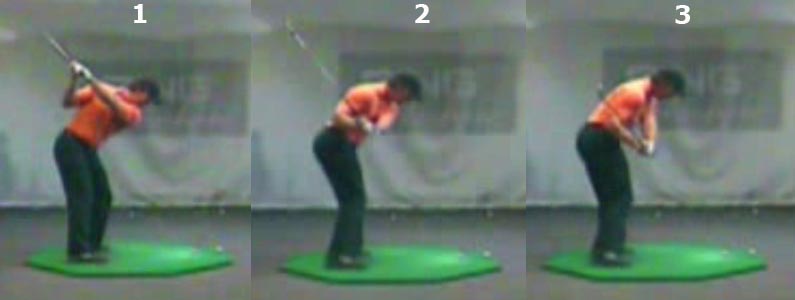 I think that the time point of PA#4 release depends on the pivot motion pattern and different golfers have different PA#4 release patterns (eg. equivalent to a sweep, random, or late release of PA#2). Jeff. |
Quote:
I'd say #4 has more to do with Plane than Pivot . . . both must comply to the selected plane and where the hands are in-space inorder to keep them there. VJ has to cover WAY more distance to keep his hands in enough rather than them flying out over the plane. And there's more "out" in the other dudes deal from the top vs. VJ who has more "down" to cover. |
Release of acc.4 is about left arm above nipple line going to below nipple line rather than keeping something under left armpit.
Look at Hogan (the model for Hardy 1PS as I understand it):  Quite alot of room in between chest and left arm. Seperate issue...no real attempt to threadjack....Looking at Jeff Ritter in photo 3 - he has rotated the clubface off the inclined plane (ie. sweetspot plane seperate from shaft plane ...unlike at top/end) and still appears to have quite alot of wristcock....he has a FLW from top ...and is onplane. Do people think that he is releasing 2+3 simultaneously....releasing 3 before 2....or something else....if he "cupped" his left wrist at top and start down...what would happen?... |
Quote:
|
Quote:
ie. do all back and downswing looks the same until the hinge? (albeit with the hinge mentally programmed before downswing). Is the hinge action "supposed" to be evident in the backstroke?? Back on topic...this is one of KOC's great videos... although it does demo a very special musical taste that he has developed! it also shows a great view of accumulator 4 release and the long journey that the hands take whilst leaving the right shoulder behind....right shoulder continues movement but less that during the initial start down. Seems to have very little overlap between acc 4 release and acc 2 release...no? ( at about 1:01 mins) http://uk.youtube.com/watch?v=Gj_GVe61LZo |
Golfbulldog
You wrote-: "Looking at Jeff Ritter in photo 3 - he has rotated the clubface off the inclined plane (ie. sweetspot plane seperate from shaft plane ...unlike at top/end) and still appears to have quite alot of wristcock....he has a FLW from top ...and is onplane. Do people think that he is releasing 2+3 simultaneously....releasing 3 before 2....or something else." You need to understand the differences between the standard swinger's swing (ala Tiger Woods or Anthony Kim) and the Hardy OPS swing. In the standard swing, there is a takeaway swivel action that gets the club toe to be straight-up at the end of the takeaway. Then there has to a release swivel action to reverse the process. By contrast, a Hardy OPS golfer keeps the clubface facing the ball during the takeaway and there is no start up swivel action. Their clubface is relatively closed to the clubhead arc throughout the swing. Therefore, during the downswing, there is no release swivel action - PA#3 doesn't have to rotate that much into impact because the clubface is closed to the clubhead arc during the downswing. In that sense, they are similar to hitters - who does not incorporate a startup swivel action and release swivel action in their swing pattern. Jeff. |
Quote:
|
Quote:
Pretty much the difference between Single Wrist Action and Standard Wrist Action . . . . Looks like this cat has single wrist action going on all the tops look pretty much the same unless there is some arching or double cocking going on. |
Quote:
But as far as hinging goes . . . the bottom line is the ball starts basically at right angles to the face at separation so if you want to hit a cut that starts left of the target and curves back to it the face has to be looking looking left of the target to get the initial direction right. You can hit cuts or draws with ANY hinge action. |
12PB
I find that 10-18-C description very interesting and very new to me - as it implies that there is horizontal/angled/vertical hinging actions in the backswing. I cannot understand this biomechanical phenomenon. Does HK describe the biomechanics of backswing hinging actions? I can understand the followthrough hinging actions as being due to a variable degree of external humeral rotation happening at left shoulder socket level, and I can conceptualize the biomechanical process. However, what is happening biomechanically if hinging actions are actually occurring during the backswing? Jeff. |
Quote:
Could be wrong about this but . . . . I think Homer's thinking was . . . as she goes back she comes down . .. not sure though. There are plenty of mix and matchers though . . . generally standard wrist action is for the swinger . .. but Nicklaus was as single wrist action swinger I believe. Not sure about the biomechanics of it all . . . . but I prefer more of a "quiet" face . . . . but many times the grip, how the face is set at address/fix and the intended trajectory/shape can dictate the required hand motions. Example . . . .Lee Trevino type set up with the shaft leaning and face looking left would have to get more lean in order to have the face open enough not to hook it between his legs. So lots of it has to do with how you have the face and where you want the ball to start out. Dudes with shutty faces can't do too much standard wrist action . . . or at least ones that you've actually heard of . . . |
Quote:
Homer was always keen on backswing feels mimicking downswing feels...snap load with snap release.... takeaway swivel with release swivel....the same can be done with hinge action it appears - no? In the Cuscowilla homecoming thread several people saw Yoda and Golf Guru do full swing vertical hinged 6/7 iron shots....somebody asked if they did a "reverse roll"/vertical hinge in the backswing (ie. hinge action "prep feel" in the backswing) ....the replies did not apear to deny this action. If, as some of the science TGM investigators appear to be saying now (as I understand it = Dr Zick for TGM ?) Hinge action actually starts to occur on the downswing then it would appear sensible to start prepping that feel on the backswing ( snap with snap etc...) - no? Has anybody got any 3D analysis (with back up trackman data) to show that a swinger with intended dual horizontal hinge has the same downswing as a swinger with dual vertical hinge? As wrist action is intimately connected with pp3 location and loading for swingers....and that is related to aiming point...I hope this is not too much threadjack....sorry!:liar: |
Thanks, Bucket. Looks like you posted an answer whilst I was typing - that telepathy online course you enrolled in seems to be working well!
|
12PB
If there are "true" hinging actions happening in the backswing, then I would like to learn more about the phenomenon. I would particularly like to see visual examples. I am aware that a swinger's action has a release swivel action in the downswing, but I know of no difference in the release swivel action of a swinger who uses horizontal hinging versus angled hinging. If there is a difference, I would like to learn more about this difference. Jeff. |
Hinging
In my studies with Alex Sloan, who was a Homer Kelley purist, hinge action was Impact to Follow Thru. At Cuscowilla I wasn't aware of any other context. Lynn talked about closing the door, rhythm, and pointed out that hinging was arm action not wrist action with the selected hinge pin installed at the shoulder. As a swinger I have no hinge "thoughts" on back swing. Only right forearm takeaway with tracing , drinking a beer to top(lifting left arm) with hands on plane. Downswing hands still on plane, taking loaded no # 2 beyond line of sight of ball and with my strong grip knuckles up. At top Delivery line roll prep occurs. Now I guess that includes the intention of taking out the plane line with karate chop performing the selected hinge action with a geometric right wrist. That hinge is performed to finish off the release. Hopefully the pro's that were there will comment on that 6 iron with vertical hinging. Keep it simple.
|
Quote:
Anyway . . . . I'd say it's more of a wrist action thing than a hinging thing on the backstroke anyway. You can be single wrist action on the backstroke and standard wrist action on the way down. Regardless though if the if the sweetspot and the shaft are in the same plane and "laying on the Plane" they have to eventually come off . . . and then execute the selected hinging (assuming one actually understands and does hinging). But to you point . . . . a "textbook" or chapter 12 pattern swinger that is using Standard Wrist action by definition would have to swivel the wrist to vertical regardless of the desired hinging (angled/horizontal/vertical) to actually put the face on the ball and not the hosel. But as far as that OPD or OPP or whatever deal from Hardy . . . I don't know anything about him or his patterns but seems to me he's simply describing swinging with Single Wrist Action . . . which is valid. Single Wrist Action isn't exclusive to Hitting. But I'd say much of this discussion also is relevant to grip type . . . for example in the 3rd edition Homer has a 10-2-D grip (strong left hand or Turned Left Hand) pattern . .. . the wrist action is "Angled Hinge" . .. . So the stronger the grip GENERALLY the more the face will be looking at the ball on the way back and THROWN at the ball on the way down. |
Quote:
http://www.lynnblakegolf.com/forum/s...ge#po st57070 It may have been a misunderstanding Between Burner and MB... but it looks like Burner confirms a takeaway move which was different to standard....specific to the use of vertical hinge. Yoda or GolfGuru, could you confirm what you did to achieve vertical hinge on 6 and 7 irons please? Thanks! |
| All times are GMT -4. The time now is 08:45 AM. |