
|
Release of power accumulator 3
Here is a series of images showing the release of PA#3 in Tiger Woods swing.
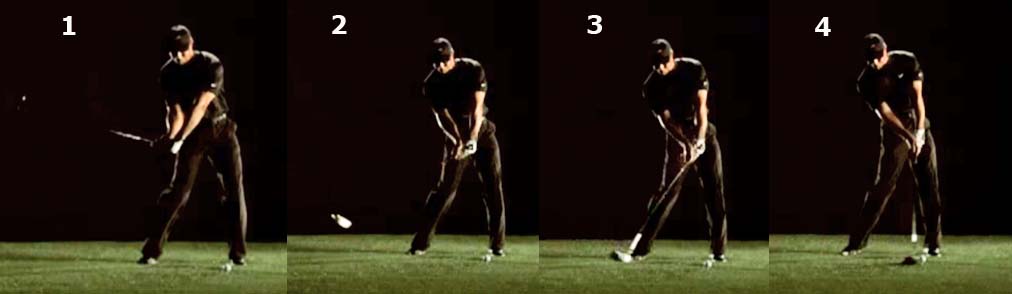 One cans see that both PAs 2 and 3 are releasing. Although PA#2 must sequentially release before PA#3 in a swinger, HK states that they can overlap. What determines the degree of overlap of the release of PA#2 and PA#3? Does the position of the right elbow and the position of the right forearm (degree of passive release of PA#1 at every particular time point in the pre-impact phase of the swing) determine the degree of overlap? Should a golfer consciously control the rate of counterclockwise rotation of the left forearm during the release swivel phase of the swing - so as to affect the rate of release of PA#3? Why did HK refer to PA#3 as the transfer PA? The word transfer implies the transfer of power without any independent production of power. Do you think that in Tiger Woods full driver swing, PA#3 is independently responsible for the production of significant swing power (relative to PA #4 and PA#2)? Jeff. |
Quote:
|
I have another question (which is really a rephrasing of my original question).
I presume that in a swinger's action, that the release swivel action represents the release of PA#3 and that the left hand roll over is due to left forearm rotation. Should a swinger simply allow the left forearm to rotate passively in response to the clubhead's momentum (due to the active release of PA#4 and the passive release of PA#2) or should a swinger actively rotate the left forearm in a counterclockwise manner as the club approaches impact? Jeff |
Please release me, let me go...
Release action can be either Automatic (normally) or Non-Automatic (per pattern)
|
In a sequensed release 3 starts when the left wrist is level.
|
DG
Could you please expand on the topic of non-automatic releases - what optional patterns are there and how are they executed? Thanks. Jeff. |
acsweden
In a sequenced release, you state that PA#3 releases when the left wrist is level (which means that the left wrist is already uncocked - PA#2 fully released). Do you perceive that statement as an imperative or an option? What would prevent a golfer from releasing PA#3 while PA#2 is still being released? Jeff. |
Quote:
|
Quote:
Jeff, The left wrist is fully released when its uncocked wich is not the same thing as level. HK made this statement on one of his tapes. In a sequenced release 2 and 3 still overlap so 3 starts before 2 is fully uncocked/released - when its level. If 3 starts to early the club and left arm would lose its in-lined condition and you would get an off plane downstroke. |
Quote:
So pre-release - left wrist cocked / right wrist level /right elbow bent during acc#2 release - left wrist uncocks/ right stays bent / therefore right elbow must straighten. IN THEORY - (maybe in reality - I am not sure whether this is real world or just a wonderful "seems as if" - either way it works) the left wrist uncocks to level and then acc#3 releases which requires some straightening of the right elbow - I guess that in swinger it is due to CF force rather than muscle power. I am not sure that anyone has really got this release thing sorted out in reality but Homer did seem to have wonderful idea of uncocking on plane and rolling on plane in CAPS and italics in mechanical checklist. That is the way to achieve the right kind of release IMO. What actually happens in the real world is a matter for 3 D analysis machines etc... but the way to achieve an on plane release is through the uncock and roll on plane concept. That requires pp sensation driven swing - hands' sensations controlling the pivot. |
acsweden
You state that-: "The left wrist is fully released when its uncocked which is not the same thing as level." I don't understand this point. Are you stating that the endpoint of PA#2 release is a fully uncocked left wrist rather than uncocking to a level left wrist position? It is my understanding that the left wrist at impact should be level - if correct, are you implying that PA#2 has not completely released by impact? Jeff. |
Bucket,
Bulldog posted #500- check it out- I definitely think he's ready- send the jacket in the overnight mail! Better start the paperwork early- this could be a serious case. Oh, by the way, can you go up to floor five, the east wing, they are complaining up there that Jeff won't stop walking the halls and talking to himself! No one is sleeping and it's getting serious. Then come to my office - we've got some potential serious legal issues with you and some of the nurses. |
Quote:
Thanks for keeping tally . I have been hibernating (deep incubation state) for a while now and the drugs have worn off . Time to next 500 posts will be much faster now! Remeber - Straight-jackets do not stop those who type with their toes from posting - unless it is the full-length version with individual toe restraints...that would probably be a problem....:eyes: |
Wrist uncocking
Jeff my problem before seeing Lynn was "holding on", as Ben Doyle said "avoiding the motion". I stopped uncocking when the wrist was level. This was aiding by the release of accum #3 too soon which decreased club head speed. Video showed just a slight flip after impact. Lynn uncocking the left wrist by throwing the club directly down into the ground really registerd. Translating that to the inclined plane gave me more distance. Now I work on uncocking beyond line of sight, rolling on the plane line to both arms straight. I make sure my THRUST continues to be down after impact to both arms straight. Impact swivel seems to be automatic. So all is left is to work on hinging. The early initiation of accumulator 3 seems to take away the down from the stroke. The downward thrust after impact seem to me to be more related to completely uncocking.
|
Kettle, or the pot?
[quote=golfbulldog;57638]Thanks for keeping tally . I have been hibernating (deep incubation state) for a while now and the drugs have worn off . Time to next 500 posts will be much faster now!
Personally I think it is silly to make a fuss about a mere 500 posts...but congrats anyway! |
Dr. D on #3
Quote:
No wonder you hit it so far :) |
Not far enough
I never realized till now that post impact was so important. My failure to release properly has resulted in stiffness and tightness on my right side(I'm left handed). So to finish better and easier I am working on stretching to finish doing stuff to release my right lateral band and other fascias that are holding me back. In a recent clinic at my course Gary Player stressed the importance of the FINISH.! It was his number one thing. Therefore what happens after impact is quite important. So I'm working on impact to follow thru(Acquired motion drill) and total motion trying to "catch the dog by the tail" as I get to finish. Most of my dogs run away. Then all you can do is yell at the ball. Since I'm told balls are female I have a chance - I am a retired gyn and made a career of talking to em.
|
Quote:
2 is released when its uncocked. I would say it would be fully released after lowpoint before follow through. |
Inent
Quote:
I'm discovering post-impact swing thoughts (that I had never considered) which are helping me with attaining good pre-impact alignments. CG |
Quote:
|
What position is the left wrist in at impact fix? Level??
What position should it be in at impact?? Level or fully uncocked?? |
OB left
On re-reading the TGM, I agree that the endpoint of PA#2 release is the fully uncocked position which occurs at the end of the followthrough. The same applies to PA#1 and #3. However, I am not sure about #4. The TGM states that the endpoint for PA#4 release is an inline condition with the shoulders - whatever that means. Jeff. |
Hey Jeff
In line, in a power accumulator sense can mean different things. In the case of #4, Im guessing at 90 degrees roughly. O.B. |
Quote:
Level for both. |
A Folow Up on Follow through
Quote:
|
| All times are GMT -4. The time now is 08:33 AM. |