
|
TGM and OTHER
First up,I am totally TGM,make no mistake,my question is what do "other" golf teaching systems have that make their followers not want to embrace TGM.I mean,FLW ,lag,extensor action etc,etc.What other teaching principles do they employ that are so different to homers teachings.Thanks in advance
|
Quote:
BTW- On Kuykendall's site where is bashes Homer, he lifted copyrighted images and diagrams from a physics book that I have in my library- It is a High School Physics book that non-college prep students learn from. Not exactly the stuff a self proclaimed genius would steal from. I got mine from a garage sale of an old science teacher in the neighborhood. |
Many of the concepts Homer developed like Extensor Action, Flying Wedges, to name two, don't even exist in the outside golf world. Like a fish claiming jet aircraft can't fly- they aren't aware of flight. The outside Golfworld can't dispute something that doesn't exist in their kingdom. Most of the bashing comes from chalkboard amateur non-golfer physicists claiming Chapter two is wrong because it doesn't fit into Quantum Physics. Homer didn't write a golf swing science book- Homer wanted to improve golfers not write the end all to end all science golf books. Simple Newtonian laws of motion that exist even today in the new Quantum physics era post Einstein.
|
Quote:
Mike, here's a little something you might enjoy. :eyes: http://www.kuysg.com/ |
Can't we limit our bashing to golf systems and not to golf professionals. Better yet why not discuss the pros and cons of TGM versus other methods in an intellectual manner and not bash at all:)
|
Quote:
Its hard to separate Kuykendall from his system. He is one of the original Kelley attackers since the internet became popular. To avoid his barbs without defense would be ludicrous. We all know the merits of TGM and the joy Homer Kelley had in sharing it. It is about 180 degrees from what Jack is all about. This is not a bash- just an HONEST assessment of what I know about him from former students, his web site, and my email conversation with him. |
golf system
Quote:
|
If any Admin wants to remove my posts please do- I did not post a single false word about Jack or his past history toward TGM. It sometimes pays to know the whole story. TGM was and still is "controversial" because of bashers like Jack keeping misconceptions alive. Sorry I upset everyone with some truth.
|
fine by me
Quote:
|
Quote:
|
Are you kidding me?
That's a joke, isn't it!??:laughing9
|
Quote:
|
Quote:
http://www.youtube.com/watch?v=X9v53zFP2fE lots of instuctors claim their method is based on the swing of the above but simply they are light years away most of the answers are in the yellow book |
A Method to the Madness
Many instructors teach a method "the way", which can have success with a student if the student fits their model. The problem with methods is that they are often incomplete and quite often based on subjective interpretations.
TGM informs and explains a flexible "feel" system based on geometry (alignments) and Physics (power) that can be adjust to the individual's needs. A complete flexible system that incorporates ALL successful methods. |
moe norman
Keeping in mind that I am true TGM believer ,I am always open to improvement and different ways to achieving the improvements.Now Im just a hacker in so much as I will never be a pro, just a joe blow who enjoys his golf so I can go out and try different things and it wont be the end of the world if it fails,I just love seeing the ball rocket off the clubface and actually going where I aimed.
Getting to the point of my post,I had a delve into the MOE NORMAN one plane swing,I couldnt believe the resulting ball flight and consistancy of the strike,on looking closer at the alighnments they are very similar to homers teachings,ON PLANE..LEVER ALIGHNMENTS,footwork is very different but in saying that,I found that my body isnt all over the shop,hence my ability to make better ball contact. I am looking forward to any and all comments on this swing method.Thanks TERRY |
Quote:
Moe and many instructors say the left arm is one plane when it is the right arm- the right forearm horizontal plane that is on plane into impact. Natural golf instruction, which I feel is not Moe's Swing at all, say the hips need to be square at impact when Moe's hips begin and are opening before impact. Again we benefit from studying Homer Kelley via Lynn Blake. Natural golf instructors tell you that address and impact are the same-- that is why a single axis/single plane of the shaft is important. But we know that address and Impact are very different and this is why a single plane/axis is not the objective. As I said Moe is well respected by LBG- we just have a Homer Kelley eye on his golf stroke that doesn't always match the common thought of what he did. And when you see his swing through the eyes of Homer Kelley- it becomes a thing of beauty- a machine based stroke for sure. |
Quote:
|
moe
Pistol,Im no expert but I can tell you that in my efforts to reproduce Moe,s swing that any success I have is due to ..1..H/hinging...2...hitting...the latter being a contradiction in somuchas hitter uses angle hinging as we know.It may be in the hand action in follow through causing conflict of hinging...Terry
|
Quote:
Moe had little or no acc3 or acc2 due to his palm grip. He seem to have one very long primary Lever (which lead to the idea the left was on plane- a vertical plane but not the incline plane) so Swinging is out. RASer or Hitter, doesn't matter trying to put him in a Kelley pigeon hole- he was one of a kind. Off to soccer with the son |
Quote:
|
Quote:
|
ball position
I han,nt really had the time yet to really get into this as yet(ball pos),but it is a bit disconcerting,ie,opposite the outside of L/shoulder but I can still hit the ball pretty good,It would have to mean that Im hitting the ball on the upswing,the hand action is vital here as the c/face is definitly rotating and up and in,I like to hear what the brains trust have to say hear,one thing I do know for sure that if the hands do not roll in accordance with Mr Kelly,s teachings and they flip,you will definitly cold top it....Terry
|
Quote:
A swinger with a ball position up in the stance (but not as far as yours :) ) will produce a draw since the face is closing. A Hitter with the same ball position will hit a fade because his face is (very) angled to the right and laid back - so ball postion matters. |
ball position
Yes I do agree completly,it is apparently is the recommended position for the driver leastways,didnt say I liked it ,in fact feels odd,also I definitly using h/pattern with h/hinging,if I tried with a/hinge ,one call only imagine the slice.There has to be rhime and reason to Moes hand technique that is incorporated in the swing,maybe its also something to do with his both feet NOT moving at all until well after the ball is gone,I believe we will soon get to the bottom of this yet.Thanks..TERRY
|
Quote:
Patrick |
I have taken a look at several alternatives to TGM the last 9 months or so. Some of the more interesting alternative seem to be heavily influenced by HK. His legacy is secured as far as I can see.
LBG have a TGM cousin over at Advanced Ball Striking, mr John Erickson. He was originally a student of Ben Doyle, and basically was breeded into a swinging TGM pattern. In the middle of his professional carreer, he concluded that the stroke pattern he had grown up with didn't hold up under pressure and converted to what he calls Pivot Driven Hitting. Per description it is quite different from the hitting protocol that is so often discussed here, but apart from a few specialities that he has implemented (such as using clubs with very flat lies) I am not quite sure what the real differences is when we get past the semantics. I think there is a different understanding of the pivot and Accumulator #4. But on the other hand, Lynn Blake's hitting pattern looks very pivot driven as well. It takes a pretty good eye to see the difference when Lynn Blake hits or swings. He has a beautiful pivot motion with both stroke patterns. Then there is a bunch of Ben Hogan followers. I wouldn't excactly call it a teaching school, because it is probably mostly for the enthusiasts. But nevertheless, there is a very active subforum dedicated to exploring BH's swing over at Golfwrx.com. A lot of very knowledgeable people there too, and some of them also know their TGM. Then you have MORAD, which is Mac O'Grady's project. I don't know much about the swing, but he was a HK disciple and while he eventually concluded that TGM had serious shortcomings, he still seems to attribute at least 75% of his approach to HK and TGM. What's perhaps more interesting on the big scene is that the current big hit - the Stack & Tilt - was developed from guys that came from MORAD and was heavily influenced by TGM. I am reading the S&T book these days. It is a pretty simple motion, and what they write is very goal oriented and relevant. Everyone who struggles with a slice and with inconsistent ball contact should read it. As I said, heavily influenced by TGM, but the style and purpose is totally different. HK tried to make a general theory of ball striking. These guys have done the opposite; Deliberately emphasizing a stroke pattern and components that (hopefully) cures the slice and produces solid ball contact time and again. A very different approach that I find very interesting and refreshing - and also very complimentary to TGM is the works of mr Kelvin Myiahira. He is a speed trainer that has become very occupied with golf lately. His work seems to be only moderately influenced by the golfing literature. I can't see that what he teaches is much in conflict with TGM, but he is emphasizing different aspects of the golf stroke. If you wander what happens between the hips and the shoulders you might find spending a couple of hours reading his blog worthwhile. http://www.aroundhawaii.com/speed_training.html There are of course a lot of other teaching approaches out there too, but most of them are very hands-on, lacks a systematic approach, leaves a lot to the teacher and can't really be regardet as a school. |
I'm convinced that Golf Stroke Mechanics be directed at controlling the Line of Compression. That's the beginning of Ball Control.
Quote:
|
Quote:
|
Quote:
2-D-0 DIRECTIONAL FACTORS Quote:
|
Quote:
|
I maybe should have asked : "In which direction does the Line of Compression point at Impact, assuming total compression as in Horizontal Hinging". But I didnt.
The answer is not what most golfers would be inclined to think. Dave Pelz for instance or Johnny Miller too perhaps given a comment I heard him make in regard to Dustin Johnson's swing and the need to hold the clubface square to the target for "five inches" at the bottom of the arc. "Five inches"? "How bout 4.5 or 2.75", said Lynn when I told about this comment. For Homer's thoughts on the importance of the Line of Compression see 2-0 "........The Principle of Golf is the "Line of Compression". The Mechanics of Golf is the production and manipulation of the "Line of Compression". The Secret of Golf is sustaining the "Line of Compression". Precision is recognizing and reconciling minute differentiations." Got to get me some of that Line of Compression!!! Holding the clubface square to the target throughout the impact interval,type 1 Steering, would see the ball slide on the face. For total compression the point of contact between ball and clubface needs to remain intact "as if welded together". But the clubhead and therefore this point of contact are traveling Down and Out (assuming there is no type 2 or 3 Steering). And so the ball must be captured , cradled by a closing clubface. No more , no less amount of closing than that of Horizontal or the ball will slide , wobble. Angled is in the process of closing too after all. Though you can compensate for its associated ball slide by closing the face. So given Horizontal Hinging and assuming the Line of Compression and the Clubface are pointed straight at the Target at the moment of Separation, at the moment of Impact the Line of Compression, the "bullet hole through the baseball" ......... points Down and to the right. Hogan's "inside aft" of the ball. The face is pointed right as well, briefly. I personally imagine it to be a long spike or nail driven through a golf ball. It points down into the ground and to the right, my clubhead is the hammer. One visualization as the cure for the three types of Steering. |
Angle of Approach.
|
Quote:
But at separation the club face and the ball has rotated a few degrees. And hopefully both of them point in the direction where you want to start the ball. So then it will be down and forward. The down part will lead to compression leak. Too steep impact can literally be a slice even though the ball takes a draw pattern. If we could dismiss the physical side of things (or biokinetics or whatever) - a flat path through the ball would be best. I believe shallow through the ball is a good thing if it is produced the right way. |
Quote:
Yes, to the right and down at the moment of Impact only. At separation both the clubface and the Line of Compression have rotated towards the target in the ideal. But, the point being that this is not what most people attempt to do. Its counter intuitive. "Golf's problem" as Lynn refers to it. Their intention is to hit the back of the ball with a clubface that stays square to the target and if they succeed they get what that impact geometry naturally produces ..........a cut shot in Homers terms. See 2-C-2. Type one Steering. Vertical Hinging. Very useful when you need it. If they also manage to somehow succeed in leveling out the Angle of Attack , removing the Down and also the Out they have added the other two forms of Steering and in the process lost two of the Three Dimensions of Three Dimensional Impact. (Down and Out). This will produce what Homer termed the Lob Shot , maximum compression leakage. 2-C-3. A great shot to have in the arsenal but not something you want off the tee normally, what Homer referred to as the "Duffers nothing ball". This counter intuitive impact geometry is a product of the tools we use to strike the ball. The golf club with its hooked face and lie angle swung in a circular manner. It requires Horizontal Hinge Action to capture the ball so it doesnt slide off the face, or a slightly closed clubface for Angled Hinging as a compensation. We can generate a lot of speed with a golf club hence its usefulness but once gripped and employed we are subject to the associated geometry. And subject to what Homer named "the three all encompassing Primary Concepts upon which all detail can easily be attached as they surface------they are the Hinge Action (2-G) of an Angular Motion (2-K) operating on an Inclined Plane (2-F). If on the other hand if we had chosen a pool cue to strike the golf ball in a pool like manner.............then we'd have a different set of rules governing the impact geometry. It'd be way easier, more intuitive ..... but the ball wouldnt go as far. Anyone notice K.J. Choi putting side saddle at the Open, Snead style? Never thought Id see that again. You could argue that its a useful form of type one Steering. Although its still Vertical Hinging which will produce Lay back with no closing and all that implies to the balls reaction. Now if he didnt lock his upper hand against his chest but pushed the hole club forward .........it'd be an inconsistent motion to make maybe but then he'd have no layback and no closing and no Out or Down. He'd have stepped around Homers three guiding Primary Concepts. It'd be awkward though. As an aside when I watched him on the practice green at St Andrews he was really struggling with it. |
Quote:
Hey D do you have 2-C-1 #3 blown up and mounted on the wall in your basement? Did you ever notice how at Impact the line representing CF, RD, LOC etc is not quite on top of the Angle of Approach Line or at right angles to the face? What up with that? It's close but not quite . The RD etc is supposed to be at right angles to the face no? Im 6th edition , maybe they cleaned that up in the 7th. I dunno. |
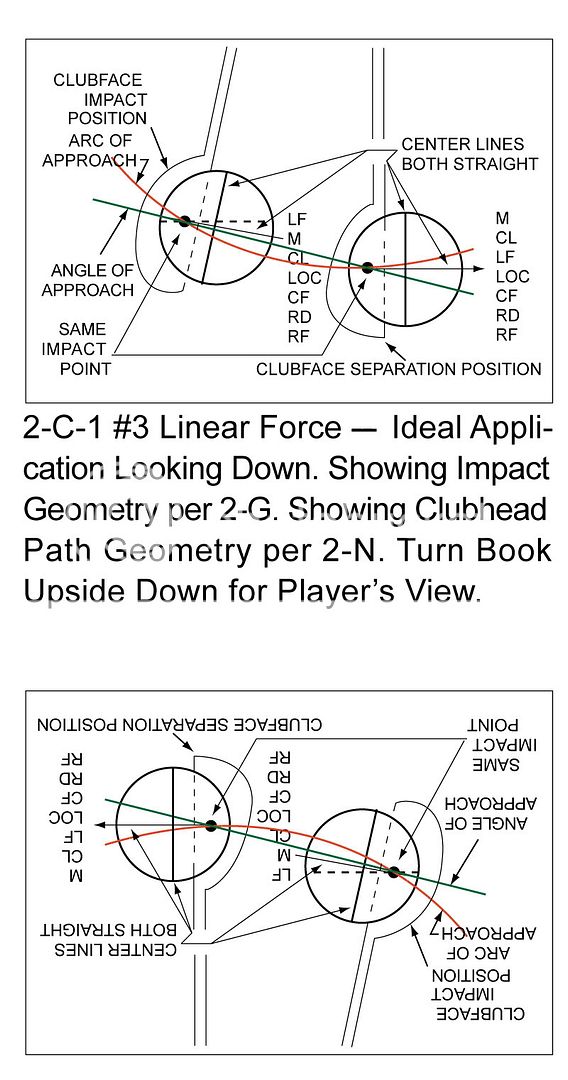 |
Yes , thats the one, thanks. You see how the "center lines in the first drawing at Impact are not at 90 degrees to each other but then they are at Separation.
This isnt exactly the same as in my 6th but its very similar. Is that an error? |
Diagrams are from the 7th Edition page 17. It's the same in the 6th edition except that the 6th edition has an arrowhead on one of the center lines at impact.
|
| All times are GMT -4. The time now is 01:43 AM. |