
|
Plane of left wrist cock and left arm
 Downswing, assuming straight square-square plane line (mid iron so not unreasonable). The left arm is not in the same plane as the sweetspot and left wrist uncock. So when Homer says "delivery line prep...delivery line uncocking prep...delivery line ROLL prep..." etc.. That means that the left wrist needs to be bent or cupped if there is to be no rolling of the sweetspot off the plane prior to a sequenced release for swinger...if the left wrist uncocks on the square-square plane line.... That is my interpretation of Matthew's video posts last month.... maybe i got some of it wrong... If left wrist uncocks on the plane line that the left arm is moving on at this time (in photo) then it will uncock on a 10-5-E type angle...? anybody agree?...it is just that that thought might give one a downswing plane something like ...  in Modern Fundamentals... Any comments or thoughts? Thanks...I am sure to this topic than we got out of the thread last month. |
Look at the overhead shot of Jack at about 0:42...
http://www.youtube.com/watch?v=aJ87eGG0svo Does the the left arm reach parallel to the square-square plane line at the end of pivot transport(ie. before acc 4 releases)...acc 4 releases "on plane"...and the left wrist uncocks when the shaft is parallel to the plane line...and hence can allow a true flat left wrist to uncock on the plane line without a need for cupping of the left wrist?? At 0:42....the clubshaft can not uncock on the straight plane line....the left wrist is flat or even arched...does Jack have to hold/delay the left wrist uncock until the shaft is parallel with the square-square plane line? Sorry if abit rambling...tired...if bored can see what Jack has to say in this clip about ball position and check out the thread I started in "basic" section. |
Nice questions...
10.5.E .. will result in a more armish release because the arm will release to the right or to the target ... a more high push trajectory. like trevino. norman. fred couples. We have a choice to do open.square .close plane relationships and they will yield different playing characteristic and trajectories.. this for at least what i am told.. Cupping of wrist.. you should seach on " Geometrical FLAT LEFT wrist" Ted fort did a real good explanation on that. 3D and not 2D , Your getting somewhere ! .. The left arm and shaft angle , the accumulator 3 .. thus the only thing on plane is the shaft.. left arm point straight to ground.. and the left wrist uncocks and cocks to that plane... Now the during the downswing.. the left hand is ahead of the right hand and butt pointing at target at waist height. shaft parrallel to plane. THEN left wrist start to uncock downplane.. also the right hand start to "show" itself to the target..as the wrists uncocks downplane.. UNTILL at impact. the club /and arms become Inline conditions. at this point the body already open up if we are using pp 4 .. and the left arm and right arm should see the target .. and the right hand is down the plane below the left hand.. after this point.. the right arm should start overtaking the left..until the club is again waist high.. the right arm is closest to target and the left wrist is behind.. and the Acc3 of the left wrist increases... due to cocking. The stronger the left grip.. the more bend the left wrist at this point. The more FLIPPY it looks which is not a Hacker flip btw.. We could see this "traits" very clearly in Swingvision. I hope i made some interesting descriptions.but take it for some reference,, who knows hehe. Most players in tour now uses either strong double or strong single.. their wrist will arched at/after impact even. I started to get it when i observed Hogan home video... doing it in slow motion. waist to waist.. also take a good hard look at 10-3-D to 10-3-H. Minor stroke arm positions... It sure give alot of clues on how it can be done. in detail look at 10-3- F . J, and K ...pay attention to 10 3 f #1 and #2... picture ... arm wrist and hand relationship. |
Quote:
|
Quote:
Do you have any thoughts about the release of acc.4...does that occur on any plane line? |
Quote:
While the Right Shoulder can not get down to to either the Hands Plane or the Elbow Plane, could you please explain why the Right Shoulder motion can not be "On Plane"? |
Right Shoulder Stuff
Quote:
Thanks for all your help around here. Question: Is the Right Shoulder ever on Plane? if so, when? Thanks! :salut: |
Quote:
Now earlier, I stated that the right shoulder cannot be on the inclined plane but also it cannot be on a singular plane towards the plane line. I think instead of going into why this is so, I will just explain what happens - much more instructive I think.... The right shoulder should always move with a parallel relationship to the inclined plane. There is one exception, when the right shoulder is on the inclined plane that parallel will actually be on the inclined plane, however to maintain the right shoulder on the shoulder plane for impact is absolutely 'physically' impossible and totally ludicrous if you try to draw it...anyways im not going into that just now. Also the club cannot be swung during total motion on a singular plane angle (another common misconception (which im also not going into just now)), therefore it is advantageous for the plane angle to be set to the turned shoulder plane at the top of the backstroke so the initial motion can be made onplane. As the plane shifts to the angle desired for release as the clubs design mandates (and actually must be that way for mechanical reasons also - another factor I am not going into just now). The right shoulder must move identically with the inclined plane and as the plane angle adjusts will seperate and stay above the inclined plane moving with a parallel relationship so that the shoulder motion induces an onplane motion of the club. |
Quote:
I am very convinced that the right shoulder should be onplane at the top of the backstroke only. |
Although I can understand the mechanical logic of moving the right shoulder parallel to the downswing plane (eg. elbow plane), I would imagine that one's ability to do so depends on spinal flexibility.
Here is a photo of Paula Creamer during the downswing. 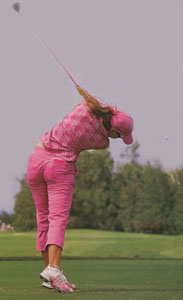 She has amazing spinal flexibility and can tilt her right shoulder significantly downwards. I think that middle-aged/elderly male golfers are severely handicapped in terms of spinal/torso flexibility. Is there a suitable compensatory movement that can help them? Jeff. |
Quote:
|
Quote:
What she's doing is winning a lot of money with that swing. Her swing works. Don't say why it's wrong, tell us how it's right. |
Once loaded the right shoulder is better off staying on plane throughout the downswing...no? Maybe not always on the same plane as the pp3 at impact..ie. the shoulder does not have to be on the same elbow plane as pp3might be using at impact....but it can still be on plane....ie tracing??
|
Quote:
Ok think of it this way - you have a stationary point fixed in space and lets just for the sake of simplicity take that as the point between the shoulders. For any specific plane angle this stationary point is going to be a set distance above the plane. Now each shoulder is a set distance apart from this stationary point. If the right shoulder is on one specific plane angle then the left shoulder is going to be moving parallel and twice the height above the plane as the distance that the right shoulder and the stationary point. Now an exercise - Visualise this and tell me whats wrong with the idea... |
Mathew
You wrote-: "Tell me what you think she is doing and ill tell you why its wrong from pure logic...." OK. I notice that her shoulder turn angle in the photo is roughly on the same plane angle as her clubshaft in the photo. So, I presume that she is turning her shoulders in the downswing along a plane angle that is very close to being parallel to the inclined plane angle that her clubshaft will travel along when it passes through the impact zone. Jeff. |
Quote:
Quote:
You can't take what I wrote and use a picture and say that it is mean't to be an exhibit to disprove me and now say this is an example of it (still not getting it right) just after making some statement about both shoulders and the club being onplane. Tell me what you think happens in her stroke from the top of the backstroke where the right shoulder is on the inclined plane and then the left shoulder and stationary point is above the inclined plane to the picture in question and then tell me what you think it is mean't to portray. |
Mathew
I simply think that HK correctly implied that the right shoulder should move downplane during the downswing to support the clubshaft and that it should be tracking close to parallel to the inclined plane in the late downswing and early followthrough. That's what I think Creamer is doing. I think that it is physically impossible for the right shoulder to move on the same plane as the clubshaft (eg. elbow plane) because the human body cannot contort to that degree. It is my understanding that HK merely implied that when the right shoulder moves downplane, that it should move as close to parallel to the inclined plane so as to better support the movement of the right forearm/clubshaft. I also think that it is physically impossible for the right shoulder to move steeply downplane at the very start of the downswing. I think that the pelvis has to shift left-laterally first, so that secondary spinal axis tilt is produced, and that those biomechanical events allow the right shoulder to move more steeply downplane later in the downswing. During the early downswing, the right shoulder has to move around along a less steep angle. Jeff. |
"The Push of the Right Shoulder accelerates the Swinger's Left Arm and
causes it to Pull the Hands and Club (6-B-4-0). The direction of that Pull is toward its source (the Pushing Right Shoulder). Therefore, when you Turn your Right Shoulder Down Plane (toward the Ball), i.e., 10-13-D #3 per 2-H, 2-L and 6-E-2-1, that is the direction taken by your Left Arm and Club -- the Golfer's Flail (2-K)." Lynn Blake words above, my bold... 10-13-D On-plane shoulder turn...Homer Kelley's words and photos...dianne's pics show the right shoulder moving down the turned shoulder...single plane throughout the downstroke..."the right shoulder moves toward timpact precisely on the preselected downstroke clubshaft plane..." Homer Kelley's words above... These words seem to have established in my mind that the right shoulder moves on a single plane on the downswing...now I will go back and read Matthew's words again... PS. guys - the thread was about plane of left wristcock...and left arm.... it has been interesting chat so far...very illuminating but maybe we need a 2-H thread for shoulder motion as a whole? |
Quote:
Why do you interpret Homer's words as NOT stating that the right shoulder should turn on a single plane on the downswing? He called the downstroke shoulder turn "on plane"....as in 10-13-C...really hard to interpret that as anything other than on plane...TSP as recommended in 12-1-0 and 12-2-0.... |
Order In the Court
To restore civility to this thread, I have deleted in full several offending posts and have edited others to remove insensitive and inflammatory remarks. For now, the thread remains open based on the merit of its content.
We at LBG take very seriously violations of the site's collegial atmosphere, and disrespective behavior of any member toward another will not be tolerated. Membership at LBG is a privilege, not a right, and we will not hesitate to suspend or even revoke permanently those privileges should the violations continue. |
Quote:
|
Right Shoulder To the Ball
Quote:
When focused on Pivot assignments, Homer Kelley advised his students to "Hit the ball with your right shoulder." That was good advice then. It is good advice now. |
"On plane right shoulder is possible only by tilting its axis - the spin." That's why i play my Hula Hula every night.
|
Golfbulldog - you wrote-: "10-13-D On-plane shoulder turn...Homer Kelley's words and photos...dianne's pics show the right shoulder moving down the turned shoulder...single plane throughout the downstroke..."the right shoulder moves toward timpact precisely on the preselected downstroke clubshaft plane..."
---------------------------- You are seemingly implying that the i) right shoulder has to move down the turned shoulder plane, and then you state that the ii) right shoulder moves down toward impact on the preselected downstroke clubshaft plane. If the preselected downstroke clubshaft plane is the turned shoulder plane, then i) and ii) are the same. However, what happens if the preselected downstroke clubshaft plane is shallower eg. elbow plane? Surely, it is physically impossible to move the right shoulder along such a shallow plane - unless you have the spinal/torso flexibility of Paula Creamer? It would seem to me that the best that most inflexible golfers can do is aim the right shoulder towards the ball and hope that one has sufficient spinal/torso flexibility to enable the right shoulder to move down sufficiently in the general direction of the ball. Jeff. |
Quote:
Could you speak to spinal flexibility? How do you determine how much spinal flexibility you have? Thanks! Bucket |
Quote:
Absolutely ... the right shoulder at impact is not on the elbow plane even if the clubshaft is....the bits that you quoted were Homer's words...not mine....go back and look at my words earlier in this thread and i say that the right shoulder stays on the TSP plane even if pp3 goes to elbow plane at impact. Here it is... "#13 05-22-2008, 07:01 AM golfbulldog Senior Member Join Date: Dec 2005 Posts: 448 Once loaded the right shoulder is better off staying on plane throughout the downswing...no? Maybe not always on the same plane as the pp3 at impact..ie. the shoulder does not have to be on the same elbow plane as pp3might be using at impact....but it can still be on plane....ie tracing??" I think that we agree with eachother on this point...:salut: and that is a first for this particular thread!!!:laughing9 |
Back On Thread
Left arm and left wristcock....
If the left wrist is to uncock on the square plane line in the manner of a sequenced release for a swinger... then the left wrist must remain absolutely turned to the plane prior to uncocking even if that means that the left wrist is bent. Discuss....with particular reference to the following:- - Remember that the clubface must remain turned to the plane prior to the sequenced release. - A bent left wrist means that there is a visual bend at the left wrist and the left wrist cock/uncock motion is in a different plane to the left forearm. (NB. this is different to a geometrically/mechanically flat wrist (at least my understanding) where there might be a small visual bend but the left wrist cocks and uncocks in the same plane as the left forearm WITHOUT forearm rotation) I see that there are 3 variables that need to be considered....the plane line used for uncocking (either square or out to right field like Hogan illustrates, whether the left wrist is mechanically flat or bent...and whether the clubface remains 100% turned to the plane prior to uncocking) Thanks for sticking to thread.:golf: :salut: |
Bucket - there are formal tests for spine flexibility that measure flexion/extension, lateral flexion and rotation of different sections of the spine (cervical, thoracic and lumbar).
However, in a general sense, there are two important informal tests that I think are useful to assess whether a golfer has good spine flexibility. 1) Adopt the standard golfer's bent-over posture with the arms folded across the chest, and turn the hips to at least 45-50 degrees while maximally turning the shoulders around the bent-over spine in a standard backswing motion. The shoulder turn should be 90-110 degrees if one has sufficient spinal flexibility (presuming that other factors [eg. barrel chest, overweight central torso] aren't limiting torso rotation). I unfortiunately, can only rotate to 70 degrees despite a full hip turn. 2) Repeat the above test and get to the end-backswing position. Then have a friend place his right hand palm over the front of the right shoulder to prevent the shoulders turning (with your friend standing behind you). Then start an imaginary downswing pivot action by shift-rotating the pelvis (hip squaring action). If you can square the pelvis (representing a 45-50 pelvic rotation), without your friend "feeling" a tremendous pull force on his right palm, then you have a very flexible spine (good hula flexibility). If you friend "feels" a significant pull-force against his right hand palm, but you can still square the hips, then you have moderate hula flexibility. If you are inflexible like me, then you will not be able to square the hips without the shoulders immediately turning in a rounhousing manner- that represents very poor hula flexibility. Jeff. |
sequenced release
Quote:
IF the left wrist is the only thing moving and everything else is not moving- then the shaft would move on the same plane as the left wrist was moving (uncocking or cocking). That's not the case in the golf swing. The left wrist motion creates one vector of many vectors (lots of joint motions) - so the left wrist can uncock on a plane that is different that the resultant "on plane" motion of the clubshaft. For Homer Kelley's analysis of this issue see 2-N-1 in his book- "The Golfing Machine". It seems to me that given the post above and the video link - that there is a belief or implied statement that the left wrist has to be on the clubshaft plane during a sequenced release for the clubshaft to stay "on plane". A sequenced release involves the release of accumulators #2 and #3- there's a lot more going on in the swing besides just those two accumulators- while Accumulator #2 is releasing before #3- there are a lot of force vectors than combine with accumulator #2 to maintain an on plane clubshaft. |
Quote:
From my comments, it should be understood that the sweetspot and pp3 can remain on-plane (square plane line tracing) and yet in a different plane to the left arm only with a bent left wrist. (assuming that the clubface has not rolled away from the plane prior to left wrist uncock.) At least that is the way it seems to me from Matthew's videos and previous posts. Is this wrong? |
Quote:
|
Quote:
If the left wristcock takes place without a bent or arched condition, it moves on a plane that is aligned with the left arm. Since the left arm is not onplane and it is above plane therefore the left wristcock plane CANNOT EVER be aligned to the inclined plane. There no other 'mystical' divergent vector alignments working here...just someone who cannot comprehend simple fact. |
Quote:
"we're learning now!!!" misquote by me... |
Unneccessary Roughness
Quote:
Your posts of late have taken on a decidedly negative and disrepectful tone, one that is inappropriate to these Forums and that we will not tolerate. I had hoped that Bagger's PM to you last week and my post #20 above (Order In the Court) would eliminate your bullying tactics and verbal abuse. Unfortunately, it seems to be 'business as usual'. Hence, this Open Letter of Censure. Here is the opening statement from our Forum Information and Rules: Golf is known as a gentleman’s game, and the intent of this board is to carry forward etiquette in a manner befitting that tradition.http://www.lynnblakegolf.com/forum/s....php?p=4#post4 Your demeaning personal attacks are disrespectful and counterproductive. Instead of encouraging our friends, you belittle their efforts to study and understand. Should you persist in this behavior, you leave me no alternative but to suspend your posting privileges. You have made significant contributions to these Forums and are capable of many more. But, unless you begin immediately to conduct yourself in a more civil way, you will no longer be permitted to interact with us. We are not your personal punching bags: You are hurting this site; you are hurting those who in good faith attempt to interact with you; and, most of all, you are hurting yourself. Bottom line: Behave or be gone. We want you here, but the choice is yours. |
Mathew wrote-: "If the left wristcock takes place without a bent or arched condition, it moves on a plane that is aligned with the left arm. Since the left arm is not onplane and it is above plane therefore the left wristcock plane CANNOT EVER be aligned to the inclined plane."
I cannot understand why Mathew believes this fact. He uses the phrase "cannot ever", which I think is incorrect. It is true that the left arm is above plane, but that doesn't mean that the left wrist cock cannot be on plane. In fact, I think that the left wrist has to be on plane if the butt end of the club is always pointing at the ball-target line (when the lower end of the club is tracing the planar baseline). Let's presume that the butt end of the club and left hand moves from the elbow plane (at address) to the turned shoulder plane (at the end-backswing), then there is a time period during the backswing when the butt end of the club is pointing at the ball-target line (even while it is shifting planes from the elbow plane to the turned shoulder plane) and when it is pointing at the ball-target line (or its extension) then it is "on plane" (presuming that the baseline of the plane is the ball-target line). When the butt end of the club is 'on plane", then surely the left wrist cock must be "on plane" because the left wrist cock occurs on the same plane as the back of the left wrist/hand. For example, here is a photo of Tiger Woods and Adam Scott in mid-backswing. 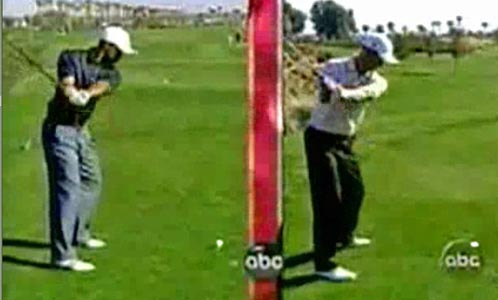 Note that the butt end of their club is pointing at the ball-target line. Surely, at this moment in time, their left wrist cock is also "on plane". Jeff. |
Quote:
|
There are 3 factors in this discussion:-
1. Left wrist condition a) Mechanically flat left wrist / geometrically flat left wrist b) Bent left wrist 2. Sweetspot Plane line alignment a) square to target (10-5-A) b) out to right field (10-5-E) 3. Clubface alignment with respect to face of plane a) Fully turned to face of plane (ie. no "squaring" or roll of clubface prior to uncocking) b) clubface rolls off face of plane prior to uncocking All of these criteria have been specified since my first post. It strikes me that 1(a) + 2(a) + 3(a) = impossible 1(a) and 2(a) require the clubface to roll off the face of the plane 3(b) 2(a) and 3(a) require a bent left wrist 1(b) 1(a) and 3(a) require a plane line out to right field 2(b) So in Jeffs Photos I would say that they are off the square plane line (maybe heading back towards it at this point of backswing) ...but photos and parallax prove nothing...just lead to debate... the answers to this question lies in principles...I think...I am slightly confused but sure that the answers are nearby! |
Quote:
The left wrist cock and uncocking motion are just one of many "off clubshaft plane" motions that combine for the resultant on-plane motion of the clubshaft. Therefore, I don't think I said or certainly I never meant to say that the left wrist cock and uncocking motion with a flat left wrist was aligned with the inclined plane. That in fact was the point of my orginal post-that the flat left wrist with its cocking and uncocking motion is indeed NOT on the plane of the clubshaft- but contrary to what I thought bulldog and Matthew were saying "that therefore that would create an "off plane" clubshaft motion- I was saying that the left wrist can cock and uncock during a sequenced release on a plane that is not the clubshaft plane ("aligned with the left arm") and that will not create an off plane clubshaft motion (assuming clubhead lag etc.). A simple non golf example is that you can throw a ball off a train in a direction perpendicular to the rail road track but since the train is moving down the track at a certain speed the resultant flight of the ball isn't perpendicular to the train track. A separate topic and area of discussion on a similar issue- is the concept of the left wrist "moves on a plane that is aligned with the left arm". Since the wrist via the forearm and upper arm can rotate approximately 270 degrees- the plane of the left wrist cocking and uncocking has the ability to rotate 270 degrees (anatomcially speaking) so you have to ask yourself "What does aligned with the left arm mean or how does that help us define something important if the left wrist motion "always aligned with the left arm" whenever it is flat. |
Consider this statement - "I was saying that although the left wrist cock with a flat left wrist is not cocking/uncocking in the plane of the inclined clubshaft plane."
What is the plane of the inclined plane of the clubshaft? Is this plane linear (like a plate of glass) or curved? If the left wrist cocks up during the backswing along a curved path (which I will label a curved left wrist cock plane) that is dicated by the rate of rotation of the straight left arm during the backswing, wouldn't the clubshaft also be on that curved plane if the left wrist remains flat during the entire left wrist upcocking phenomenon? Jeff. |
Quote:
I don't know about a curved plane. I was just looking at the simple example of a plate of glass swing plane and the sequenced release of the left wrist uncocking on the downswing- while it would uncock in line with the left wrist alignment which let's assume isn't on the clubshaft plane- that fact doesn't mean that the clubshaft would be thrown off the intended clubshaft plane. Your additional comments may have validity and be great to look into but they are outside of the principle that I was describing. Post on though if you can further describe your thought process on this line- I'm not saying they are not valid - I am just saying that they aren't needed in regards to my post i.e. regardless of a flat plane or curved plane- the left wrist could be uncocking in one plane while the clubshaft is moving in another plane- they don't both have to mirror one another- unless there are no offsetting vectors/ joint motions. I would only have one basic question or comment regarding your post at this time. When you use the term upcocking- that's a term that breaks out to mean - "up"= backswing? and cocking=cocking? or is there something more to the term "upcocking"? |
| All times are GMT -4. The time now is 01:43 AM. |