
|
Release of power accumulator #4
I would like to know when the release of power accumulator #4 is complete in a swinger's swing action.
From TGM, I understand that a triple barrel swing involves the release of power accumulators 4,2,3 in that sequence. At what point in the downswing has power accumulator #4 fully released? Consider the following graph from a paper by Phil Cheetham of TPI. 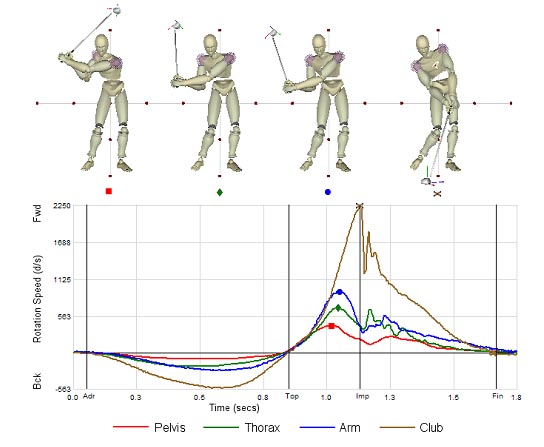 Note that pelvic rotation peaks when the lead arm is parallel to the ground in the early downswing, and shoulder rotation peaks when the hands reach waist level. After that time point, one can say that the downswing pivot action starts subsiding, which apparently is causally responsible for the release of power accumulator #4. If that is the time point when power accumulator #4 starts to release, then when is release deemed to be complete? Jeff. |
Jeff
Keep it up. I love your questions, as the answers always bring some enlightenment to the rest of us seekers. I think that the "in line" position for accum #4 is the left arm returning to 90 degrees to the shoulders at both arms straight. At this point, I believe, it stops, in that there is no further movement beyond 90 degrees. O.B. |
OB
Thanks for replying. If the power accumulator #4 is fully released at the "both arms straight" end-followthrough position, then is it correct to state that all power accumulators used in a swinger's action are fully released at the same time time point, even though the release sequence is 4/2/3? Secondly, you stated a 90 degree angle. However, I presume that the angle depends on the degree of shoulder openess at impact. The more open one rotates the shoulders by impact, the less the angle. Consider the following sequence of Hogan's swing - note that left arm-shoulder angle is <90 degrees at impact, and that it remains at that angle well into the finish phase of the swing.  Jeff. |
Quote:
Jeff . . . Good questions dude . . . It's simply the relationship of the arm and the shoulder joint. It doesn't matter really where the shoulder is "in space". Once the arm is directly under the shoulder it is "fully released." So you could have a stroke where you had no shoulder turn at all. Just simply #4 accumulator motion via the #1 accumulator (right elbow) and once it is 90 degrees it's released with the shoulder turn "zeroed out". The shoulder turn simply carries the #4 angle via turning into the #4 pressure point. So basically the arm moves up and down the chest. It can be driven by the shoulder turn or swinging the arm. So in the 1st frame I would say that #4 is "fully released" in your sequence of Mr. Hogan above. #4 is considered the master accumulator because if the left arm doesn't move "down the chest" then none of the other accumulators can release. You'd swing literally over the top of the ball. 6-B-4-0 THE FORTH POWER ACCUMULATOR The angle formed by the Left Arm and Left Shoulder forms the Forth Power Accumulator. It is not only an independent Power Accumulator, but its Triggering function as the Checkrein of the Right Elbow is also vastly important and it thus can be the Accumulator of the Accumulators – or Master Accumulator. Also see 2-M-4. As Accumulator #4 it is Pivot (Body) Power supplying the initial acceleration of the Downstroke to throw the Lever Assemblies toward Impact by the Thrust of the Shoulder Turn. See 7-13. Another major contribution to Impact Power is geometric – it is the first link in the Swing Radius power train between the Club and the Feet. “Left Arm Power” in any form or amount can still be considered #4 Accumulator Action. Otherwise it actually substitutes for the Pivot to introduce the circular motion required to produce Centrifugal Force. RADIUS POWER 6-B-4-A MAXIMUM POWER is obtained by using maximum On Plane Shoulder Turn Thrust against Pressure Point #4 per 7-19, and maximum Swing Radius (6-B-0). 6-B-4-B ZERO ACCUMULATION is either no Shoulder Turn or the use of Accumulator #1 alone for actuating the Primary Lever Assembly. 6-B-4-C MAXIMUM TRIGGER DELAY is achieved by using either the Standard or Delayed Pivot (to increase the Lag of the Downstroke Shoulder Turn) with a Snap Loading Action (per 7-19-3 and 10-22-C) followed by a Snap Release (10-24-E) with a Pitch One fault people have (me for one) . . . is NOT RELEASING #4 down the chest rather "OUT" which basically moves the hands out away from the plane rather than keeping them "in on-plane." Thus a compensatory move must be made because the radius (left shoulder to clubhead to ball) has been disrupted a miriad of compensations have to be made to get the sweetspot on the ball (standing up, flip, alligator arms . . etc. etc.). But back to the sequence you put up . . . I think the #4 angle releases differently for different plane angles and hand paths. In other words, Hogan's pivot and plane is going to have the left arm "pinned" via the pressure point longer than say a Jack Nicklaus or Scott Hoch. Some one with lots of #3 angle that swings on a "wider" arc of approach (or just arc) is going to have #4 pressure point "pinned" by the pivot due to the hand path requirements, pivot requirements . . . to stay ON THE SELECTED PLANE. |
Drumstick with slaw
Nice one, pards!
|
Quote:
Where you been Fred? You don't call no mo' . . . you don't write . . . Is there somebody else??? I thought we had something . . . I reckon I'll have to get that tramp stamp tattoo with your name (Bart) changed . .. maybe they can make the B into an F. |
Quote:
I think that you blast it from above the nipple line to below the nipple line... http://www.youtube.com/watch?v=oh184bHGkpM In this video I tried to show the stage where the pivot carries the power package to...then the acc 4 releases...and the right shoulder appears to stop rotating toward the target and goes down whilst the acc 4 releases...the left shoulder moves up quite alot as the axis tilt becomes more evident. But the left arm moves almost independently after "blast down" of the left arm. |
When one talks of blasting the left arm off the chest with the downswing pivot action thereby releasing power accumulator #4, doesn't the left arm have to move both downwards (towards the left foot) and outwards (towards the ball-target line), and isn't the direction of left arm movement determined by the movement of the conjoined hand unit, which is itself directionally moved by the right forearm/PP#3 which traces the straight plane line and also moves towards the aiming point?
Jeff. |
Quote:
There is fo' sho' a big relation to HOW the pivot must work inorder for #4 to release to keep the hands on plane . . . Steep plane . . . more slidy pivot to keep the hands IN and not flying out over the plane early. Flat plane more rotation to get the club OUT and keep it from getting stuck and not getting to low point b/c the angle of attack is too shallow. I had a nice conversation with Eddie Cox on this . . . #4 has to release DOWN your chest. Eddie said you need to feel like you are taking your sternum into your left bicept in a way that blasts the arm more DOWN and less out. If you blast the left arm OUT early the hands stay to HIGH and you have to do some weird stuff to get the club to shallow out (stand up, shrink your arms) otherwise you just bend the plane line left and become Craig Parry. |
Quote:
|
Aren't all accumulators basically connected? When you blast the left arm off your chest, your right arm has to straighten, which uncocks the left wrist. Only the 3rd accumulator doesn't have to be released when all the other accumulators are...
|
Quote:
Correct . . . The release sequence is predicated on the left arm otherwise nothing happens. So no matter what your procedure the sequence is 1. #4 Left arm moving down the chest 2. #1 The right arm unbending 3. #2 The left wrist uncocking 4. #3 The angle between the left arm and shaft is rolled through the ball |
Jeff, once again your great question provided the rest of us with a deeper level of understanding. As well as some humour that also brought light to places where the sun dont shine.
"B" to "F", you're killing me, Bucket. |
Quote:
Sorry for taking this thread further away from #4. |
Quote:
Per Mr. K . . . 6-B-3 Accumulator #3 should never be “Out-of-Line – instead, it seeks to MAINTAIN its radial alignment with the Left Arm and Left Wrist vertical to its associated Plane.The established #3 angle at fix sets up lots of thangs really. And per the above that angle SEEKS to be maintained through the ball. Otherwise if you disrupt it you are going to disrupt your hinging and the clubface alignments can potentially be outta whack. |
What is it...the fried chicken or the egg?
I thought that the more your hands become the command post the more the pivot is a responsive action i.e. getting out of the way of the mittens...to make sure there is no hint of the collision nature will not allow (CNWNA for short) to happen, namely hips and hands! No doubt the pivot is trained...but eventually it responds to the assignment the hands have been given...say an all expenses paid simultaneous back up and in trip to a location on the turned shoulder plane, right? To me there is no greater concept to understand...the old hands to pivot deal. I reread your post...I'm tripping...never mind! Much to do about nuttin' |
Quote:
Geometrically, #4 is fully released effectively at 90 degrees to the ground. The physics perspective 'can' have #4 pressure through to nearly both arm straight, with the appropriate axis tilt, delivery paths and planes working in the proper sequences and angles. Remember that the right arm is not straight until follow thru, and ideally the right wrist remains bent. 4 barrels are needed to really do that IMO. |
Quote:
The "roll" is power accumulator #3- transfer power of #2's uncocking of velocity power. It is not a hinge action until the clubface begins to close on the ball at impact. Roll starts much earlier- startdown. one other point. A proper start down, hip action- right shoulder thrust -cranking the gyro shown in Lynn's "hitting and Swinging video" sets the sweetspot on plane. It sounds like some of you need to steer the club and hands on plane. Let the hands teach the pivot, then let it rip. you will be on plane which means all direction is Down Out and Through simultenously. Not performed seperately. |
Quote:
|
Quote:
Am I right in thinking the #3 angle decreases through the ball as the left wrist un cocks from level at impact to uncocked at I dunno, follow through maybe? I set the #3 angle level at fix and make an effort to go all the way down and out to uncocked, the full extension of the left arm and club. Its working great please dont tell me its wrong. Maybe I dont understand Homer's radial alignment maintenance. O.B. |
I don't think that I really understand the action of power accumulator #3.
When HK talks of the "? clubshaft" seeking to be in line with the left arm, is this from a face-on view or DTL view. Here is a photo of Tiger Woods through impact.  I have drawn colored lines to represent the different power accumulator angles. Blue lines - PA #4 angle Yellow lines - PA#1 angle Red Lines - PA#2 angle. Green Lines - PA#3 angle Have I correctly represented PA#3? I have understood it to be the situation where the release swivel occurs causing the left hand to roll over so that it approaches the impact location with forward clubshaft lean (which means that the clubshaft is not in-line with the left arm thereby implying incomplete PA#3 release). However, after impact (image 3) the left arm and clubshaft are in a straight line thereby implying complete release of PA#3. Am I wrong, and is the PA#3 angle best seen, and understood, from the DTL view? Jeff. |
Jeff
Upon further review, I now think I understand Bucket. And may God have mercy on poor innocent soul. The #3 angle is turned to reveal its power, the more it is angled the more potential power it has. It matters not if it is turned via swivel or hinging. To answer your question. The best view would be from a camera mounted to a rod driven through the A team. In other words, "it seeks to maintain its radial alignment" means the maintenance of the LFFW? Im out on a limb here a bit so please, everybody rip into me all at once. O.B. |
Question.. did I see Tiger's right wrist unbent?...
|
Quote:
  Here's #3 Maintained  Now it's gone . . .  |
Quote:
Kinda . . . you are sniffin' it pretty good . . . This would be my OPINION on more #3 and it's relation to plane angle and staying on plane. 1. Flatter Planes = more #3 2. Release motions according to Mr. K are #2 and #3 . . . so it's a blend right? 3. The more #3 you have . . . the more #3 dependent your release is . . .you have #3 bias . . . 4. Flat planes are #3 dependent more so . . . Steep planes are more #2 dependent . . . 5. All this can change IF you disrupt #3 from what you have programed in at Fix . . . In other words, let's say you set up the club with the amount of shaft lean and handle height that you intend at impact . . . take your grip from their. You have just established your "intended" plane requirements (#3 requirment) at Impact. Now lets say that you have an improper start down and you have to do something like stand up (Bob) . . . you just shifted your plane angle from what you programed in at Fix. This is one reason why right shoulder location is soooooooooo important. You can disrupt the whole shootin' match and this impacts the amount of face closure you have which can screw up your intended hinging etc. |
Quote:
About #4 Accumulator. Consider the Power Package. The Power Package moves as a single unit. The Power Package must be moved into the Release Zone in-tact. This will cause the Left Arm to move down the chest as the Right Elbow moves down (as determined by the Right Shoulder). The Left Arm (Straight Line Delivery Path of the Hands) operates on two Planes of Motion. Vertical and Horizontal. The Vertical Plane of Motion is controlled by the Right Elbow Location (Power Package Delivery). The Horizontal Plane of motion straightens the Right Arm (Release) but does not destroy the Power Package. The #4 Accumulator works on the Horizontal Plane of Motion. This way, Hitting or Swinging, the Flying Wedges maintain their geometrical alignment. If the #4 Accumulator goes Vertical, the Flying Wedges are ruined, because the Elbows spread apart which affects the Bent Right Wrist, etc. So, the Beginning of the #4 Accumulator Release is when the Left Arm starts moving away from the Body on a Horizontal Plane and the Right Arm begins to Straighten. The End of #4 Accumulator Release occurs when Both Arms are Straight. The total Distance (not counting shoulder movement) is only 6-9” (the amount of right elbow bend). The Release Interval is surprisingly fast. If we could slow motion the downswing from Top to Impact to 10 seconds, the Start of #4 Release is about the 8th second, #2 about 8.5 and #3 about 9. |
Quote:
Lost me . . . |
Quote:
|
Bucket, Daryl thank you. This is great stuff.
Not wanting to take the discussion at hand away from #4 too much but I have to ask: Although they fire at different times do they all go "in line" at follow through? After follow through #2 re cocks, #1 stays straight a la Hogans one iron photo #4 keeps its 90 degrees to the shoulder although the left arm does move up vertically #3 stays put after swiveling onto the plane and completing its turn. Tiger, Hogan and Moe sort of hold onto the fully uncocked #2 for a while. Why? Perhaps because they got to fully uncocked where as most people dont? Perhaps thats where the golfing machine lives, is that why? |
Quote:
You lost me? |
Quote:
|
Quote:
Uncocked Left Wrist at Impact is still Level Right Wrist. If you take the Ball away, whatever angles and relationships and forces that occur after Low Point Exactly result from angles and relationships and forces before Low Point. All of the above is regurgitation. :) |
http://www.youtube.com/watch?v=loJJ0qmDQxY
Is the left arm really connected to chest before impact? Would the "headcover" have slipped from his left armpit? |
| All times are GMT -4. The time now is 01:43 AM. |