
|
Sequenced Release... (video)
Heres a video I made to start up a conversation which I believe will make a good discussion.
http://www.youtube.com/watch?v=7SbM-G-fGwQ |
Quote:
However, you’re assertion in your last sentence that only 10-18-B can be sequenced is wrong. The #3 Accumulator Roll occurs because of the Right Hands’ geometry to Plane, not the Left Hand. Paddlewheel vs. Karate Chop. If the Right Hand remains Turned to Plane after Release begins (Right Elbow begins to Straighten, Left Wrist Uncocks), then it is Sequenced. If one uses 10-18-B, then the Clubshaft is laying on the Turned Shoulder Plane at Release and he can Swivel the #3 Accumulator on the Turned Shoulder Plane. With 10-18-A, the Swinger Rolls the #3 Accumulator on the Elbow Plane. The Right Hand Motion is the same for both Procedures, but the FEEL is different because FEEL depends which plane the Clubshaft is Rolling on. Swiveling on the Turned Shoulder Plane does not have the Wallup that Rolling on the Elbow Plane has. One cannot Roll the Clubshaft on a Turned Shoulder Plane with a FLW/BRW but you can on the Elbow Plane. Hogan Rolled on the Elbow Plane with 10-18-B. That's unusual. |
Video
Matthew,
I viewed the video. I think you have opened up a great avenue to communicate ideas. I have no opinion on your topic, but others should chime in with their views. Thank you again for paving the way. :salut: UPP in wintry Ohio |
|
video
i wish everything on this site was discussed with videos. as t.t.said, the book should have come with an instructor. i would slove to have the audios and videos that were made at the tgm seminars. fkeep up the good work, and bring on the videos.
|
Quote:
|
New video shedding light on 7-3 in regards to what I've said so far...
http://www.youtube.com/watch?v=MjJY5v-z6F0 |
i am not able to see you hands because of the darkness. when do you think the roll occurs.
|
Quote:
I would like to endorse Uppndown's comments and congratulate you again on your use of video. Your animation on Hinges three years ago was an eye opener and elicited my first post on this forum. Hopefully you will encourage others to make more use of this neglected and underutilized technology which can and will accelerate our understanding. I appreciate your pioneering. :salut: :salut: :salut: |
Matthew,
Can I just check that the end result of what you are saying is that on the downswing/swinging/sequenced release... - the left wrist is bent in order for the sweetspot and pp3 to stay on plane. Is that correct? - And then for the sequenced release to occur... the left wrist uncocks on plane...with a left wrist that is bent and gradually straightens....and then rolls...is that correct? Thanks |
A bent left wrist is not mandatory -to some it is good as it helps to prevent throwaway when going from bent to flat on the downstroke.
|
Quote:
|
Quote:
|
Quote:
I don't mean to offend anybody, especially Matthew. However CF will align the Clubface for Swingers, no matter what Grip to Plane being used (Within reason of course) and no matter the Plane Angle degree. CF closes the Clubface in Sequenced Releases. If you need to Compensate by Bending your Left Wrist simply to Keep the Clubshaft On-Plane and Sequence the Release, then something else is to blame; not the Flat Left Wrist. |
Quote:
Critique is fine by logical reasoning and asking questions but just making stupid statements that I am somehow confused is not acceptable whilst I am spending my time helping people to understand things I know to be fact! Your post has no counterarguements because you have none and you will always have none against me or certain none with any premise. I also knew that alot of people would have trouble with this challenges their whole basis of thinking on thinking towards wrist conditions. I haven't even said anything on clubface control yet just the sequenced release motions and a little bit on the right forearm. Ive been working alot recently so haven't had much chance to make any videos. But first chance I will get I will show you through animation as to why you are wrong and I am right... as it will always be btw.:) |
Chill Bro!
Dang! Daryl is an honest seeker...bear with him! If not it would seem that you have the expertise to teach...just not the disposition. I have never seen Yoda fly off the handle...and most of what he hears from us is inane rambling. Everyone knows who you are and are in awe of your non compensatory contributions...stating them is clumsy. Task one...know your material...check. Task two...coax others into the light of understanding...not so much. Task two is by far the tougher of the two. One of the things I love about this site is that it is civil...you know like in civilized!
|
seeker or speaker
okie, you are right. there are seekers, and there are speakers. when people realize which they are the web will benifit, and so will the members.
|
Quote:
To some people -not a bad thing,particularly on short ,slow strokes. |
Quote:
|
Quote:
His friends catching dinner? http://www.youtube.com/watch?v=hznGNIsHn5M |
Momma Was Right!
Quote:
Brings new meaning to "You don't know where that hand's been." :pale: |
Right forearm coming into impact when l.hand is turned to plane.
http://youtube.com/watch?v=vfLxeNUDz5g |
Quote:
|
Mathew, thanks for the direct video reply - I shall review the specific references you made in due course.
In your reply there are some bits that still appear heretical...namely the precedence you give to the left wristcock being on plane over and above the left wrist remaining "flat" throughout the downswing. If that is what you are saying then please nod, please do not use too many long words...just nod...keep it simple please. The reason I ask you to keep your reply simple is that I think that what you might not appreciate is that for most of us here the "Flat left wrist" is crutch that we hold onto dearly.... I think I speak for many who have started learning from TGM but have much remaining to learn...in that we feel that once you have got your left wrist flat at some stage in the backswing...you keep it in that position. My interpretation of your words is that that is not the case. That is why I /we need a simple reply to confirm this conclusion. I appreciate that the explaination may require more complex words but mere confirmation of this conclusion does not. I think that a simple statement from you will help the discussion further. The reason it is taking us a while to understand this is because it is certainly something that I have not seen stressed by other knowledgeable TGM people...now that might be my misunderstanding of their words...it might be their misunderstanding of Homer's words...or...some other reason... I keep my mind open ... |
The Wristcock
Quote:
1. Get a hammer. 2. Grip it in your left hand, and hold it opposite your left shoulder. 3. Cock the hammer straight up in line with your left forearm. That is how your left wrist should look at the top of your backswing. :) |
Hammer-Time Video
Quote:
In addition to my Post #25 above, go here to Post #55 and its video: http://www.lynnblakegolf.com/forum/s...1238#post51238 And see if you don't come back with a different idea! :salut: |
Hey Yoda, nice to visit my lil thread here :)
I suppose alot of people might be wondering is do you agree with me? and why ? |
The Cocked Flat Left Wrist
Quote:
:) |
Quote:
:) |
A vertical relationship of your arms coming down whilst turned to plane....
http://www.youtube.com/watch?v=yYgkM4GL8fk |
Quote:
I get the idea of hammering in a purely vertical plane as you demo in the drill, left arm, forearm and club all in/on the same vertical plane out in front of the left shoulder - no problems... But , and here is the seed of doubt that Mathew has planted and I am struggling with, ... The left arm is not on the same inclined plane as the left wristcock at the top of the backswing. The right shoulder is on the inclined plane but the left shoulder and left wrist aren't and so the left arm isn't on the inclined plane... this is the bit i am having problems in understanding... I interpret Mathew's videos as requiring a cupping(in Hogan terminology) or bending of the left wrist at the top and start of downswing so that the sweetspot can stay turned to the plane prior to and during a sequenced release. I think that Mathew describes this in his latest video... i feel as though the fog is lifting slowly...just not sure if it is fog or smoke from Mathew's ciggys:laughing9 ... only joking Mathew! Hope this thread keeps going - lots to unlearn and learn for me... |
Mathew,
after reading the article below I would say that obviously the left arm isn´t pointing at the plane line and because of that the uncocking by the left wrist toward the plane line can´t be executed in the same plane as the left arm. So then I would say that you are correct in what you saying. Hope this article helps to explain this complex action. A three-dimensional examination of the planar nature of the golf swing. Coleman SG, Rankin AJ. PESLS Department, University of Edinburgh, Edinburgh, UK. simon.coleman@ed.ac.uk Previous planar models of the downswing in golf have suggested that upper limb segments (left shoulder girdle and left arm) move in a consistent fixed plane and that the clubhead also moves only in this plane. This study sought to examine these assumptions. Three-dimensional kinematic analysis of seven right-handed golfers of various abilities (handicap 0- 15) was used to define a plane (named the left-arm plane) containing the 7th cervical vertebra, left shoulder and left wrist. We found that the angles of this plane to the reference horizontal z axis and target line axis (parallel to the reference x axis) were not consistent. The angle to the horizontal z axis varied from a mean of 133 degrees (s = 1 degrees) at the start of the downswing to 102 degrees (s = 4 degrees) at impact, suggesting a "steepening" of the left-arm plane. The angle of the plane to the target line changed from - 9 degrees (s = 16 degrees) to 5 degrees (s = 15 degrees) during the same period, showing anticlockwise (from above) rotation, although there was large inter-individual variation. The distance of the clubhead from the left-arm plane was 0.019 m (s = 0.280 m) at the start at the downswing and 0.291 m (s = 0.077 m) at impact, showing that the clubhead did not lie in the same plane as the body segments. We conclude that the left arm and shoulder girdle do not move in a consistent plane throughout the downswing, and that the clubhead does not move in this plane. Previous models of the downswing in golf may therefore be incorrect, and more complex (but realistic) simulations should be performed. |
Quote:
|
Swivel Up the Plane
Hi Matthew
I fully appreciate your time and effort explaining these concepts on video...especially for us visual learners. Can you please discuss more the roles of the hands & arms post impact and full release on the other side of the swing ...you mentioned briefly at the end of your last video clip that their roles reverse and the left arm & hand now supports the inclined plane...where if I understood correctly the right wrist flattens and the left wrist now becomes bent as the left arm folds...when does this occur...is it part of the swivel action? I thought these boys kept their respective flat/bent relationship to the finish. Thanks in advance of your reply.:) HG |
I cannot understand why the left wrist has to cup excessively when the left hand moves down from its end-backswing position to the impact position in the downswing.
Here is a link to a swing video of Stuart Appleby swinging on plane. http://www.youtube.com/watch?v=_jqJ9R2LypY&NR=1 I have made a series of capture images of his downswing. 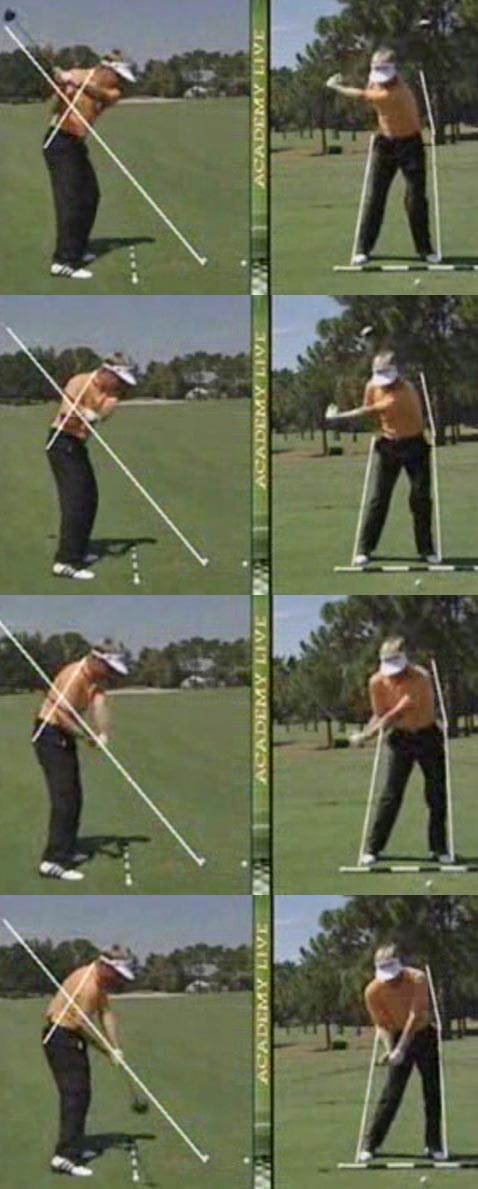 Isn't his left hand essentially flat throughout the downswing? The left hand in the second image may be slightly less flat than the first image (start of the downswing) only because his left hand is minimally less palmar flexed, and I think that a small degree of left wrist palmar flexion is necessary to have a perfectly flat left wrist. Jeff. |
Hey Jeff
This is a concept I struggled with for years. Until I came here that is, welcome. "Flat" is somewhat relative, I now think. Relative to the position of your left wrist when taking your grip at impact fix. A week grip would see the left wrist literally flat, a neutral grip would see a stronger and less flat left wrist etc. In the video, at the end of his backswing, Apples club face is square to his left arm and his left wrist is flat. To me that suggests a similar situation at fix, a weaker left hand grip in other words. As has been noted here before Couples displays the opposite tendencies. Strong left hand grip and cupped (but still "flat") at end. To determine what is flat for you, follow along with Yoda's hammer drill and look,look,look to see what position your left hand is in at top, given your grip variation. Things seem more apparent when you take yourself off the inclined plane. I now believe a strong single action grip, which is recommended for swinging, should show a corresponding "flat" but slightly cupped left wrist at top. Through release I am still a searching newbie, but I assume cupped in accordance with top. More cupped if any float loading, down cock. If the left wrist uncocks while maintaining the LFFW as in the vertical hammer drill, then i see no need for further cupping for normal non specialty shots. Please correct me if I am wrong guys, cause its something I am working on daily albeit with a fair deal of downswing black out, a video camera and a yellow book with some pages covered in fog. |
On the Path
Quote:
:salut: |
I have produced the following series of images that may have relevance to this discussion.
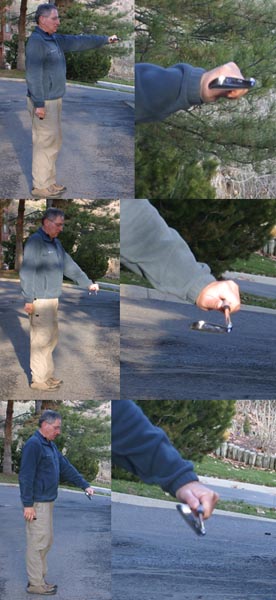 In the top image, I have adopted a neutral grip and I am holding a short iron so that the clubshaft is parallel to the ground and the clubshaft is at right angles to the left forearm which is parallel to the ground. One can see that the clubface is parallel to the back of the left forearm and back of the left hand. Note that my left hand is slightly cupped - simply due to the fact that my left wrist is in a neutral position (neither palmar flexed or dorsiflexed) while holding the grip, but when I hold a rounded grip, my FLW becomes slightly cupped. In the middle image, I simply lowered my left arm so that it is about 45 degrees to the horizontal. I have kept the clubshaft parallel to the ground. Note that the degree of cupping has increased. In the lowest image, I have deliberately palmar flexed my left wrist in order to obtain a FLW situation when my left arm is at 45 degrees to the horizontal. That causes the clubface angle to change. I think that these images have relevance to the golf swing - because when the left arm is in the mid-dowswing, the left arm is angled downwards so that the left hand is below left shoulder level. In that situation, I suspect that the left wrist can only be really flat (when the clubshaft is on the inclined plane) if the left wrist is slightly palmar flexed. I personally think that Tiger Woods seems to be palmar flexing his left wrist slightly during the downswing, and that seems to keep his left wrist in a FLW situation during the downswing. What do you think? Jeff. |
Jeff
Did you see Tiger today? Man that guy is going to be good some day, eh? To answer your question. I think: -as crazy as this may sound, Tiger's slightly arched left wrist at top and in release is questionable technically given his grip. Hoganesque maybe but not Hogan like. See Chuck Evan's web sight for a discussion on this. I am merely reiterating here and dont wish to be in Tigers bad books should he be reading this. For the record. -when you moved your left arm from horizontal to 45 degrees you did not maintain your left arm flying wedge. The club face moved to an open, not square to you left forearm position. I think you are suggesting this a natural occurrence when the left arm moves below shoulder level but I don't understand why. -perhaps you are misreading the flat left wrist mandate. Try cocking and un cocking the left wrist while maintaining the LFFW (and in so doing the associated square to the left forearm club face alignment) and see what your left wrist looks like. This to me is flat in all its variations. My apologies if I misunderstand your insights as I am merely a seeker like yourself. |
OB Left
I did maintain a 90 degree angle between the left forearm and clubshaft when I lowered my left arm to a 45 degree angle. However, I deliberately kept the clubface unchanged relative to the ground (and not relative to the left forearm) in the first sequence by keeping my left wrist very relaxed, while in the second sequence I kept the clubface neutral relative to the left forearm. However, to keep the clubface neutral relative to the left forearm in the second sequence, I actually had to actively palmar flex the left wrist while lowering the left arm. The purpose of this little exercise is to suggest the possibility that one has to actively palmar flex the left wrist slightly to allow the left wrist to remain flat when the left arm is angled below left shoulder level in the downswing and the clubshaft is on plane. Jeff. |
| All times are GMT -4. The time now is 09:10 AM. |