
|
Planes, Lines, and Words
Recently a few posts have been centered around the golf stroke's 'swing plane'. Be it for analysis, for an explanation, etc. This may sound counter to Mr. Kelley's teaching or your understanding but given what he has written and what exist in the world of science and math, not to mention what new technology has to offer us in our understanding, I submit the following for consideration and comments. Sorry for the length and rambling...it is long. :(
Really what we are talking about I believe is the 'Plane of Motion' - 2-F. Plane of Motion (2-F) - All the action of the Golf Club takes place on a flat, inflexible, Inclined Plane which extends well beyond the circumference of the stroke--in every direction. The full length of the Clubshaft remain unwaveringly on the face of the Inclined Plane--Waggle to Follow-through. Plane - A flat surface extending in all directions. Any three noncollinear points lie on one and only one plane. So do any two distinct intersecting lines. A plane is a two-dimensional figure. (http://www.mathwords.com/p/plane.htm) Starting off with what Mr. Kelley defined or stated as 'How you can check if you are on plane'. Golf Club on Plane (2-F) - There are some very simple but very accurate checks for being "on Plane." Whenever the Clubshaft is parallel to the ground it must also be parallel to the base line of the Inclined Plane which is usually (but not always) the Line of Flight also. Otherwise, the end of the Club that is closes to the ground must be pointing at the base line of the Inclined Plane--or extensions of that line, even if they must be extended to the horizon. Inclined Plane - A flat surface of any extent positioned somewhere between horizontal and vertical. The through-the-waist "Plane of Rotation" of the Clubshaft as established during Address Routine. Plane Line - A line inscribed on a flat surface to be considered its Base Line and the line along which that Plane is to be rotated when changing its angle. A line inscribed on the surface of the Inclined Plane passing through the Ball location to serve as its Base Line and its center of rotation when changing its angle. Also in 2-F it is stated 'Regardless of where the Clubshaft and Clubhead are joined together, it always feels as if they are joined at the Sweet Spot--the longitudinal center of gravity, the line of the pull of Centrifugal Force. Sweet Spot - The longitudinal Center of Gravity of a length of material. That spot on the Clubface through which a plum-bob line would pass if suspended from the Grip area. So there is a "Clubshaft" Plane and a "Sweet Spot", or "Swing" Plane. But herein, unless otherwise noted, "Plane Angle" and "Plane Line" always refer to the Center of Gravity application. Now this is a lot of planes and lines in a very short section of the chapter. If we look at 2-C-1, the diagram, we can see the following: a. Inclined Plane b. Clubshaft Plane c. Sweet Spot Plane Interesting is that the Inclined Plane and Clubshaft Plane are parallel to each other while the Sweet Spot Plane appears not to be. This would have the Sweet Spot Plane to be flatter than the Inclined or Clubshaft Plane. The Inclined Plane is used quite extensively in The Golfing Machine book for illustration purposes, it is in effect and fact the Plane Board Mr. Kelley used. And based on the pictures (realizing the pictures should only be studied for what they are label as to show, not anything else,) it is safe to state that the Clubshaft Plane is parallel to the Inclined Plane and their angles are the same. 1. I am not sure I have seen anyone actually draw the Sweet Spot Plane. Anyone know of picture of such? 2. Being on Plane is defined by Mr. Kelley of using the ClubShaft to the Base Line of the Inclined Plane. The Inclined Plane is not the Sweet Spot Plane if we are to use a Plane Board or reference Mr. Kelley's illustrations. This concept is very critical if one is going to use lasers. 3. If one is to use a Plane Board, then what is one really attempting to accomplish? Can you really trace the Sweet Spot Plane (Plane Line) when it is flatter than the Inclined Plane or Clubshaft Plane? Digressing for a minute... Note, I don't say this often but taking Mr. Kelley's words for the Sweet Spot (That spot on the Clubface through which a plum-bob line would pass if suspended from the Grip area. ) and the other words for Plane, which are "The longitudinal Center of Gravity of a length of material", need to be applied correctly. For the Golf Club it is the top center of the grip that the line will go through down to the clubface weighted center point of the Clubface. Take the test. Suspend the golf club vertically from the ceiling. Then parallel to it, suspend a plum line or weighted line where it is in the center of the grip. The weighted line will point down to an area on the clubface. Holding the plum line on the front, top, aft or bottom of the golf grip is not finding the Longitudinal Center of Gravity. I can hold the plum line on all four sides and have it point to the clubface, but this is not correct, it is not the center. This is important, very important concept to understand correctly. Back in 2-F again, Mr. Kelley explains, "Except during Impact, the Clubshaft can travel on, or to-and-from, either Plane because Club Shaft rotation must be around the Sweet Spot--not vice versa. So Clubhead "Feel" is Clubhead lag Pressure (6-C) and is a Golfing Imperative. (2-0). If Lag Pressure is lost the Hands tend to start the hosel (instead of the Sweet Spot) toward Impact--that mysterious "Shank". When in doubt, "Turn" the Clubface so both the Clubshaft and the Sweet Spot will be on the same Plane at the Start Down. Both Planes always pass through the Lag Pressure Point. ... Monitoring, feeling, Clubhead Lag is the "Secret of Golf". It can be any one or any combination of Pressure Points, selected to sense Clubhead acceleration rate and direction (2-M-2), but herein, unless otherwise specified, always refers to Pressure Point #3. .... (6-C-2-0) Imperative #2 A Clubhead Lag Pressure Point DOES NOT HAVE TO BE Pressure Point #3. Now for most of us mortal golfers, it probably is or should be. To state that Clubhead Lag Pressure Point is PP#3 period, is counter to Mr. Kelley's words. 4. Why is it that the Clubshaft rotates around the Sweet Spot? Is it because we have chosen that as a reference point? Is it because of centrifugal force? Could it be considered that the Clubshaft moves on a plane and the Clubhead rotation is a factor of (1) a fixed point from which the club is suspended and the natural action/path of the inclined plane [back, up and in causing the opening of the clubface, etc.] (2) the golfer's wrist actions of turning and rolled (3) a combination of both 1 and 2? Where all this leads to is What defines the actual a. Plane Line you employ for tracings? b. What Line on a Down the Line Video can you draw to detect a proper Inclined Plane? c. What does using Mr. Kelley's checks for on plane really mean (the clubshaft to the Plane Line)? d. Right Forearm on Clubshaft Angle and what Plane Angle is being used? e. Most of the above assumes Zero Shift BUT.... Golf Club Design is an important factor in consideration. The golf club to begin with has a forward lean, which promotes the hands leading the clubhead. The golf shaft Lie Angle is fixed per club and ideally the sole of the clubhead will at Impact/Separation will be parallel to the surface. This indicates that the clubshaft angle (Lie Angle) is at least a factor if not critical in an alignment at Impact. 7-6 states, "The Clubshaft must start its journey on the Plane of its Address angle of inclination. It may or may not more to other Planes as it travels." Mr. Kelley noted that at address or Impact Fix, that the club should not be grounded, if it is grounded then the toe should be up and aft ball location should be closer to the toe. (2-J-1) In addition Mr. Kelley indicated that the faster the swing, the more centrifugal force, the more the clubhead will be pulled down. Often referred to as Clubhead Droop. Suppose ably with modern shaft technology this has been minimized. So ideally the clubshaft angle at Impact/Separation meets the requirements/design of the golf club, ensures toe/heel not a factor, though the ball should be gone before either makes contact with the ground and the applied forces and sweet spot are aligned to provide the best resultant.  Again sorry for long post, but in attempting to make some sense of a few basics, I rambled through this mess. Thoughts, Comments, etc.? (I hope I proofed this okay :? ) |
Re: Planes, Lines, and Words
Quote:
You say " when ever the clubshaft is parallel to the ground it must be also parallel to the base line...." At address, start your back swing and stop when the club is parallel to the ground. Since you are making a perfect backswing it is on plane. Now, swing the club parallel to the ground until it is straight out in front of you. It no longer is parallel to the base line or line of flight but it remains parallel to the ground plane. When two non-parallel non- coexistant planes meet they form a line. The golfer positions himself so that the line of flight formed by the intersection of the club plane and the plane of the earth is directed at his target. To monitor the path of my club, to make sure that the plane my club is moving on has not wavered, I make sure the lowest end of the club is always pointing to the original flight line established during my impact set. Weather this is correct or not, this has been the single biggest item that has straightened out my ball flight. |
Re: Planes, Lines, and Words
Quote:
It was said here that the golf club is designed with a forward leaning shaft. Yet when I want to measure all the parameters of a customer's club I place it in my very accurate measuring machine so that the sole of the club touches the base of the machine right under the CG of the head. The face of the club is parallel to lines scribed on the base of the machine. The shaft is held by the machine so that it forms the lie angle and is parallel to those lines on the base. At this point all the parameters, loft, lie and progression of the face to determine if where the plane of the face hits the ground plane is in front of or behind where the shaft line hits the ground. Never during the precision measurements is the shaft pointing forward. Why? Is this just convention? When I set up my impact position during address I usually place my hands so they appear over the toe of my left foot and then the head of the club, on the ground, defines where my ball is. Is this correct? |
Re: Planes, Lines, and Words
Quote:
That was a direct qoute from 2-F of The Golfing Machine. I didn't add or change anything. 2-N-0 addresses the Line of the Flight of the Clubhead and the Line of Flight of the ball. Pointing at the Flight Line is not what Mr. Kelley has advocated. I am working on a diagram to show these lines according to 2-N-0 along with what else has been stated. Target Line, Flight Line of Ball, Base Line, Inclined Plane, etc. not to mention the Impact Point, Low Point as well. Way too much or busy for an analysis picture of a golf stroke when combined. Way too much when just overlaying all of them. |
Re: Planes, Lines, and Words
[quote="Martee"]
Inclined Plane - A flat surface of any extent positioned somewhere between horizontal and vertical. The through-the-waist "Plane of Rotation" of the Clubshaft as established during Address Routine. What is the significance of the second sentence and how or where is it used? Cannot the clubshaft at address be on a plane that does not run through the waist? I can see how it is distinguished from a "basic plane" since a plane line is not included in the definition but could also see this implied if the conditions are an example. Seems like a strange way to define the plane angle if that is the intent. DRW |
Re: Planes, Lines, and Words
Quote:
This exercise is the easiest to see with irons, then woods, and putters are a totally different animal. You can find the shaft all over the places with putters. The Lie Angle measurement as you described, I have heard and seen. But lets for a minute say okay I am going to measure all my clubs and adjust them using this method. Now they are all done correctly in regard to the reference, but in reality the actual Lie Angle by design may not be the same as you measure and for sure if you are hitting down on the ball's aft quadrant and the shaft is leaning forward, you are in effect delofting the club, the degree you lead with your hands, will determine how much you deloft it. As for your address, the visual of the hands over the left toe, in reality doesn't have you shaft leaning as far forward as you might think, but definitely leaning forward. I have heard of another process for setting up where you set the leading edge on the ground and then align you left arm pit up so it is in line with the shaft. My guess is your results will be about the same. One last point, when addressing the golf ball, the club should not be grounded if you are aligning the golf ball with the sweet spot. It should hover. If you were to ground it, you then need to ensure that as the club goes to the ground, the ball moves out toward the toe and the toe should be raised off the ground with the heel just touching. Anything else will require compensations in the golf stroke to get the club back to the proper Impact Fix position. |
Re: Planes, Lines, and Words
[quote="DOCW3"]
Quote:
Can you have a plane that is not through the waist? You can without a doubt. Is it ideal, is it effective? I guess I haven't come to a conclusion. In fact I am still trying to equate the last sentence to other areas of the text. Mr. Kelley stated that Inclined Planes that fell between the elbow and shoulders were accepted planes. (elbow location, around the waist?) |
Re: Planes, Lines, and Words
[quote="Martee"][quote="DOCW3"]
Quote:
DRW |
Re: Planes, Lines, and Words
[quote="rwh
I e-mailed Tom Wishon about this and he disagreed with Chuck’s statement; his reply was that the hosel is vertical when the club is soled at it's designed loft. Most irons today have 4-way cambered soles. Are you sure the club is level from front to back when it is clamped in the loft/lie machine?[/quote] When I'm taking the loft, lie and other measurements the club is not in my loft/lie machine. While I can measure in that machine I use another device to do the measuring. I do this because the lof/lie machine can take a beating where as the other machine is ONLY used for measuring. Tom's discription is an accurate description of the club orentation in my machine. |
rotate around the sweetspot or rotate around the hands
I want to add a backswing point not too clear to the discussion:
On the dowswing, centrifugal force mantains the longitudinal mass gravity centre of the lever assembly (left arm, club), which is the sweetspot, on the same 2 dimensional (flat) circular trajectory. Especially in release, we can see the sweet spot staying on The Plane, or just staying moving in the same flat circular motion, while the lighter hands come closer to the body and near to the ground when rolling the wrists (with uncocked wrists, but plenty nº3 accumulator). In the backswing(from address to end/top) rotating the shaft around the sweetspot and not viceversa is very difficult, and having the sweetpot as a "fixed or rotation fixed point/centre" reference point is very difficult. Here little centrifugal force can be generated. So when a turn in the left wrist is made, the club (shaft and club head) moves around the hands. So when Homer Kelley was talking about "rotating the shaft around the sweetspot and not viceversa" maybe he is only adding this to the dowswing. Because in the backswing it is better I think to have as reference point the hands moving with the same thrust' direction on the same plane and controlling the hands (rotating the clubhead/shaft around the hands). Because when you attempt to rotate your hands around the clubhead(club's sweetspot), rotate the hands (by turning action of the wrists) around a "sweetspot moving in a 2 dimensional angular motion(on the plane)", the club's sweetspot will be throwed out of plane (becomes 3 dimensional sweetspot's path) by not on plane forces that don't move in the same direction along the plane or flat circular trajectory. Not on plane forces such as cocking(when the left wrist cocking action is not on plane, i.e. when the left back of the hand is not facing/resting on the sweetspot plane), also turning/rolling with non zero nº3 accumulator is not an on plane force with the plane the sweetspot had previous to starting the turn/roll. An experiment to illustrate this, hold a very light dowel and get with zero pivot on a position in the downswing when the right forearm is level to the ground. Point the dowel to your intended line of flight(to the ball), and then swing to impact very very very slowly. In the way down roll fast, snap rolling your wrist (but keep the hand's slow but even thrust) so at impact the imaginary clubface will be vertical to the intended line of flight. There you can see that the dowel rotated around the hands, the hands kept the same direction of motion (or in the same path), while the extreme of the dowel that would be the clubhead moved outward far beyond the line of flight, and the dowel missed the ball because the dowel moved away, and the hands mantained its position. Incrementing the experiment's downswing velocity increases the centriugal force, and the effect "sweetspot/dowel impact zone becoming out of 2 dimensional plane, flat surface" is minimized. The backswing velocity is smaller in comparison to the velocity we can see at release. Can you TGM's confirm if at the backswing you follow the sentence "rotate around the sweetspot", or do you turn the left wrist and move/rotate the clubhead around the hands, mantaining the hands in an ideal flat surface/plane and then when that is done, a little later you put the sweetspot on that same plane the hands are moving in. |
Quote:
|
Mike that is a nice visual, but if you were to use Kelley's Plane board, it doesn't work as written in chptr2.
Very simple, Kelley stating that the shaft remains on or against a flat plane and this concept creates two different planes that intersect at the grip, the sweetspot plane being the flatter. I believe that chptr 2 is very problematic, Kelley needed more words and diagrams. I know I sound like a broken record on this topic, but I have tried and tried and can not make his statements work as they are written. Something is missing, much like what is the reference point of the camera regarding CF in Kelley's descriptions. I really believe that Kelley would not intentionally use a device or recommend a training aid that would contradict his intentions, the use of the plane board and the use of the park bench (drill) just doesn't support the plane being defined phyically by the sweetspot. I will shut up now. (it has been almost a year since I argued these points):confused: ](*,) |
Quote:
The above bold that I've added is a critical point to understand regarding plane, and why it is that intersection, at pressure point #1, that stays 'on 'the' plane' - the line of pull of CF. The shaft, stays on 'a' plane per 1-L. See second paragraph of 2-F. |
he thought that we were smarter than we are
Quote:
First of all, this thread is light-years away from "The Golfing Machine - Basic". That first post might run a newbie as far away from LBG as reading TGM would do. ;) More words and more diagrams meant more out of pocket $$$ for Homer. But, as evidenced in Homer's earliest sketch of 1-L, he thought we could see all the things that he saw. He understood later that he needed to list those 21 things, since no one knew what he was talking about. The quote worthy of your first tattoo: “But herein, unless otherwise noted, "Plane Angle" and "Plane Line" always refer to the Center of Gravity application.” The Sweet Spot moves in an orbit, on a plane. A plane board is a reasonable proximity, but does not allow the Sweet Spot to move in a straight line and is a total contradiction to the geometry and physics of the above quote. The challenge for anyone becomes this: create a plane board that utilizes the Center of Gravity application. :idea1: Good luck. Let me know when you’ve finished it, and I’ll buy one. |
Quote:
Patent pending :) |
I've ruined the thread...
2 Attachment(s)
Quote:
I was thinking more of the shape of a cone. Imagine a golfer standing in a Plane. Now, imagine the plane of the base of the cone is placed on the golfer's Plane, with it's vertex extended somewhere out and in front of the golfer's face (above Plane). If the Sweet Spot traveled in a perfect circle, a machine could be built. Because of the true elliptical shape of the Sweet Spot travel on the Plane (not a perfect circle), it cannot be a right (triangle) cone with a constant length of "s" (slant). It would have to be an elliptical cone, and therefore would create many problems in designing a machine to hold the Sweet Spot On-Plane, acting as a Plane board substitute. 1. With "s" being of different lengths in this elliptical cone, a machine with a fixed vertex would have to have an "s" that telescopes in length. How would it know when to lengthen and shorten? If done incorrectly, you would add the third dimension to the plane (bad news/bending of the Plane). 2. If "s" was a fixed length, the vertex would have to telescope toward and away from the Plane. How would the vertex know when to move to or fro. Problems, problems, problems. 3. Or, use a plane board, and get the best representation of the Plane known to man. |
Quote:
|
holla holla!
|
Quote:
I suppose a circle delivery, zeroed #3 motion 'may' allow you to build some sort of sweet spot device, but why bother when you can monitor the hands! The plane of the pressure point travel. |
Quote:
However, as the club head is delivered in to impact the sweetspot and shaft planes then reveal their true, geometric, differences. |
Toe Fettish
One last point, when addressing the golf ball, the club should not be grounded if you are aligning the golf ball with the sweet spot. It should hover. If you were to ground it, you then need to ensure that as the club goes to the ground, the ball moves out toward the toe and the toe should be raised off the ground with the heel just touching. Anything else will require compensations in the golf stroke to get the club back to the proper Impact Fix position.[/quote]
Trolling around per usual and stumbled on this post. I am aware of how to sole the club correctly with regards to the ball being addressed towards the toe, but I did not know about the toe sticking up in the air. Can anyone enlighten me? Is that in 2-J-3? |
2-j-1
[/quote]Trolling around per usual and stumbled on this post. I am aware of how to sole the club correctly with regards to the ball being addressed towards the toe, but I did not know about the toe sticking up in the air. Can anyone enlighten me? Is that in 2-J-3?[/quote]
This point has always confused me. I find it easy to hover the driver, not irons. Homer says: "A geometrically proper procedure is to establish the correct radius with the Clubhead rasied to the desired Impact realtionship. Then maintain the center of the arc-that is, the left shoulder-as now established, and hold the Hands at the height and angle now established, then let the club swing down from the Wrist to rest on the ground. Now apply Extensor Action (6-B-1-D) to stretch the left arm and 'get as 'far away from the ball as possible.' (Without disturbing any of the Fix alignments) So- 'Soled,' the ball is toward the Toe of the Clubface, but 'on center' for Impact. All this is the geometry for a clean pick-off. 2-J-1. It seems to me that by letting the club swing down from the Wrist, the left wrist goes from level to uncocked and that the toe, correspondingly, gets lowered, not raised. Now I am not at all sure about this and I have never heard of any teachers or even players talk about this. But, on those rare days that my irons can do no wrong, I find something along this line to be instictively correct. |
I believe that most golfers have their hands higher at impact with a slightly steeper clubshaft angle than at address. Therefore, the correct lie is established at impact, and not at address. At address, the toe of the club should be elevated slightly off the ground if the lie is correct - see next photo.
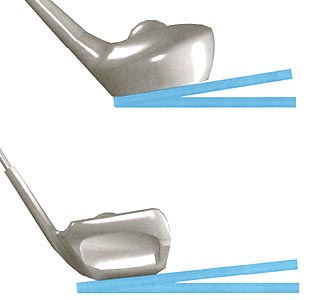 Note that the toe of the club is off the ground for both woods and irons. At impact, this next diagram shows the likely hand and clubshaft position. 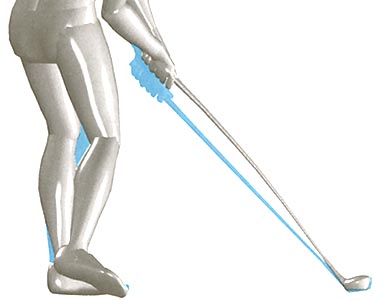 Blue color = Address position. Grey color = impact position. The degree that the hands are higher at impact varies between different players. Hogan got to the same low hand position, but Zach Johnson's hands are much higher at impact than address - see next photo. 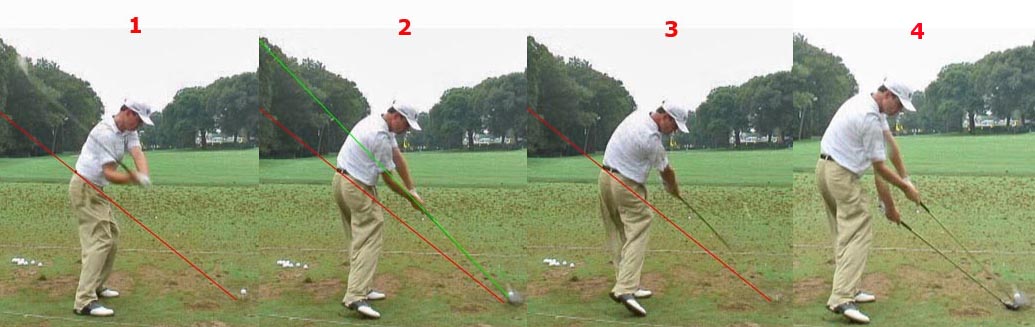 The red line is the hand plane at address. Image 4 shows the difference in hand position between address and impact. Homer offers this piece of advice to establish the swing radius. ""A geometrically proper procedure is to establish the correct radius with the Clubhead raised to the desired Impact relationship. Then maintain the center of the arc-that is, the left shoulder-as now established, and hold the Hands at the height and angle now established, then let the club swing down from the Wrist to rest on the ground. Now apply Extensor Action (6-B-1-D) to stretch the left arm and 'get as 'far away from the ball as possible." I personally don't think that it can be very critical to pre-establish this swing radius at address, because the true swing radius at impact is very different (as demonstrated in the Zach Johnson photo) and the left shoulder socket is not in the same position at impact as it is at address. Jeff. |
That is what I thought
That is what my experimentation with 2-J-1 (thanks!) has told me. HK's "little tricks" have had a huge impact!
|
Thanks Jeff
Just saw your reply. Thank you for explanation as well as the pics, Jeff. I really appreciate the visuals you have provided. Althought, it gets testy at times I also appreciate the thinker threads you have initiated. Is this still the case if your intention is a zero shift, using the turned shoulder plane?
|
Okie
I think that this difference between impact and address hand/clubshaft alignments gets markedly minimized (or eliminated) if one uses a zero-plane shift swing with a steep clubshaft plane (eg. on turned shoulder plane). I have never seen a swing video of a golfer who has a zero-plane shift swing on the turned shoulder plane. The only zero-plane shift swing I have seen is Moe Norman's swing.  You can see that More stretches his arms out at address and his clubshaft-at-address plane is higher than the hand plane. The photo-series shows only the backswing and he stays on a single plane during the entire backswing. During the downswing, he comes down that same plane and he ends up on the clubshaft-at-address plane at impact. Brian Gay also has close to a zero-plane shift swing. 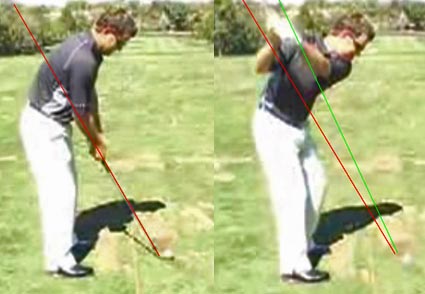 Brian Gay also holds his hands high at address, and doesn't have much plane shift during the backswing (his hands end up just under the turned shoulder plane at the end-backswing). He then comes down to the same clubshaft-at-address plane (elbow plane) at impact. Jeff. |
Shifty Character
I was thinking along those lines! I have been working hard on emulating 10-6-B#1 at address and # 2 at top with mixed success. My hands are used to starting low and then finding their way to a more upright plane at impact. I find the distinction between address and impact helpful. Still, shifts are hazardous! Thanks again for your insights.
|
Moe zero-plane shift?
Jeff
One month ago, you wrote on another forum, in a very controversial thread about plane shift: 20/05/2008 This issue of More having a zero shift swing has previously been discussed, and I produced a number of images that demonstrates that Moe has a single (not zero) plane shift swing Jeff Today you say: Quote:
Can you indicate where is the truth and why you changed opinion? Phil |
Phil
I had to change my mind because I was proven wrong. I originally took the position that Moe Norman shifted planes during the backswing - based on an analysis of this swing video. http://www.youtube.com/watch?v=Z2FBoHmq_h8 This is a photo series form that swing video. 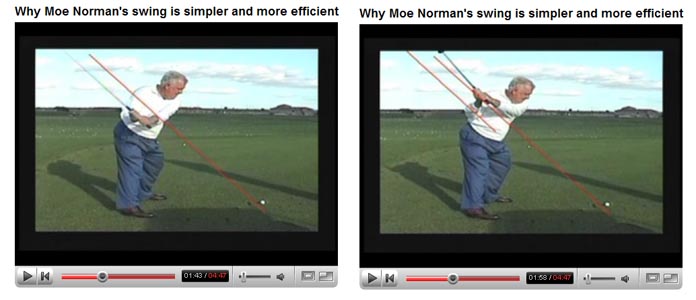 It looks like Moe Norman is on shallower, but parallel, plane in mid-backswing. However, I now realize that my interpretation of a plane shift was wrong and that it was due to camera angle distortion-error. I only realized that Moe Norman really stayed on the same plane when I had the opportunity to analyse a swing video from an up-the-line (rather than down-the-line) swing video where there was far less camera angle parallax error problems. I then realized that Moe Norman really had a zero-plane shift swing. As a Popperian, I was forced to change my opinion when my original opinion was falsified by "solid" contrary evidence. Later in that forum's thread, I admitted I was wrong and I produced this photo-series showing how Moe Norman's clubshaft stayed on the same plane during the backswing and downswing. Jeff. |
Karl Popper I presume - there are only two type of scientific facts those untrue and those yet to be proven untrue.
|
The only problem I see is the second set of photos appear to be take at an angle to Moe. Perhaps the angle makes it appear to be a one plane swing?
|
Mb
It is true that both swing videos of Moe Norman have imperfect camera angles, so ultimately it is a "guess" re: the accuracy of the visual assessments. My own guesstimation is that the up-the-line view has less camera angle parallax distortion, and that Moe Norman had a zero-plane shift swing, or a near-zero-plane shift swing. I am always open to being supplied with yet another swing video of Moe Norman's swing that has a better (more neutral) DTL camera angle. Jeff. |
Quote:
I remember this....it is me, KOC, shared this swing sequences to Jeff and you have it.:) |
| All times are GMT -4. The time now is 05:35 PM. |