
|
The Finish Swivel
Just back from our wonderful LBG Academy experience at Old Waverly Golf Club. Once again, the video camera revealed that few students have an adequate Finish Swivel to bridge the gap between the end of the Left Wrist Hinge Action from Impact to Follow-Through (Both Arms Straight and the Club about 45 degrees to the ground) and the Finish (any point beyond the Follow-Through).
Here's my version (taken from a revealing camera angle at our Woodmont school). After the Horizontal Hinge Action (Frames 7-9, Left Wrist remaining Vertical, or perpendicular, to the ground, i.e., the horizontal plane), the Left Wrist Swivels (Frames 10 and 11) -- actually twists, i.e., rotates to the left away from the Vertical -- until the Wrists are in their 'parallel to the Plane' alignment. With momentum, especially in the longer shots, the wrists may actually Swivel a bit further. It is in this Swiveled condition that the Right Wrist loses its Bend. As the Stroke comes to its conclusion, the Right Wrist Bend is re-established and the Flying Wedge alignments are restored (Frame 12). One good way to learn this Feel is to do the following simple drill: 1. From a normal standing posture, extend your Left Hand chest-high in front of your Body with the Left Palm facing the sky ("catching raindrops"). 2. Lay your Right Wrist directly over your Left Wrist, letting the palm 'hang' facing the ground. Your palms will not be touching. Instead, your Left palm will extend from under your Right Wrist, and your Right Wrist will extend over the top of your Left. 3. Leaving your Feet planted, turn your Body to the left and then look at your Wrists and Arms. That's about how they should appear at the completion of your Finish Swivel -- the Right Wrist has 'crossed-over' the Left. This is how the Clubshaft completes its rotation around the Sweet Spot. Can you believe it? :shock: Of course, your Computer will not let you get there if you are approaching the Ball from above the Plane ("Outside-In"). Instead, it will actually rotate the Left Wrist in the opposite direction (clockwise) -- and usually throw in a good old-fashioned 'chicken wing' for good measure -- in order to STEER (the First Snare / 3-F-7-A) the Clubhead and Clubface (and Ball) back to the Target. But that's another story...   Many thanks to 6bmike for both the Stroke Sequence and Video. |
Left Elbow
Thanks Yoda - this is very helpful information and I think misunderstanding hinge action and finish swivel is a major problem of mine. There's danger in misunderstanding concepts - I had misapplied the concept of flat left wrist and a bent right wrist at impact and would try to "freeze" that position beyond impact by trying to keep the hands ahead of the clubhead after impact and the hands in a vertical line with a straight and rigid left arm. This results in severe arching and then ultimately flipping of the left wrist (the very thing I was trying not to do). So this overtaking by the clubhead of the hands via rolling during the hinging action is a great revelation to me. I think I am also now starting to understand the need for me to uncock and then roll in the release.
One other thing I have been trying is to keep my left elbow close to my left side right after impact so that the left elbow moves towards my rear as my shoulders and torso turn - this allows my hands to also "pass" the left elbow. With the old move, my shoulders wouldn't turn much right after impact as I tried to keep my left elbow in front of my hands. I also have now allowed my left elbow to be more supple and be prepared to bend soon after impact as it stays near the left side of my body. I hope these thoughts are headed in the right direction. Now I need to figure out how to get to these alignments from the top at full speed (chipping has started to improve a lot). |
Another great clip and terrific slow motion of Yoda at impact making it look easy.
Thanks for posting!!! |
Hall-of-Fame post, Yoda
V-E-R-Y important clip!
It took me a long time until I could finally (only this winter) grasp how crucial the swivel action was to improve my swing. Bascially my swivel was premature. Thus destroying my left arm flying wedge, straightening my right wrist, bending my plane line severely left, causing vicious hooks and what have you. L@@K, L@@K, L@@K. Wouldn't you say that over-swiveling (based on the false idea that it would smack the ball harder) is more common than under-swiveling? |
Hinge First, Then Swivel
Quote:
However, once the player begins in earnest to incorporate into his Stroke this missing element, then, as you have said, it is easy to make the mistake of executing Impact as a Swivel Action (and not as a Hinge Action). I should know, because before The Golfing Machine, I did it for years. You must Hinge first, and only then Swivel. Or else expect a mass exodus of the left rough field mice every time you step to the Tee. :D Bobby Jones once wrote: "There is no virtue that cannot be exaggerated into a fault." Certainly, that truth applies to the Finish Swivel. |
Focus On the Finish Swivel
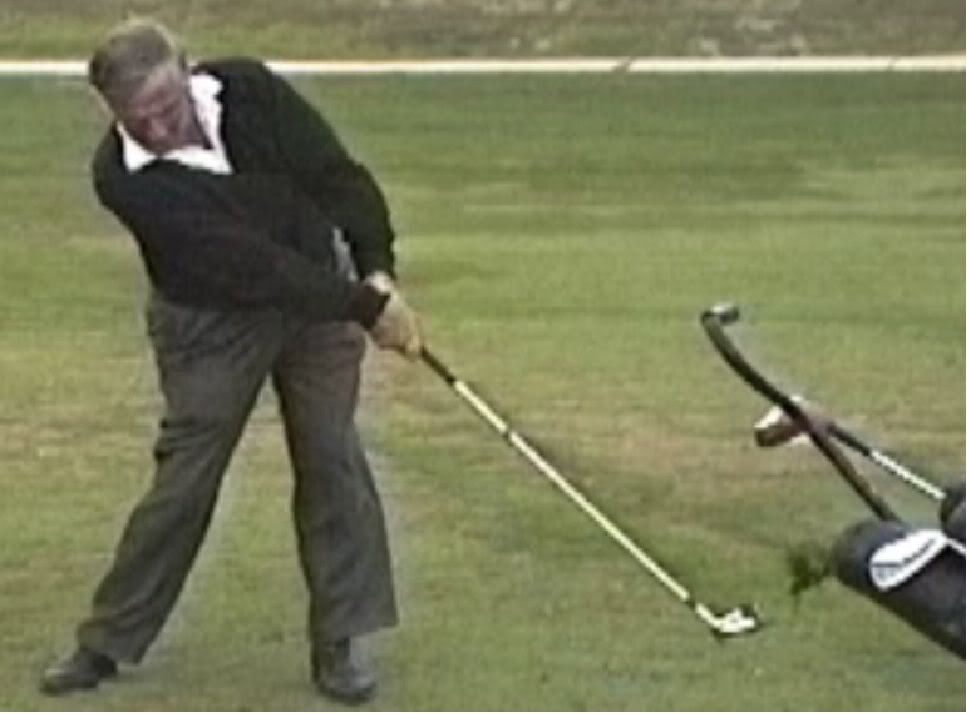
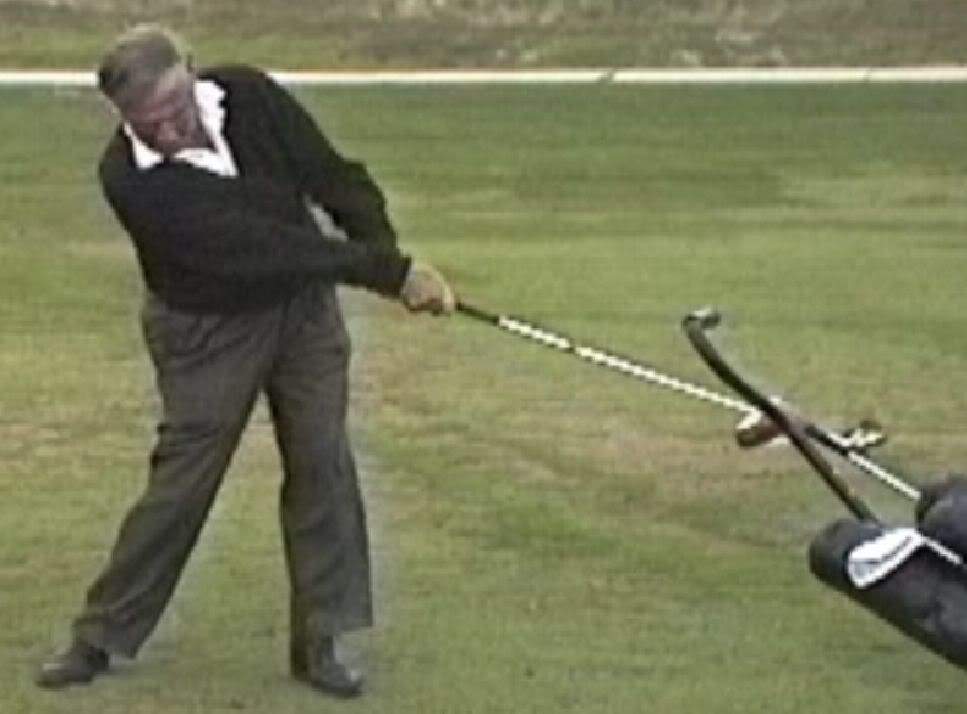
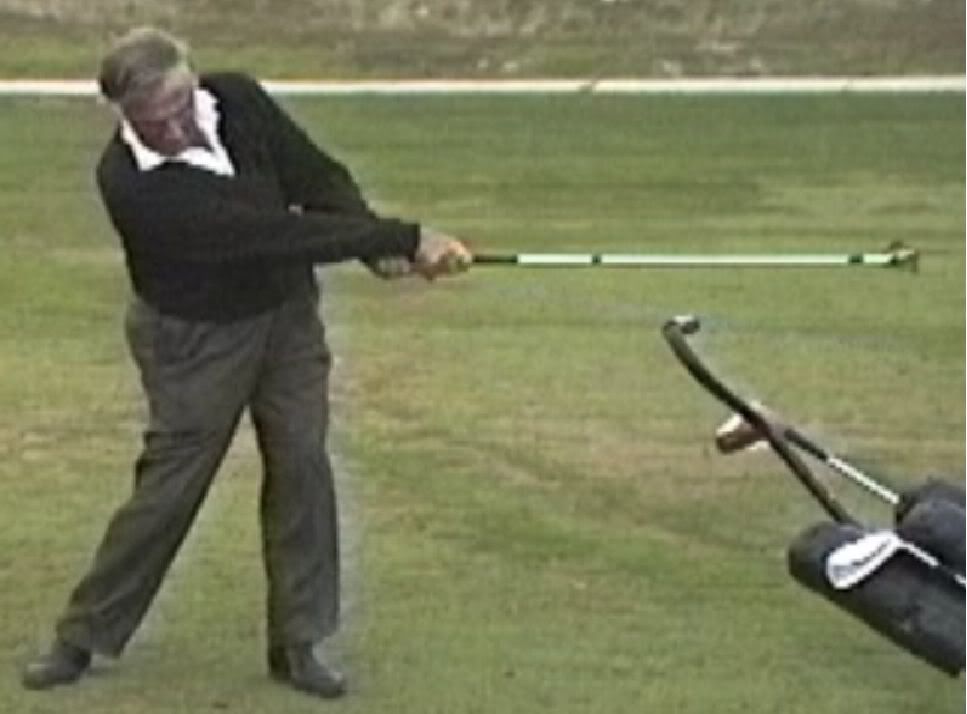
Here are three enlargements of the Finish Swivel.
The first illustrates the exit from the Follow-Through (Both Arms Straight Position). The Wrists have begun their rotation from their 'Vertical (perpendicular) to the ground' alignment during the Impact Hinge Action into their 'parallel to the Plane' alignment during the Finish Swivel. The Hands are waist-high, and the Clubshaft is parallel to the ground (and also to the Plane Line). The second and third photos show the momentum-induced move past 'parallel to the plane' to almost horizontal. This occurs only as the Hands approach chest-high and the Clubshaft points skyward (and also to the Plane Line). Many make the serious mistake of executing this Action through Impact. This is Clubhead Throwaway: An Over-Roll that puts the Clubshaft out of line with the Left Arm -- loss of Rhythm (RPM) -- just as surely as does a Bent Left Wrist. Avoid both. Note that the Left Wrist has remained Flat. Also, the Right Arm has straightened through Impact and has remained that way deep into the Finish. That is possible only with Extensor Action. The Ball was well-compressed and went dead straight. I was not born with these mechanics. Far from it. But, I did learn them, and you can, too. By the way, the figure in the background is Ben Doyle, the first Authorized Instructor of The Golfing Machine. He has taught the Finish Swivel for almost fifty years, and I think he would give this one 'two thumbs up.'    |
Regarding the Finish Swivel, I couldn't quite remember what Ben taught at Canton, but was it something like this?
http://homepage.mac.com/brianmanzell...endoyle-fi.mov |
Lynn truly outstanding work...yes Hinge action and Finish swivel very different indeed...
However very important points to consider... #1) Finish Swivel is parallel to the Selected Plane Angle...I see so many over swivel to the finish ...both off plane with the Hands and the sweetspot and shaft planes....Reulting in the dreaded "Count Dracula" Finish... #2) Many argue here that the left wrist must still be "Flat" but I beg to differ using the Grip Type variation as the ever present "Trump Card" #3) Although I respect my elders in TGM..just like there is Perverted Pitch Elbow, Perverted Axis Tilt...I am now proclaiming that there can be a Perverted Finish Swivel...I don't really care how many years someone has taught something it can be misrepresented...For Example the Flying Wedges? Lesson I've learned the most in life and G.O.L.F.:...Don't be perverted!!!....Bucket? I thought your demonstration of Finish Swivel was more accurate and concise at Pine Needles than what has been demonstrated after your Canton experience with the Grand Pooh Bah. But point is well made and very well demonstrated... Don't execute Impact as a Swivel... But in reality there is a Hinge Action between Release Swivel and Finish Swivel for the Swinger... :cool: Annikan |
Cool video lynn
That was cool :)
|
Yoda,
Thank you for spending so much time on this at the "Old Waverly" seminar. The finish swivel concept became clear with the help of three learning experiences. The time line was: First. V.J.’s computer illustrating low point and the #3 pressure point that Must continue on-plane after impact. Impact is further down plane than I thought. Second. Ted using the Hula Hoop and a rod to demonstrate low point, divot depth, ball position and the #3 pressure point that must continue on-plane after impact. Impact is further down plane than I thought. Third. Yoda, taking my hands, shoulders and arms, moving them through the motion over and over until I could see and feel how far down-out-and-forward-on-plane the hinging motion travels (rhythm) before the finish swivel. Impact is further down plane than I thought. This is "The Golfing Machine". Hinging and the finish swivel and EXTENSOR action. I never could or would have learned this on my own and it’s the difference between hackers and golfers. |
Journey Toward the Correct Finish Swivel
Quote:
In between I hit some 800,000 practice balls. And that's a conservative number. There were many good shots, but my understanding was incomplete and it showed. What a waste. And now, 25 years and probably another 800,000 practice balls later, I think I know the difference between the two. I have described that difference clearly in countless posts -- including those most recent above -- and now have illustrated it in both still sequence and video. The only difference between the Hinge Action and Finish Swivel you see in this video -- both, by the way, executed with a Strong Single Action Grip (Wristcock Only, no Wrist Bend) -- and the ones I photographed and sent to Homer Kelley in 1982 and later still those demonstrated in the first 'night-time' videos (late 2004) now on this site -- is the camera angle. And, at least according to my own understanding... Both are correct. |
Ben doing Finish Swivel
Quote:
   |
I just feel grasping swivel is sooooo important
Quote:
Many amateurs have the idea that the trick is to swivel during impact. Impact becomes a blur of uncocking, rolling and swiveling. In order to hit it further the selected option is to swivel more during impact. Since an over-swiveling during impact will effectively hood the face (de-loft and close) this may result in occasional longer shots (strong draws or pull-hooks). Even though the shots are likely to go all over the place it will become hard to convince the golfer that he should not (effectively) de-loft as much in order to hit it farther. So how can it be that a (perceived) de-lofting will actually produce longer shots? Tentative answer: Premature (over-)swiveling during impact will indirectly: - Make the right shoulder rise - Destroy the shoulder plane - Cause round-housing - Terminate the rotation and cause the hips to slide forward instead of rotating to face the target - Unbending the right wrist All-in-all: The faulty swivel action will distort the swing and eliminate many of the factors that enable the golfer to add more power to his swing. At least in my case it did. :rolleyes: |
Head
Based on the video the uncocking, hinge and swivel must be precise. It becomes clear why the stationary head is necessary.
Sway slightly and the uncocking is to early or to far behind the ball. |
I must not Know what I'm doing.... because if the clubface should look to the ground with the Correct Finish Swivel..then I really just don't know anything about TGM....So...I will continue my learning...Onward!!!
|
Quote:
|
Grip
Quote:
Mr. 12 Piece... I suppose grip could be a factor here. Not sure why Mr. Doyle wants the FACE pointing to the ground like this, but from talking with people that have been around him... this is what he wants. I remember Mr. Yoda saying once in a situation similar to this... that just because the ball is gone does not mean that this(or similar) position is not important. I believe he said something about "a precision destination." This is part of the "landing" of the golf stroke. You want a smooth landing. If the brain knows you are going to crash land, it will do something beforehand to prepare for that crash. Sooo... you better know how to "land." This idea came from Mr. Bleckley, who was/is associated with Mr. Kelnhofer G.S.E.D.. |
I would suspect to be geometrically correct the club should swivel back on plane after contact (thus no under or over swivel). Just as it swiveled on plane on the back swing.
|
Quote:
|
Quote:
It is the single greatest bit of info I learned from reading Hogan's 5 Lessons. Rotation point. That said - I'm right there with Lynn - He learned the difference between hinge and swivel from Homer at 34. I learned it from Lynn a bit over a year ago at OCN (at about the same age). The clearest way to 'feel' the difference is to get a true horizontal hinge action, which 'feels' very level. This combined with the straight line motion of the right arm (hitting or swinging, active or passive). As for perverted or not, I would suggest the root issue is the clubface rotation around the sweet spot, not the hosel. If #3 Accum is zero'd out, you wouldn't see this 'perversion' - but if you have a fair bit of #3, you will. Grip type is certainly a factor as well. |
Do "finish swivel" by the book (TGM) and the face should rest back on the plane just like it did on the backstroke/downstroke. Works well and may be "geometrically" correct.
If you do the finish swivel the "ben doyle" way it is technically "off plane" because it is now facing more towards the target than the plane but 2 things will happen: 1) you will hit the ball lower 2) you will hit the ball farther (smash factor) I have proved this via launch monitors time and time again. It's just like "someone" said in an online video, "sometimes you want to maximize compression and sometimes you don't." |
Quote:
|
Quote:
Quote:
Quote:
Hope that helps |
Nice post Jim,I would imagine(hell i know)it is difficult to feel what is happening in that millisecond.What I learned this weekend at old waverley was the difference between practice and play -and to look 'look 'look.If I practice acquired motion I have a tendency to underroll- IF i really try -normally i would flip or angle hinge.So i try to imagine the "watch to the ground" position -which is fine as long as i don't actually do it (UNLESS I WANT TO) . I just think the "feel"side of TGM is underrated -but not by the master YODA,or TED ,or V.J.orJEFF!You MUST BE bang on plane:)
|
Quote:
Just proves that a hands manipulated swinger with great hand-eye coordination (even Tiger) can create any ball flight. :) Wish I could. Horizontal hinging is a closing only motion. The motion starts a few inches before impact (slightly open clubface) and ends about a foot after low point (slightly closed clubface). It’s a smooth and mild closing motion because the hands-clubshaft-clubface are moving downward-outward-forward on plane (even past low point) and the radius of the hinge is from the left shoulder. The closing is mild both in degrees and rate from the beginning to end during its’ approximately fifteen inch impact travel. Therefore, hinging cannot account for radical ball flight inconsistencies. The finish swivel occurs after finish. It’s important to keep hinging and finish swivel separate. Study Bens’ pictures. If his right wrist is flattening, then his left wrist is bending. Can’t have one without the other using a strong single action grip. Do I see a slight amount of chicken wing? Where are “BOTH ARMS STRAIGHT FULL EXTENSION” and extensor action. See 9-2-11 #1 and 9-2-11 #2. Look at Lynn Blake picture #8: perfect horizontal hinge…. Look at the clubface in #8: end of on plane horizontal hinge. Precise follow-through position after hinge. Both arms straight. #9 and #10 and #11 are on plane swivel. |
i use no hand manipulation.
Doyle's "chicken wing" is not actually a chicken wing. It's a result of what happens when you swivel with a flat left wrist through the ball. The left arm bends much quicker at the elbow. Just because your right wrist "un bends" a little doesn't mean that you're left wrist becomes bent. I can swing throughout the entire swing with a flat left wrist with a tac-tic on if you want and you'll never hear it click. |
Yoda - Preach it
In some churches you might hear "Preach it brother Lynn" after a sermon like that video!
Thanks for this thread. |
jim,
From my experiences with that damn tac-tic you need to bend a good 10 degrees before it will click. Not to say I don't believe you can keep a flat left wrist whilst swiveling dramatically. I just don't know that the tac-tic is the ultimate test. Matt |
Quote:
I'm not advocating to swing with a flat left wrist throughout the entire swing as i feel it did create some shoulder issues for me a little. However i can still do it w/o much issue. |
How does one stop swivelling during impact?
There is a video on Peter Croker's site in which someone swings a golfer's flail, 2k-4 and 2k-5. The person swinging the flail states that if the club is not swung properly, the swing will get "lumpy". Although the instructor doesn't use the term swivel,I believe that "lumpy" referred to a lack of swivel. Lately, I find that executing the golfer's flail, taking out the lump, results in better rotation. Nevertheless, I am probably initiating the swivel during impact. |
Quote:
KEEP THE LEFT WRIST VERTICAL TO THE HORIZONTAL PLANE WHILE YOU TRACE THE PLANE LINE WITH THE RIGHT FOREARM PAST LOW POINT. Do not roll the left arm independent of the upper torso until after follow-through. :) Do not pass go. Do not collect $200.00 (my weird sense of humor) |
jim,
I must have managed to get a manufacturer defect or something. Double loop is still yielding crappy results. Matt |
..........
|
Quote:
|
Quote:
I have had a few friends buy them since then and they are more flimsy. Try a credit card under your watch. |
Most bad players don't Swivel enough and most good players
Swivel too much, even coming in too steep they can Swivel their way out without any trace of a chicken wing or LW breakdown. Most teachers spend so much time on the range demonstrating Hinge Action, especially the Horizontal variety and Swivelling that they themselves become the victims of too much of a good thing. The subject here under discussion is one of the reasons TGM sank into obscurity in the eighties while others became very, very wealthy selling a less extreme Swivel, after a less Horizontal Hinge. Please dont head down that road again!. |
Horizontal Hinges don't jive with me for some reason. Don't like it at all.
I think it's one of those things I need a lesson on. |
jim,
That's very interesting to know and thanks for the tip! Matt |
Hinge Action And Swivel Action -- Independent,, Coordinate and Precise
Quote:
The Teacher who encourages a Clubface to the Ground at waist-high (or earlier) is encouraging an Over Roll and Throwaway. Likewise, the Non-Swiveling Student who takes the whole bottle of medicine -- not just one pill -- and combines it with a Turned Left Hand Grip (10-2-D) proves to the world that it just "doesn't work." In the face of these misguided efforts, The Golfing Machine stands in its precision. The Horizontal Hinge Action of the Flat Left Wrist is just that: Through Impact and Follow-Through, the Flat Left Wrist remains Vertical (Perpendicular) to the Horizontal Plane (the ground). As the bridge to the Finish, Swivel Action Rolls that Horizontal Hinge Action -- AFTER the Follow-Through -- into its correct Parallel to the Angled Plane alignment. This is a far more dramatic motion than most golfers appreciate. Then, as the player emerges from Follow-Through, he often begins to 'stand up' into his Finish, i.e., the Right Shoulder comes off the Plane. I know I do -- my back and lack of flexibility demand it -- and when that happens, the On Plane Wrists now appear to Roll further toward the Horizontal. Actually, the Wrists are merely maintaining their original On Plane alignments. Only the On Plane Shoulder alignment has changed. And that by just a 'smidgeon.' Again, at no time do the Head and upper torso 'hang back' while the Hands Swivel independently through Impact. That way lies sorrow. Nor do they Swivel as a high Right Forearm directs the Clubhead across the Plane Line from the Outside-In. Read The Book and my posts. Define the geometry of the Hinge Action and the Swivel Action and their respective relationships with the Plane Line. And don't be frightened by that Rolling, Vertical-To-the-Ground Clubface through Impact or its subsequent Swiveled, On Plane condition. Know that its relationship through the Ball is with its Associated Plane (Horizontal, Angled or Vertical / Hinge Action) and only after the Follow-Through (Both Arms Straight) with the Plane Angle (Swivel Action). Except as integral to the Impact Alignments established at Impact Fix (2-J-1), the Target Line is incidental. |
Yes, thankyou.
I was referring specifically to the head and torso "hangback" and what became known as the "Horizontal Hinge on steroids". Thankyou for your obviously tireless work and devotion to Homer Kelley's great work. It is very, very much appreciated. |
| All times are GMT -4. The time now is 08:18 PM. |