
|
The point is: If I throw a ball to you just out of your reach, you move to catch it based on where you hand needs to be. I would doubt that you would shuffle, twist or contort yourself or think about what your body is doing. See ball- catch ball. I am not discussing chains, sequencing, etc.
My job as an instructor is to help people learn and enjoy the game. If I can do that and help them reduce or avoid injury because some other teacher gave them the impression they need 120 degrees of shoulder turn, then that is what I will do. Dr. Seaman did his research and it's not my job to prove it is credible because someone else doesn't like it. If you or anyone else wants to take the time and refute his findings then knock yourself out. |
Bio Just admit it...
"agree with shear forces"????? What kind of ridiculous idiocy is that? Its like saying you agree the sky is blue.... Admit it Bio-BSer, you're a technician whose been taught how to perform a measurement, but you're clueless when it comes to interpretation of results. Its obvious y what you've written (here and elsewhere) that you have no clue what shear force is let alone a dof or COAM. And the fact that you are such fawning sycophant of homer's proves that you are completely unaware how riddled with technical error his work really is. But what's worst is that think the spine is designed for twisting and or that there is ANY power to be had by torquing the torso. That is down right scary. Mark my words you will be sued for injuries you will cause. Lasty you may think being an a-hole is all "just fun and games" but where I'm from its just BEING AND A-HOLE. Quote:
|
Thank you for the kind words Coop. There was a time when that forum was open to all ideas but not anymore. When they went to "rev. 3" or what ever it is, apparently they closed the door to all but the owner's personally espoused beliefs. This I knew (or at least suspected) but I spoke up anyway and for that I take personal responsibility. I try not to let any of this get personal but when the ad homenim starts flowing... I'm human.
Fact is some of these guys (especially those starting the arguments) are simply marketing. They are promoting what ever snake oil it is they think might get them noticed, invited to speak, write for a periodical or perhaps even just con the next client into signing up for lessons (or measurements). To them its "just business" or as one says, "good fun" which is too bad for everyone. Quote:
Lastly Coop I also think there is much work yet to be done in understanding the bio-mechanics of the golf-swing and it is people like you that will get it done. (You are the author of that highly regarded book are you not... well done!) Quote:
|
augusta golfer
Quote:
At the end of the day he put his name on the book, look deeper and you will find where his research came from. |
no mind
Quote:
People develop the wrong perceptions of body rotations from glossy magazines. what the x factor thats destroyed more swings and injured more people, I agree go sue the x factor boys. welldone to your letter from your biomechanists friend, he's right, it's called muscular loading, go to see he is on the right path.:) I sincerely mean this well done to him, he is on the money. I agree with him. the chain is an indication to what the body is doing in a motion, all it indicates is rotational speeds, show's each segments acceleration and deceleration and if the segment are moving in the right sequence and whether the body segment is efficient and inefficient in their swing. there is stability as well,muscular loading and club dynamics as well to consider, which we measure. measuring shear force is also some thing we measure, we can tell you if they apply enough shear force or not enough. No-mind golfer you may not agree on coam that's ok, but if we were to speak in person you would find we are on the same page on a lot of things.I like the letter you presented and liked what was said. I would love to explain coam, but to put to paper is to hard to explain. honestly send me a email and would love to organise a webinar and speak with you further.:) i would be happy to show you in depth what we do. how this is measured and why would you like to find out? |
I thought that this thread was removed from the forum. I didn't realize that is was moved to this section.
Wow! It is good to see nmgolfer's posts again. I thought that he had disappeared from online golf forums. I especially like his sound argument that the logic of a poster's argumentative position depends on its intrinsic logicality (its intellectual coherence and its concordance with objective reality) and not on the "qualifications" of the poster. I am not surprised that he found Biomechanic's posts of little value, and I am not surprised that Biomechanic thought he was a Jeff-clone. Going back to the "facts" regarding the kinetic chain - I agree with nmgolfer that the kinetic chain and COAM doesn't apply to torso movements in a golf swing. However, I think that nmgolfer is wrong about two points. 1)I think that COAM does apply to the relationship between the movement of the left arm and the clubshaft. 2) I think that the the left arm slows down prior to impact. nmgolfer only quoted one source that claims that the arms/hands do not slow down prior to impact - Nesbit's research study. However, there is substantial evidence from many other sources that demonstrate that the left arm/hands do slow down prior to impact. An explanation of why the hands should be expected to slow down prior to impact comes from an understanding of TGM mechanics. Here is my personal explanation. In a pivot-driven swinger's action, the pivot supplies swing power that is responsible for the release of PA#4. From then on, the body pivot motion does not affect power production because the PA release sequence is 4:2:3 and PA#2/3 are passive release phenomena. The club is an inert object that doesn't know from where the source of power is derived - it only responds to the pull force at the grip (exerted by the left hand). In that sense, the double pendulum swing model applies. The clubshaft is equivalent to the peripheral arm and only responds to pull forces exerted at the peripheral hinge joint (left hand), and the peripheral hinge joint only moves as fast as the central arm (equivalent to the golfer's left arm). In a pivot-driven swing, the pivot supplies swing power that causes the release of PA#4. Once PA#4 has been released, then no more energy is imparted to the system of the flying left arm (from the central torque generator = body pivot motion) . In that sense the flying left arm is a motional system containing a "fixed" amount of energy. When PA#2 releases, and the clubshaft becomes more in line with the left arm, then the left arm must slow down. There are two valid explanations for this phenomenon. The one explanation relates to COAM. Explanation number 1 If the left arm (central arm)/clubshaft (peripheral arm) is a system in motion, and there is a "fixed" amount of energy in the entire motional system, then the central arm must slow down if the peripheral arm speeds up - because energy moves from the center to the periphery. Explanation number 2 Another way of understanding this COAM phenomenon relates to the distribution of the COG relative to the axis of rotation. If the COG of the entire motional system moves further from the central axis of rotation (which is the central hinge point from which the central arm is suspended in a double pendulum model), then the entire motional system must slow down. That's the explanation evoked by David Tutelman in his explanation. I now believe that the hands slow down prior to impact (because the left arm slows down prior to impact) in an excellent golfer's swing and it's a good thing - because it allows time for release of PA#3 and the squaring-up of the clubface prior to impact. Here is a capture image of Tiger Woods swing - videod at 4,000 frames/second. Every white dot joining those red lines represents 10 frames (1/400th second) and one can see that Tiger's left arm slows down just before impact. 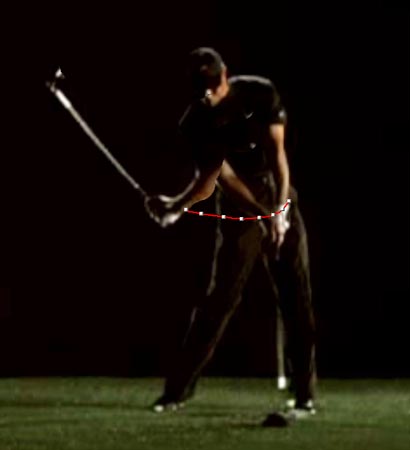 There is one other unquantifiable factor that makes my COAM explanation far from full-proof. The COAM idea is based on the belief that all the energy propelling the clubshaft is only passively derived from the left arm (according to the principle of COAM), and that the left arm derives all its energy via the release of PA#4. However, one needs to consider another factor - the role of left forearm muscles in actively releasing PA#2 and/or PA#3. If the left forearm muscles supply any energy to actively release PA#2 or PA#3, then the left arm may not need to slow down as much as predicted by the COAM theory. Jeff. |
| All times are GMT -4. The time now is 07:18 PM. |