|
No. I am not plowing new ground. I am simply using words, and pictorial examples, to explain relevant Newtoniain laws that pertain to this issue of "centripetal acceleration" (as I understand those laws).
Although, nmgolfer labels me "clueless", I believe that all my posts are fully compatible with the Newtonian laws expressed in all those links. That's why I am very comfortable with the idea of having him dissect my opinions as thoroughly as possible. It is interesting that nmgolfer is full of bluster about my "cluelessness", but doesn't offer a detailed argument explaining why my many posted explanations are inaccurate and incompatible with Newtonian laws. Jeff. |
Memos For Understanding
Quote:
:salut: |
Quote:
i am no physics buff but what about if its the other way around..i.e if there is no tangential force it would end up at point B..nice drawing btw |
Quote:
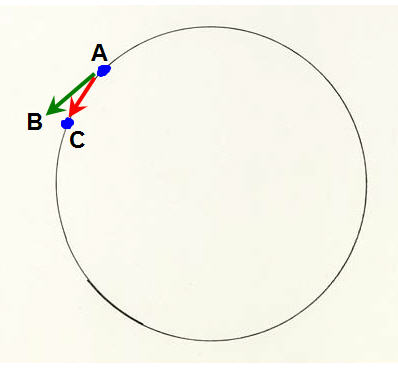
You've already drawn two vectors in your figure, so let's just start by saying that a vector is a directed size. In our case it will either be a directed force or a directed velocity. If the object is already moving in a circle you don't need the B force vector to move it from A to C. You only need a centripetal force from A to Origo to do that. So your diagram need an invard pointing vector to be complete. Origo is the center of the circle, btw. The centripetal force simply adjust the direction a little all the time, so the object is forced to move in a circle instead of going straight ahead. It can be a string attached to a pole or it could be a physical path that forces the object to circulate. As long as there's no friction loss, air drag or other resistance that consumes energy, the object will spin forever. The centripetal force doesn't do any work in a Newtonian sense. It doesn't increase the speed. It doesn't overcome any resistive loss if any of such is present. It only changes the direction of the mass movement. If you apply a B force vector to the system the speed of the moving object will be increased. But only to the the extent that the force vector points in the same direction as the object is moving. It's the B forces that produces the swing speed. |
The newtonian approach
Quote:
The formula is 100% correct. Without exception. This is very basic physics. The efforts to stay in balance, preventing the object from flying off its circular path etc does not produce work in a Newtonian sense. And they do not produce swing speed either. Even though they are required to perform a golf stroke. |
Bernt - you wrote-: "If the object is already moving in a circle you don't need the B force vector to move it from A to C. You only need a centripetal force from A to Origo to do that. So your diagram need an invard pointing vector to be complete. Origo is the center of the circle, btw."
You don't understand my position. I have simply divided the model into the two forces that are operant when an orbiting object travels in a circular path - a tangential force (operating always in a straight line direction) that supplies energy to allow the oribiting object to travel at a constant speed; and a centripetal force that causes the orbiting object to centripetally accelerate so that it travels along a circular path instead of a straight line path. In that diagram - the tangential force vector is directed towards B because a tangential force always operates in a straight line direction. The centripetal force (which is directed towards the center of the circle) deflects the orbiting object so that it ends up at point C instead of point B. You also wrote-: "The centripetal force doesn't do any work in a Newtonian sense. It doesn't increase the speed. It doesn't overcome any resistive loss if any of such is present. It only changes the direction of the mass movement." I agree that a centripetal force doesn't increase the speed of the orbiting object and that it only changes the direction of the movement of the mass. However, it requires a Newtonian force to change the direction of a moving object, and when that force is operant it is using energy and therefore doing work. To make it even easier for anyone to falsify my understanding/explanation of "centripetal force action", I am producing this simple example of forces in action. 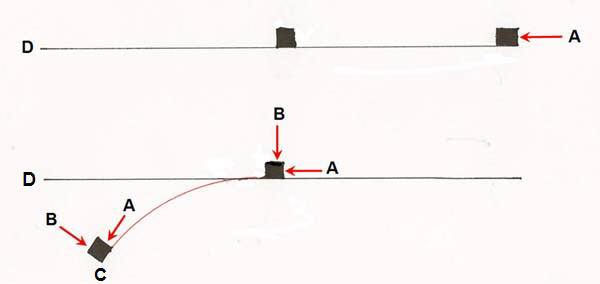 This diagram represents a birds eye view of person A pushing a lightweight 10'x10'X10' square box across an ice rink. His plan is to push the square box in a straight line direction towards destination D. He works out that it would take him 20 minutes to accomplish that goal - considering the friction drag of the ice against the undersurface of the box. He pushes in a straight line direction towards destination point D. Because of the 10' height of the box he cannot see where he is going, but imagine that person A has an uncanny ability to always apply his constant push force perpendicular to the surface of the box and that he is always pushing in a straight line thrust action. After 10 minutes, person A stops for a rest and he notes that he has completed 50% of the distance to destination point D (top diagram) - because he is applying a constant straight line push-force against the box. Now imagine that person A starts pushing again with the same level of straight line push-force. However, he doesn't realise that person B has arrived and person B is also pushing in a straight line thrust against the surface of the box - at a right angle to person A's straight line thrust action. Person B is less strong than person A and applies less push-force than person B. What happens after 10 minutes? The box ends up at point C rather than destination point D (bottom diagram). The reason is that there is another force present that deflects the moving mass from its straight line path. In other words, that other force changes the direction of the movement of the moving mass, so that it follows a circular path instead of a straight line path. Note that the other force pushes at right angles to the circumference of the circular path - and that it is therefore directing its force towards the center of a hypothetical circle. It doesn't take much common sense to interpret what I have described. Person A is supplying a push-force that moves the mass at a constant speed in a straight line direction - and that represents the tangential force. Person B is also supplying a push-force that is directed at right angles to the tangential force - and that represents the centripetal force. It should also be apparent that the centripetal force is a Newtonian-type force that is capable of changing the direction of movement of a mass (that is being moved at a constant speed by a constantly present tangential force), and that it is manifesting energy and performing work. Jeff. |
Hello Jeff,
Since there is friction here, A is doing work even though the speed becomes constant after a while. If B's contribution is only to turn a linear movement into a circular movement, B is not doing any work. The object is always moving perpendicular to the direction B is pushing. The angle between the object movement and B's pull force need to be different from 90* before any work is done. Changing direction is not the same as doing work - even though it makes a significant difference. |
Bernt
You wrote-: "If B's contribution is only to turn a linear movement into a circular movement, B is not doing any work. The object is always moving perpendicular to the direction B is pushing. The angle between the object movement and B's pull force need to be different from 90* before any work is done." I think that you are wrong. The fact that the object is changing direction means that there is a force present that is causing that change of direction. If a force is present and causing a change in the direction of the object's path, then it is doing work by moving the object in another direction. Person A represents the tangential force that causes the object to overcome friction and move forward at a finite speed. Person B is providing another force that pushes the object in a constantly changing direction at every instantaneous moment in time, and causes the object to follow a circular path. Conceptually, person B is providing a push-force that constantly deflects the object in its straight line path, so that the object is forced to follow a circular path. In a Newtonian sense, that push-force must have energy and it must be working - if it has the capacity to constantly deflect the mass of the object to an ever-changing directional path (a circular path). I think that your idea that person B cannot be doing push-work because he is standing at 90 degrees to the circular path is incorrect. He is only standing at 90 degrees to the circular path - as result of his successful work effort of constantly deflecting the object from person's A desired straight line push-action. If person B wasn't doing any work, the path would no longer be circular and it would become a straight line path again. You wrote-: "The object is always moving perpendicular to the direction B is pushing." That is correct, but it is a reflection of person B's effective work effort. In fact, if person B increases his push-force by working even harder, he will still always be perpendicular to the circular path, but now the circular path will have a tighter (smaller) radius. If that doesn't represent the result of increased work effort, then I do not understand simple Newtonian physics. Jeff. |
Pistol - you asked -: " -- what about if its the other way around..i.e if there is no tangential force it would end up at point B."
Not according to Newtonian laws. Let me quote from this link that nmgolfer suggested that I read. http://www.physicsclassroom.com/Class/circles/U6L1d.cfm "An object moving in circular motion is at all times moving tangent to the circle; the velocity vector for the object is directed tangentially. To make the circular motion, there must be a net or unbalanced force directed towards the center of the circle in order to deviate the object from its otherwise tangential path. This path is an inward force - a centripetal force." That section states that at every instantaneous moment in time an object in circular motion is moving at a tangent to a circle and the velocity vector is directed tangentially. Tangentially means that it is directed at right angles to the radius of the circle at the point on the circumference where the object is presently located. That means that if there was no centripetal force operant, the vector force would cause the object to travel in a straight line direction - towards point B. What causes the orbiting object to remain on the circular path, and move to point C, is the presence of an unbalanced force directed towards the center of the circle - a centripetal force. Jeff. |
Yodas Luke
You asked for credible evidence that the clubhead arc is more rounded than the hand arc. I posted a strobe photograph of Bobby Jones which demonstrated that the hand arc is less circular than the clubhead arc. I also posted this composite photograph that shows the clubhead arc (in red) and also shows the hand position at different time points. An imaginary line joining the hand position points would be less circular and more U-shaped. 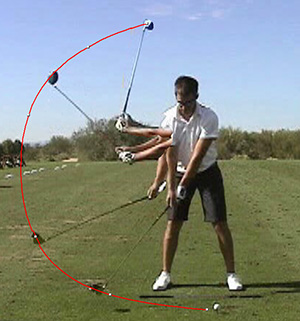 Of course, there is the problem of camera perspective distortion due to the fact that the camera is face-on, while the clubhead/hand arcs are on an inclined plane. I therefore produced the following down-the-line views of the clubhead arc and hand arc. Clubhead arc 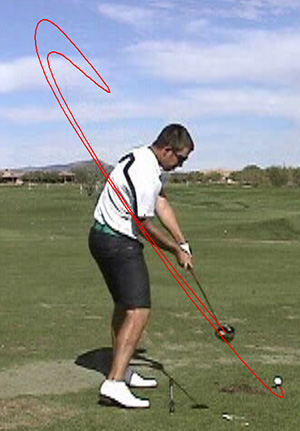 Hand arc 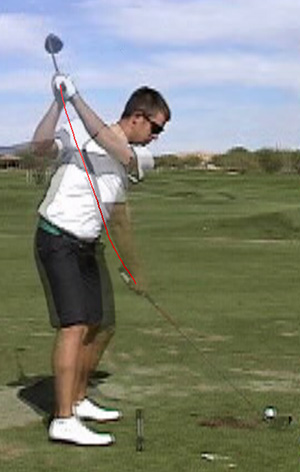 Note that the hand arc is more vertical than the clubhead arc. Therefore there will be there less camera perspective distortion with respect to the hand arc, and there is every reason to believe that the hand arc is U-shaped rather than circular. Do you have any problem with the quality of the "evidence" that I am presenting? Jeff. |
Got the World On A String
Quote:
Jeff, Forgive the interrupt, but . . . Could we please take a moment and revisit this idea -- which, either in this thread or another (can't remember) -- started this whole magnificent interchange . . . In the Golf Stroke, does the Left Arm and Clubshaft function as the "string" (Centripetal Force) keeping the Sweetspot in orbit around its Left Shoulder Center? Or does it not? Thank you. :) |
Quote:
In my opinion TGM is the only truly systematic framework for understanding the golf stroke. But the book itself is at least as hard a read as an advanced textbook in digital signal processing. And while your countless explanations have opened the door and then some, I believe there is more between the lines of the yellow book than we currently are aware of. And with all due respect to the legacy of Homer Kelley - there is (probably) always room for improvement. And kudos to Jeff for asking questions that triggers this kind of discussions (even though he is a hardheaded bloke). |
Yoda - I strongly suspect that you are not going to like this answer.
I think that the concept of the left arm-clubshaft combination being equivalent to a taut string connecting the sweetspot to the left shoulder socket only applies to a very small part of the clubhead arc - when the left arm becomes straight-in-line with the clubshaft post-impact. In the early downswing when the clubhead is lagging well behind the hands (>90 degrees) - prior to the release of PA#4 - there is essentially no independent rotation of the left arm around the left shoulder socket joint, and the left hand is essentially traveling along the straightish part of its U-shaped arc - so there can be no centripetal force involved. During the release phase of the downswing - after release of PA#4 - it is only the left hand that is rotating in a circle around the left shoulder socket (which acts as the fulcrum point), and a centripetal force only applies to the relationship between the left hand and the shoulder socket, and not between the clubhead sweetspot and the left shoulder socket. In fact, during the release phase the clubhead sweetspot is actually in a state of centrifugal release, which by definition means that it is essentially free of any centripetal influence. When the clubhead catches up to the hands and the left arm becomes in line with the clubshaft, then the clubhead sweetspot moves at roughly the same rpm as the left hand, and under those conditions a centripetal force applies to the relationship between the clubhead sweetspot and the left shoulder socket, with the left arm and clubshaft structural unit acting as a taut string connecting the sweetspot to the left shoulder. If you are seriously interested in a detailed explanation of my personal opinions, then I may consider preparing a detailed post. Jeff. |
Quote:
|
Quote:
Jeff, d Work/dt (work per time unit, power) = A * B * cos(ab), A = centripetal force, B = distance per time unit (speed), ab = angle between force and speed = 90* cos(ab) = Zero. Work per time unit is zero at all times as far as the centripetal force is conserned. Therefore total work is zero. All this is according to Newton's physics. |
radius change
Quote:
 |
Yodas Luke
If the hand arc is really as circular as your drew it, and as circular as the clubhead arc, how does HK's endless belt analogy work? According to the analogy, the machine has a straight line belt section with a pulley at the end. The release phenomenon occurs when the hands pass around the small pulley. If the hand arc is circular, then the idea of the endless belt system (as described by HK) becomes inapplicable. So, how does a random/late release phenomenon occur in a golfer who has a perfectly circular hand arc path? Jeff. |
Bernt
In your formula, the work output is zero because of the way the formula is structured. That's why I sometimes distrust the input of physicists (like nmgolfer) who are capable of deep mathematical expositions based on mathematical formulas. The "real" issue is not the accuracy of the formula, the "real" issue is it's relevance. The most important question is what's the best perspective to look at a problem, and then one has to decide which formula to use in that situation. In the situation of centripetal force, if the force doesn't provide the tangential force needed to move a mass at a certain speed a certain distance, then one shouldn't be using a formula that 'a priori' uses those requirements (speed and distance) to calculate work output. Secondly, the idea of a centripetal force always being at 90 degrees to the mass is only a mental concept, and it obviously results in zero work output according to that formula. Consider the example I gave of person B applying a force to deflect the mass (that was being pushed in a straight line direction by person A). Presume that he doesn't apply a force at right angles to the moving mass, but presume that he stands at an angle to the mass - as described in this next example - and pushes in the direction of the arrow. 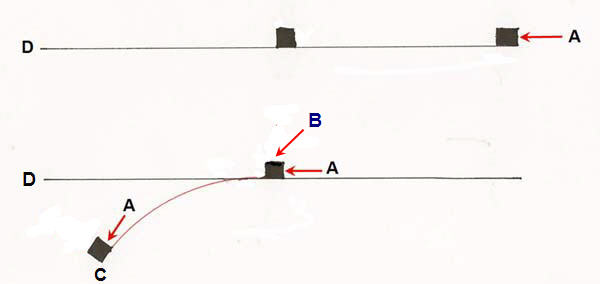 If you look at the angle that he is pushing, one can imagine that the object will not travel in a straight line path and that it will be deflected slightly leftwards. The amount that it will be deflected leftwards depends on the magnitude of person B's push-force relative to the magnitude of person A's push-force. If person B's push-force far exceeds person A's push-force, then the degree of leftwards deflection will increase. Note that person B's push-force will make the object travel faster, because a component of the push-force is working in the same direction as person's A's push-force. In other words, from a conceptual perspective, one can describe person B's push-force as having two directional components - a vector component that works in the same direction as person A's push-force and helps increase the speed of movement of the mass in person A's straight line direction, and a vector component that works at 90 degrees to person's A's straight line path, and that causes the mass to be deflected slightly leftwards. Both vector components are doing work. Now consider another example. 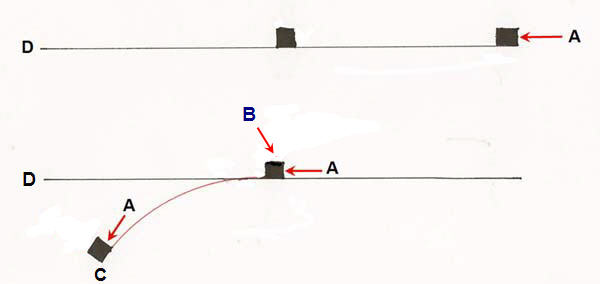 Note the direction of person B's push force. It is directed somewhat backwards. If one dissects person B's push-force into two directional components - one vector component will work in direct opposition (180 degree angle) to person A's push-force and that will slow the speed of movement of the mass. The other vector component will conceptually work at right angles to person's A direction of push-force and that will cause the object to be deflected leftwards. Both vector components are producing a work output. The amount that the object is deflected leftward depends on the magnitude of person B's push force relative to the magnitude of person A's push force. Hopefully, you will understand what points I am trying to make. 1) The first point is that the force (exerted by person B) that deflects the object leftwards is a "real" force that requires energy, and one has to rationally conclude that the force is doing work by deflecting the object. 2) After the object has been deflected, one can look back at the circular path that was transcribed on the ice rink and one can 'a posteriori' theorize as to what "force" resulted in the path being circular rather than straight line (towards destination D). One can simply conceive/theorize that a deflection force was present that caused the path to become circular-shaped. One can conceive that the "force" has centripetally accelerated (deflected) the object - defined simply as a "force" that causes an object (that already has enough energy to move in a straight line direction) to follow a circular path rather than a straight line path. In one's mental conception, one can conceive that the "force" is directed towards the center of a hypothetical circle, which means that the "force" is operating at 90 degrees to the circular path transcribed on the ice rink. However, this "force" and its 90 degree directional angle relative to the final arced path transcribed on the ice rink is merely a mental construct. In reality, there was only one force exerted by person B and it was in the direction of the red arrow, and the red arrow is not perpendicular to the circular path's arc. Jeff. |
Jeff,
For a starter, a real force can exist without any energy spending. For instance, when you stand on the ground, you are subject to a gravity force. It is as real as any other force, but while you'r standing, it doesn't do any work. Regarding your curve pattern. You could put up a fence that forces the object to turn. The forces from this fence will not use any energy and they will not work. Still they will do the same "work" as the centripetal components in your examples. In the world of golf swings & Newton, work is related to energy pretty much in the same way as acceleration is related to speed. Whenever you do work you change the mass-speed of the club or any other moving mass. (or you generate kinetic energy somewhere). When you don't do work, the energy remains constant - or is reduced due to resistance. If you learn to see the difference between forces that work and forces that doesn't, you will get a clearer image of what swing speed is made of. |
Quote:
How can the club path in the downswing be more circular when the left wrist is cocked for a large portion of the downswing (shrinking the radius from shoulder to clubhead) while the left arm remains straight (maintaining the radius from shoulder to hand)? Notice that YodasLuke used #3 to mark the spline while you used the butt end of the club. |
Bernt - If you prefer to see certain forces as existing without performing work, then you are free to perceive the world functioning in that manner. I think that if a force exists and it is operant, then it is performing work - even if the object remains stationary. So, in your example of a person standing stationary, you do not see any "work" because the object is stationary. I see "work" - because muscles forces are required to keep the person stationary and erect in the presence of gravity. If body muscles weren't actively working to oppose the force of gravity, then the person would fall to the ground.
Consider this ice rink example. 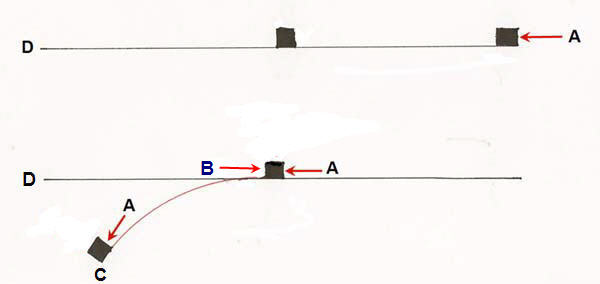 In this example, person B is applying a push-force at a 180 degree angle to person A's push-force. If the push-forces are equal, then the object will remain stationary and not move in a straight line direction towards destination D or along a circular path towards position C. If the object remains stationary, you may "feel" that person A and person B are not working. However, in my mental universe, both person A and person B are working just as hard as before (as in those previous examples) because they are supplying the same amount of push-force (energy) as before - the only difference is that their push-forces are working in perfect opposition thereby eliminating any possibility of there being any net force available to move the object on the ice rink. According to Newtonian physics - forces can be in a state of balance that results in an object being stationary. Here is a link to Newton's first law of motion. http://www.glenbrook.k12.il.us/GBSSC...aws/u2l1a.html Note that it states the following with respect to Newton's first law of motion = An object at rest tends to stay at rest and an object in motion tends to stay in motion with the same speed and in the same direction unless acted upon by an unbalanced force. In other words, it takes an unbalanced force to disturb a an object from its position of rest. If the forces are in balance, then the object will remain at rest - even though the forces are working. You wrote-: "Regarding your curve pattern. You could put up a fence that forces the object to turn. The forces from this fence will not use any energy and they will not work. Still they will do the same "work" as the centripetal components in your examples." The fence is working in a Newtonian sense - by providing an unbalanced force that deflects the object. See that same link. http://www.glenbrook.k12.il.us/GBSSC...aws/u2l1a.html It states with respect to a person riding in a car. "Have you ever experienced inertia (resisting changes in your state of motion) in an automobile while it is braking to a stop? The force of the road on the locked wheels provides the unbalanced force to change the car's state of motion, yet there is no unbalanced force to change your own state of motion. Thus, you continue in motion, sliding along the seat in forward motion. A person in motion tends to stay in motion with the same speed and in the same direction ... unless acted upon by the unbalanced force of a seat belt. Yes! Seat belts are used to provide safety for passengers whose motion is governed by Newton's laws. The seat belt provides the unbalanced force which brings you from a state of motion to a state of rest." Here is another example http://www.glenbrook.k12.il.us/GBSSC...aws/u2l1d.html In this example the book on the table is at rest - because the table top is providing a force to balance the force of gravity. Therefore, inanimate objects can provide an unbalanced force that changes a state of motion to a state of rest. An unbalanced force can also cause a change of direction - as in the examples I have previously supplied (where person B supplied the unbalanced force that deflected the object) or in the presence of a fence which provides the unbalanced force that deflects the object. Jeff. |
HB - you wrote-: "Circle path is a hand path. Endless belt is about #2. They are related but not the same thing."
I do not understand this point. I believe that circle path is left hand path, and that the endless belt is also left hand path. The clubshaft touches the endless belt at the position of the left hand which is fixedly attached to the endless belt, and during the straight line directional movement of the endless belt the left hand (which is fixedly attached to the endless belt) is moving in a straight line. You wrote-: "Are you saying that there is no wrist cock with a circle path? Whatever the size of the pulley, if the left wrist cocks, there is a pulley." I have no idea what you are describing. I do not think that the statement "if the left wrist cocks there is a pulley" makes sense. My understanding of the endless belt analogy is that the pulley has no necessary causal connection with the degree of left wrist cock. My idea of the pulley is the shape of the hand arc at the bottom of the swing. So in this photo of Sergio Garcia's hand arc - the pulley section of the endless belt is the lower rounded part of the U-shaped hand arc where the radius is smallest (tightest curve). 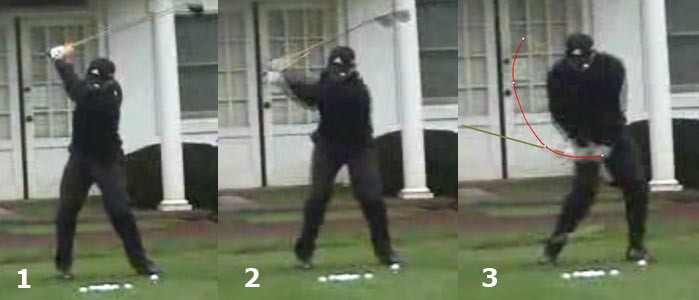 Surely the pulley relates to the hand arc's tight curve at the bottom of the hand arc, and not the degree of left wrist cock that may/may not be present when the hands pass through that section of the hand delivery path. You wrote-: "How can the club path in the downswing be more circular when the left wrist is cocked for a large portion of the downswing (shrinking the radius from shoulder to clubhead) while the left arm remains straight (maintaining the radius from shoulder to hand)?" Why not? Here is the visual evidence? 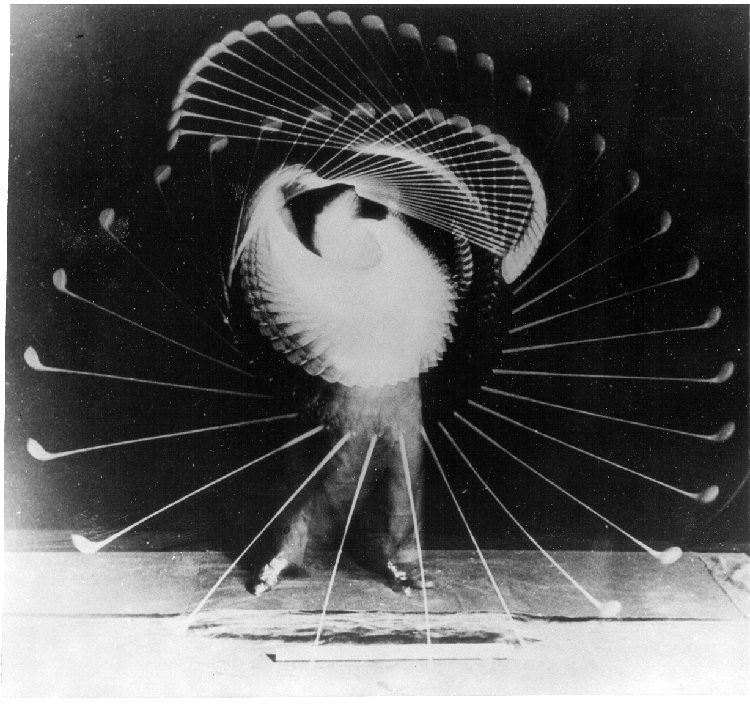 In this strobe photograph of Bobby Jones swing, isn't the clubhead arc as circular when the left wrist is cocked as it is when the left wrist becomes uncocked? By the way, do you do not agree that many professional golfers have a 10-23-A or a 10-23-B hand path? Both those hand paths have a straight line portion (the only difference being that the angled line hand path requires a vertical drop of the hands down to the elbow plane before the hands move along its straight line path section). Also, in Yoda's Alignment Golf DVD -disc 2 - he shows how to perform a straight line thrust action down towards the ground (down towards an aiming point on the ground). Do you think that his straight line thrust action is compatible with a perfectly circular hand path? What is the purpose of teaching that action - if not to produce a 10-23-A type hand delivery path? Jeff. |
Jeff,
Feel free to redefine basics physics all you want. But IMO you should really study the concept of work in the Newtonian sense before you throw it in the trash bin. So far Newton mechanics has been more than adequate for all my purposes related to mechanics. Should I ever face a problem where Newton's doesn't deliver I will most likely turn to Einsteins theory of relativity. And perhaps also have a close look at quantum mechanics. If I still haven't found what I'm looking for, maybe I will ask you for assistance :-) |
Bernt
I wasn't redefining Newtonian physics. I was attempting to clarify it for your educational benefit. I apologize for not being successful in my multiple attempts, but I did make a serious effort (which involved a considerable amount of "work"). "Work" that is not successful in moving a person's mind is still work! :) Jeff. |
Load (The Clubshaft) and Drive
Quote:
Directly toward and through (10-23-A/B) the Aiming Point (6-E-2). Even with Circle Path Delivery (10-23-E / usually restricted to short shots & S&T video) . . . And assuming the appropriate Ball Position . . . The Ball. :salut: |
Yoda - could you please expand on that point?
Why must the thrust be straight line towards an aiming point (the ball) in a circle hand delivery path? Doesn't that straight line thrust action affect the hand delivery path by virtue of its use of the aiming point concept - aiming at the ball? If not, what are the factors that allows a golfer to adopt a 10-23-A straight line hand path rather than a 10-23-E circle hand path. Secondly, it is my understanding regarding the automatic release variants (10-24-C and 10-24-E) that one uses the aiming point concept to trigger the release. Is this different to the straight thrust action towards an aiming point that you described in your last post? Jeff. |
Aim And Fire
Quote:
The Ball is the Target. |
Yoda - you haven't answered all the other pertinent questions.
Doesn't a straight line thrust action towards the ball affect the hand delivery path? What are the primary factors that allows a golfer to move between a 10-23-A and 10-23-E hand delivery path? Jeff. |
Wii for golf balance
My daughter received a Wii exercise game for Christmas. It is designed to help core strength and balance. It measures weight distribution on each leg and a series of exercises and games helps you learn to improve your balance. It would have great golf applications. Software could be developed to help one learn all of the various pivots i.e. Hogan, Stack and Tilt etc. The grandkids were wizards playing the ski jump, soccer and ski slalom games. Would appreciate your input. Perhaps this needs its own thread outside this maze of technical jargon that is unlikely to help one hit the ball better.
|
Quote:
|
I agree that many pros are like 10-23-C/D. However, that only means that they have a rounded section at the top of their swing. That is followed by a straight section. I am interested in learning whether forum members have any idea what causes that straight section.
I have started another thread to deal with this subject. Interested forum members can post their opinions in that thread. Jeff. |
Quote:
|
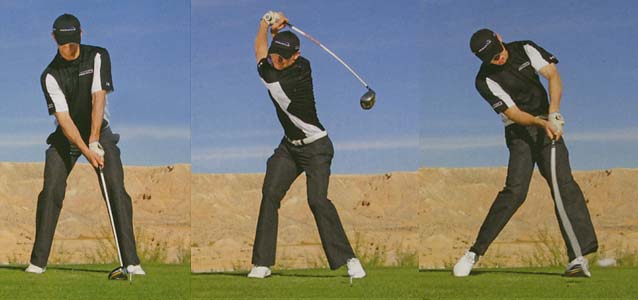
Here's about one of the straightest line deals you'll see . . . . and MAJOR axis tilt to get it . . . connect the dots here and see what you get on the delivery path . . .
http://www.youtube.com/watch?v=bVZ0wY03rjk |
Quote:
Can I chim in here? I like were this whole post is going, read a bunch of it for the second time. Thought I would write something, however guys smarter than me have done so. Great picture you posted of Jamie here. I have to say however, one of my good friends took 7th over all in the Remax with jamie. Said that kids is amazing at such a young age. However he did say he almost did not make it because one out of four of his balls curves more than anyones out there. I will say however he will win more Remax LD deals in the future, he has a ton of talent. I think for the average golfer they can learn alot from what he does in his swing, but must pick and choose what part. It fully a pure power stroke rather than a control stroke. I think you nailed that one well. |
IMHO the large secondary axis tilt is because he tees it high and hits up with the driver. It wouldn't work with a 5 iron off the ground.
I know it is anti TGM but the long drivers hit up on the ball and Trackman confirms the video below. http://www.youtube.com/watch?v=FkTHwazAbTw go to the 3:26 mark |
I think that it is a mistake to causally equate a large amount of secondary axis tilt with hitting upwards at a teed ball when using a driver.
Here is a capture image of VJ Singh from a swing video. 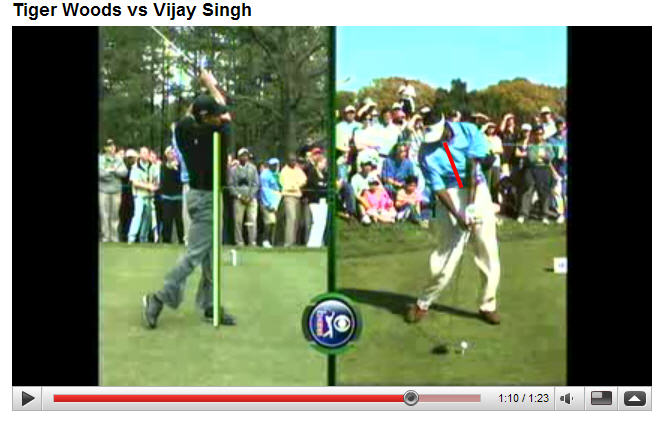 VJ Singh always hits down with his driver - note the forward clubshaft lean. However, he has a large amount of secondary axis tilt. I think that a large amount of secondary axis tilt in long hitters (like Tiger Woods and VJ Singh) better correlates with a need to keep in balance when swinging at fast arm speeds. Jeff. |
Quote:
both of them are great on power. But, what about middle of the short grass. Thats what I was getting at. |
Quote:
But, for the record, the ball is only hit on the upswing if it is forward of low point, the left shoulder, at impact. VJ's left shoulder and others are not so and therefore they are hitting down. |
OB Left - you are presuming that the low point must always be opposite the left shoulder. That may apply most of the time, but not necessarily all of the time. I don't think that it applies to Jamie's driver swing. It is possible to get the hands ahead of the left shoulder at impact with forward shaft lean - which means that the clubhead is on a descending path and not an ascending path. In Jamie's photo, the central end of the clubshaft near the hands has forward shaft lean at impact - even though the hands are ahead of the left shoulder. Note the bend in his left elbow at impact - which makes this possible.
Jeff. |
Jeff,
I know this is a little of topic here, but what do you make of the backward lean of the bottom of Jamies clubshaft. What affect does this have on low point, hinge action, body movement etc.??? Just trying to learn some more. Sorting Through the Duffer's Bible. B-Ray |
| All times are GMT -4. The time now is 04:33 AM. |