|
Quote:
O.B. |
Quote:
I think there is a form of loading the legs and pushing off the ground that would allow for a stable center, much like, and including, staying centered with hula hula. |
Quote:
Biomechanically, can one jump higher from a static bent knee posture or down and up motion? |
HB
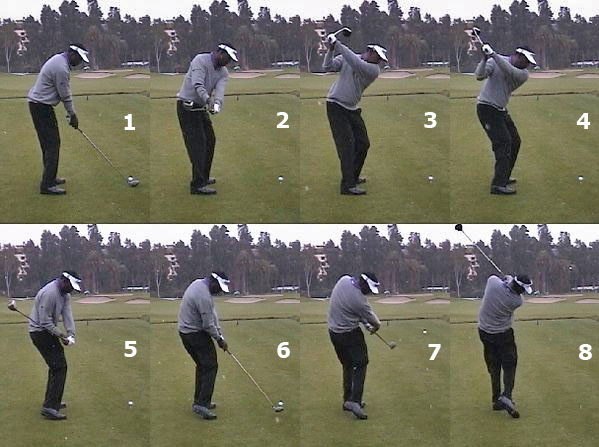
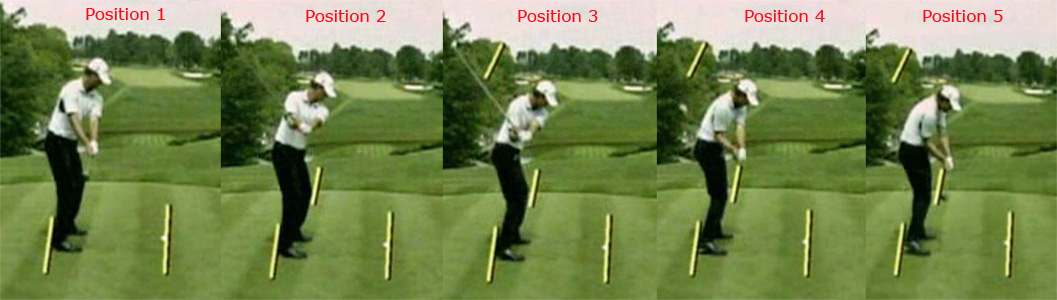
I imagine that one could jump higher with a dynamic bend rather than a static knee bend. However, what's the relevance of the jumping-up part? My mental image of this knee-flexing action is that it is designed to stablise the golfer in his downward thrust action - a form of bracing equivalent to the bracing action of a "firm left leg" that is needed to brace a golfer against the forward momentum generated by the rotating arms/clubshaft. David Lee, in his book "Gravity Golf" described a counterfall action directed 70 degrees left of the target - that he felt was required to stablise the torso during the down-and-out thrust action of the arms during the early-mid downswing. I think that all these stabilising movements allow a golfer to swing faster and still remain in balance, but I don't think these movements are prime sources of added power. I have become more conservative since I discovered TGM's system of power accumulator loading/release. I am skeptical of any "new" idea of generating more swing power - if the "new" idea cannot be explained in TGM terms/concepts. Consider the idea of a second hip/shoulder firing. How could it increase swing power? I think that any proponent of that "new" idea would have to demonstrate how it increases power via the PA system - which is essentially an arm power system. They would have to demonstrate how body power translates into increased arm power at a time point in the downswing when added arm power is useful, rather than harmful. Jeff. |
Quote:
I'm skeptical too. The more I figure out, the more Homer rings true. In fact, the more I think about moving my power package fast, the father the ball goes. But, I do notice that the guys that hit it really far in the air tend to go from bent legs to straight legs. |
Quote:
So this bent to straight leg thing, aint in the book? Is that right? Thats ok , though right. Homer did say "because of question of all kinds.... O.B. |
HB - I think that going from a bent knee position in the downswing to a straight left leg position at impact is nothing more than the O factor principle - as described by Robert Baker in his swing video lesson. It simply depends on how much of a positive O factor one wants to acquire at impact. Some golfers like Tiger Woods have a very straight left leg at impact (which is partially responsible for his left knee damage) while other golfers keep their left knee slightly flexed at impact.
See -http://www.golf.com/golf/video/artic...595277,00.html I agree with Robert Baker that it is a good idea to have a positive O factor at impact, but greater amounts of O factor do not necessarily correlate with increased clubhead speed. One only needs enough O factor to get secondary axis tilt that allows the right shoulder to move downplane, which allows for the correct in-to-square-to-in clubhead swingpath when PA#4 releases the left arm into impact. Jeff. |
Quote:
|
Quote:
|
Quote:
http://www.youtube.com/watch?v=kizEPmGiQzc http://www.youtube.com/watch?v=GZsplhHXQy0 http://www.youtube.com/watch?v=TAB7L...eature=related |
| All times are GMT -4. The time now is 09:58 PM. |