
|
Quote:
Not sure how that drill encourages the base of the neck to be still but whatever . . . . So now that we know your theory on proper backstroke pivoting . . . . What should the head do on the way through the stroke? Move forward the amount it moved back or move forward that much more or just stay back there? That article doesn't mention anything on the spine's ability to side bend or extend in either direction . . . . If you don't extend your spine on the backstroke you'll end up looking like the drill does. |
Quote:
I'm here to learn some TGM structure. Thanks Yoda for keeping us on the proper path! Kevin |
12PB
You wrote-: "Not sure how that drill encourages the base of the neck to be still but whatever . . . ." I don't think that you understand why he proposes that drill. I think that many beginner golfers tend to reverse pivot. One cause is a tendency to "fixedly" keep the head still while swaying the pelvis right-laterally (as demonstrated by Brady Riggs). That causes the upper torso to sway to the left in order to keep in balance. All these lower and upper torso motions are lateral swaying motions without any rotary component. What both BM and BR are saying is that one needs to rotate the pelvis during the backswing. I believe that the natural result will be the production of a reverse K position - as previously described. Therefore, a golfer must have the distinct feeling that his upper torso is slanted to the right. BM was presumably promoting that exaggerated drill so that a beginner golfer would get the "feel" of how the upper torso slant-rotates to the right when the pelvis rotates 45 degrees back. That doesn't mean that a golfer should have that amount of right slant-rotation of the upper torso in his "real swing". I think that it is better to minimise the slant-rotation of the upper torso so that it doesn't move the head back more than 1-3". I believe that any unnecessary movement of the head or upper swing center is a disadvantage because it means that the golfer has to move back again in the downswing. It is possible to keep the head back and not move it forward to where it was at address and still hit the ball well. Tiger Woods does that - see next image. 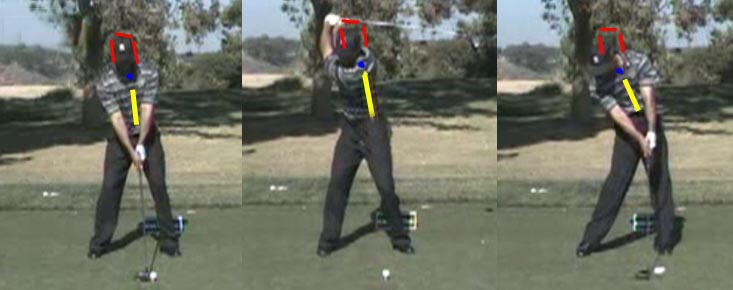 Note that his head moved down-and-back in the downswing. I think that it doesn't affect his swing because his upper swing center (blue dot) remains in the "correct" position. I am not at all promoting any unnecessary movement of the head. My favorite swings are of golfers who keep their head stationary despite acquiring a reverse-K position at the end of the backswing. Here are two examples. 1) Mike Finney. (requires Applet to view). http://homepage.mac.com/brianmanzell...ver05front.mov 2) Anthony Kim http://www.youtube.com/watch?v=oqmejmw-lu4&NR=1 http://www.youtube.com/watch?v=Cuu6KJZMUdg The first video shows that he gets a lot of rightwards slant-rotation of his upper torso by the end of the backswing. Also, one can learn a lot about spine movements by watching that second view. Note how his mid-upper thoracic spine gets torqued by his large shoulder turn and how its verticalizes his mid-upper thoracic spine, and therefore allows him to keep his head stationary. That is optimum from my perspective. He doesn't allow his head to move as far rightwards as BM. Jeff. |
Kev
My theory is that BM gets his head too far to the right during the mid-backswing because he starts off with his head too far over to the right at address. I suspect that he keeps his pelvis central and then tilts his upper spine to the right at address. That moves his head to the right of center of his stance. Then, when he rotates his pelvis in the mid-backswing, his head moves further rightwards. I think that he would be better off if he followed Yoda's advice for getting rightwards spinal tilt at address - keep the head centralised between the feet and then shift the pelvis sightly to the left. Jeff. |
Quote:
What is a "reverse pivot"? I'd like to define terms please . . . How would you teach those reverse pivoting beginners to hit a draw? |
Small Crowd
From your post #26 above:
Quote:
Quote:
|
Tiger's driving accuracy . . .
Driving Accuracy Percentage 57.86% 169th Total Driving 1,998 197th Total rank from stats 1 & 2 Not sure about all this analysis . . . but here's a Tiger swing that I'd say is at the very least DIFFERENT . . . http://www.youtube.com/watch?v=eUl82HFvFVM GIR Stats . . . Greens in Regulation Percentage 71.39% 1st Wonder what may happen if he swing a little more like this with a driver? hmmmmmmmmmm. |
Yoda - very good point about Hogan. That demonstrates my foolishness and yet again demonstrates to me that I should never make strict rules that are not 100% biomechanically solid. Hogan slides his pelvis quite a lot left-laterally in my photo series and that moves his torso/head slightly leftwards. That's obviously not a problem for the golfer who is without doubt one of the greatest ball strikers in the history of golf.
It is interesting that VJ Trolio shows in his book that Hogan didn't have that much slide later in his career. In fact, he states that Hogan didn't have any slide during the downswing because he moved his pelvis left-laterally in the backswing. I am still conflicted by this issue and I wonder if there was a major change in his pelvic movements later in his life, or whether we are having a problem with camera angle distortion issues. Jeff. |
Quote:
I still don't get all this . . . I got no beef with biomechanics . . . but to what end? Are we trying to hit it the farthest? Are we trying to hit it far and straight blending the two? How much distance are we to believe Tiger is gaining by moving his head back and bobbing? Or is that an accuracy deal? |
12PB
I am a student of golf biomechanics because I think that a golfer is likely to swing better if he moves in a biomechanically natural manner. That's why I constantly study the swings of good players to try and identify biomechanically sound golf movement practices that are consistent with sound TGM mechanical principles. HK did wonderful work on the mechanics/physics/geometry of the golf swing, but he didn't have much to say about how the body must move biomechanically to achieve desirable TGM practices. I suspect that Tiger Woods' head falls back-and-down because he develops so much secondary axis tilt in his driver swing. He has far less secondary axis tilt in his mid/short iron swings. I simply define a reverse pivot as a backswing action where the spine tilts left towards the target, so that the golfer is leaning over to the left at the end of the backswing. I think that a severe reverse pivoting golfer cannot hit a draw because he is forced to throw his club OTT to get his hands down to the ball. There is no space below the right shoulder as occurs when a golfer has the standard pivot-driven swing which allows one to establish a reverse-K look at the end-backswing position. Jeff. |
| All times are GMT -4. The time now is 02:32 PM. |