
|
Quote:
 |
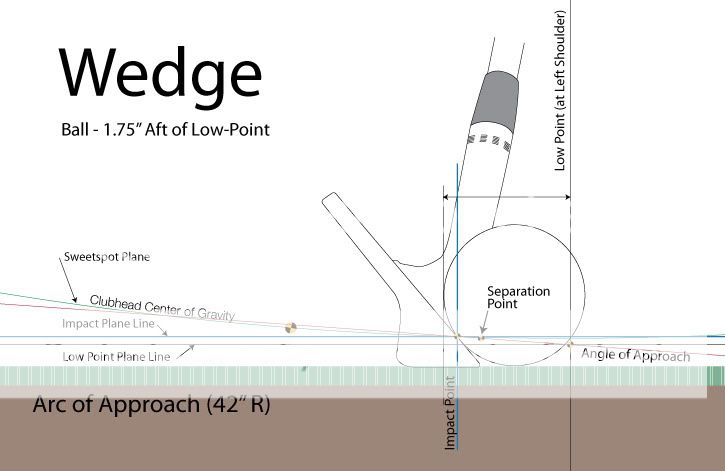
It looks like, when the Clubface strikes the Ball, the inclined striker will move the Impact Point into the Separation Point as long as the Clubhead is traveling the Angle of Approach. 3 dimension impact needs a "Flat Left Wrist".
 |
Daryl,
Once again, thank you for these wonderful drawings. They are really top notch. I look forward to seeing the photos of a well struck wedge. |
I'm still a little confused.
How does this information mesh with leaving the face at practically 90 degrees? Seems as if they are opposite. One going down and one going up. |
Quote:
Quote:
But, The Rebound Vectors will be scattered unless the Line of Compression is focused on one line. So, The LINE OF FLIGHT (Resultant Force) depends on the "Quality of Compression" (new Daryl Term). That's one reason. Another reason why the Line of Flight "Won't become at Right Angles to the Clubface" is Ball Location. There is only one Ball Location that can produce a Line of Flight at Right Angles to the Clubface. The following is another reason: Quote:
Quote:
Lastly. Club makers move the Center of Gravity around like it's a tool to make the average player get the ball into the air. This really screws with the Line of Compression when the center of gravity of the Clubhead is down near the sole of the club. Look at the Illustration in the previous Post with the Clubhead at Impact. Ideally, the Center of Gravity of the Clubhead will be on the same Angle of Approach at the moment of Impact and remain on the Angle of Approach through Separation and Low-Point. |
Good Discussion - Questions:
I'll start with a simple tip - "pre-drilling". For any ball that you tee up- at impact as the compressed ball flows out in all directions - it will push the tee further into the ground - therefore when teeing the ball - always insert the tee an extra distance into the ground and then pull it back out some distance before striking the shot - this way you are not wasting energy while the compressed ball pushes the tee further into the ground - or worse yet - having the ball flow around the tee if the tee was immovable. Secondly, The ball leaves the clubface at practically 90 degrees to the face. That doesn't mean that it flies where the face is pointing. Becuase it travels along with the clubhead and picks up that force vector - the actual flight of the ball is somewhere between the face and the clubhead path. Throw a ball 10 miles an hour off a train at "practically" right angles - for this example let's just say "exactly" at right angles to the track and if the train is moving 10 mph down the track - does the ball fly in a direction 90 degrees to the track - NO. |
Exit Rows
Quote:
With regards to your need for immediate answers . . . It ain't necessarily about your asking a question that is "bad" or "specious" or even of such "magnitude" that we at Oracle LBG find it "unanswerable" and thus requiring a leap of 'faith" into our purple Kool-Aid (a metaphor preening others have found convenient). There are (at least) two other reasons why readers don't immediately jump through your hoops: 1. They don't know the answer. 2. They know the answer -- or, at least, think they do or feel they can 'add value' and spur the discussion along the way -- but, they don't have the time or the inclination to respond. At least, not now. Where the desire is strong enough, maybe later. In my case . . . Later. :salut: |
What Did He Know?
Quote:
Seems simple enough. But, maybe I didn't catch the whole gist. If not, please forgive. In any event, here's my 'quickie': In a clinic, Sam Snead called his action in a Lob Shot as "going down and up at the same time". Clubhead down (to Low Point); Clubface up (Layback through Impact). :eyes: |
Just reading all this. John, re Homers drawings of 2-C.
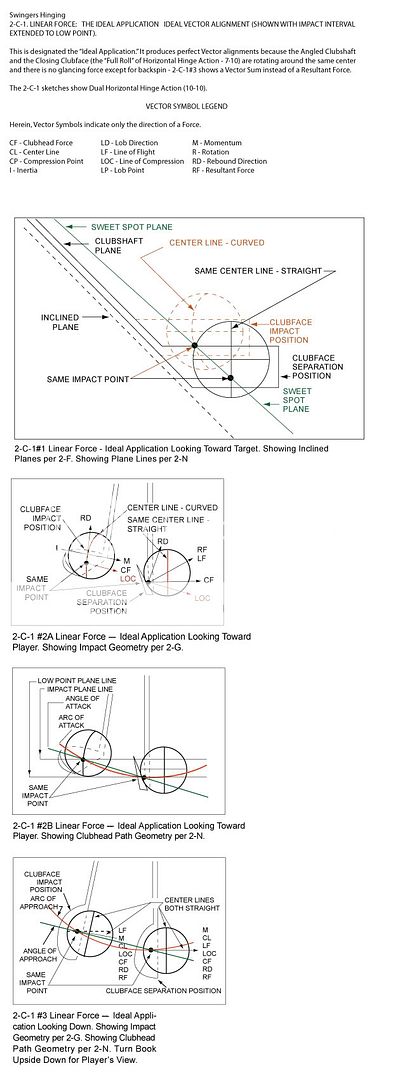
- they are not to scale. Not even close. The ball is about the size of a tennis ball for instance, vis a vis the club. I assume Homer did this to make the underlying geometry more obvious to the reader. To make the drawings more illustrative. -the "ideal application" or 2-C-1 represents the ideal of total compression and therefor, per 2-C-0, assumes the point of contact between ball and face stay together, intact "as if welded together" throughout the impact interval. So if impact is prior to low point this mandates that the point of contact will go down plane all the way to it low point position (assuming the clubhead completes its orbit). -separation is assumed to be at low point, so the shaft will therefor be vertical given a flat left wrist. You could also therefore deduce that Homer assumed a flat left wrist. -if impact is made prior to low point there will be some shaft lean. -shots that see the ball roll on the face even if it is solely a result of loft are not examples of "total compression". We golfers know this intuitively.....we dont tee up a driver on a 120 yard par 3 for instance. We choose a more lofted club for its inherent loss of compression. Why did Homer draw a somewhat lofted club in 2-C-1 2A then? I assume for illustrative purposes again. To highlight some of the vectors directions. See 2-C-0 its an interesting read and concludes with: Quote:
You'll notice a relationship between the drawings of 2-C and Steering. Intentional compression loss vs. unintentional compression loss due to a common conceptual problem. Can you see these things in slow mo? Id say yes, you can see Steering....guys verticaling a driver say... But impact is violent and distorts all of the parties to it: ball, clubface , clubshaft and clubhead. So you have to look before and after impact to see what going on. |
Each of these pictures clarly show the ball getting carried downward and to the right from impact to seperation.
That would mean the ball would get pinched between the turf and the face. When an inclined striker does that from a solid strike, it will be a fantastic picture indeed. I look forward to seeing it. |
| All times are GMT -4. The time now is 04:48 AM. |