|
Quote:
|
Quote:
I am curious. Why is that grip bad? Obvsiously, you can integrate a movement with any grip. Is it a grip that someone could play well with? - sure. That said- here is my perspective. To call that grip neutral is a crime really. Historically and even in the Golfing Machine book- that grip is a weak grip- the left thumb is on top of the shaft and not more behind the shaft at impact. There is a reason that historically those terms were used - i.e. strong and weak - in relation to different grips. Weak isn't good. For golfing machine fanatics that would want to grip the club with the left hand flat, level and vertical- that grip doesn't accomplish that for a normal straight shot with the ball separating at or before lowpoint. That's my viewpoint. You also wrote-: "Horizontal hinging does not have a draw bias. You can slice, fade, draw, hook using horizontal hinging as it really depends on the clubface relationship to clubhead path." I cannot understand this point. Why would one use horizontal hinging if one deliberately wanted to fade/slice the ball? In golfing machine terms- horizontal hinging is the result of a golf swing that uses centrifugal force- that's what creates that amount and type of clubface closing through impact. Since golf swings that use centrifugal force- are no different than other golf swings - they all encounter on course conditions that require fading or drawing the golf ball at times. Therefore alterations are made to the impact conditions that create fading and drawing - while the motion the face makes through impact is still horizontal hinging created by centrifugal force. At least that would be "your" golf machine answer in a nutshell. |
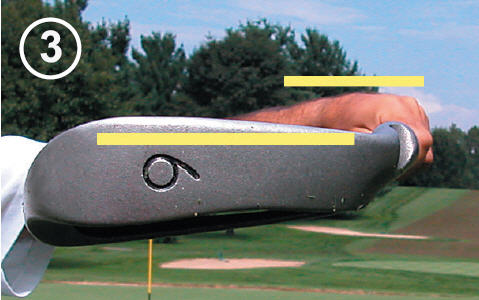
The left thumb is slightly to the right of center in that photo. It is not a weak grip. You can read the original article if you want.
http://homepage.mac.com/brianmanzell...ellasept03.pdf I can readily accept the idea that horizontal hinging occurs naturally when a golf club releases naturally in a swinger's action. However, you didn't answer my two questions. i) Why would a swinger employ horizontal, rather than angled hinging, if he wants to fade/slice the ball? 11) What type of hinging action will result in a perfectly straight ball flight if the clubhead arc is perfectly symmetrical to the ball-target line and the clubface is square to the ball-target line at the exact moment of ball-clubface separation? Jeff. |
Quote:
I don't have the energy lately to post in detail on a lot of these subjects. You are usually pretty thorough about analyzing golf data. In regards to the photo above- the two yellow lines are parallel to each other - but do you really think that each one represents what it is suppose to represent? I see the leading edge or the equivalent score lines as not lining up with the yellow line. Also, likewise I don't see the yellow line representing the true angle of the left arm? Just camera angles etc. - obviously if someone wants to grip the way he describes it they certainly could. Regardless of all the details - that is a really weak grip. It appears that Brian Manzella via reading the linked article that you provided has derived that grip by associating it with Arnold Palmer, Tiger Woods, Sam Snead etc. and he has made that determination by noting that at the top of their swings the left wrist matches the angle of the leading edge of the clubface. All I can think of - there must be some poor measurements that were taken to come to that conclusion. To think that Sam Snead and Arnold Palmer had a flat left wrist and leading edge of the clubface that faced the target only at lowpoint- :confused1 you're kidding me right? Arnold Palmer!? YOU'RE KIDDING ME right?:scratch: |
As with most Hogan threads, it is interesting.
As for the '3 right hands', I would suggest that some who are trying to understand this concept, at least as I think I understand it, read John Schlee's "Maximum Golf" and Tom Bertrand's "The Secret of Hogan's Swing". Add the original Hogan's book and VJ Trolio's "The Final Missing Piece of Ben Hogan's Secret Puzzle". Leadbetter's book is good for pics as is the DVD series Hogan Collection and one other. But at least for me most of the questions, debated topics can be answered with those 4 books. Why Hogan had the weakened grip and how he managed to square the clubface with it, the reason for the arms close together, and why he stated others should not use his pictures to learn the golf swing but rather the book. (Thus the reason the still pics and diagram don't always track with his real life motion, cause he had to make adjustments cause of his accident). |
Very nice post Martee. Said from the heart with knowledge
study and understanding. All the best, Donn |
Quote:
Lynn, sorry for bringing this thread from the basement - but it cannot be regarded as complete without your non-TGM translation that your promised :) Cheers |
I'm glad you did bring it back up Dariusz J. There's a lot of interesting argument.
Jeff started by saying that Hogan's lower body created the flattening of the left wrist at the start of the downswing. I think John Schlee said that this was a key move for Hogan. Only it was not produced by the lower body but rather by consciously sensing the right thumb and forefinger both fall down, and in, at the start of the downswing. If the arms don't drop I believe this will both flatten the left wrist and lessen the amount of wrist cock he would be playing with through the ball. It gives the appearance of being laid off but not in a bad way I don't think. Would this increase his lag pressure? He may have been using both inertia and gravity. It may also explain part of the downcocking appearance he gives through the ball. This move is clearly evident in that famous sequence from Andrisani's book. I find it very interesting that in Modern Fundamentals he says that the right thumb and forefinger are not to be used but then qualifies this warning by saying that they may be used for finesse shots for the better player. I always thought this was referring to the short game and wedge shots but perhaps not.:idea1: |
Quote:
lower body motion would not make that happen...gravity and a heavy club could but hogan probably was a bit smarter than "hoping for the best" |
A few thoughts on some of the posts...
As far as the 'flattening' of the shaft during startdown (Sergio/Hogan) "When in doubt TURN the clubface at startdown" (I don't have the book with me for the exact location) To my eye, Hogan 'Turned' slightly at startdown, so he could 'Roll' at release, giving the appearance of a falling/flattening shaft, and maintaining his left arm flying wedge. For 'weak' vs 'strong' - keep in mind that the left hand grip, within a range, doesn't really matter in producing a horizontal hinge - it is the left arm flying wedge that matters. The left arm wedge alignments can be maintained with both a so called 'weak' or 'strong' left hand, with the appropriate compensations in the rest of the machine. |
| All times are GMT -4. The time now is 03:36 AM. |