
|
Thin Ice
Quote:
Have you even bothered to look at your own 'Big Three'? Gary Player 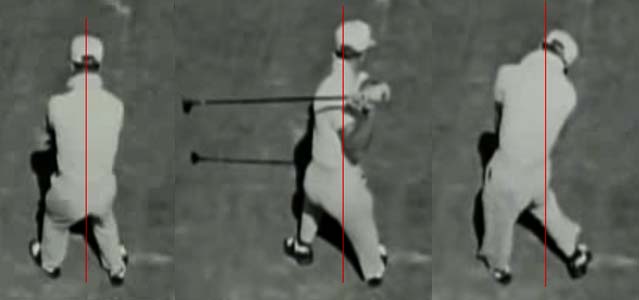 Arnold Palmer 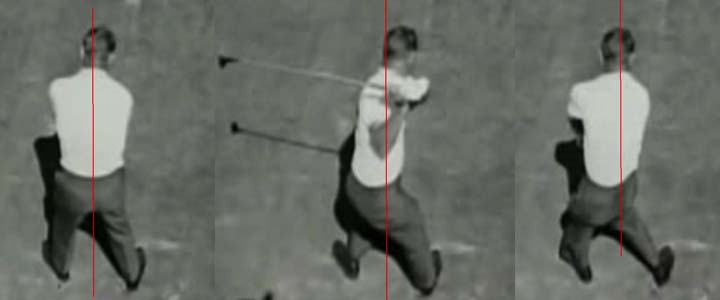 Jack Nicklaus 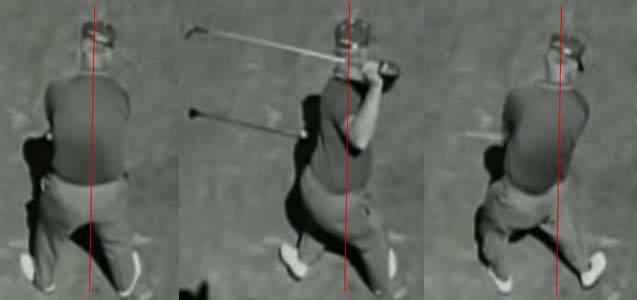 Assuming you may actually be interested in words other than your own, read my post #16 -- learn something -- and stop tilting at windmills. Meanwhile . . . Talk to The Hand. :hand: P.S. I don't know about the rest of you guys, but I'm all of sudden missin' DG! :laugh: |
Quote:
The premise of the book is that it is a machine, a golfing machine that we are trying to build. It doesnt take much to see the need for balance and a vertical c.o.g line about which to rotate. Like the spinning top. Now if you did have a machine that wobbled about at its top, which of the following would you prescribe in an effort to increase its efficiency: - More securely set its moorings to the floor in effort to stabilize it. Albeit with the knowledge that the wobble will still make for some inefficiencies, abnormal wear and tear, production delays etc etc. -Leave it to wobble around on the floor. See the Creamer, Gulbis machines and how they wobble about at their connection points to the floor at impact. (They are both on their toes). -Balance the machine so there is no wobble at the top and then for good measure secure it to the floor anyways (with some custom Maxwell golf shoes from England perhaps). Aye, now thats a Machine lad! O.B. |
Quote:
Hannah: "Maybe you're over pleasuring yourself or something?" Woody Allen: "..now your going to start knocking my hobbies?" Woody Allen, "Hannah and Her Sisters" |
At the risk of being far too basic for you guys...
The drill "Steady Head Drill" on the 2nd disk of Alignment Golf shows this perfectly. Lynn discusses keeping he head centered while creating tilt by moving the hips a little forward. This actually gives the illusion of the head being back, but Lynn shows us that the head is still centered between his feet. Homer Kelley's text along with Yoda's demonstration is good enough for me, I want as few compensations in my motion as possible! :golf: Kevin |
OB left
You wrote-: "Your looking at his driver swing, I believe. His iron swing is more balanced, centered if you will. No wobble at the top. The premise of the book is that it is a machine, a golfing machine that we are trying to build. It doesnt take much to see the need for balance and a vertical c.o.g line about which to rotate. Like the spinning top." I agree with your position about having a centralised swing and the idea of minimising any sway/wobbling. Tiger Woods stays more centralised, with less secondary axis tilt, in his short iron swing - compared to his driver swing where he has far more secondary axis tilt. I made that point in a previous post where I stated that I believe that a stationary head is a marker of a stable pivot structure. I compared Mike Bennett to Anthony Kim, and I stated that Mike Bennett's COG remained closer to the center and that one could conceive of him having a very centralised pivot center and a very centralised pivot axis - like a spinning top. I think that it's a much better technique than the idiosyncratic technique of Natalie Gulbis. Natalie Gulbis is to Mike Bennett (re: centralised pivot axis and stationary head) like Jim Furyk is to Anthony Kim (re: keeping the clubshaft on-plane during the backswing). One can get away with atypical moves, but that requires a compensatory adjustment action. I prefer staying as close to the TGM model as possible. I simply don't think that HK's idea of a "stationary head" mandates a pivot axis in the center of the stance. I think that for driver swings (where one places a premium on distance) that certain golfers may prefer to have their stationary head (which stabilises their pivoting skeletal structure) just to the right of the center of their stance - like Anthony Kim. That allows them to have more secondary axis tilt and still remain stable and balanced. Jeff. |
Quote:
I don't see how it allows more secondary axis tilt. It just means you have to change your tilt less in the downswing, it does not change the range of motion. The modern "got to have it now" generation. A bunch of teachers see axis tilt at impact in good players and don't in poor players, so they preset it at address (reverse K), instead of teaching people how to change the axis tilt dynamically. It is just fine with a ball high on a peg. And there are other compensations one can make to hit the ball off the ground. But why? |
Jeff
You wrote..........a frig it. Couple of notes: -as per another one of your threads, axis tilt as defined in TGM assumes the head is centered. The ability to do this is a display of "Hula hula flexibility" with the hips and a resulting tilt of shoulders. -the head back move, I think, is a compensation regardless of who is doing it. It allows more time for the primary lever assembly to lengthen by moving low point further back in the stance. A common move for junior golfers who cant support the increasing mass of the levers extension with their power packages or throw out action. A moved that once learned is hard to break especially for the physically weaker adult golfer be they male or female. This is C.O.A.M. as Homer defined it (6-C-2-B) and as it should be applied when building your own machine. The reason we release a driver earlier than a wedge for instance. The reason some hang back. A reason for kids clubs. You could with a long enough lever move the world but who here amongst us could move a lever of that length? I played with a guy who overcame his driver yips by cutting it down to 5 iron length. He didnt seem to lose much distance. Where is Golfgnome? O.B. |
O.B.Left,
I hope you guys don't mind the thread jack, but your driver yips comment hit close to home... I quit the game this summer because of the driver yips. I couldn't even hit drivers on the practice range, buildings and other golfers weren't safe, and I didn't want my members to see me, I needed to give a few lessons and didn't want them to see how bad I was hitting it... :) I solved the problem by beginning my journey of learning TGM, finding out that I had lost ALL MY LAG PRESSURE, along with losing all sensation of where the club-head and club-face were, and working with the Pure Ball Striker while reading the yellow book to get the lag feeling back. Sorry if that looks like a plug, but I consider it as a public service announcement. It has allowed me to play golf again, Just in time for the snow. :) Now so it doesn't look so much like a thread jack, I'm keeping my lag pressure through the line of compression, with a steady head placed right between my feet, and striping it! Kevin Quote:
|
O.B.
You wrote-: "as per another one of your threads, axis tilt as defined in TGM assumes the head is centered. The ability to do this is a display of "Hula hula flexibility" with the hips and a resulting tilt of shoulders." I don't understand why axis tilt implies that the head be centered. I prefer Yoda's advice given in post#16. The head position is dictated by the head position at impact. If one has a greater degree of secondary axis tilt at impact, then the head will need to be further back (away from the target). In Tiger's short iron swing, he doesn't have much secondary axis tilt at impact and his head position at impact would be centralised between his feet. However, when Tiger hits a driver he has a large amount of secondary axis tilt at impact, and that would cause his head to be behind the center of his stance. In that sense. Tiger Woods is following HK's advice by starting with his head at its impact location - which will be slightly behind the center of his stance when using a driver, and in the center of his stance when using a short iron. In both situations, that "head position" choice will allow the head to remain stationary. Jeff. |
Hennybogan -- PGA TOUR Warrior
Quote:
They have no peer on this site. :salut: |
| All times are GMT -4. The time now is 01:15 AM. |