
|
Quote:
|
Can't we just say "shaft" and everyone agree that we're talking about the Long Cntr of grav of the Club. Unless we're talking about getting our shafts re-gripped.
|
I asked you not to tell me that!
Quote:
HB, re smaller: One word can imply quite a bit and save this idiot a lot of writing time. IMO, the book assumes 90 degrees for clarity , brevity reasons in that it assumes one grip type . But Homer does define other grip types and their implications to wrist action. Hence my "smaller" . I personally have the wedges at about 90 degrees , (never measured em) but when writing I didnt want to exclude the stronger Left Hand Grip dudes with their (approaching) Single Wrist Action. Some have Turned their Left Hand all the way to Plane in their grip , at Fix even. IMO these stronger left hand grip types guys do not have their wedges at 90 degrees. But Im open for ideas on this. Also if I may enter the Lab for a moment, even with a more neutral grip in common golf speak there is something else to consider: namely the effect on the nature of the left hand grip and wrist action and the relationship of the two wedges to each other, in degrees if you must , of positioning the ball back in the stance. Lemme explain what Im thinking. We grip the club with the club in its FIX position. Not at low point or where ever . Now for balls played back in the stance , prior to forming the grip, the clubhead moves back along the Arc of Approach. AND THE HANDS MOVE BACK ALONG THEIR THREE DIMENSIONAL PATH TOO . If only slightly . As the left hand moves back , in, up it must Turn slightly. This is all prior to forming the grip. You dont form the grip at low point fix or some arbitrary place and then take the hands and clubhead back to where the ball actuallly is . You dont do this and then ROLL THE LEFT HAND AND GRIP WITH THE GRIP ALREADY FORMED TO SQUARE THE FACE TO THE TARGET . Some people do this , the grip is precision alignment. Which demands precision. You dont form your grip vis a vis some lines on the rubber BTW arent those formed grip things are actually only correct for one ball position? Theoretically. If you subscribe to this turning of the left hand grip, minute though it is ,as the ball placement moves back in the stance, then the wedges are not at 90 degrees to each other anymore and the Hand Action becomes more , er approaches a more Single Actiony action. I think. Please discuss. Mike O . whats your 20? Over. That is to say there is less turning required to get the left hand on plane , less Startup Swivel if you will for the shorter sticks , for balls played back of Straight Away. Add Homer's Grip Rotation into this business and it would make for a nice little thread on how to adjust your machine for specific ball response . This relates to yodas recent post about Plane Line Rotation as (over) reco'd by some Trackman guys. Ive got a buddy who reps Flightscope we're supposed to get together and talk about all this. He's TGM literate so itll be interesting. Maybe Im making some wrong assumptions. I dunno. Im fascinated by the data these guys are looking at and the different ways to adjust the machine or dynamically change the path . This is something we've never really gotten into . Homers ball flight stuff. Its all over the place in the book . What else is new you you say? Itd be nice to pull it together in a thread . Bucket started to but got jumped by a angry mob of visitors. Hopefully times have changed and those guys have gotten bored with us. "And ...... loving it". "Max the cone of silence hasnt worked in three weeks". Happy Holidays LBG. |
Quote:
When Hogan "slots" the shaft, the hand pressure is downward and perpendicular to the plane of the left wrist. He flattens the shaft and whirls through impact, keeping his hands moving in an ever tightening curved path around his body rather than letting the pivot throw them away from the body down the line as in a cf Swing. |
Quote:
|
Quote:
Hb |
Quote:
:rolleyes: |
Quote:
Just so we agree, because the Terms are really confusing. "Turn and Roll" describe the Primary Lever, using a Vertical Left Wrist, moving away from (backstroke) or toward (forward) Low-Point. So Turning is the Primary Lever moving "Away" and the Clubface "Opens" and Rolling is moving toward Low-Point and the Clubface "Closes". For the life of me, I have no idea why HK would use these terms. Swiveling occurs when the Clubface (Left Wrist) changes from Vertical to On-Plane and back to Vertical again. 90 Degree Wedges. If your Left Wrist is Vertical at Low-Point and your Right Forearm Wedge is On-Plane, then the Wedges are at 90 degrees. Here's where we differ; I think. My opinion is that the Wedges should remain at 90 degrees regardless of Ball Location (its ok if they're not if you prefer it that way). If you play the ball back 6 inches, then, at Impact, the Primary Lever will be Closed but Rolling. It will also be Swiveled and will be Swiveling toward Vertical which it will be when it arrives at Low Point. For the Clubface to be square to the Angle of Approach at Impact, you will need to rotate the grip of the club in your Hands. So at Impact, the Hands will be moving exactly as they would (but on a steeper plane) if the Impact were going to be at Low-Point. I need to make a "Fine Point". It's pretty advanced but I think everyone can handle it and not lose sleep tonight. "Swiveling" and "Turn and Roll" are not opposites nor are they related. "Turn and Roll" is one concept, separate. "Swiveling and "Hinging" are related. They are Two different ways that the Clubface moves through the impact interval. Hitters Only Hinge. Swingers use a Hinge and Swivel but its not a Hand Swivel. Swingers use a "Release Swivel" whereby as the Hands move down Plane during the Pulley, the Clubface moves from On Plane to Vertical at Low Point. This Swivel is compatible with Hinging whereas Hand Swivels are not. |
Quote:
that have some great pictures. If, for no other reason, the pix alone are their review. hb |
Quote:
Id personally would just say Left Hand above. The clubface given what Homer termed Grip Rotation may or may not align to plane at Top , may or may not be vertical at Low Point. May or may not be parallel to the left arm at the top of the backswing as is commonly held. But ideally the Left Hand lays flat to plane at top. My right palm lays flat to the bottom of the plane too. But I have a vertical/vertical grip type. As I assume you must. |
Quote:
"EXACTLY", the best you can put it into words. Where does the "release swivel" occur for the swinger? HB |
The Release Swivel starts at Release and ends at Both Arms Straight.
2 Choices. 2 very simple demonstrations. Release with Extensor Action/Throw-out Swivel Release with Extensor Action/Drive-out no-Swivel Demonstration 1 - Swingers: Right Arm only.
So, straightening the Right Arm by lowering the hand caused the Clubface to change its Alignment from On-Plane to Vertical for impact and the Right Hand became Aligned with the Elbow and Right Shoulder. Extensor Action without the #1 Accumulator. So, the Release Swivel begins when the right arm begins to straighten (Release) and Ends when the Right Arm is Straight (Both Arms Straight). Demonstration 2 - Hitters: Right Arm only.
So, straightening the Right Arm by pushing the Hand away caused the right Elbow to move into a straight Alignment with the Hand and Shoulder. Straightening the Elbow by using the #1 Accumulator does not change the Vertical Clubface Alignment. Extensor Action with the #1 Accumulator, no Swivel. These demonstrations can be easily performed On-Plane with the Right Forearm Flying Wedge. I think that a lot of the confusion occurs while trying to understand and use Extensor Action. Extensor Action is not the #1 Accumulator however, it does use the same muscle group and they can be used simultaneously. |
Quote:
I now realize that we have much different geometry. my left stays flat, wertical and moveing from cocked to uncocked-release to both arms straight. My right stays vertical, level and bent and only releases bent as necessary after impact. This, for me , is dual horizontal hinge. The bones in my forearms do not change their relative position, release to arms streight. We therefore have "differences" in extensor action application. I thing I am OK with what HK wrote. HB |
Quote:
It doesn't sound like your Right Forearm Wedge is On-Plane at Impact. |
Quote:
Slightly longer answer: and ends at the beginning of Hinge Action. Or if you prefer a really longer answer with some patented rambling: Same with Finish Swivel:starts where Hinge Action ends and finishes with the ..... wait for it... Left Hand on the bottom of the plane / right hand on the top assuming a V/V grip type. This sounds weird I know , but when Swinging it can feel like one big Roll from Release to Finish Swivel . But it isnt just any old Roll it is an Roll that has specific alignments .... which you alluded to in a previous post. And now for some rambling: BTW Bear you said your axis of rotation is the spine. I think there is more to the story and its a major point of departure for many a golf theorist. In startdown , yes the tilted axis of rotation (spine) drives the Right Shoulder down plane (assuming a Turned Shoulder Plane procedure and I do recommend it) this is the period of shoulder acceleration . But there is another lever IMO. The straight left arm attached to the pivot at the left shoulder accelerates away from the pivot thereby accelerating the hands to a speed that the pivot could never achieve. The hands are travelling at faster speed than the RPM of the pivot alone would ever allow for . There is no need for a crazy drastic over emphasized attempt to spin the pivot forever with arms pinned to chest. You dont pull with arms either. You dont do that when scything grass (Wild Bill again). As such the Spine is the centre of the pivot rotation and the left shoulder is the centre of the arm swing. You can change this for putting and make a shoulder stroke with two bent arms and thereby have low point mid body. Or you can Full Sweep Release a wedge flop say and get the arms swinging early. But for full power you need a transfer of momentum and a long lever for leverage --the straight left arm and you need what Homer termed Independent body and arm motion ---one thing Lynn loves about the McDonald drills . What Abe Mitchell tried to explain in his 1933 book. Its what we do all day with our arms. Like hinged blades on a rotor . Or one is hinged , one is a ball joint. I like your right shoulder ball joint thing. Nice. Short version of above: Once the left arm pulls away from the body (#4 firing and its the first to go) the Arms are moving about their own centre the Left Shoulder . Well assuming a Left Arm as centre procedure ... you could use the Right Elbow as some pros do , with a soft bent left arm at impact. A wise man once when discussing this very thing and the notion that Hogan kept em plugged in ALL THE TIME pointed me to the Augusta footage Power Golf where he is letting one rip , high and long with a driver . He is leaning back like a long drive guy , ball forward and just ripping it and almost falling backwards as he flights it high. And of note he looks like he is trying to throw his arms off as fast as he can . Sure keep em pinned for control shots with angled hinging ! Not saying you cant do that when the situation demands. As Homer might have said if he were alive to hear these arguments " The pinned arm guys arent wrong necessarily their theory is just... well , incomplete". Hogan didnt pin em all the time. You could pin em for every shot of course , not saying you cant , but it aint ideal IMO. Sure are a lot of guys doing it these days. I did for a while. with a blocked angled release. A buddy of mine just kills it like this. Short swing , pinned, sorta like the new Tiger swing. Theres room for a difference of opinion. You got options. |
Quote:
That is what I do- may not work for others. HB |
Quote:
Impact: Right Wrist is Bent Right Wrist is Level #3 PP and Elbow are On Plane |
Quote:
|
Very instructive and highly useful!
Quote:
ICT |
Also very helpful and useful
Quote:
ICT |
Sorry I overlooked your reply O.B.
Quote:
U walk up to a door that opens out- away from you- hing on left door knob on right. You reach out with your right hand to turn the knob and open the door. The question- for EA do U turn the knob clockwise or counterclockwise? 2 muscle sets. for me clockwise is good EA counterclockwise is disruptive. What do U think? HB |
Quote:
EA is always in line with left arm , out away , not on plane given any #3 angle . Not a counter clock or anti clock thing, just out along the line of the left arm . It extends the inert left arm. The radius. Say the door is not rigid its made of say kling wrap. EA stretches it out to full extension. Full Radius. The hinge is set at the left shoulder. Talking the machine here. A door is Single Horizontal , like a pin ball paddle. No Up. Just Back and IN. Any clockwise or counter clockwise turning of the DOOR (not the knob) by the Right Arm Flying Wedge (not the right hand) will not change the nature of the Hinge assuming an turn parallel to the plane of the door. If the turning of the knob as you say rolls the wedges , the hinge at the left shoulder will change its Alignment . It isnt Single Horizontal any more. But Homer after much thought preferred to leave Club Face Control as a left sided thing. Especially for the Swinger. Not saying it cant be done by the Right Forearm Flying Wedge it can . A lot of Angled Hinge guys do this. Swingers and Hitters. But .... |
Quote:
I don't think "preferred" is a good choice. Unless there's a breakdown in the Primary Lever, the Primary Lever behaves as though the Left Shoulder was a Hinged joint rather than a Ball Joint (one end of the Primary Lever). This is because the Left Arm rotation is restrained by the Right Forearm Wedge and its Elbow Location, which Holds and Moves the Flat Left Wrist aligned to a Vertical, Angled or Horizontal Plane. |
I should have asked U about your application of extensor action- I will below
Quote:
Experiment- Sit in a desk chair - piush away from the desk with palms against edge of desk fingers on top, thumbs inward. pushing tends to roll the elbows out- ccw right cw left. --push away from the desk but with fingers under edge of desk, thumbs up/out. pushing tends to roll elbows in- cw right , ccw left. two different muscle sections of tricept used?? have you noticed this and if so - which way do you do Extensor action and why?? HB |
Quote:
Extensor Action is the Right Hand moving Away while keeping the Elbow checked. This, I think is already agreed by many. |
Quote:
do U mean by checked-Elbow in to side, cw right , or ??? HB |
Quote:
Tell me , do you tend towards Angled when using this swinging procedure D? About Hinge Action its merely a description of the attitude of the face through the impact area in 3 Dimensional space. There are three basic planes . None of this did Homer invent. Its just logical. As such you could swing a golf club with your right arm only or attached to dogs tail and it would describe some sort of path through the ball. Homer just liked the left shoulder and the left side. Re the dogs tail etc it would no doubt promote an inconsistent rate of face closure . Compliance with a basic plane (horizontal, verictical or anything in between , aka angled ) guarantee's a constant rate of face closure . No spikes or valleys on the rate of closure graph so to speak. In this regard Homer in the audio tapes suggested that grooving a Hinge Action (any one of em) for putting was the secret to consistent putting . That you didnt need to practice putting as much or as often when you could effect your desired Hinge Action and get your ball positioned consistently. Of note is that he didnt even seem opposed to Vertical Hinging Straight Back Straight Through aka Steering , non shaft planar motion, covering the target line. If you could do it consistently you'd produce consistent results. But he acknowledged the difference in ball reaction ...... not as much ball travel , a tendency to loft in the first few inches given layback of the face . So ya to have a Hinge Action you need to be compliant with a basic plane and there are mechanical alignments that promote that. A centre to the arm motion , a constant radius , a delivery line to watch/ monitor, a ROLL feel. YOU SEEM TO ROLL THE RIGHT FOREARM WEDGE.. WHY NOT? And for this you must prepare. At Top . They form your intentions. But I digress. My apologies to ICT . Uh can you repeat the question? Bueller ? |
I wanna go back to what the centre of the motion is re the wedges.
Wouldnt the wedges attach to the primary lever? Which is centred at the left shoulder. So you spin your pivot in startdown and then throw out your primary lever and roll the wedges about the left shoulder. Or is it the LCOG? (Bear need not answer he disagrees we know) I dont see the wedges as rotating about the spine. Thats how I feel it, see it anyways. Sorta like a top spin backhand in tennis . Talking flail action here. Wedges roll together. |
O.B.
I'm not putting Clubface control under anything but the left shoulder, Hinge action. I'm only saying that the kind of hinge is determined by the right forearm. |
Quote:
D, we need drawings. This stuff is the stuff of shot making. Me i square the face to the target line for balls back in the stance , draw shot resulting. For fades I move the ball forward , rotate my plane line left , left of my start line /face angle then swing along the plane line ... with a hold off angled hinge. (Lets be honest here) Straight shots ? The hardest shot in golf ? Experiment and compare your results . I dont try to hit em. Using these procedures the fade goes high , soft given more loft at Fix and the layback of Angled etc . The Draw is harder lower typically . You can adjust the release point to change the traj. This is what I want to talk about ... lets start a thread using Homers book references. Tilted backspin, divergence between path and face angle, angle of attack, less out for steeper lie /plane angles , plane line rotation vs face rotation .... |
Quote:
If you want to hit a straight shot with a ball played 6 inches aft of Low Point, then steepen the plane. The ball is moved back on the orbit (not on the plane line). Moving it back on orbit will raise the ball above ground, so steepen the plane from the Plane reference point on your body (shoulder or hip). Then, you're not changing Low Point Location but you are substantially reducing the Clubheads Angle of Approach. Homer said 'move the ball back toward your right foot (see illustration #3 and #4). When you move the ball back on the plane line you're creating additional divergence and you need to pivot or align differently or swing cross line to intersect the ball, illustration #2. Why do players move the ball back on the Plane Line, when all that does is create more divergence? Besides, moving it back on the Plane Line moves the ball away from the Clubhead Orbit, see illustration #2. 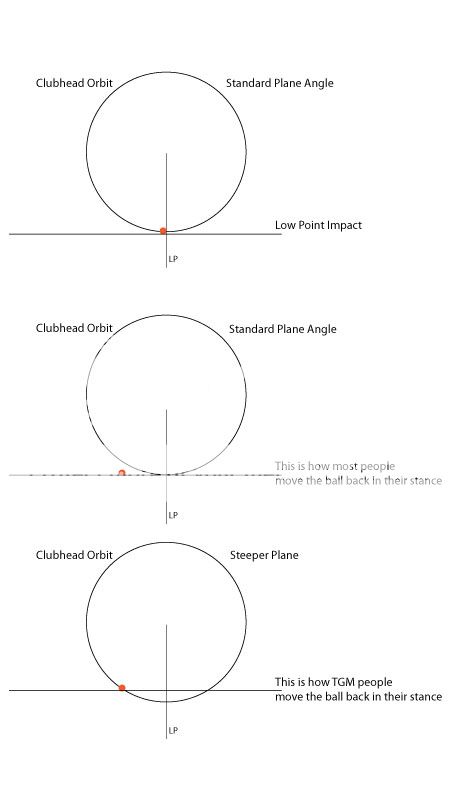 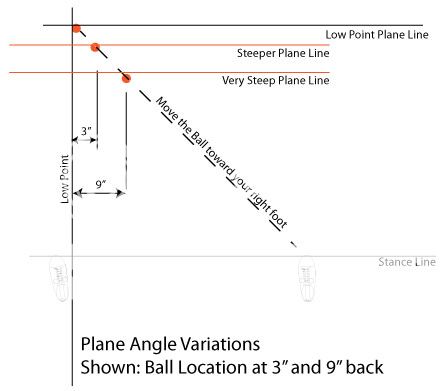 Moving the ball back more than 9 inches (maybe 9" is too far) would result in having the Toe of the club Strike the ground first. So there is a limit to how far back the ball can be played while still hitting a straight shot. It may be only 4-6" for a clean pick-off. Of course, all of this assumes that you're using the "Right Forearm Angle of Approach" and not using a Hand Swivel at Impact. Also, when Homer said to move the Ball toward your right foot, he was giving a fast way to locate the plane angle. This should work for most people but its only a guideline. The right forearm angle of approach will give you the exact location each time but I find moving it back toward your right foot a pretty good quick method substitute. |
Quote:
HB |
Quote:
|
Totally new information! Wow!
Quote:
ICT |
D I think you took "towards the right foot" too literally. I dont where Homer said this but I would take it to mean laterally rather diagonally.
Shorter sticks require more upright lie angles however which does lead to a more upright plane angle , that and the abreviated backswing (less back up and IN for a shorter backswing) . Which translates into less OUT more Down , steeper Angle of Attack, less "side spin" (tilted backspin) more backspin. IMO, you can maintain shaft plane while moving the ball back with a singular club in hand. Lets go to a new thread. |
Quote:
|
Quote:
HB |
Yes up plane which back in up as opposed to straight line laterally .
Bear I did start a thread. Dare you to draw a circle with a center radius and low point plane line. Or maybe Daryl has some drawings like that . Tbd. |
| All times are GMT -4. The time now is 09:59 AM. |