
|
Quote:
|
Quote:
But this goes back to the "is it really that simple?" argument. i.e. is it that simple that if the "Stationary Post" moves precision is lost? (flat-out) ... And besides, I only referenced the significance of a few inches in regards to the FEEL of head movement. I was saying that I didn't think the feel was very significant. I think the body position is tho. It's arguable tho. (both of those points) Anyway...I have not whiffed in a real long time, I'll tell you that buddy. Quote:
|
Of course , I am not qualified to give any thesis .
But I think golf is a game, where there is no perfect options. To a very huge extend, its Comfort and feel preference, and maybe even Illusions. As long as you find a way that the shoulder joint to club position have the same position and radius all the time, you hit good balls. John Daly, Jim Furyk. However, Since you agree that TGM is geometrically correct. Can you also agree that, The less thing you have to move or monitor is thus less compensation. I think That is the true meaning of what is compensation. Or kindly explain what is your meaning of compensation, compensating for what we feel? This is the impression i got from your thesis. The less thing you have to move, 1. The more confident you have to apply maximum lag pressure. 2. The less thing you have to monitor and train. And the more accurate you are from day to day thus less compensation. Though I remember , something someone said, i think its very deep. In Pivot controlled hands, Physics Precedes Hand controlled pivot, Geometry precedes So I believe, body controlled hands or people trying to use their body to generate power, will like to feel momentum transfer, thus the said phenomenum. Ben hogan pushing the right heel etc. But at the end of the day. As long as you can strike the way you like it , ball after ball after ball . its your correct way. Nothing to argue about really and not worth getting confused about. David Orr didn't mind his students with a slight BOB. Why should us ? |
This video seems to illustrate very well the complications of moving the head: http://www.youtube.com/watch?v=-wN2p...elated&search=
Matt |
How so M-dog? (can I call u M-dog?...lol)
It shows the head move...doesn't prove anything really tho. He did have more head movement back then too. (and he did do OK) |
Quote:
Yeah, I answer to M-dog. Watching this clip is disorientating, and I think it illustrates the amount of compensation necessary by the motor system in order to strike solid golf shots with head movement. Yeah, I'm sure he hit it extremely well. The question is whether the average player is giving up consistency by moving the head. For me personally, this clip is enough for me to try and keep my head as still as possible and feel that I have eliminated one element from my swing that can go wrong. Certainly for another person this clip will not mean the same as it does to me, I think that's perfectly reasonable. That's the beauty of golf, with a lot of study and work we can design a golf swing that we feel makes sense and hopefully produces excellent results, head movement or not. |
Kind of.
He DID have quite a bit of head movement back then and I'd say his Pivot these days is better... ... This video does not give you a true representation of what the Tiger SEES tho. You have to remember that Tiger's eyes move in the sockets throughout....and they will stay glued on the ball in the Backstroke... The camera on the other hand only represents how the head moves. The camera basically shows what it would be like if his eyes could only look STRAIGHT out of the face. (so you'd look to the right of the ball as the head sways AND swivels in the Backstroke) I hope you understand what I'm trying to get across. ... Try a Pivot like Tiger's and tell me if it's as disorienting as the video might make it seem. |
BTW as you said if you are having better results with what you're doing then by all means do it.
|
Quote:
Matt |
Quote:
Excellent point birdieman...well done! This makes me think of my own swing that I have been working on more with video...some distressing compensations in my swing that I need to work on...one is head movement on my backswing...I move my head up but it might be due to my head/chin being too close to my body and in the way when my left shoulder attempts to complete a shoulder turn...in order to continue turning my whole body and head raise a bit as I complete the back turn...I am going to work on a preturned head and my chin raised up to accomodate my shoulder turn...my eyes can still be looking down and to the left. |
In reading this thread to learn more about TGM, I noted that Yoda stated in post #53, #56 and #61 that the lower spine moves away from the target at the startup of the backstroke. Surely that is wrong.
Doesn't the lower lumbar spine move towards the target as the golfer pivots over the right femoral head in the backswing? Here is a diagram showing the movement of the right femoral head in the backswing pivot action - it moves backwards and leftwards. That causes the lumbar spine to move slightly leftwards, although the face-orientation of the lumbar spine becomes increasingly rightwards. 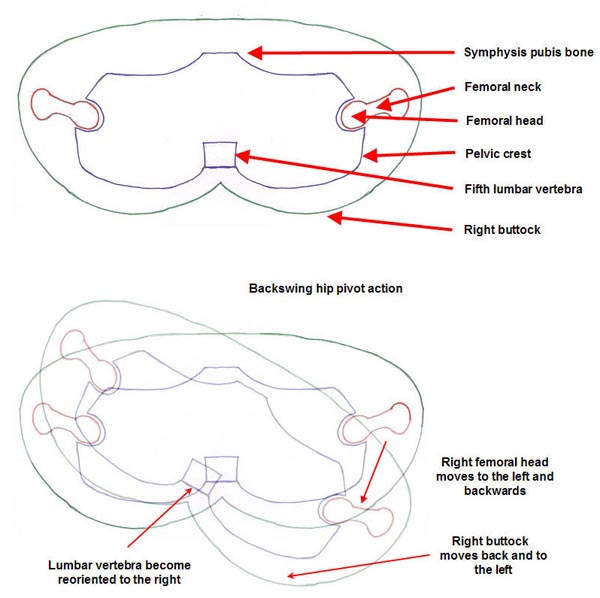 Jeff. |
"and don't call me surely"-(Airplane, 1980)
Quote:
The diagram that you've used would assume no weight shift and a single axis of rotation. (10-14-C) |
Thanks for the reply. Do you know which PGA tour golfers allow their pelvis to slide to the right during the backswing. It is my impression that most PGA tour golfers pivot-rotate around a slightly flexed right knee and don't allow the pelvis to slide to the right. Some, like Ben Hogan, even push their pelvis left-laterally in the late backswing, causing even more left-shift of the lumbar spine, as the following photo series demonstrates.
 Jeff. |
pictures don't tell the whole story
Quote:
I always have questions about 2-D pictures. Do we know that the camera was on a tripod or was it held? Do we know the distance from camera to golfer? Do we know the wind conditions and the trajectory on which the golfer wanted the ball to travel? Do we know the shot pattern required for the given hole? Do we know that the subjects in the background are standing perfectly still? In making so many assumptions about a couple of pictures, any hypothesis would have a hard time holding water. It does look like his left hip relative to his fellow competitor has moved to the right, in the second picture. And, that could be attributable to many things. |
Do You See What I See?
Quote:
Your detailed work is the kind of thing that makes our site work. Thanks! In reply, I'm sure hg can add the appropriate lines for us, but for now, let's just 'eyeball' Frame 3 of the Hogan sequence. Do you see -- as I do -- the belt-line tilited upwards? And the 'line' of his spine -- up the MIDDLE of his back -- tilted AWAY from the target (as opposed to its vertical position in Frame 1)? |
Yoda - if you are arguing that the general tilt of the lumbar spine is towards the right (away from the target) then I agree with you 100%. That's my mental picture of what happens to the human spine during the backswing pivot action - the junction of the lumbar spine and pelvic sacrum moves slightly leftwards as the right buttocks moves backwards/leftwards, but the frontal spine orientation becomes rightwards oriented so that the entire spine develops a rightwards tilt away from the target.
Here is a photo image of Ben Hogan at the end-backswing position - from the front view. He has a reverse-K look, because although his right thigh is oriented to the left, his spine and upper torso is oriented to the right due to the increased rightwards tilt of the spine that occurs secondary to the movement of the right buttocks leftwards/backwards (that produces a reorientation of the spine to the right). 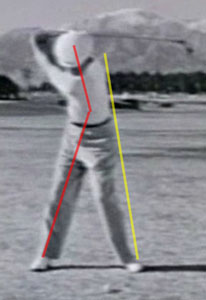 Jeff. |
Quote:
|
12 piece bucket
When I drew that upper red line, I didn't draw it over the spine. I simply drew it through the middle of the upper torso and through the middle of the head to reflect the general direction of tilt of the upper torso - to demonstrate the reverse-K look. The spine is actually between that upper red line and the yellow line, and the general direction of tilt of the spine is parallel to that upper red line. Jeff. |
Quote:
No biggie but that's just me. holla! |
The spine could be parallel to the yellow line. The yellow line is nearly parallel to the upper red line anyway, and these lines are not meant to be exact representations of body anatomy, but merely illustrative of the reverse-K end-backswing position.
Jeff. |
Quote:
|
Monty
Quote:
|
Is that what Homer talking about?
1 Attachment(s)
I am no expert, but it looks alike to me.
|
stationary center
See 7-12 . . . I think that should clear up any interpretation issues. The title of the section is Swing Center TRIPOD. The head does't move, but what is UNDERNEATH it may. And in 1-L #1 it says STATIONARY Post (player's head). The post is IMAGINARY . . . It ain't the spine. It is a line drawn up between the feets and up through the mellon. Also see Axis Tilt in the Glossary . . .
Mechanical - To change directions, the helicopter pilot alters the plane of the rotating blades by tilting their axis in the new direction. Well put!!! Golf - To change the plane of the Shoulder Turn without moving the Head, the golfer must tilt the Shoulder Axis by moving the Hips. It all depends on your focus of the "staionary center". I think you can have a stationary head and that becomes a "head centered" pivot .... Colin Montgomery comes to mind. But if the head is to stay centered and I agree with Mr. Blake "set it there and keep it there", the multiple centers and hip shift "tilts" the axis to allow for this (in a dynamic motion). Flexibility and conditioning and "too flat" of a shoulder turn have adverse effects on keeping this head centered IMO. jpgolf |
Connecting the 'Swing Center Tripod' Dots
Quote:
The important thing is that the true Swing Center for ALL COMPONENTS is around a Hinge Pin with one end at the top of the Stationary Head and the other in the ground, precisely between the Feet, with no regard for Body Location or Position at any time.:salut: |
Quote:
I have always viewed this swing center being slightly left of center... |
Pivot Center Versus Low Point
Quote:
The Pivot Center lies between the feet. The Low Point (of the Arm Swing) lies opposite the Left Shoulder. :) |
Head in the vertical dimension
I'm a newb with a stationary head question. Snead is mentioned many times in the thread, one of his traits is the so-called "squat" on the downswing. The "squat" move is now highlighted in Tiger swing analyses.
I wonder how the so-called squat doesn't lower the head vertically? I accept that a head bob or sway is counterproductive, and would like some informed opinion. Thanks |
Welcome groverw.
Great question too, Ill be interested in the answers you get. Lots of great players with squats. Although most didnt start from Impact Fix but rather some place a little higher up. Id say that Tigers head was for sure dropping with that big squat. Especially with the driver. His radius, his left shoulder to ball distance was changing dynamically. Low point was lowering. But he doesnt establish his radius at Impact Fix. Hogan got pretty close to Fix but had some squat. Lyn's got some squat. Is a little squat a good thing? Can you squat and keep the radius properly measured? O.b. |
Quote:
2. That move also helps you get the club coming down the face of the plane delaying the hip rotation 3. Eldrick may accentuate this move due to his set up. He sets up with his neck and back all straight and probably does this move some so he can get the ball focused with his eyes when he makes his down stroke. |
Adams Scott does point #3. Practically looks down his cheek bones. Maybe he needs more elsquatto! Bucket, Tiger is always presented as the paragon of posture. Do you think the straight neck is more form than function?
|
Where are his eyes at impact though? Id bet not looking down his cheek bones. I think Homer would want your eye line at impact previewed in fix too, no? So I vote for Form or misguided function maybe.
And agreed its nice have Bucket back posting, he is an expert on this subject. Why just the other day Daryl was saying Bucket new squat. He did, I heard him. Daryl is so kind sometimes. So Bucket, what are the implications to the radius, bobbing etc when you squat. Do you have to unsquat prior to impact? |
Okie,
Will you take that wooden pot stirring spoon away from O.B.?  |
woah!
I'm getting deja vu all over again! This is what caused Daryl's 'meltdown' on Lag Erickson's site! When is a stationary head not stationary! lol! |
Quote:
Dudes I fear that maybe my humourisms might be taken the wrong way. I do honestly value Buckets ground force knowledge and my question is an earnest one. Daryl you know squat too, maybe you could add something here? Ob |
Squat is a Vertical Downward Force. It takes the Hands from a Steeper Plane to an Elbow Plane; Always.
It lowers the Head. What goes up must go down, then Up again. The Squat is a Position, destination. The Sit-down is an Alignment and it's not a destination. The Squat is timed with the Arm Drop to the Elbow Plane. The Squatter, Squats to Pull the Hands to the Elbow Plane, and waits for the Elbow position to get to release. Then the Squatter uses his legs to thrust and throw his right forearm into the Impact Zone. I like it best when it's followed by flinging the clubhead from the wrist through Impact. The #3 pressure point monitors and coordinates the procedure, not the plane line. It reminds me of a two handed forearm smash in Tennis. |
Thanks for the head-squat answers
O.B., Daryl, Bucket and Okie;
thanks for sharing your opinions so quickly! Good stuff. As to a swing center, I guess the squatter can still maintain a still head in two dimensions. I think this site is the single greatest forum on golf. My mailbox has been filling up with commercial golf magazine subscription offers and I couldn't care less. |
TGM's Stationary Head
Homer Kelley viewed the Stationary Head as a geometric ideal, not as a mechanical absolute.
He recognized our humanity. Hence, his advice: "Just keep it as still as you can." :salut: |
Quote:
      Who can see? Compare the upper spines and who gots the bobbing for apples faces . . . being able to see is a pretty big deal. |
Quote:
       |
| All times are GMT -4. The time now is 02:11 PM. |