
|
riddle me this plane
So -many planes:
Get them all "guessed" at FIX and they all change at impact. Here is a big one. COG pull causes toe down at speed. The shaft is now bent in an arc. the grip now points, not at the hossel, not at the cog but, because it is a tangent to the arc of the bent shaft caused at toe down, out beyond the toe of the clubhead. But how much? What is the correction? how is it added? Tell me what becomes the feel at pp #3? Not an Easy Riddle. Hint- I have posted the solution as I see it some time ago. hb |
Quote:
|
Quote:
We can restrict the scope to the Impact Interval because Ball response depends on that. The Lie Angle of the Club affects direction. If the Hands are too low, then the ball goes Left, if too high then the ball goes right. It's named "Swing Plane" because we will Swing the Club along this Plane. So the Swing Plane is built-in to the club, and it's normally somewhere between the Shoulder and Elbow planes. Our job begins by aligning the ball, low point and the target to this plane. Low point and target are already reconciled. Just get the ball right. Ben Hogan, in his book "Five Lessons" made an obvious mistake and he himself contradicted this illustration in numerous interviews and demonstrations. 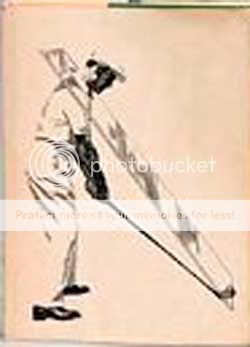 |
Quote:
HB |
Quote:
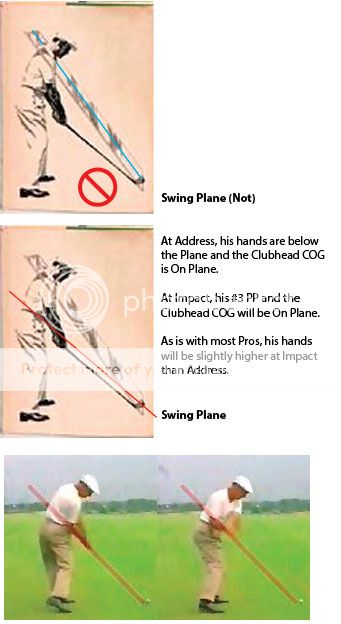 One point to make is that there are 3 Planes. Left Arm Wedge, Right Forearm Flying Wedge and Swing Plane. Although its possible to align the Flying Wedges at 90 degrees and thus have the Club on both of these Planes simultaneously, the Left Arm Wedge Plane is Opening and Closing (Turning and Rolling) and cannot directly move the Club along the Swing Plane. It can do so under the guidance of the Right Forearm Flying Wedge. |
Turning Shoulder Plane
I've been talking about hand paths in the context of the Turned Shoulder Plane because it's the most common, but let's look at the Turning SP - the version with vertical moving arms. Homer says the hands trace a line on the ground INSIDE the base line, so in this case, the hand path NEVER lies in the Swing Plane, unlike the Turned SP in which the hands trace the baseline from the Top.
|
Quote:
|
Quote:
http://www.lynnblakegolf.com/forum/post94266-1.html So, in the context of this post, post #1 of this thread is not practical? Hogan just said DON'T GO ABOVE the glass plane and the DOWN SWING plane is relocated BECAUSE OF AXIS TILT. Hogan did not talk about COG plane or "sweet spot" plane. Likely because he was smart enough to know it was not useful to the golf swing beyond an accademic curiosity. HB |
Quote:
I've made BOLD in the quote below, an important point. Also, it may have been widely used in his day but its no longer widely used. There are two versions and as Homer said, its difficult to assign a reference point while using these procedure. The Club will return appropriately to within a few degrees of the Clubs Lie Angle and as long as this is compensated, it will work. Quote:
|
Quote:
Quote:
|
Quote:
I do no necessarily agree with your arguement, I am just point it out. This is neither a question or problem for me because I am comfortable with the dynamics as understood. I will put forward another arguement- that the use of left hand alone tends to bend the plane by throwing the clubhead around the left hand , bending the plane to close the clubface and use of the right arm only tends to throw the clubhead out to right field because there is no checkrein. HB |
Quote:
I've swung the Club both ways with equal results. I've also swung the club with Left arm only and right arm only with near equal results. I think that the Club needs to stay On Plane during the impact interval. |
Quote:
|
plane flex
Quote:
It is satisfying radial alignments"clubface control" As for the R/arm,imo opinion,it is forward and downplane to right arm straight using only forearm thrust with pp on base of hand,that one is the easy one...cheers:eyes: |
Quote:
This was a popular procedure back in Homers day the era of "sky high hands" and covering the Base Line with lots of "extension" in startup. I used to do this . Homer called it Steering , but so long as the golfers returns to the ball in a manner consistent with 3 Dimensional Impact Alignments the ball does not know the difference and so he himself would teach the Turning Shoulder Plane to those who for what he termed "psychological reasons" just couldnt stop swinging like that... it was after all very common back then . Normally with a reverse C finish and lots of knee drive. Homer wouldnt fight it for too long , he would just improve it (vertical drop I imagine being a common improvement) as he reasoned the "game is supposed to be fun". Now if you had a more ambitious student ... that might be a different story. BTW Furyk's dad when teaching young Jim the game placed a wooden ruler behind the ball and encouraged him to cover it on the way back. Thereby taking him off the elbow or shaft plane immediately and shifting his plane angle up up up continuously . Its more complicated mechanically than is necessary but assuming you can ingrain consistency it is just as effective in terms of impact dynamics. Some folks would point to Furyk and say " Where's your plane angle now , Homer!". But the geometry is still there if you know where to look. Homer might not have been perfect but he was a bleepin genius IMO. |
Genius looks different too at different times during the day!
Quote:
When I started asking better questions, Daryl's Right Fore Arm Angle of Approach gave me countless insights into how to consistently stay on plane using that bucket drill. Now, a lot of what you OB, and Daryl, and what Lynn showed me is actually obvious but I was missing the vocabulary to even stutter correctly. I couldn't even begin. :rolleyes: I am going back to see Lynn and try to be a better student so I can get to become one of his junior instructors or something but "On Plane" is not negotiable as are flying wedges and other stuff. As a classroom teacher, I always struggle with where to start kids in a lesson so all teachers everywhere, who care, always second-guess their lesson plans since none of us know what is really inside another person. Lynn knows so much about the golf swing! One minute he is teaching three PGA instructors how to really putt and chip for dough, and the next minute he is teaching me a basic grip and stance! He is amazing!:golfing_banana: ICT |
Quote:
I agree with HB here, never use the left hand "alone " to manipulate a Flail Action or a Hinge ACtion for that matter . Hinge Action is defined by the Left Hands alignment to one of the three basic planes but its not done by the Left Hand!! The entire Primary Lever moves as a unit. Everybody gets this wrong at first, some never move on . Elk , some GSED's talk about full rolls , half rolls of the left hand etc but thats not quite right , close but not correct . Flail Action isnt what it seems at first either!!! Its not loosy goosy rubber wristed kids stuff in any way. Although it appears to be very handsy, it isn't. No Sir. TAke for instance , what Lynn calls Startup Swivel: It is actually powered by the momentum created from his Lagging Takeaway in his swing. So even there the left hand is not turning to plane on its own, or under its own power. You have options here of course , Single Wrist Action , Double . Lagging Takeaway , Carry Back. But since we have considered the left side Flail Action I thought Id throw this out. I got hooked on holding off release , lynn taught me how to free wheel and release . If you're directionally challenged when learning the on plane flail action you havent learned how to release and maintain Rhythm or the alignments of the Primary Lever or the Left Arm Flying Wedge or or .. Dont be so quick to adopt a blocked release, learn the golfers Flail with alignments and structure. When you get it right you will love it. It will be on plane on both sides of the ball! Swoosh. Swoosh. You can hear it as the face rolls over like Hogans little baseball bat . Swooosh. There's power there, Transfer Power. Unblocked Transfer Power if you will. Number 3 angle with its added clubhead Travel is powerful in its own right too. And thats how it feels .... feels i said. From top you must prepare to do this ... "Delivery LIne , ROLL prep". |
Quote:
|
Quote:
HB |
Quote:
|
Quote:
|
Quote:
The more I get into Homers Rhythm , capital R... the more I think its responsible for the bad shots we see on tv by the best in the game. Its that important I believe. I dunno. But you can still have a common speak "full release" and maintain Rhythm. Thats when the good ball striker becomes a great ball striker perhaps. I know this will sound old fashioned to some. That swinging left with what we call angled thing is sweeping the nation like the British invasion. Some day somebody is going to invent a Rhythm drill that will become so popular that itll be seen on every practice tee the world over. Some day.... eh, Ted? Can you copyright a drill? Can you buy shares in a golf drill? Golf drill futures? |
Quote:
The Essential Imperatives? |
Quote:
Let me try an find an example: Breathing is an essential Walking the fairways is an imperative on the PGA tour. The tour pro must be in good enough shape to have good and comfortable breathing or he/she will not be able to walk well. The pro's must train himself to walk and play at a reasonable rate. If he can't he will loose strokes and have a poor round. Not a great example but it will serve the point. hb |
Quote:
Quote:
|
Quote:
I do think that as goes one Wedge so must the other to maintain their 90 degree or smaller relationship. |
Quote:
Hogan lowered his head towards and through impact. Luke Donald raises his head through impact. I'm thinking that the guy who dips his head is pushing more and the other is pulling more.... and that the guy who is pulling more will get both ends of the club on the same plane sooner. Eventually even Hogan was pulling 100% but that was (I think) way after impact. |
Quote:
Your examples are the opposite of what you think. Hogan is pulling from release all the way to his anatomical limit at the finish, while Donald is throwing the arms/club through Impact with his Right Shoulder. |
Quote:
|
Quote:
LOL. 24 components. Mix em up any way you want. The Right and Left Wedges are not components. Quote:
|
Quote:
|
Quote:
Hogan wished he had three right hands so it goes without saying that he didn't purely drag the club through impact. He must have been applying a lot of pp#1/#3 through the ball. As far as Luke Donald is concerned, throwing is a very ambiguous term the way you use it to describe Donald's release & impact but no matter how I twist the meaning of the term, throwing plus raising the head before impact doesn't make any sense to me whatsoever. The thing that intrigues me about this is that the hands to plane stuff seem to make a difference to club face control. Hands that are above the plane will make it easier to close the face towards impact, and sometimes it will make it too easy, ref the dreaded snap hook. Similar, with hands that are under plane early on - as with an OTT problem, the golfer will have big problems squaring the club face before impact. Seems to me like hands above plane will promote a closing action while hands below plane will tend to keep the face open. Just not sure how it applies to good golfers in real life. Perhaps Daryl is right and that it has to be right on plane through impact. |
Quote:
Let me start with my moving power package parts. There are not that many. Left arm, wrist and hand- moves at the shoulder only as allowed by the installed hinge and 90 deg pin if dual action is required, The left wrist can cock and uncock only vertical to the hinge. There is no other roll or turn in the left other than a swivel of the arm to plane near top of backswing. Right arm and hand- The right shoulder has a ball joint at the shoulder, the right elbow can fold and unfold , that is it. the right wrist is fixed and bent, it does not cock or roll. Thats it, work with those capable movement and move the shoulders and axis to get what u need. Whe swinging this ENTIRE assembly is Pulled then released as far into follow through as practical. The center of rotation is my spine. The right arm, elbow, forearm, hand assembly is thrown into impact with care that the right wedge not just the club is "THROWN" down the plane with a SLAP by the right hand. Get the RHYTHM right Get Your BALANCE perfect Keep your center of rotation (we will call it your "HEAD") stable In summary, thats how it works for me. HB |
Feeling versus knowing
Quote:
ICT |
Quote:
Then the guys you are watching are shanking it, which is exactly what anybody will do if they plane the shaft at Impact. :blackeye: You must plane the Sweetspot. |
Quote:
hb |
Quote:
Yes he did - the pressure he felt at PP#3 was lag pressure - a "receiving" pressure. He was pulling all the way in what Morad calls a "cp" swing, in which the lag pressure is felt to pull toward the body mass center. Notice how bent his right arm is through Impact. Donald uses the Morad and TGM "cf" Swing, in which the hands are thrown away from the flywheel - the Right Shoulder. His head raises up to counterbalance the hands moving away. |
Quote:
|
Quote:
|
Quote:
HB |
| All times are GMT -4. The time now is 03:04 PM. |