
|
12 piece bucket
You wrote-: "Jeff . . . keep in mind that Homer was simply using the Endless Belt to illustrate a CONCEPT. I don't think Homer ever thought that hands move on anything but an Arc. It is the player's intent to move the hands in a straight line . .. but as you say in reality that don't happen. I'm sure that Homer was certainly aware of that fact. The Endless Belt is a nice way to think about things particularly with different "pulley diameters" controlled by hand path and #3 angle." I agree with you that the endless belt is a nice way to think about it, but there are alternative ways of thinking about the release phenomenon that may be more compatible with reality. If you look at the hand arc of many professional golfers swinging a driver, you will see that the hand arc is C-shaped with a broad curve of near-constant radius (near-circular or elliptical). There is no J-shaped hand arc that would fit in with the endless belt analogy. So, the question becomes - how best to explain the release phenomenon in those golfers who have C-shaped hand arcs (like Bobby Jones, Tiger Woods and the Pingman machine). 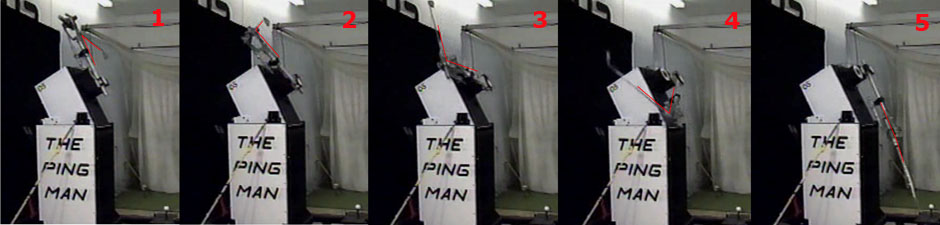 I think that the best mathematic explanation was provided by nmgolfer in that link. Even David Tutelman has recently accepted his mathematical explanation as a better alternative than thinking about centrifugal forces (which is a controversial concept). The fundamental mathematical principle underlying the release phenomenon is that a golf club will develop angular acceleration when the pull force on the grip is at an angle to the COG of the club, and that the club progressively builds up angular momentum because of the cumulative effect of these angular acceleration forces at every moment of the downswing. Although Bagger doesn't think that the waterskier analogy is useful in trying to understand the release phenomenon, I think that he is not thinking of the waterskier analogy in the correct manner. He was talking of water resistance, when one should ignore water resistance and consider the situation from the following perspective. 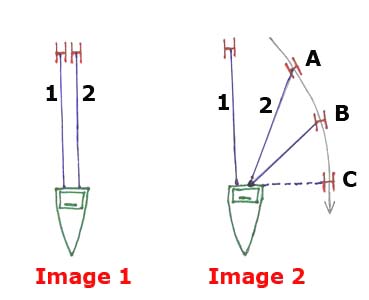 Image 1 - there is a constant pull force from the connecting rope because the motorboat is traveling at a constant speed. Therefore, the two waterskiers will travel at the same speed as the boat because the rope pull force is linearly in line with the angle of the skiers skis. Image 2 - now, if waterskier number 2 angles his skis to the side so that they would intentionally carve a curved path of constant radius, thereby creating a C-shaped path, he starts to accelerate relative to waterskier number 1 and the boat. Why? It is secondary to the fact that the pull force from the rope is now at an angle to the direction of his skis. He subsequently experiences angular acceleration. The amount is very small at first, but imagine that there are 1,000 time-points between the start of his curved path and point A. At every one of those 1,000 time-points, he develops an additional amount of angular acceleration because the constant pull force is at angle to his direction of travel. The effect is compounded and his velocity increases. Now imagine another 1,000 time-points between point A and point B. At every one of these 1,000 time-points, he continues to accrue even more angular acceleration because the pull force from the rope is at an increasing angle to his direction of travel. Therefore, it is not difficult to understand how waterskier will be travelling much faster at point B than point A - even though the boat and waterskier number 1 are travelling at a constant speed. This process of accumulating additional angular acceleration in very small incremental amounts continues to point C when the waterskier is traveling at maximum speed and catches up the boat. In other words, his speed increases constantly due to the cumulative effect of additional amounts of angular acceleration at every moment of his C-shaped curved path (of constant radius). I believe that the same phenomenon occurs in the Pingman machine and professional golfers like Tiger Woods. Consider the situation of Tiger Woods. 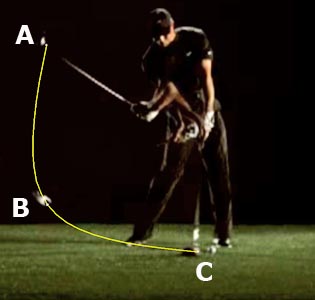 Note that at point A, Tiger still has a 90 degree angle between the left arm and clubshaft and the club has not released, while it is released by impact (point C). Both the hand arc and clubhead arc is C-shaped between point A and point C. So, how does the release phenomenon occur? It occurs because at every moment between point A and point C, the pull force on the grip end of the club is at an angle to the COG of the club, and the club therefore develops angular acceleration. Between point A and point B, the cumulative effect of the angular acceleration increments is very small so the degree of release is very small by point B, but between point B and point C the release happens faster-and-faster because of the cumulative effect of incremental amounts of additional angular acceleration at every moment in that C-shaped curved hand/clubhead path. There are many logical/intellectual benefits to nmgolfer's mathematical explanation. 1) It doesn't invoke the idea of centrifugal forces, which some people believe is an abstract concept. 2) It explains why the clubshaft reaches maximum speed at impact, while the endless belt concept incorrectly predicts maximum clubhead speed at the time of "going through the acute J-shaped curve bend". HK has to provide an additional explanation for the fact that clubhead speed increases all the way to impact, and he writes about factors that must maintain hand speed all the way to impact. 3) It is not depend on any COAM-belief. HK invoked COAM in his TGM book and apparently implied that the hands have to slow down as the clubhead speeds up, unless the golfer did "something" in addition to ensure that the hands maintain a constant speed. In nmgolfer's mathematical explanation, there is no COAM-effect, and the hand speed can easily remain constant while the club constantly develops angular acceleration at every fractional moment of the release phase of the swing. Now, if any forum member can demonstrate a flaw in nmgomfer's mathematical explanation, I would like to learn of that flaw, so that I can more correctly understand the physics of the release phenomenon. Jeff. |
Quote:
You've put significant thought and effort into this so lets explore the boat analogy one more time. I've just invented some magic dragless skis so we that we can continue. Likewise, I can put on ice skates and you can pull me across a frozen lake on your snowmobile in order to reduce the drag effect of plowing water in your skiing example. First a couple of questions: When the skier reaches point C what speed is he traveling? If faster than the boat, does he pass the boat? If he passes the boat, how far does he go before ceasing to accelerate? Check out these cats who are looking for the maximum acceleration point. http://www.youtube.com/watch?v=-JVXk...eature=related To save time, I'll answer the above. The skier will travel at the same rate of speed as the boat when he reaches point C. In other words, somewhere around point B he loses the ability to accelerate and momentum will carry him to point C as he decelerates to the speed of the boat. If he had a head start like the ski jumpers, he might be able to pass the boat from momentum alone. Somewhere between point A and point B (a 22.5 degree angle), he will not be able to accelerate much further no matter how much he angles the ski. In other words, if you are going the same rate as the boat while at a 22.5 degree angle to it, you will be hard pressed to gain any speed to get to point C no matter how hard you lean into it. In the golf swing, we are talking about wristcock faciliating angular momentum by use of the flail or left wrist. Why doesn't the clubhead overtake the hands (boat) or decelerate when nearing their inline condition in a good swing? Because the golfer transfers all of that wristcock angular momentum into his turning left wrist which is #3 accumulator roll power. There is no skiing analogy for the transfer of wrist cock momentum into roll power. |
Bagger
You would have to supply a solid physics/mathematical explanation for your assertion that a skier cannot accelerate between point B and point C if he keeps his skis constantly angled for me to consider your assertion seriously. Those U-tube waterskier competitors straightened their skis after accelerating sufficiently, so that they could have a straight-line directional launch from that launching platform. There is a big difference between a waterskier between point B and point C (and Tiger Woods' club between point B and point C in his swing). Because of the presence of waterdrag and an increasing angle between the rope and the the skier's curved path, the skier will slow down as he passes point C and approaches the boat. By contrast, in a golf swing, air-resistance doesn't impede the release phenomenon in a golf swing, and there is no reason why the club cannot continue to accelerate between point B and point C. In fact, the club does and the clubhead passes the hands after impact. The waterskier example obviously has limited analogy to a golf swing because the left hand undergoes a 90 degree rotation during the release swivel, as you pointed out, and that is an obvious confounding variable. My only point of using the waterskier analogy is to give an analogous, easy-to-understand, example of the principle that underlies the release phenomenon - that it is due to angular acceleration developing because the hand pull on the grip is at an angle to the club's COG-momentum and that i) variations in hand speed and ii) hand arc curvature at all time-points during the downswing will cause variations in the degree of angular acceleration during the downswing, and therefore release variations - between different golfers (as nm golfer's mathematical explanation predicts). Another added point - I have a PingMan-type driver-testing machine at the golf facility where I practice, and I have studied that machine's release action. It has a passive hinge joint that can rotate >90 degrees to simulate the release swivel. Interestingly, it always rotates perfectly during the release even though the hinge joint is totally passive - I presume that it has something to do with the COG of the clubhead causing the clubhead to automatically rotate to a square alignment at impact. I also have noticed that the central arm's swingarc, and therefore hinge joint's (between the central arm and clubshaft) swingarc is circular, and that the central arm travels at a constant speed. There is no endless belt pulley analogy that is applicable to that machine and yet it releases the clubshaft perfectly/naturally - the only "release phenomenon" explanation that presently makes sense to me is nm golfer's mathematical explanation. Jeff. |
Quote:
As an exercise, think of the ski angle to the rope as fixed during initial acceleration prior to point A at 22.5 degrees (direction of intended travel). When the rope angle to the boat has reached 22.5 degrees to the boat, the skier must then have a 45 degree relationship of the rope to the ski in order to continue accelerating on his original linear 22.5 degree direction of travel. Otherwise the effective angle of his ski to the boat is reduced towards parallel with the boat, with accompanying deceleration towards the boats constant speed. So as the skiers ski travels on an arc with an original ski angle at 22.5 to the boat, the angle of the ski must increase for every degree of increase in the angle of the rope to the boat, otherwise acceleration stops. So yes, at the end of the day, its all about drag and skier strength. You simply cannot maintain a constant ski angle in relation to the boat in order to accelerate to point C. Quote:
I tried to dig up some of the physics on skiing but didn't have any success. I hope my simple geometry make sense. Quote:
Everything in a golf stroke is seen as circular but like the skier analogy, what is not seen is linear intent. But it is the lines that are our guide-lines to good golf. |
Bagger
Thank you for your explanation of the effect of water drag load on the limits of a waterskier's physical ability to maintain a curved path. That makes the waterskier analogy less useful. Hopefully, other forum members will imagine the waterskier situation as an "imaginary situation" that exists in the absence of any water drag load, so that they can basically try to get a visual picture of nm golfer's mathematical explanation. I wonder if there is a better visual analogy that can better convey the "essential idea" behind his mathematical explanation, which seems to be very sound. Jeff. |
Quote:
I would have said Thank You to Baggerfor taking the time to explain instead pissing on him. Maybe on your other forum this is protocol. |
No Harm
Its cool 6B. Given Jeff's distinguished Medical background and attention to detail, I can appreciate where he is coming from.
I took his response as a compliment and kind of enjoyed re-experiencing my Skiing time anyway. |
6BMike
You wrote-: "would have said Thank You to Baggerfor taking the time to explain instead pissing on him." Wow! I am flabbergasted at this comment. I did thank Bagger. I wasn't insulting him. I acknowledged his greater knowledge re: the effect of water drag load on a waterskier's skis, and I therefore concluded that I would need to find another visual analogy to better illuminate nmgolfer's mathematical explanation. Jeff. |
that reminds me in the arm stroke,
there are paw, pick , and a very interesting one Pause... alot of interesting points.. |
Quote:
I find you being flabbergasted hold to imagine. But nothing personal ol chap. It's just you seem less than affable in many replies. Not many rocket scientists on this site but a whole lot of good golfers that know how the sweet spots moves on plane to achieve impact. |
| All times are GMT -4. The time now is 06:00 AM. |