
|
Quote:
Getting the hands more "in" and the plane flatter will make the pivot more rotary by necessity. If he spins his hips on his current steep plane he's WAY OVER THE PLANE. Right now he's on plane just a steep plane. |
Quote:
I agree with Bagger... he has many hitting components... but that can depend alot on where you get your first exposure to TGM.... if you learn a "twistaway" type move early on....then you can get a swing that looks like this... I did... works well until one ( OK ...i mean I) ignorantly start to work on incorporating swingers components into the hitting pattern that one has subconsiously started to develop. Would a conscious move to the angle of approach help if Detonum wants to hit ? Maybe his hip slide looks better if one considers it from the 10-5-E downswing plane option that Hitters can use? The arch starts in frame 2 of the DTL views....hands stay stationary whilst the clubhead moves up back and in....if the hands moved up back and in at the same pace and the impact address was less pronounced....there would be no arch... essentially what Mike was saying... |
Quote:
|
Am I the only person that can't see the pics?
|
Hallelujah! Had a small breakthrough at the range.I was concentrating on hand path.. I was thinking that with an arched wrist, my hand path is quite out-in to keep the club on plane...So I tried to feel my left wrist abit bent, and swing my hands more in to out...and there it was, compression with a flat left wrist! I checked it on video, flat left wrist all the way baby! Flatter plane too, because of that hand path swing though. Then I realized something: I felt like I was tracing a straight plane line for the first time with my right forearm. Now that's something.
curtisj76, I see them, but you can see the sequences as videos on youtube.. http://www.youtube.com/user/detonum The two latest videos are the same as the sequences I posted here. |
Quote:
Bucket- from post #21 on this thread" "The steeper the plane you have to slide more. Flatter planes require less slide and more rotation." What are you drinking? I mean thinking? :confused1 So it doesn't get too confusing- let's keep "rotation" out of the picture and just deal with steepness of the plane and required hip slide. The steeper the plane the less slide is required. The flatter the plane the more slide is required. Why? Because the flatter the plane the more the hands move "behind" you "deeper"- that requires a larger slide of the hips on the downswing for clearance of the hands to make their way to the ball without the right elbow hitting the hip. The above would hold true to a completely "hand controlled" pivot"- or for a simplified theory with just a couple of factors in play. However, in the real world you can find golfers with steep planes that have more hip slide than golfers with flatter planes. It just depends on what kinds of movements the golfer has memorized and incorporated into his particular swing based on compensations or psychological preferences. For an example of the simplied theory- if you were Al Geiberger with a fairly upright swing and minimal hip slide- you wouldn't want to look at a Ben Hogan with a flat plane and a tremendous hip slide and say "Gee, I'll maintain my upright swing and I think I'll try to get that big hip slide that I see Hogan had". Holla back Homey when the medication wears off! |
Quote:
The hip action is (hopefully) a blend of turning and sliding in order to keep the club on plane. What makes the club come out? What makes the club stay in? Which plane has more OUT? Hogan did slide but he got his hips OPEN too. Much more rotary than a Nicklaus or Watson . . . How can you "for arguement's sake" take rotation out of the picture? That ain't gonna work. Sliding keeps the hands IN rotation gets the OUT. It's like taking the straight edge puzzle peices out . . . can't do that and have a puzzle. Dookeyball  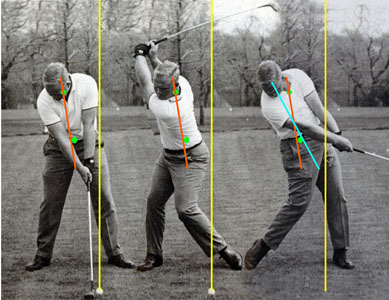 If you have a steep plane and high hands you have to slide to keep them from flying out over the plane. Sorry doofus . . . it's you that's needing a bottle or two of pills. Wipe the boogers out of your eyes. |
Here's one of the flattest swings in golf . . . where's the slide Mikey?
 |
Quote:
    |
Power Play
Quote:
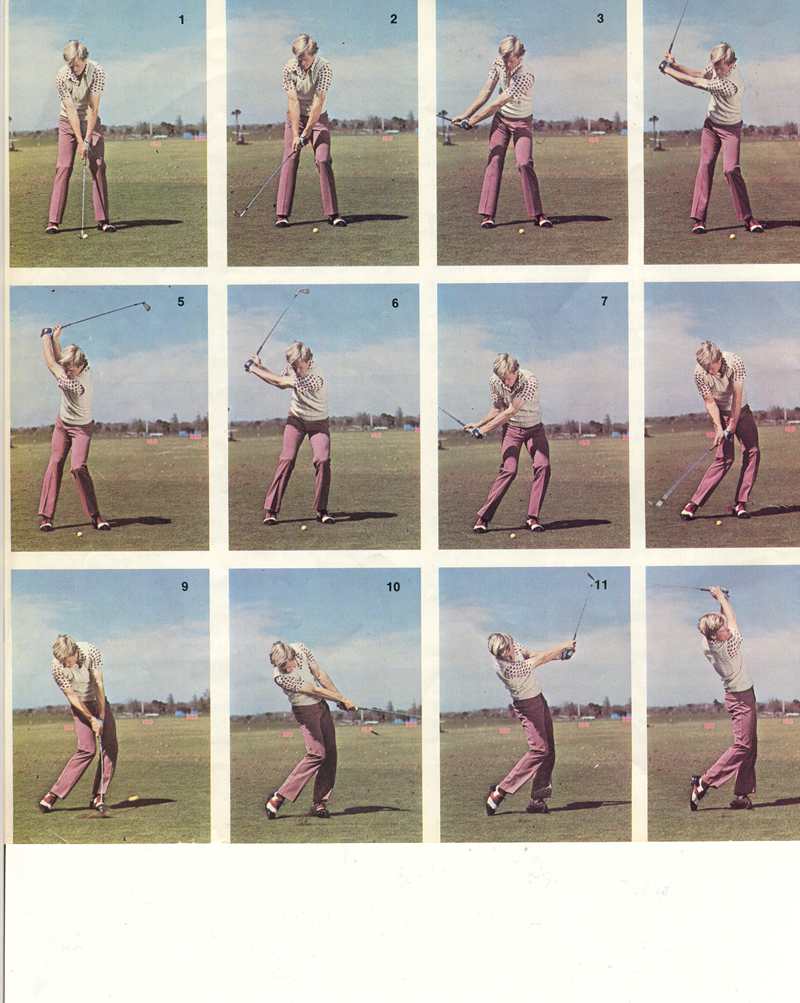
Use your left arm and club only and imitate photos #10 and #14. This is The Flail. It is "the Swinger's primary concern" (2-K-0). With just your left arm and club -- and with a bit of additional pressure in the last three fingers of the left hand -- Swing back and through and back and through and back and through. Again, imitate the photos exactly. Let your Pivot help you. This is important. The left arm has little power other than that which the pivot gives it. Contrast Sergio's belt line in Photo #10 with Photo #14. The Body Rotor turns a full quarter-of-the-way around from Release to Finish Swivel. Point the butt-end of the Shaft at the Line (first in the Backstroke and then into the Finish). Stick a tee in the butt-end of the grip as a reminder. Do it. Learn Plane. Then, with Body Power supplying the initial Thrust (in the Start Down and Downstroke), let the Club rip past the Left Arm (and your Rolling Flat Left Wrist) through Impact into the Follow-Through and Finish. Learn Power. |
| All times are GMT -4. The time now is 11:17 PM. |