
|
Wasted Time
Quote:
All those millions of balls . . . Keeping my Head steady . . . Leading with my Hands . . . Doing my dead-level best to generate Lag Pressure, and . . . Trace that Straight Plane Line. If only I had known . . . Quote:
|
Quote:
I'm giving up. |
Roadhouse Partners
Quote:
:occasion: No players allowed though. Otherwise . . . We're both out of a job! :salut: |
nmg,
Quote:
This is very basic fysics. And perhaps the point is so self-evident that you looked for something more "exotic" in my statements. Quote:
Quote:
Quote:
Further, I do not see a significant upside in moving this swing center around much. Good golfers + instructors introduces all kind of "tricks" to hit the ball furter. And a lot of ordinary golfers gets confused. X-factor, late release and your "jump on your toe" by the end. The reason I think the concept of work and energy storage is important in understanding the golf swing because: 1) As long as we can (more or less) accumulate energy until impact, it doesn't matter whether we energize the swing early or late. I don't regard the "late hit" as a magic formula for increased distance for instance. 2) Not even the purest swing is all about centripetal acceleration. Centripetal acceleration only helps us store the energy. We need to actively rotate mass to build swing speed. Tangential forces must be applied. Centripetal acceleration feels powerful but it doesn't add power. 3) A lot ofthe magic mystery moves that is supposed to increase swing speed is misleading. A stroke pattern that enables the golfer to apply max tangential forces throughout, and at the same time provide the required centripetal force to carry the m*v2 until impact is as good as it gets as far as swing speed is conserned. If that doesn't produce enough swing speed it's time to hit the gym. |
minimized vs. omitted
Quote:
Thank you for letting me know what I had in my mind. I had no idea. :eyes: It still doesn't justify the statement that you made and I quoted. I included the movement of the left shoulder in my statement. You've still omitted the ever changing distance between the left shoulder and the clubhead. If you're choosing to speak specifically about the Start Down, that's one small part. The "more circular" statement was vague at best, and it's still lacking. |
Yodas Luke
I am puzzled when you state that the clubhead arc is likely to be less circular than the hand arc because of the following problem - the everchanging distance between the left shoulder and the clubhead. I suspect that you don't spend much time studying golf swings using a swing analyser program and that you don't plot the clubhead arc and hand arc to see what is really happening. The clubhead arc is amazingly circular in reality, compared to the hand arc. Here is a strobe photograph showing the clubhead and hand arcs. 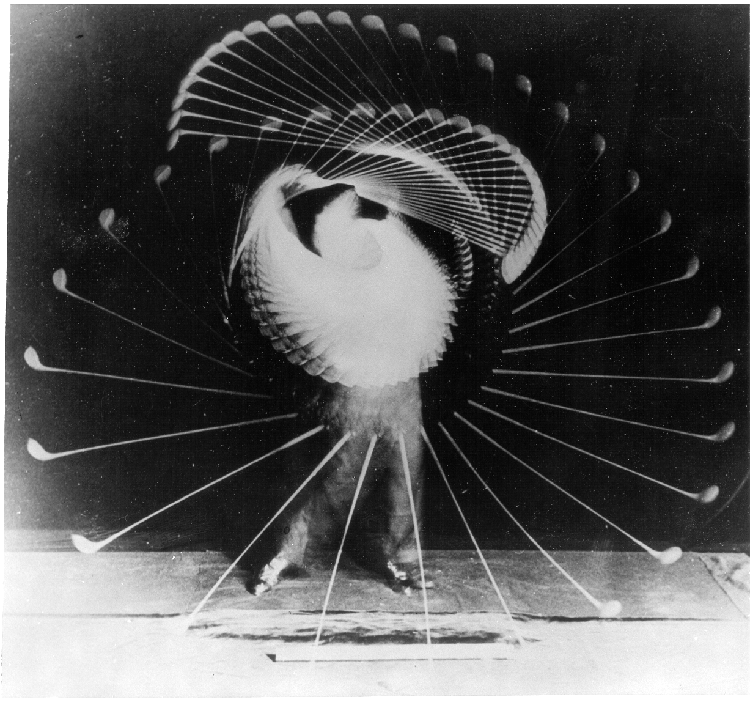 Note that the clubhead arc is much more circular than the hand arc. Here is a composite photograph of Aaron Baddeley' swing. 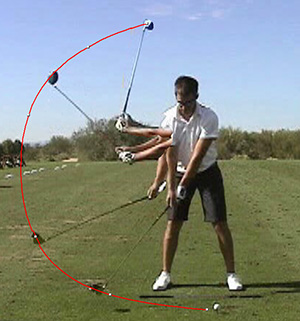 Note how circular the clubhead's path is in space -despite a varying distance from the clubhead to the left shoulder. I have previously posted photos of the hand arc of Tiger Woods, which shows an U-shaped hand arc. Here is Sergio Garcia's hand arc. 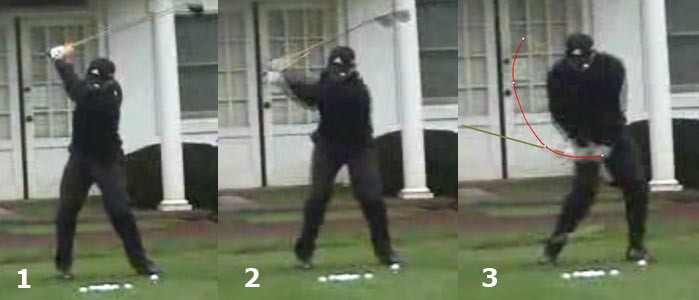 Even when taking into account the camera perspective distortion problem (due the camera not being perpendicular to the plane of the clubshaft and the plane of the hand motion), it should be readily apparent that the clubhead arc of a good golfer is more rounded than the hand arc. Jeff. |
nmgolfer
I like your mathematical expertise when dealing with problems in golf physics. However, sometimes you get it wrong. You wrote-: "Nope.... sometimes forces do no work and when the don't do work they can't contribute power (or store energy) Lets step back. Work is Force X Distance (has units of energy) Power is Work / time." Your formula is wrong when you state that work = force X distance. One also needs to consider the work force needed to stay in balance when moving in a circular manner. Centripetal force is constantly operating to keep an object in its circular track while traveling at a constant speed - and if the centripetal force is operant, then it is contributing to work (energy) output by preventing the object from flying off its circular path. Consider two cars having a 100 miles race. Car A has to travel 100 miles on a straight track. If car A completes the race in 1 hour by traveling at 100mph, then car A has expended a certain amount of energy (work output) to complete the race in 1 hour. Now imagine car B having to travel 100 miles on a circular track. If car B completes the race in 1 hour by traveling at a constant speed of 100mph, then car B has expended much more energy (work output) in the same time than car A. The extra energy was expended in trying to keep the car on the circular track at all times while it was racing around a constantly present amount of road bend at 100mph. That extra energy is the centripetal force energy required to constantly centripetally accelerate the car (to constantly keep the car moving along a circular path, rather than a straight path). Jeff. |
BerntR
I don't know "fysics" but I do know PHYSICS and to be very picky in this case speed and velocity are synonymous. You say speed I say velocity we get the same answer. Energy doesn't get banked (stored ... dollars in an account) ... the downswing converts potential energy to kinetic. Forces across levers create movement.... that's kinetic energy. As for the rest... you are entitled to your beliefs. Some people never stop believing in Santa Claus or the tooth fairy. Now we must now agree to disagree. Quote:
|
Quote:
Quote:
 Work ONLY gets done when it causes kinetic energy to change. If D (distance) is zero, no work gets done. Centripetal acceleration does not change the kinetic energy of a rotating body. IT DOES NO WORK. Quote:
|
nm golfer
Sorry. I cannot accept your explanation. You eliminate the possibility of using centripetal force as being part of your work output equation by framing your equation in that manner. If you "a priori" exclude centripetal force, then obviously it seems that centripetal force doesn't require energy to become operant. The energy may not be utilised to generate forward momentum (forward kinetic energy) along the race track (in the car example), but energy is required to keep the car on a circular track (and the car's tires know that). Consider a simple example. Imagine traveling in a NYC subway car that is traveling at 40mph on a straight rail track. Imagine that you are standing in the center aisle and holding onto a vertical post. Then imagine what happens when the subway car goes around a tight bend at the same speed. You will have to hang onto that vertical post for "dear life" to prevent yourself from being catapulted down the length of the subway car. It requires "energy" to remain stationary in balance and that energy is the energy required to offset a centrifugal force acting on your body. I would imagine that the subway car also needs to expend energy to stay in balance on its circular track, and that energy is centripetal energy. Jeff. |
| All times are GMT -4. The time now is 02:32 PM. |

