
|
Quote:
YOU HAVE NOT WASTED AN HOUR OF YOUR LIFE....YOU HAVE DELIVERED THE VERY BASIS OF THE SYSTEM THAT IS THE GOLFING MACHINE ....PERFECTLY!!! AS USUAL NO DOUBT!!! GREAT POST.... PIGGY BACKING HERE.... The thing to keep in mind in all this...for the hands to go IN (as stated above particularly in an angle of approach procedure)...the right hip MUST "get outta the way" ...IMO EARLY....this is the beauty of what Homer was systematizing....IN HOMER'S MIND THE EARLIEST WOULD BE....BEFORE THE HIP IS SET "IN MOTION"....Some will achieve the required depth "dynamically"...depth as required by the selected delivery line and/or plane angle... remember ALL GEOMETRY STEMS FROM IMPACT GEOMETRY.....hence the crucial importance of 2-J-3....the sweetspot is executing a DIFFERENT MOTION IN A HITTING VS. SWINGING PROCEDURE...therefore your delivery lines and hand paths are necessarily different....another factor is the plane angle....essentially the lines in your 2-J-3 Ben Doyle-ish mat on the ground are dictated a. by your procedure b. selected delivery line c. plane angle....so as the plane angle steepens and flattens the delivery lines and hand path NECESSARILY CHANGE...which also implies a change in the pivot....that is why the pictures of the King are sooooooooooo sexy....beautiful GEOMETRY....his swing in his younger days was very much unappreciated....this cat wasn't just a brute....he had HOT lines....  I doubt Palmer had a clue about his procedure....BUT his geometry arrived at likely spontaneously rather than systematically is beautifully compliant with 2-J-3 Angle of Approach Hitting Procedure....Homer states that the pivot is to comply with the delivery line.... Note how AP's shoulder lines, right hip depth in connection to the left knee line and his left arm all are approximately parallel and in my mind ...RELATED TO THE ANGLE OF APPROACH... Note the standard knee action...allowing the right hip to reach deep....to tilt the hip girdle...tilt the shoulders...achieving a relationship that to me is related to the angle of approach delivery line.... Even his neck and head seem to be tilted such that his eye line is compliant with the angle of approach... Note the primary lever assembly's (left arm and club)relationship to the right shoulder (back stop in the hitting procedure)...truly an uncompensated alignment from which the right forearm and pivot can LAUNCH/DRIVE OUT...the sweetspot.... Note the beautiful level right wrist (don't so much like the archy left wrist but nobody is perfect)....the hitter being reliant on ALIGNMENTS cannot afford to have a slack laden set of flying wedges...no double cocked slingy wedges...the swinger can get away with it...not the hitter...with his simultaneous release he can't have no double cocked right wrist that he has to wait for cf to line up....very much like keeping the left arm UNDER the right shoulder...no wasted space,motion or slack....lines very much compliant to the selected delivery and release type required to execute the selected hitting procedure...can't count on old cf to help you line up your junk...better have your alignments correct ... the throw out of the sweetspot is "IN YOUR HANDS" literally and figuratively...you won't be getting an assisted from a cf palm to plane karate chop...3 stage rocket release....you got them batteries connected and the firing is happening all at the same time...no building up in this release type. AP's hands are DEEP...allowing for the Sweetspot to be delivered out to the plane line at a faster rate than the swinger due to the SIMULTANEOUS RELEASE TYPE COMPLIANT with the Hitting Procedure...this is why NO MIXING....the sweetspot is driven out and off the face of the plane EARLIER...so as not to "come over the top"...the handpath is necessarily more inward in the Angle of Approach procedure...the elbow IS NOT PITCHED...it is PUNCH...there fore compliant with the required release type to comply with Hitting. The left arm striving for depth as dictated by the angle of approach's INWARD direction...the left arm (top leg of the primary lever) NEVER ABOVE THE RIGHT SHOULDER... THE DUAL AGENT IN THE POWER PACKAGE....ALLOWING THE ABILITY OF THE RIGHT SHOULDER TO MAN HANDLE THE LEFT ARM...LAUNCHING THE PRIMARY LEVER DOWN PLANE IN RELATION TO THE ANGLE OF APPROACH...WITH THE LEFT ARM NEVER RISING ABOVE THE RIGHT SHOULDER(DUAL AGENT..PART OF PIVOT AND POWER PACKAGE) THERE IS CONSIDERABLY LESS "SPACE", "SLACK", "TIME", "MOTION" TO "MAKE UP"....THE HITTER FROM THIS ALIGNMENT CAN IMMEDIATELY BEGIN TO DRIVE THE SWEETSPOT DOWN AND OUT ON PLANE....the clubhead never falling behind the hands as in swinging.... note the comparative lack of depth in the right hip in Toms and Eldrick....Primary Lever ...lifted up...less deep...set up for a delivery line that is the geometric plane line...thus better set up to swing...  Note the picture of Robert Garrett (OLYMPIC DISCUS CHUCKER IN EARLY 1900'S)....preparing to LAUNCH the discus....he would NEVER allow the mass of the discus to rise ABOVE his right shoulder...the mass well below the right shoulder as to have NO SLACK in the system...therefore he can recruit his PIVOT to DRIVE the discus down plane....in studying discus throwing....some of their focus is on LOW POINT...otherwise the discus would be launched too high and out to the right.... Instinctive genius of the King....Systematic Genius of Homer Kelley.... I have been having some FAN-FREAKIN'-TASTIC YELLOW BOOK CONVERSATION ON THIS WITH THE EVIL GENIUS MECHANIC...EDDIE COX....IT MAY JUST BE TIME FOR ANOTHER PINEHURST REUNION????????????......HMMMMMMM????????????? |
Not done yet...
why does homer recommend delayed hip action for his swingers basic pattern and not standard hip action? Surely he is not using the the preturned hip, which is an angle of approach enabler(hitting). Wouldn't the shoulders leading the hips fit more with a carry back hitters procedure? Whereas swingers with their swing away would seem more fitting to use standard hip action.
Ps Arnold Palmer and Tommy gainey probably two of the most incredible motions ever to be seen on the PGA tour highly underrated. I thought toms was a hitter who went on to end. |
Quote:
not sure if that answers your questions...BUT...remember Homer was very much not in favor of RECOMMENDING ANYTHING....so I imagine it was difficult for him to be "pigeon holed" into being restricted to the patterns in chapter 12. |
Quote:
|
Quote:
Not sure what edition and this was discussed out here in the day...there was a pattern that Homer had in one of the earlier editions I think 3 or 5 maybe that had the grip type as 10-2-D rather than 10-2-B....that pattern MAY HAVE BEEN the 10-5-E pattern...not sure though. |
Quote:
|
Yes, correct angle of approach uses closed stance line, ...that is why I deleted that sentence. Maybe it is not the overall length that is the important factor but rather the live tension that is more easily noticed with a restriction to a motion (which would be conducive to shorter overall swing radius), such is the case with flat left foot action, right anchor and delayed hip action. I think the key is that in 10-15-b he says "tighten the left side tension and set the stage perfectly for the hips to initiate the downstroke shoulder acceleration." Which is a very crucial moment and concept when swinging. 10-19-c drag loading wants you to launch the right shoulder down plane via the hips, and as homer states delayed hip action can set the stage perfectly for this.
|
Of course the application must still be there, but discussing this stuff I feel my swing has improved without even picking up a club, as homer said you can do a lot of learning in your armchair. This is the beauty of the yellow book. By simply reading and studying a subject that information is absorbed into the computer, upgrading your album instantly.
|
Quote:
Didn't Homer Kelley just consider the patterns in Chapter 12 as a starting point and expect us ALL to take them in different directions? I am very fond of that approach. Keeps it very simple when starting out, and lots of OPTIONS as we become more advanced.… Kevin |
Quote:
Just to make sure I understand you correctly... Are you suggesting that a player using a Hitter's Angle of Approach procedure with Top alignments like the King in your pictures PRETURN HIS HIPS as far as illustrated in these pictures before the backstroke motion (Start Up) starts? |
Quote:
Nice.... But why are you implying that standard hip action which is described as actuating the shoulders in both directions has a "perceptible slackness..." when in fact he makes the distinction between zero hip action and standard with the following description "10-15-ZERO HIP ACTION except with zero hip turn, this can resemble standard hip action above, but there is usually a perceptible slackness between the hip and shoulder relationship in both directions, the motion is a hip turn only, not a true action in either direction" Unlike Standard hip action in which there is not a slackness because the hips are actuating the shoulders both ways, it is a true action in both directions |
Quote:
The point I was trying to make is that the dragging effect that Standard Hip Action has on the Shoulders can lead to a Shoulder Turn Takeaway. |
Quote:
|
Quote:
|
Quote:
|
Quote:
|
Quote:
Quote:
|
One thing to note on the angle of approach, hitting ARBITRARILY requires 10-5-e closed plane line the listing for the angle of approach procedure is the hitting basic pattern. Also par71s questions are very well pointed, AP has quite a bit of hip turn there and is going on to end.....wouldn't this require a switch to an arc of approach procedure....
Also I would agree with you par71 in that delayed hip action will help the golfer get up the plane better versus a tendency to drag it under(shoulder turn takeaway) with standard hip action along with my previous reasons I believe this to be why he recommended delayed hip action for the swingers basic pattern Definition of arbitrary Based on random choice or personal whim, rather than any reason or system. (of power or a ruling body) Unrestrained and autocratic in the use of authority. In other words it may require it if thats what it takes to accomplish it but it does not absolutely require a closed plane line which is very minimal anyway |
Let's throw some gasoline on the campfire
Arnold Palmer wasn't a Hitter, he swung the club.
It's August 1970, I get to the course early for the first round of the PGA Championship. The range only has a handful of players with two of them on the far right side. Back when, there were no ropes, just respectful fans. I sit down in the grass not more than 15 feet behind the two players who happen to be Gary Player and Arnold Palmer. Player is incessantly peppering Palmer with questions about the grip and Palmer grunts short, inaudible answers, appearing to be annoyed. He is taking giant beaver pelt divots and showering me with dirt and grass as there's a wind out of the West. Back then, of course, I didn't know Hitting from Swinging, but I remember clearly this muscular whirling dervish raking the balls with his massive shoulders - a veritable human g-machine centrifuge. Looking back 41 yrs later, I know I was watching a Swinger. |
Quote:
|
Standard Hip Action in the 7th Edition
According to Tom Tomasello Standard Hip Action was suppose to be the 10-15 Hip Action for both the swinging and hitting patterns for the 7th edition. Tom assembled a complete 7th edition with Homer's notes. It appears Joe Daniels did the same thing. Tom had that revision completed by the late 80's. Tom instructed his students to change 10-15-B to 10-15-A in the book. When I studied with Tommy, I came to the lessons with delayed hip action, by the time I left (I have it on audio tape)I was learning standard hip action. Trust me, I'm definitely clearing my right hip, combined with the magic of the right forearm action, I have a very stable and reliable backswing.
I use Standard Hip Action for both swinging and hitting with equally good results. I have no desire to go back to delayed hip action. You have to go with what works, I believe Homer would be in agreement. Great exchange going on in this thread. :golf: DG |
Two obvious Swingers.....
 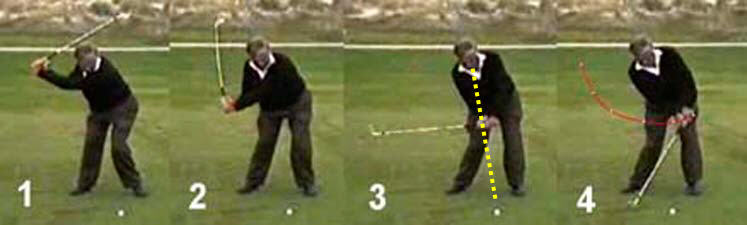 |
practical insight
Quote:
As a swinger who tends to overswing, i prefer delayed hip action. It helps me set up the lag and drag in the backstroke for all components in the downstroke. I prefer the sequence to be arms, shoulders, hips, knees then feet in the backstroke. By reversing that sequence in the downstroke, this extends the swing radius to the feet, which resists impact deceleration (think of pivot lag in both directions as a kind of extensor action for the pivot). |
Quote:
You do not try to fix in your mind the (original) Right Forearm Angle of Approach at Impact Fix (or at Address before preturning the Hips) and then preturn the Hips until the line between your Left Knee and your Right Hip becomes parallel to that (remembered) angle. Instead, you pre-turn the Hips at Adjusted Address (and also pre-straighten the Right Knee) until the line from the Left Knee to the Right Hip is parallel to the Right Forearm Angle of Approach that results from that preturn. So you can simply check these alignments by looking down after the preturn.:cool: |
Quote:
I seem to remember that you wrote in other threads that in the 7th edition Hip Action for the Basic Stroke Patterns had been changed from Delayed to Standard. Were you referring to that draft 7th edition that Tom Tomasello assembled, or is this really somewhere in the final 7th edition? |
Quote:
|
Quote:
|
Quote:
Pre-turn and pre-straighten to allow the abruptly inward hand path as dictated by the AOA...    AOA...10-5-E....inward.....people have made a point that your hands can go too low and underplane...so how do you "adjust" to this inward direction? You are seeing the model...in my mind... AP's hands are IN but his clubhead is in and UP...how is this accomplished? Sweetspot up and deep hands below shoulder line and deep? 1. Palmer had a MASSIVE amount of hip turn (facilitated by an almost hyper extended right knee and bent left knee) allowing his right shoulder and right hip to reach deeeeep. BUT...why not underplane? 2. The inward component is from the TURNING PIVOT 3. The upward component is from the loading of the right elbow...Palmer elevated the club by bending his right elbow (as well as fanning and retracting it...more inward componet) 4. More upward from the LENGTHENING of his entire right side...right shoulder deep and high ...right hip deep and high...right leg long.....left side compressed....also allowing a centered motion with the AOA geometry...his right shoulder is not really "flat to the plane"...it is more UP AND DEEP to the plane...adjusted 10-5-E AOA plane...more in and steeper He IS NOT getting up by LIFTING...he is not raising his right humerus bone off his body....this allows his hands and the primary lever assembly to stay BELOW his right shoulder...he can immediately LAUNCH the lever assemblies and wedge structure down AND OUT on plane....his right shoulder is ON TOP of the left arm being the upper leg of the primary lever...providing the initial acceleration and then the LAUNCHING PAD You'll note if you put yourself in a top position (minus the archy left wrist) like Palmer with one of them ninja sticks or a dowel on the ground aproximating the AOA...your LEFT ARM will also be approximately parallel to the AOA at top...right shoulder and hip joints deep and high...no elevating the club by lifting the arms off the rib cage...upward from the loading of the right elbow..no right wrist cock disrupting the wedges...upward from a long and deep right side..reaching BACK AND STRIVING FOR HEIGHT.... Note the height of the right shoulders and shoulder slant difference....this is basically the difference between pitch and punch elbow and what it does to the rate that you achieve your axis tilt... Have a look at the swing at the 1:30 mark...BEAUTIFUL... http://www.youtube.com/watch?v=sDDWd5vVl0Q&feature=player_detailpage#t=90 s |
Great analysis Bucket, difficult to do with Arnie because he never seemed to swing it the same way twice in a row! Mr. Palmer never tried to be pretty, it was all about playing the game and posting up a number...
Palmer always looked like he was "holding off" that driver, afraid of the hook. Possibly because he was a little under plane? A little under like Stricker, but he just plays for the draw and let's her buck! I haven't studied much footage of Mr. Player, but his swing sure looked sweet in that video. Very under rated... Really enjoying this thread! Kevin |
Great job, Bucket.:clap:
|
Quote:
2-J-3 aoa geometry matching 10-2-D-ish grip with pressure points and left thumb aligned aft along LCOG matching preturned prestraightened right hip address matching inward hand path matching knee action matching deep turn right hip action matching steep shoulder turn matching right elbow right forearm flying wedge compliant loading matching hands and left arm underneath dual action right shoulder matching centered launching pad pivot matching right shoulder releasing over primary lever matching release type matching thrown over sweetspot matching angled hinge action matching down plane way forward axis tilt springing up full radius brought to bare on ball radius extend from feet-ankles-knees-hips-spine-right elbow-fully uncocked left wrist throw out and over. |
Notes for the 7th Edition
Quote:
With my backswing, I'm sensing both the right hip action and the action of the hands per the straight line delivery path per the #3 pressure point. I'm hitting the ball long and straight, consistently. Why? If I use Right Forearm Takeaway (trying to keep right arm straight, wide arc), I lose my pivot angle/waist bend, that condition is called bobbing. If I use Magic of the Right Forearm takeaway (bending or levering the right elbow at the start of the backswing) with delayed hip action that puts an excessive amount of pressure on the right elbow. The backstroke motion that Tommy taught; Magic of the Right Forearm and Standard Hip action solved all of my backswing issues. I'm swinging within myself and retaining the three most important angles. 1) Knee flex 2) Maintaining Waist Bend 3) The Right Wrist conditon (Bent and Level) I believe this is a process an AI should be taking you through. DG |
DG, do you like to work out of the 6th or 7th?
|
Quote:
DG |
I've heard others say they enjoy the 3rd edition. I've not seen a copy, and understand they fetch a pretty penny. So far, I enjoy the 6th.
Kevin |
Matchmaker Matchmaker
Quote:
To you and Eddie . . . Thanks! :occasion: |
Quote:
|
Quote:
|
Quote:
Unfortunately I can only understand about 10% of the above goobledygook. I did however hit a 2/3 swing PW with Eddie's "hitting pattern" today as far as I normally hit a PW with a full swing. There is some meat on this bone, even I can see. Today was our first of many lessons. I got a lot to learn, but the hour I spent today is a huge step in the right direction. [video]http://www.youtube.com/watch?v=56STh7fVx1U&list=UUarTiQGGapZlRRGsESNduKA& feature=plcp[/video] -Dan |
Quote:
Did Eddie give you the "hammering" drill? You got too much under release on that downswing...but man you have made a nice start on the backswing! Stick with it! |
| All times are GMT -4. The time now is 02:35 PM. |