
|
I've seen D's Hip Action........he's got rhythm. Small "r" variety and capital R too.
I like the dance off idea though. Maybe it could be pay per view or skype or something so we can all watch it. |
Quote:
No doubt the hands slow as the heavy clubhead begins overtaking at release. But there is also a supporting mechanism; that is a turning left shoulder and an extending right arm (paddlewheel motion) providing resistance, because they are supporting the flat left wrist and intended hinge action through impact. If this is part of what you mean by Basic Rhythm then I think I understand where you are coming from. Homer used crankshaft RPM as the model. Even though the piston is connected to a crankshaft spinning at 3000RPM, the piston is going from 0 to 75MPH in less than 9 inches (my rough estimate). If there was a way to measure piston RPM, it would be much higher than the crankshaft as it accelerates to full extension, but that's not the what the gauge on my car is measuring. In the golfing machine, the crankshaft is the left arm flying wedge rotating through impact. Everything supporting that includes spark plugs, fuel, air, and oil. If those are out of whack, its time for a tune up. |
Im just reading all of these posts for the first time. Interesting stuff.
Hope Im not covering old ground but BerntR from a pure golf perspective Ive always considered the flat left wrist to be a Rhythm enabler and "ROLLING" as a Flat Left Wrist maintainer. Is this correct in a scientific sense or is this just a golfer talking feels or something? To my mind its as if the left wrist will be broken by an insurmountable force unless its rolled in some manner. Hence you cant try to merely hold it flat , you have to Roll it flat..... to coin a phrase. My apologies if Im digressing or regressing conversationally. |
Quote:
I had a light bulb go on a few years back when Ted told me about roll'in. I'm a steer'in kinda guy and that cured my illness of steer'in and flip'in and cow tip'in. Not really, I still tip cows. There are only two people who are allowed to apologize on this site when posting and you ain't one of em. |
Quote:
Homer said that a student of his had a swing that improved just by understanding the proper impact geometry and the ball flight laws, nothing else. An intellectual cure for Steering. Digression and regression at the same time? Now were getting somewhere. |
You Won't Flip Over This Video
Quote:
http://www.youtube.com/watch?v=Z4-KX...ayer_embedded#! Watch the first five and a half minutes. Ted at his best. |
OK, I apologize!
Quote:
ICT |
Quote:
Sorry, you aren't allowed to apologize. :eyes: The whereabouts of the members who can apologize are unknown. They are most likely snowbound somewhere on the Eastern seaboard. |
Quote:
Isnt that great! Now thats how Homer's Impact Geometry and the Alignments that relate directly to it can be taught to the masses. Ted's right down where it matters , where the rubber meets the road, this is the stuff that kids who learn the game with ease do that old hackers never get right. |
Tempo and rhythm
|
Quote:
That could mean that TGM basic RPM in the definition refers to the RPM of the hands. |
Air,
I gotta take your vids of Hibbard and Clement down. No offense, but they aren't LBG certified instructors and they aren't talking about Golfing Machine Rhythm. Their's is the popular definition. Rhythm and Tempo can be related, but they are not the same in the golfing machine. And I'd like 20 minutes of my life back please.:laughing9 |
Sorry
Quote:
I thought Hibbard's movements reminded me of the MacDonald drills. |
Quote:
In theory I guess you could use a strong double action grip, just cock and recock both hands through the swing - angled hinging without turn and roll. But I guess it would be very difficult to monitor and control the club that way. |
Angular Speed - RPM - Rhythm
The Left Wrist and Clubhead should travel at the same Angular Speed. Quote:
Quote:
Quote:
|
Yes.
The hands are attached to the club so the angular speed will be the same. But the arms will have lower angular speed. Both Accumulator #2 and #3 are enablers for higher angular speed in the club than in the arms. |
Quote:
Don't be sad, we'll get this all worked out. Its a complex subject and Bucket beat me up pretty good in our last round. http://www.lynnblakegolf.com/forum/thread4716.html |
Quote:
http://www.youtube.com/watch?v=rL7mF...eature=related |
Quote:
Nice references Daryl. Made me look at 2K-5 and low and behold, #3 roll power. Look carefully at the difference between 2K-4 and 5. There'in is rhythm. |
|
Quote:
I am not confusing RPM with MPH. I've even explained in an earlier post why the MPH diffence between hands speed and clubhead speed can't be explained without a significant RPM difference being present. But you seem to read my posts with less presicion than I write them. My English may not be the most eloquent. But I make an effort to be clear and precise on such matters. It doesn't help much if the reader doesn't appreciate the clarity though. |
Some background on the editions.
Like so many golfing machine concepts, rhythm is hard to grasp not only because Homer used a word that has an intuitive meaning to most people, but also because the importance and precision of Homer's definition doesn't resonate with most people...until it is distilled and explained by great teachers. He didn't fully define rhythm or mention it(I haven't found any use of the word) until the 4th edition. The development of the concept was important in describing accumulator #3 (6-B-3-0) The Third Power Accumulator - Roll Power. Starting with 4th edition, Homer expanded 2-P to include the concept of rhythm when describing the function of wristcock. The term wasn't included in prior editions in this context. He also added the "golfers flail" sketches in 2K. Likewise, the Homer hadn't fully developed the concept of the physics of Hinging until the 4th edition in 2-G. In the 4th edition he also expanded 2-G, the physics of hinging for hitting and swinging was that, "Roll is actually imparted by the turning torso and/or the orbiting arms per 2-K4 and 2-K5...The point to be learned here is that the Club, because of the Flat Left Wrist, must always travel at the same RPM as the Arms and reproduce the Hinging inherent in the selected Lag Loading procedure (10-19) per 4-D, 9-2, and 9-3, regardless of Clubhead Extention velocity. This is the basis of Golf Stroke Rhythm". In the 5th edition he removed the last sentence and replaced it with "See 2-P". Thanks for the reply Bernt. I'll reread your earlier post and try to reconcile it. You're probably on to something. |
Quote:
Viewed as separate entities, the clubhead has much greater travel and speed than arms/hands. The difference: As the left arm flying wedge, clubhead/shaft, left wrist, and arm are combined into a three sided triangle. The left arm flying wedge is viewed as a dynamic unit in motion. One corner is left shoulder, the other corner is left wristcock, and the third corner is clubhead. Viewed as a wedged shaped triangle the entire unit travels at the same RPM from the shoulder, even though two sides of the triangle nearly come together or combine with the third side momentarily if accumulator 2 & 3 are zeroed out at low point. So while in motion, there is clubhead overtaking, i.e. one side of the triangle between clubhead and shoulder lengthens, but the overall wedge rotates at the same RPM speed. It is a two dimensional flying wedge set on the plane of the left wristcock motion. If it goes 3D or ceases to be a triangle due to clubhead throwaway, then rhythm has been lost. I wish we had an animation artist around to show this. |
Per Bagger:
Shown is the Plane of the Left Wrist Cock (the Left Arm Wedge). Unfortunately, you don't see the rotation of the Plane as the Uncocking progresses as the Left Arm Wedge gets closer to impact. You'll need to use your 3D brain to visualize the rotation.  |
I get tired of copying and pasting all the good comments and drawings on this forum to a file now called "Best of Lynn Blake 4". Golly Lynn should just write a book with Daryl doing the illustrations. What a great presentation of the flying wedge. Now if Daryl could animate could have one figure with left arm flying wedge in the yellow color, then another figure of right arm flying wedge in red all in motion. Then both together. Then add in appropriate music. Then work it out so we could program it to change plane, lie, speed etc. Then of course could overlay the wedges on a pro golfers swing making the planes transparent. Even a better idea would use Lynn's swing and overlay the planes on his motion. He could then demo hinging swinging and hitting with the wedges overlaid. I can see it now an ebook that would teach golf incorporating lynn's swing and Daryl's drawings all set into motion.
Of course that ebook would also have the yellow book digitized so it could be searched. Notes included would reference the yellow book and then you could click on it and it would pop right up. then additional buttons would be available to bring up additional yellow book stuff that would be appropriate. Then you could put it all on your ipad and take it to the range. Of course the new ipad will have two cameras. The one for golf could have the high speed camera with swing analyzing software. Don't forget they are now developing a device to attach to the club that will replace trackman!. Probably have devices to clip to your shoulders leg and head that will provide 3D analysis. New golf caps will have have heads up displays for practice to help your adjust "your machine". It's all coming |
Quote:
|
Quote:
Blue is the color of my wedgie. Thanks! |
 |
Just as I see it too. The club rotates ca 120 deggrees in that figure while the arm rotates 45. That is based on their angle away from vertical when the motion starts.
Bagger, Naturally I agree with your description of the flying wedge. There's however nothing in there that disputes that the club has higher RPM than the right arm. |
Quote:
How many Revolutions per Minute is the Clubhead completing? How many Revolutions per Minute is the Left Wrist completing?  |
Quote:
|
 |
Two different rotation planes.
I see where you are going, Daryl. The last figure descibes the rotation of the Left Arm Flying Wedge in a horizontal hinging procedure. The LAFW rotates on a plane that is on right angles to the inclined plane.
But it is the on-plane rotation* that is the big deal. The rotation that happens on the inclined plane. The plane the clubhead moves on. That's the plane we have to look at when we consider hand speed and clubhead speed, and RPM vs MPH. The rotation of the LAFW is just a secondary rotation in the golf stroke. Amongst other things it causes the club to rotate around its own sweeet spot. It is an important enabler for what we want to achieve on the main stage. The RAFW rotation enables us to add club rotation by uncocking (turning) and recocking the Left Wrist (accumulator #2) and by simply turning (accumulator #3). These two releases produces on-plane club rotation without producing on-plane arm rotation. And that's what makes the huge difference between club rotation and left arm rotation in the golf stroke. * A rotation that is on plane has a rotation axis that goes straight through the plane. |
Quote:
Quote:
Quote:
Hinging: It is said that Hinging controls the Clubface alignment. It controls the Clubface Alignment to an associated Plane. Hinging is not what squares the Clubface for Impact. Horizontal Hinge: causes he Clubface (and Left Arm Wedge) to rotate on a Horizontal Plane Angled Hinging: causes the Clubface (and Left Arm Wedge) to rotate on an Angled Plane 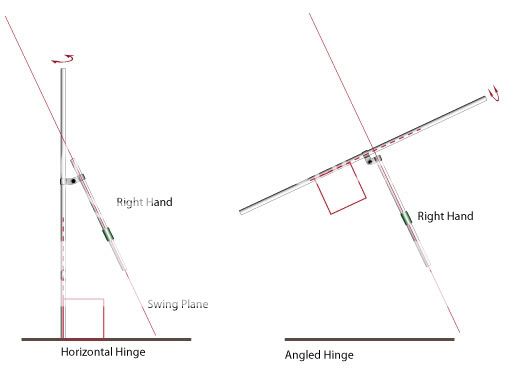 |
Quote:
Nevertheless it's the rotation of arm and club on plane that matters when we discuss RPM and MPH. |
This thread really good!
helps me rethink about rhythm. I just know that the rate of my pivot turning on the incline plane ideal should be the same rate of rotation of the clubshaft in a counterclockwise direction on the downswing. It often isn't and can be a bit slower or faster than the pivot RPM. How it mismatches together(can be done on purpose) can be used to hit a fade or draw. |
Quote:
Not sure why you haven't acknowledged Bernt's explanations of different RPM's for the left arm versus the clubshaft. I think he explained it clearly enough - If you have any left forearm rotation/upper arm rotation on the downswing - it will create greater RPM for the clubshaft than the arm. It's important to understand Homer Kelley's context when he writes - this RPM discussion is similar to his writing's on wristcock or other concepts. When he describes wristcock as a vertical motion - doesn't mean that the left wrist is always vertical to the ground and it's motion is always vertical to the ground - becuase obviously it's not vertical to the ground and therefore it's not always making it's cocking motion vertical to the ground. If it did then yes the RPM's would be the same for the clubshaft and the arm - however in the real golfer the left wrist is rotating throughout the stroke (in relation to the ground). Look at 2K#4 and 2K-#5 - for on plane left wrist motion or vertical wrist action. Similarly 7-18 2nd paragraph discussing hand and clubhead RPM's the same - ASSUMING you are looking at an endless belt example 2-K#6. He's writing in a certain context - part of that context is the fact that the biggest problem he saw was clubhead throwaway (different RPM's for the hands and the clubshaft given the most basic flail drawing). Much as he had said - in regards to hinge action - "no one does these things "perfectly" - perfectly meaning exactly horizontal or angles, or vertical - perfectly isn't used in regards to "optimal". I feel it's important to understand the relevance of Homer Kelley's writings yet at the same time understand real issues/happenings as Bernt is noting in regards to noted differences in RPM's. |
Quote:
Great point, thanks. The other little issue with the drawing is that the club always lays flat on the inclined plane , cocks up and down on the inclined plane , but the left arm is not on the Inclined Plane given any #3 Angle. The left arm and the Inclined Plane are only one and the same for the so called "theoretical left shoulder plane" , which is what seems to depicted here. For the more golf like plane angles the golf club does not cock in the direction of the left arm or the left shoulder. Meaning that blue Left ARm Flying wedge does not attach to the left arm and shoulder throughout the entire swing. At top it lays on the Inclined Plane, between the two arms. When the Left Wrist rolls off the Inclined Plane the Left ARm Flying Wedge does the same. At impact , through the ball they are as drawn. I think. Its a head scratcher I know. Could this be another reason for the use of the word "basic" in "basic rpm's"? |
Quote:
Strap a board to your left Arm, Wrist and Clubhead. If they all stay against the board (Aligned) through the Impact Interval, they traveled at the same RPM. Strap the board to your left forearm, wrist and Clubhead and they travel at the same RPM. Mike, do you "Understand"? RPM is not Turn and Roll. The Primary Lever stays Aligned regardless of the Turn and Roll. Maintaining the same RPM is necessary for Hinge Action but RPM is not Hinge Action. If the Left Wrist is Bent through Impact, I can still Hinge the Left Wrist however, the Clubface will be somewhere else. We need a Flat Left Wrist (RPM) so that anything the Wrist does, the Clubface will do likewise, and not something else. Quote:
Maybe I'll buy you a "Taly" for your birthday. It's an RPM trainer. Right? |
Quote:
Daryl's drawing wasn't focused on the inclined plane, but the drawing is still relevent to it. The bottom edge of the triangle (clubshaft) is lying on the inclined plane from release to follow-though. The other lines are not related to the inclined plane, but are related to the plane of the left wristcock motion. He could make it fancier to show the inclined plane/sweetspot plane, but I'm pretty happy with the artwork. |
| All times are GMT -4. The time now is 03:47 AM. |