
LynnBlakeGolf Forums

LynnBlakeGolf Forums (http://www.lynnblakegolf.com/forum/index.php)
-   The Golfing Machine - Basic (http://www.lynnblakegolf.com/forum/forumdisplay.php?f=16)
-   -   Maximum Compression (http://www.lynnblakegolf.com/forum/showthread.php?t=7826)

BerntR 12-14-2010 11:20 PM

Quote:

Originally Posted by Daryl (Post 79654)
Kevin,

I agree with your friend on the Champions Tour. The Balls are getting straighter. But why? Will the Ball makers tell us? If they do, then what do you think they'd say?

A wild guess from me:

They manipulate the weight distribution inside the ball so that its MOI increases: That would be a lighter core and more weight towards the surface. For a given spin rate this will give the ball more spin energy when it lands on the green. So that it can handle more turf friction before it stops spinning.

With this increased spin endurance in place the ball doesn't need to land as steep as before to have drop and stop performance on the green.

And when the ball needs less of a spin towards the sky - drop dead air flight they can reduce the air drag when the ball is in the air. And when they reduce the air drag the ball goes straighter and it doesn't spin towards heaven when you play into the wind.

But I'm only guessing here.

innercityteacher 12-15-2010 10:59 AM

Bernt, that's really interesting.
 
Quote:

Originally Posted by BerntR (Post 79684)
A wild guess from me:

They manipulate the weight distribution inside the ball so that its MOI increases: That would be a lighter core and more weight towards the surface. For a given spin rate this will give the ball more spin energy when it lands on the green. So that it can handle more turf friction before it stops spinning.

With this increased spin endurance in place the ball doesn't need to land as steep as before to have drop and stop performance on the green.

And when the ball needs less of a spin towards the sky - drop dead air flight they can reduce the air drag when the ball is in the air. And when they reduce the air drag the ball goes straighter and it doesn't spin towards heaven when you play into the wind.

But I'm only guessing here.

For a Humanities guy like me, it sure makes sense.

Cool! :)


ICT

John Graham 12-15-2010 11:34 AM

Quote:

Originally Posted by brianmontgomery2000 (Post 79682)
I'm just starting to investigate the D-plane. I actually have found it quite beneficial to my understanding of what's going on through impact and any resulting ball curvature.

I've also found it seems to explain my predominant draw/hook ball flights from the summer. As I've begun to play the ball back of low point (i.e. up plane) and take a divot, I've hit shots that I would have sworn were right down target line/plane line (one and the same for me aligned neutral or square) with club face square that drew/hooked.

Well, d-plane predicts that (maybe TGM, too, but I didn't understand). So, for me, my understanding has increased and I have a better thought as to how to align (swing plane slightly left of target line) to get a straight ball.

Having said that, I still think TGM provides the best "how to" around! As others have said, if Homer was slightly off on the precise nature of the clubhead/ball collision, I don't think that detracts from the practical results of applying the components that put that clubhead into motion.

So, for me, TGM and more precisely Alignment Golf provide the swing mechanics that I want to learn and apply to improve my ball striking and ultimately reduce my scores. The d-plane has helped me at least better understand what is going on through impact (despite what my prior "knowledge" and feel led me to believe) and understand that I HAD made the swing I intended but got results that would have led me to change things I didn't need to change...I just need to work with slight changes to alignment!

Again, as others have said, I think all of golf benefits from the search for a "unified field" theory of the swing. Facts gathered from Track Man (clubhead path, etc., more so than the "predicted" ball flights which should just be observed) need to be incorporated and explained by TGM if we are to be able to continue to expand our knowledge and understanding of the golf swing and resulting ball flights.

Just my 2 cents on the topic...


This was my experience as well.

As a constant double checker, I came hear to find out if what I learned and was teaching was incorrect.

From what I have learned here, I'm not convinced that this information about the D Plane has been trumped by the geometry of the circle but I am open minded.

As with all things, use what works and don't use what doesn't work.

Yoda 12-15-2010 06:14 PM

D Plane Versus "Circle Geometry" and Hinge Action
 
Quote:

Originally Posted by John Graham (Post 79696)

As a constant double checker, I came hear to find out if what I learned and was teaching was incorrect.

From what I have learned here, I'm not convinced that this information about the D Plane has been trumped by the geometry of the circle but I am open minded.

John,

In the precision Sketch 2-C-1 #3 (2-N-0 / Geometry of the Circle with Separation deliberately assumed at Low Point), the Swing Path (Arc of Approach), the Clubface and the Line of Compression each face directly down the Plane Line (in this case, also the Target Line). TGM contends that this configuration will produce maximum compression (no "glancing force") and a dead straight shot.

Under these exact conditions, does the D-Plane concept predict another result? If so, what? If not, then in this specific instance, how does D Plane theory "trump" Geometry of the Circle / Hinge Action theory? Or vice versa? In a non-adversarial world, could they be equally predictive?

:salut:

chipingguru 12-15-2010 07:25 PM

As D-plane is described, ball would go to the right. Straight right, no slice.

Max Impact 12-15-2010 07:34 PM

Assuming "sweet spot" contact, and The Flat Left Wrist, or its equivalent, both camps would predict a straight, on-target shot with maximum compression.

But Yoda, since you've "arrived", would angled hinging allow the original contact points between ball and clubface to remain intact throughout the arc of the impact interval?

Daryl 12-15-2010 07:53 PM

The D Plane assumes that the Ball Rolls on the Clubface. Impact and separation points are always different and D Plane never assumes Max Compression.

All Hinges produce a sustained line of compression, so all hinges give maximum compression. The Angled Hinge tilts the Line of Compression.

Max Impact 12-15-2010 11:22 PM

Quote:

Originally Posted by Daryl (Post 79706)
The D Plane assumes that the Ball Rolls on the Clubface. Impact and separation points are always different and D Plane never assumes Max Compression.

All Hinges produce a sustained line of compression, so all hinges give maximum compression. The Angled Hinge tilts the Line of Compression.

The D Plane is a term for the plane connecting two impact vectors. It is not an analytical model. Hence, The D Plane doesn't "assume" anything.

The book clearly identifies only Horizontal Hinge Action as the ideal application of linear force, producing perfect vector alignments.

And for the record, an arched left wrist, or its equivalent, would produce more compression than The Flat Left Wrist, or its equivalent. This would, of course, "hood" the clubface, which the book suggests to avoid. Although, virtually all great ball-strikers do it.

Daryl 12-16-2010 12:22 AM

Quote:

Originally Posted by Max Impact (Post 79714)
The D Plane is a term for the plane connecting two impact vectors. It is not an analytical model. Hence, The D Plane doesn't "assume" anything.

The book clearly identifies only Horizontal Hinge Action as the ideal application of linear force, producing perfect vector alignments.

And for the record, an arched left wrist, or its equivalent, would produce more compression than The Flat Left Wrist, or its equivalent. This would, of course, "hood" the clubface, which the book suggests to avoid. Although, virtually all great ball-strikers do it.

It's clear that you have NO grasp of "compression", the "line of compression" or "sustaining the line of compression". You said: "And for the record, an arched left wrist, or its equivalent, would produce more compression than The Flat Left Wrist, or its equivalent." Are you delirious?


Furthermore, you don't have a grasp of your own beliefs. Have you read page 80 of your Bible: "The Physics of Golf"? it says:

Quote:

The Ball Slides and Rolls on the Clubface

We shall finally consider the effect of this sliding friction between the ball and the clubface. When the clubhead begins to make contact with the ball, the ball will begin to slide up the clubface, with the force between the ball and the clubface gradually increasing. The resulting frictional force on the ball will gradually give the ball a rolling motion, and when the ball is about to leave the clubface, the ball will be rolling without sliding if there has been enough friction.
Duh? "Slide, then Roll" Duh?

Max Impact 12-16-2010 12:56 AM

Quote:

Originally Posted by Daryl (Post 79715)
It's clear that you have NO grasp of "compression", the "line of compression" or "sustaining the line of compression". You said: "And for the record, an arched left wrist, or its equivalent, would produce more compression than The Flat Left Wrist, or its equivalent." Are you delirious?


Furthermore, you don't have a grasp of your own beliefs. Have you read page 80 of your Bible: "The Physics of Golf"? it says:


Duh? "Slide, then Roll" Duh?

The equivalent of an arched left wrist would deliver less loft to the ball, which would compress the ball more than the equivalent of a flat left wrist, all else the same. That's Physics 101, right there.

Secondly, "The Physics of Golf" is not my "bible". Nice little book, but it doesn't really reveal anything new about the impact collision that wasn't shown in 68's "Search For the Perfect Swing". Jorgensen did coin the term "D Plane", however. Big deal.

Max Impact 12-16-2010 01:01 AM

Oh, and if I'm not mistaken, Homer Kelley was the one doing the "assuming" regarding the impact interval. It's not like he had a BizHub SwingVision camera shooting 10,000 frames per second out in his garage to confirm his theories.

Daryl 12-16-2010 01:01 AM

Quote:

Originally Posted by Max Impact (Post 79717)
The equivalent of an arched left wrist would deliver less loft to the ball, which would compress the ball more than the equivalent of a flat left wrist, all else the same. That's Physics 101, right there.

Secondly, "The Physics of Golf" is not my "bible". Nice little book, but it doesn't really reveal anything new about the impact collision that wasn't shown in 68's "Search For the Perfect Swing". Jorgensen did coin the term "D Plane", however. Big deal.

1.) No Max, you're wrong again and again. You're talking about "How much" of the ball is being compressed, not higher compression.

2.) It's your "Bible". The "D Plane Gods". You know and "Pray" to Both of them. The "Path" God and the "Clubface Angle" God.

.................................................. .................................................. .................................................. .................................................. ......

TGM - Ball Spin Physics

Quote:

2-A RESILIENCE The response of the ball to different applications of force is the factor that determines how force must be applied to produce a desired result.................

........ Roll of the ball on the face of an inclined striker does not account for all the action produced by such an impact, especially in imparting spin to the ball. When the direction of the compressing force does not pass exactly through the center of the ball, a spin will be imparted to the ball. It will rotate on the plane of a line drawn from the line of compression to a parallel center line.
Bold by Daryl

Below, is the explanation to what Homer said in the sentence that I highlighted in bold:

Imagine drilling an off-center hole through a ball (bottom line of compression) on the line of compression and pushing a stick through it so that it sticks out both ends. This stick doesn't pass through the center of the ball. Now drill a second hole through the ball that passes through the center (Top line) and is perfectly parallel to the first hole, then insert a stick. Those two sticks represent the Spin Plane caused by the Line of Compression of that Impact. The Spin Plane is highlighted in green.
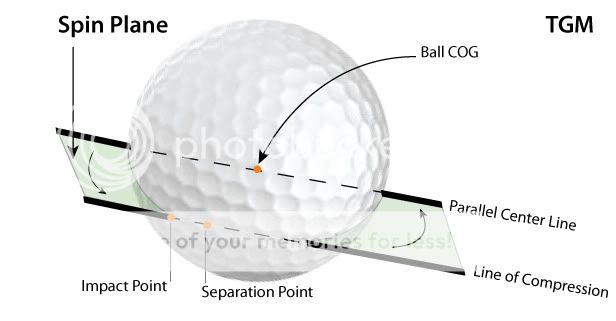


After you insert both sticks, no matter how you rotate or orient the ball, the spin plane will always be represented by those two sticks as long as "The original contact points of the Clubface and ball remain in contact throughout the entire Impact Interval". Any Impact that doesn't maintain the impact as also the separation point, unless done intentionally, is a "Mis-Hit". Furthermore, the rate of Spin is determined by the distance between those two Parallel Lines for any given Clubhead Speed.

.................................................. .................................................. .................................................. .................................................. .....

The "Search for the Perfect Swing" does not include this information. "The Search for the Perfect Swing" and "The Physics of Golf" only outline the conditions of "Mis-Hit" Impacts.

chipingguru 12-16-2010 12:00 PM

Wow, awesome illustration!

KevCarter 12-16-2010 12:04 PM

Quote:

Originally Posted by chipingguru (Post 79740)
Wow, awesome illustration!

Daryl's work is a treasure!

Kevin

chipingguru 12-16-2010 12:12 PM

Lynn,

Have you ever been on one of these Trackman devices?

Id be curious about all the Hubhub about it and whether it would tell you anything about your path or clubface or any other component of your swing that you didn't already know.

How about any of the rest of you guys? Anyone have a revelation by using the device like "i always thought i was doing this but really doing that"?

I guess I struggle with why so many think it is revolutionary.

innercityteacher 12-16-2010 12:19 PM

Da Vinci understood the airplane before we could build it.
 
Quote:

Originally Posted by Max Impact (Post 79718)
Oh, and if I'm not mistaken, Homer Kelley was the one doing the "assuming" regarding the impact interval. It's not like he had a BizHub SwingVision camera shooting 10,000 frames per second out in his garage to confirm his theories.

The people using that BizHub really have bad explanations quite often. Dorito? :)


Max, are you near Philly, MNPLS., the South, Chicago? I'd love to buy you beer and just hang. Seriously.


ICT

Yoda 12-16-2010 05:27 PM

TrackMan and Me
 
Quote:

Originally Posted by chipingguru (Post 79744)
Lynn,

Have you ever been on one of these Trackman devices?

Id be curious about all the Hubhub about it and whether it would tell you anything about your path or clubface or any other component of your swing that you didn't already know.

I've been on TM twice in the last month. It is interesting to see ball flights quantified -- particularly with deliberately employed Stroke variations. I have never used it in a teaching situation, but based on my own experiences (live with Jeff Hull and Rob Noel), I have no doubt it can add value if integrated appropriately into the lesson.

My primary purpose (especially with Jeff in my first session) was to challenge the misguided notion that a golfer cannot consciously execute a selected Hinge Action to change the Clubface alignment through Impact and thus affect Ball Behavior. No surprise here:

Of course you can.

:golfcart2:

KevCarter 12-16-2010 05:31 PM

Quote:

Originally Posted by Yoda (Post 79754)

I've been on TM twice in the last month. It is interesting to see ball flights quantified -- particularly with deliberately employed Stroke variations. I have never used it in a teaching situation, but based on my own experiences (live with Jeff Hull and Rob Noel), I have no doubt it can add value if integrated appropriately into the lesson.

My primary purpose (especially with Jeff in the first session) was to challenge the misguided notion that a golfer cannot consciously execute a selected Hinge Action to change the Clubface alignment through Impact and thus affect Ball Behavior. No surprise here:

Of course you can.

:golfcart2:

I'm guessing TrackMan doesn't have the capability of measuring it, so they don't acknowledge it's existence?

Yoda 12-16-2010 05:40 PM

Clubface Control Through Hinge Action Feel
 
Quote:

Originally Posted by KevCarter (Post 79755)
I'm guessing TrackMan doesn't have the capability of measuring it, so they don't acknowledge it's existence?

I don't think the people at TrackMan have taken a position one way or another on the validity of the Hinge Action concept. The challenge comes from other quarters.

All I wanted TrackMan to verify was what 'others' said could not be done. Namely, that I could change the Clubface alignment through Impact simply by using my Flat Left Wrist to execute selectively each of the three Hinge Action Feels, i.e., Roll, No Roll and Reverse Roll.

And it did.

Of course, I already knew I could control the Clubface with my Flat Left Wrist, but I went through the "scientific" exercise in order to "prove" that I could.

And I did.

:salut:

chipingguru 12-16-2010 05:50 PM

Lynn,

Thanks for answering my question.

A quick suggestion:

I think all in golf machine land would enjoy seeing a video of you demonstrating the different hinge actions on the TM, and the corresponding ball flight differences.

Id be fascinated in seeing the different calculations when your swinging and hitting also.

KevCarter 12-16-2010 05:59 PM

Quote:

Originally Posted by Yoda (Post 79756)
I don't think the people at TrackMan have taken a position one way or another on the validity of the Hinge Action concept. The challenge comes from other quarters.

All I wanted TrackMan to verify was what 'others' said could not be done. Namely, that I could change the Clubface alignment through Impact simply by using my Flat Left Wrist to execute selectively each of the three Hinge Action Feels, i.e., Roll, No Roll and Reverse Roll.
And it did.

Of course, I already knew I could control the Clubface with my Flat Left Wrist, but I went through the "scientific" exercise in order to "prove" that I could.

And I did.

:salut:

Case closed. Thanks YODA!

John Graham 12-16-2010 11:40 PM

Quote:

Originally Posted by Yoda (Post 79702)
John,

In the precision Sketch 2-C-1 #3 (2-N-0 / Geometry of the Circle with Separation deliberately assumed at Low Point), the Swing Path (Arc of Approach), the Clubface and the Line of Compression each face directly down the Plane Line (in this case, also the Target Line). TGM contends that this configuration will produce maximum compression (no "glancing force") and a dead straight shot.

Under these exact conditions, does the D-Plane concept predict another result? If so, what? If not, then in this specific instance, how does D Plane theory "trump" Geometry of the Circle / Hinge Action theory? Or vice versa? In a non-adversarial world, could they be equally predictive?

:salut:

Lynn,

Thanks for the question.

Are you teaching people to produce seperation at lowpoint as described in 2-C-1#3 to produce maximum compression (no "glancing force") and a dead straight shot?

I doubt it.

Clearly, you understand and respect D plane well enough to know that this is the only way you can phrase a question that matches the book in some way.

It's not really the geometry of the circle as I see it drawn on napkins, easels and pieces of paper is it?

This was my experience and I still have not been convinced.

Again, I am quite open to discussion.

John Graham 12-16-2010 11:45 PM

Quote:

Originally Posted by Daryl (Post 79719)
1.) No Max, you're wrong again and again. You're talking about "How much" of the ball is being compressed, not higher compression.

2.) It's your "Bible". The "D Plane Gods". You know and "Pray" to Both of them. The "Path" God and the "Clubface Angle" God.

.................................................. .................................................. .................................................. .................................................. ......

TGM - Ball Spin Physics


Bold by Daryl

Below, is the explanation to what Homer said in the sentence that I highlighted in bold:

Imagine drilling an off-center hole through a ball (bottom line of compression) on the line of compression and pushing a stick through it so that it sticks out both ends. This stick doesn't pass through the center of the ball. Now drill a second hole through the ball that passes through the center (Top line) and is perfectly parallel to the first hole, then insert a stick. Those two sticks represent the Spin Plane caused by the Line of Compression of that Impact. The Spin Plane is highlighted in green.


After you insert both sticks, no matter how you rotate or orient the ball, the spin plane will always be represented by those two sticks as long as "The original contact points of the Clubface and ball remain in contact throughout the entire Impact Interval". Any Impact that doesn't maintain the impact as also the separation point, unless done intentionally, is a "Mis-Hit". Furthermore, the rate of Spin is determined by the distance between those two Parallel Lines for any given Clubhead Speed.

.................................................. .................................................. .................................................. .................................................. .....

The "Search for the Perfect Swing" does not include this information. "The Search for the Perfect Swing" and "The Physics of Golf" only outline the conditions of "Mis-Hit" Impacts.

Daryl,

Wonderful pictures.

Does the ball spin perpendicular to the spin plane, parallel to it or something else?

JG

Yoda 12-17-2010 11:34 AM

Question and Answer
 
Quote:

Originally Posted by John Graham (Post 79767)
Lynn,

Thanks for the question.

Are you teaching people to produce seperation at lowpoint as described in 2-C-1#3 to produce maximum compression (no "glancing force") and a dead straight shot?

I doubt it.

Clearly, you understand and respect D plane well enough to know that this is the only way you can phrase a question that matches the book in some way.

It's not really the geometry of the circle as I see it drawn on napkins, easels and pieces of paper is it?

This was my experience and I still have not been convinced.

Again, I am quite open to discussion.

John,

Thank you for thanking me for my question. :roll: Actually, there were several questions, but for whatever the reason, you chose not to answer even one of them.

:(

Let's revisit the situation:

My questions referenced the Impact alignments of Sketch 2-C-1 #3 and asked that your answers address those alignments specifically.

I asked you simple, straightforward questions that deserved simple, straightforward answers.

I did not ask you to ask me a question regarding my teaching.

Nor did I ask you to ask me a question regarding your perception of the "geometry of the circle as .... drawn on napkins, easels and pieces of paper".

Finally, I did not ask for your comment as to how I chose to "phrase" my question.

So, let's begin again . . .

Please answer my questions. In the interest of brevity, let's make it even more simple and focus on just the first question:

Will the Impact alignments as illustrated in 2-C-1 #3 produce a dead straight shot? Or will they not?

No "discussion" required.

One word will do.

:salut:

John Graham 12-17-2010 12:39 PM

You are correct. Quid Pro Quo?
 
Quote:

Originally Posted by Yoda (Post 79778)
John,

Thank you for thanking me for my question. Actually, there were several questions, and for whatever the reason, you chose not to answer even one of them.

:sad:

Let's revisit the situation:

My questions referenced the Impact alignments of Sketch 2-C-1 #3 and asked that your answers address those alignments specifically.

I asked you simple, straightforward questions that deserved simple, straightforward answers.

I did not ask you to ask me a question regarding my teaching.

Nor did I ask you to ask me a question regarding your perception of the "geometry of the circle as .... drawn on napkins, easels and pieces of paper".

Finally, I did not ask for your comment as to how I chose to "phrase" my question.

So, let's begin again . . .

Please answer my questions. In the interest of brevity, let's make it even more simple and focus on just the first question:

Will the Impact alignments as illustrated in 2-C-1 #3 produce a dead straight shot? Or will they not?

No "discussion" required.

One word will do.

:salut:

specious but not being overly technical with the details and specifics of the drawing I have mentioned in the past, I would say yes.

I tried to use one word. I really did but I feared it would get me kicked off.

Yoda 12-17-2010 01:28 PM

Homer Got It Right
 
Quote:

Originally Posted by John Graham (Post 79780)

. . . yes.

Thank you.

I agree.

In fact, the alignments are identical -- only with more detail -- to those you demonstrated in your "level" (Low Point) explanation of the straight shot in Parts 1 and 2 of your well-done YouTube 'D Plane' videos.

I understand the complexities introduced when the ball is located forward or aft of Low Point. As did Homer Kelley. Which is why he differentiated the "precision position per 2-G" from other Impact Locations requiring "Clubface adjustment" (7-10).

For now, we at least agree that the depiction of Impact Geometry in 2-C-1 #3 will produce a dead straight shot. In other words . . .

It is correct.

:salut:

John Graham 12-17-2010 02:00 PM

Daryl,

I saw that.

This seems appropriate for the situation.

http://www.youtube.com/watch?v=i1p1nsCR84w

Daryl 12-17-2010 02:04 PM

Quote:

Originally Posted by John Graham (Post 79785)
Daryl,

I saw that.

This seems appropriate for the situation.

http://www.youtube.com/watch?v=i1p1nsCR84w

John, I really think that you're a bad, mean person.

KevCarter 12-17-2010 02:09 PM

Quote:

Originally Posted by John Graham (Post 79785)
Daryl,

I saw that.

This seems appropriate for the situation.

http://www.youtube.com/watch?v=i1p1nsCR84w

LOL

I was just about to start a chorus of Kum Bay ah, however it's spelled.

Here is a video that can go to both sides.

http://www.youtube.com/user/KevinPGA.../6/WmWi3g4RWvI

Daryl 12-17-2010 02:19 PM

Well, I don't need to go through this. I'm better off working and studying on my own than to be continually stalled in my progress by someone like John.

A few months off will do me good. I think that I'll start posting on johns website. Until I'm banned. But, since I'll be the only one posting, it may take awhile.

KevCarter 12-17-2010 02:30 PM

Quote:

Originally Posted by Daryl (Post 79789)
Well, I don't need to go through this. I'm better off working and studying on my own than to be continually stalled in my progress by someone like John.

A few months off will do me good. I think that I'll start posting on johns website. Until I'm banned. But, since I'll be the only one posting, it may take awhile.

I'm sorry to hear that. I learn so much from you here Daryl!

This discussion has done nothing but reinforce my faith in the work of Homer Kelley, and made me aware that there are modern ways of measuring that get us to basically the same place as far as application in the golf swing. I don't think any of us are very far apart, and the differences apply only in debate, not the golf swing. I personally don't care about the debate.

Kevin

John Graham 12-17-2010 02:34 PM

Daryl,

ok.

I am not a bad, mean person but you're going to believe what you want to believe anyway.

I'll save you the trouble.

John Graham 12-17-2010 02:35 PM

Kevin,

Great video and quite appropriate.

I'll catch ya on Facebook.

KevCarter 12-17-2010 02:40 PM

Quote:

Originally Posted by John Graham (Post 79792)
Kevin,

Great video and quite appropriate.

I'll catch ya on Facebook.

Sorry to and for everybody. John and Daryl would get along great if we could sit them down for a beer. Just not possible in the cyber world... We are all just trying to learn more about a game played with goofy sticks and a little round ball...

airair 12-17-2010 02:51 PM

Quote:

Originally Posted by Daryl (Post 79789)
Well, I don't need to go through this. I'm better off working and studying on my own than to be continually stalled in my progress by someone like John.

A few months off will do me good. I think that I'll start posting on johns website. Until I'm banned. But, since I'll be the only one posting, it may take awhile.

It's probably none of my business, but are you not just punishing yourself by staying away? If you don't want to have any dialoque with JG - just avoid him, if that's what you want. But it's here you belong.

John Graham 12-17-2010 02:56 PM

Quote:

Originally Posted by Yoda (Post 79783)
Thank you.

I agree.

In fact, the alignments seemed to me to be identical -- only with more detail -- to those you demonstrated in your "level" (Low Point) explanation of the straight shot in Parts 1 and 2 of your well-done YouTube 'D Plane' videos.

I understand the complexities introduced when the ball is located forward or aft of Low Point. As did Homer Kelley. Which is why he differentiated the "precision position per 2-G" from other Impact Locations requiring "adjustment".

For now, we at least agree that the depiction of Impact Geometry in 2-C-1 #3 will produce a dead straight shot. In other words . . .

It is correct.

:salut:

Lynn,

Before I say good bye, just wanted to thank you for your time and expertise. I've learned alot from you, your videos and the archives here.

I'm glad we could finish on a note of agreement.

Best of luck at the Teaching Summit and in all your future endeavors.

I apologize if I have caused too much trouble and tell Daryl not to go away.

Good Bye.

JG

Daryl 12-17-2010 03:30 PM

John, we've got to stop saying "goodbye" like this. :boohoo:


How about saying... "Good-bye forever". That would be nice.

innercityteacher 12-17-2010 06:09 PM

Ehhmmm...give this to John from me, please.
 
http://www.cyberhymnal.org/htm/k/u/kumbayah.htm

Perhaps, the young man can someday get on/off his meds and try some of these yummy Doritos (Spicy Chili flavor).

Remember, love, 12 steps, and the Yellow Book are the answer!

:)


ICT

chipingguru 12-17-2010 07:27 PM

Mr. Yoda is also very precise and well aligned with his questions!

Wow!!!!!!!!!!!!!!!!!!!!

Better bring it if your gonna dog Homer's work.

Yoda 12-17-2010 11:02 PM

Real Guys Mano-a-Mano
 
Quote:

Originally Posted by John Graham (Post 79795)

Lynn,

Before I say good bye, just wanted to thank you for your time and expertise. I've learned alot from you, your videos and the archives here.

I'm glad we could finish on a note of agreement.

Best of luck at the Teaching Summit and in all your future endeavors.

I apologize if I have caused too much trouble and tell Daryl not to go away.

Good Bye.

JG

This is silly, John.

I'll call you tomorrow.

:salut:


All times are GMT -4. The time now is 05:11 AM.