
|
I am talking about the loft of the face increasing during the impact. In every one of those irons shots, it is quite visible that the face is delofting upon impact (even the lob shot). Sure a bunch are miss hit and they also rotate.
Because the ball is going up, the face must be going down. Where in 2-c-* is the CG of club head mentioned? I can't find it. Don't get me wrong. I am not saying hinge action can't happen. Saying that the clubface is adding loft during impact is all I am discussing. |
Quote:
|
hinging
Forgetting the science for a moment. I have watched at least 6 authorized instructors teach and demonstrate hinging all the way from south carolina to california. I think I have the technique down fairly well. I know that the shot pattern is different and also useful. Therefore from that standpoint it is a valid teaching concept. Now in regard to science. It would be helpful to all of us for someone like Yoda to reveal his thoughts about trackman. Although I am a scientist I would caution all not to be overawed by science. After nearly 25 years of knowing about hinging, seeing hinging demonstrated and doing it myself the statement that there is no such thing is just laughable. Perhaps the available science is lacking. Now I am a good ping pong player and pride myself on the use of sandpaper or rubber paddles. Slams and cut shots produce various ball flights. Has that been studied also and is it relative? So when I read that science disproves hinging I just don't care frankly. My lesson using a trackman was very helpful so I believe it is a useful tool. So let the discussion continue, but for the "scientists" to snicker at the masters of the hinging art makes me lose respect for them.
|
Finders Keepers
Quote:
In Sketch 2-C-1 #1, the two Impact Points are clearly shown to be on the Sweet Spot Plane. This fact is explicitly stated in 2-N-0: "In Sketch #1, the Impact Points are on the Sweet Spot Plane". For further explanation of the Sweet Spot Plane, i.e., the assumed "Center of Gravity application", see 2-F. Finally, always remember this: "In the interest of brevity, regardless of how often any point is mentioned, every effort has been made not to discuss any one aspect more than once. So a complete definition can only be the sum of the comments about it." (1H):) |
Quote:
Although, it may appear to some that "we" may muse about aimlessly upon occasion it shall be accepted, lacking equivalent contrary demonstration, Mr. Kelley diagrams are accurate. Had he desired to demonstrate that the clubface-ball contact was other than the ideal he certainly would have included those additional resultant vectors. There is neither a need nor opportunity for us to attach additional hypotheticals to Mr. Kelleys work in this instant. Q.E.D. The Bear |
I was so weak
Quote:
Kevin |
Quote:
Interesting point but does that necessarily discount the net variances? Layback only vs closing only given the delofting you mention. There must still be a difference no? |
Motion Matters
Quote:
Conclusion: The motion of the Left Wrist -- the Master Wrist -- and its control of the Clubface through Impact . . . Matters. :doh: |
Graduation Ceremonies
Quote:
Thanks, O.B. So proud! :salut: |
In 0.5 ms, the sound travels about 17 cm in air, 70 cm in water and 250 cm in iron. What's sound got to do with it? The speed of sound equals the speed of mechanical forces running through the same medium. As in: How long does it take after you started pulling the rope until it is stretched in the other end, ready to carry a bigger force?
The golf shaft is made of iron or some other material with very similar mechanical properties. The impact shock that the ball imposes on the clubhead will reach the grip of your club after about 0.2-0.3 ms. Then add another 0.05 ms or so to get through the rubber "insulation" of the grip and to the hands. All of this means that your hand will be "talking" directly to the ball for about half of the impact interval. The brain may not receive a "minutes of meeting" before the ball has left the club, but that doesn't mean that the meeting didn't happen. And it doesn't mean that the ball, the clubhead and the hands weren't "communicating" directly. There are people who believe that the golf club head is on its own during impact. They are wrong. We can see on the impact videos that something else makes a difference. The shaft lean and the delofting that we see in some of them is due to a combination of moving mass above the sweet spot (shaft, hands, arms) and lag pressure (forces) that the golfer imposes on the clubhead through impact. 0.2 ms is a lot of time to get some work done. How you move the butt end of the club before impact will make a difference, so you can do some "impact work" beforehand that is delivered prompte. And in addition there's time to add more after the meeting has started. :salut: However... :read: The mass speed being produced prior to impact really wants to keep moving forward. That's due to conservation of energy. What happens then when the ball slows the clubhead down dramatically? Imagine what would happen if the ball was infinitely heavy and you let go of the club. The ball would then work as a hinge pin and the grip end would start to spin around the golf ball. But we don't want that to happen. We want as much of the kinetic energy that the hands, arms, shaft and clubhead is carrying to be directed at the ball. Therefore we really want to resist the tendency towards increased shaft lean through impact. We want the geometrically flat left wrist to remain flat. Bending and throwaway is the enemy before ball contact. But during impact, bending is not the eneny. Arching is. Arching during the impact interval means that we let some of the mass-velocity of the club shaft move the hands in stead of forcing all of it to move the ball. If the rope handling has slack in it - (and it will have a slack if you approach impact with a bent left wrist. And it will have slack if you're practically freewheeling through the ball. And it will have slack if you're disconnected somewhere between the ground and the hands. Well - I guess compared to the sudden increase of force at impact it will have some slack in any case, but the point is to minimise it) If the rope handling has slack in it your left wrist will arch as a response to the reverse throwout condition imposed by the ball on the club. How to avoid it? Make the power package structure as rigid as possible. As resistant as possible against this happening. Maximise the push-pull efforts by the hands. As much rope handling (pp#2) as you can carry - from the feet up - combined with linear force, type pp#3. You basically want that rope to be as tight as you can get it before you contact the ball. So there's no giving in during the impact interval. [/ Super nerd mode off] |
Quote:
|
Quote:
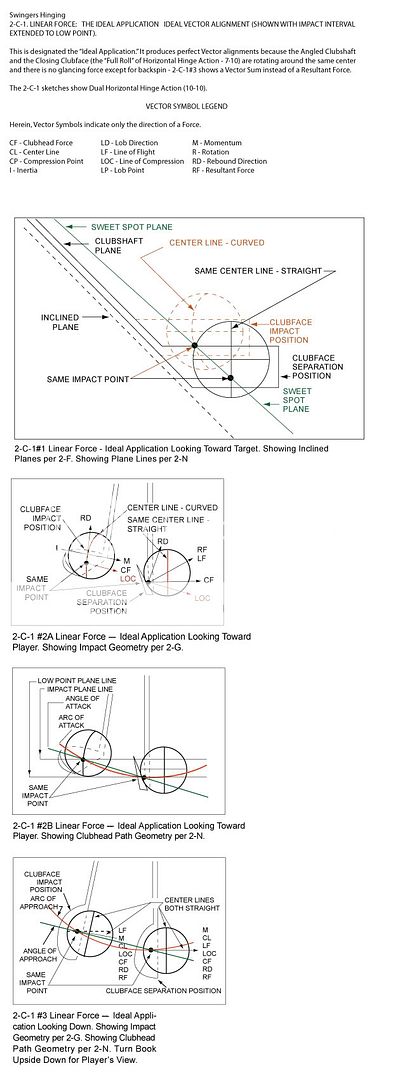
I continue to be reminded to look at the picture in 2-C-2 and every time I do I see more questions. For example, in 2-C-2 #2 and #3 it clearly shows a leaning forward shaft at impact and a vertical shaft at separation. Surely, we can all agree that is an inaccurate representation of what happens in the time frame while the ball is on the face as depicted in these pictures. I certainly agree with everyone, that vertical hinge action can be a wonderful teaching tool in the real world. Am I the only one that see's this and has a desire to question it and learn more about it. Is the picture an exaggeration? If it is, is the whole thing an exaggeration or just the shaft depiction? How would I know if just reading the book? Should this picture be changed in the 8th edition? |
Quote:
:D |
Quote:
The problem seems that you are asking for Left Brain answers to Right brain questions drawn from left brain information. Or vise-verse. Or maybe I have it wrong. BUT I understand the represtation on the sketches. I would appreciate seeing your re-do of the informatin in those sketches to also include your suggested scaleing and drafting. Please post or link so it can be seen. Take a ball and mark some "equators" on the ball so that you can watch rotation. Now, place the ball against the palm of your right hand and move your hand through the three hinge motions. Note the rotation of the ball for each. now in your mind realizing that the rotation is the same even for a very short contact interval reduce the contact to a differential interval(very small for the non technical) and accept the fact that the information transmitted to the ball is the same. You should note that the rotational information is unique to the hinge action employed. Therefore the ball flight characteristics will be different. That is good compression. You are carrying the ball on the original contact point to separation. It is hardest to do with vertical hinging or flipping the clubhead at the ball in a non lagging manner and it is sometimes amplified with a very lofted club like a 64 wedge (can almost hit that back over your shoulder with no compression) Play around with it for a while and you will feel these things- Have an epiphany so to speak. Thanks. The Bear |
The Bear,
Could you please give me your understanding on what is being represented by these pictures? I am looking at a picture that depicts a possible impact as described in the book? Does it represent an idea or a reality? If an idea, then that changes my perception of it. If a reality, then it leads me to these questions. Maybe, it's not supposed to represent a real impact. It says quite clearly (SHOWN WITH IMPACT INTERVAL EXTENDED TO LOW POINT) and I thought low point should be in front of the ball for an iron shot per the geometry of the circle. Because now as I look at, the club is carrying the ball from impact on a tee down to low point(per 2-c-1 #1 and 2-c-2#1) and I thought the ball rolled up the face. Should the ball actually go down after it's hit? What if it was on the ground and not on a tee? That would be troubling would it not? I think I keep confusing myself and can't keep it all straight in my head. I'll go back to the book and keep reading. If I knew what the exact correct image was, I wouldn't be here asking if this was the correct image. Just because someone questions something doesn't mean they don't believe it. As it holds up to questioning, one's belief in it will grow. In order for that to happen, answers to questions need to take place. When the questions don't get answered, that's when I start to wonder why didn't it get answered. Did I ask a bad question? Was my question specious as Lynn has stated? Have I not researched enough to merit a question of this magnitude? Maybe the questions aren't answerable or proovable and thus require an amount of faith. Nothing wrong with that. |
Quote:
visualize- "hand fly" the dynamics I do not mean to intrude or interpret homers intentions or meanings- This is my understanding and how I read and understand what is writen. I will take my lumps if I am off-base. The Bear |
Quote:
What do the Pro's mean when they say that they "Trapped the Ball"?  |
daryl,
Thanks for the wonderful drawings. Should I consider these replacements of the drawing in 2-c-* because they are accurate? JG |
Quote:
All of my illustrations are subject to the approval of "Mike O". So until he grants them acceptability, they're just a waste of computer memory. We may wait a few months while he completes shock therapy at the Mental Health Hospital. 12 Pc Bucket visits Mike from time to time to cut his hair, so maybe Bucket can tell us when Mike O will review the Drawings. :) He hasn't finished reviewing my plane line rotation drawings for draws and fades so it may be awhile. |
Trapped the ball? I think they think 1 of 2 things:
They think they pinch the ball between the face and turf-Inaccurate They think they hit the ball with less loft-Accurate Obviously just a guess because I haven't conducted a poll of tour pros but I have heard these two explanations. Daryl, What are your thoughts on the ball moving downward as depicted in the 2-c-* drawings? |
Quote:
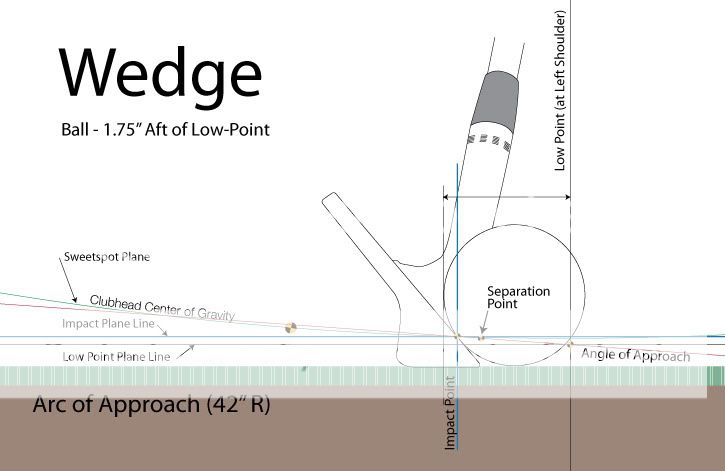
 |
It looks like, when the Clubface strikes the Ball, the inclined striker will move the Impact Point into the Separation Point as long as the Clubhead is traveling the Angle of Approach. 3 dimension impact needs a "Flat Left Wrist".
 |
Daryl,
Once again, thank you for these wonderful drawings. They are really top notch. I look forward to seeing the photos of a well struck wedge. |
I'm still a little confused.
How does this information mesh with leaving the face at practically 90 degrees? Seems as if they are opposite. One going down and one going up. |
Quote:
Quote:
But, The Rebound Vectors will be scattered unless the Line of Compression is focused on one line. So, The LINE OF FLIGHT (Resultant Force) depends on the "Quality of Compression" (new Daryl Term). That's one reason. Another reason why the Line of Flight "Won't become at Right Angles to the Clubface" is Ball Location. There is only one Ball Location that can produce a Line of Flight at Right Angles to the Clubface. The following is another reason: Quote:
Quote:
Lastly. Club makers move the Center of Gravity around like it's a tool to make the average player get the ball into the air. This really screws with the Line of Compression when the center of gravity of the Clubhead is down near the sole of the club. Look at the Illustration in the previous Post with the Clubhead at Impact. Ideally, the Center of Gravity of the Clubhead will be on the same Angle of Approach at the moment of Impact and remain on the Angle of Approach through Separation and Low-Point. |
Good Discussion - Questions:
I'll start with a simple tip - "pre-drilling". For any ball that you tee up- at impact as the compressed ball flows out in all directions - it will push the tee further into the ground - therefore when teeing the ball - always insert the tee an extra distance into the ground and then pull it back out some distance before striking the shot - this way you are not wasting energy while the compressed ball pushes the tee further into the ground - or worse yet - having the ball flow around the tee if the tee was immovable. Secondly, The ball leaves the clubface at practically 90 degrees to the face. That doesn't mean that it flies where the face is pointing. Becuase it travels along with the clubhead and picks up that force vector - the actual flight of the ball is somewhere between the face and the clubhead path. Throw a ball 10 miles an hour off a train at "practically" right angles - for this example let's just say "exactly" at right angles to the track and if the train is moving 10 mph down the track - does the ball fly in a direction 90 degrees to the track - NO. |
Exit Rows
Quote:
With regards to your need for immediate answers . . . It ain't necessarily about your asking a question that is "bad" or "specious" or even of such "magnitude" that we at Oracle LBG find it "unanswerable" and thus requiring a leap of 'faith" into our purple Kool-Aid (a metaphor preening others have found convenient). There are (at least) two other reasons why readers don't immediately jump through your hoops: 1. They don't know the answer. 2. They know the answer -- or, at least, think they do or feel they can 'add value' and spur the discussion along the way -- but, they don't have the time or the inclination to respond. At least, not now. Where the desire is strong enough, maybe later. In my case . . . Later. :salut: |
What Did He Know?
Quote:
Seems simple enough. But, maybe I didn't catch the whole gist. If not, please forgive. In any event, here's my 'quickie': In a clinic, Sam Snead called his action in a Lob Shot as "going down and up at the same time". Clubhead down (to Low Point); Clubface up (Layback through Impact). :eyes: |
Just reading all this. John, re Homers drawings of 2-C.
- they are not to scale. Not even close. The ball is about the size of a tennis ball for instance, vis a vis the club. I assume Homer did this to make the underlying geometry more obvious to the reader. To make the drawings more illustrative. -the "ideal application" or 2-C-1 represents the ideal of total compression and therefor, per 2-C-0, assumes the point of contact between ball and face stay together, intact "as if welded together" throughout the impact interval. So if impact is prior to low point this mandates that the point of contact will go down plane all the way to it low point position (assuming the clubhead completes its orbit). -separation is assumed to be at low point, so the shaft will therefor be vertical given a flat left wrist. You could also therefore deduce that Homer assumed a flat left wrist. -if impact is made prior to low point there will be some shaft lean. -shots that see the ball roll on the face even if it is solely a result of loft are not examples of "total compression". We golfers know this intuitively.....we dont tee up a driver on a 120 yard par 3 for instance. We choose a more lofted club for its inherent loss of compression. Why did Homer draw a somewhat lofted club in 2-C-1 2A then? I assume for illustrative purposes again. To highlight some of the vectors directions. See 2-C-0 its an interesting read and concludes with: Quote:
You'll notice a relationship between the drawings of 2-C and Steering. Intentional compression loss vs. unintentional compression loss due to a common conceptual problem. Can you see these things in slow mo? Id say yes, you can see Steering....guys verticaling a driver say... But impact is violent and distorts all of the parties to it: ball, clubface , clubshaft and clubhead. So you have to look before and after impact to see what going on. |
Each of these pictures clarly show the ball getting carried downward and to the right from impact to seperation.
That would mean the ball would get pinched between the turf and the face. When an inclined striker does that from a solid strike, it will be a fantastic picture indeed. I look forward to seeing it. |
Picture Perfect
Quote:
There have been a number of "pictures" posted in this thread. Please confirm you are responding to O.B. Left's post and referencing Sketches 2-C-1/2/3. Thanks. :salut: |
Quote:
Quote:
John: "I dare you to prove it to me". Daryl: "I don't care". That's not productive or positive dialogue. |
Maybe it's just his way of speaking, Daryl.
Quote:
Last night thinking of Veteran's Day made me want to challenge any golfing terrorists and humiliate them verbally. I still want to! :) Maybe John imagines we are TGM terrorists! :laughing9 He just does not understand how low-key and passive you really are Daryl! Or maybe John is 95 and just stays pissed all day due to arthritis and 'that burning sensation." :laughing1 John, just remember we have struggles, too, when you write. We are creating a community, here, of people wanting to be better golfers, not destroying a false ideology. ICT |
Quote:
Your perspective is priceless, as always. I think you're right about the "electronic media" thing. If I remember correctly, john was a golf teacher or something like that in the old days. At least I think he had something to do with golf. Your right, he's probably 95 years old, arthritis and 'that burning sensation, so he stays angry at the world all day. I think he lives in Alabama, which would answer the other questions I have about him. |
John: from the top of the page : the ball does not get turf pinched. Consider that the leading edge of the club passes under the ball. The soul hits the ground.
The ball is off the face pretty darn fast. Little ball before big ball. A pinched shot is not a pretty ball flight or set of engineering force vectors. |
Quote:
Is the "pinched" wedge simply a "feel?' There are so many "feels" involved in the Golfing Machine that make the game fun again for me. Some of these things, like the "heavy hit" are supposedly proven wrong by scientists, but are so real to me that I will always believe in them... was Mr. Kelley's work more "feel" based than "science" based than we realize? Not a knock on it if it is... it flat out works IMHO. Sorry if this question is a little bit out there... it is really addressed to all... Kevin |
Daryl,
Interesting that the post calling me combative was removed. I have yet to challenge a person and have only asked questions about ideas and information. On multiple occasions, I have been attacked along with my ideas. Attacking my ideas is just fine. I will defend them if I can. Attacking me is not. But I guess this is the type of community you are trying to build. Interesting indeed. |
Quote:
Kevin |
Quote:
Hmm? The "Science" doesn't belong to anyone. Quote:
How "more complete" can anyone get than that? |
Quote:
|
| All times are GMT -4. The time now is 03:47 AM. |