
|
Quote:
Brrrrrrrrrrrk. NO way is is Johnny Miller a Hitter . . . That's how the club works when you come close to swinging on the hands only plane . . . where's the right forearms support . . . you've lost your mind. That hinging action ain't coming from no drive loading . . . see frame 1, 9 and 8 . . . then read 2-J-3 . . . arc of approach procedure here JuneBug. Plus look at frame 5 . . . loading the entire primary lever? I ain't seeing it. |
Johnny Miller is almost Textbook 12-1-0.
The only Differences are that he doesn't use a Right Anchor, he uses an Elbow Plane and he Double Shifts his Plane Angle and he overtravels his Backstroke. His Right Elbow is slightly out of alignment at the End of the Backswing but by Frame #7 he's put back together. That's probably remnants from learning how to Swing as a kid. |
Quote:
We may never know, its really hard to tell with some guys, most guys. But frame 6 would be a nice Hitters Top. You could Drive from there pretty easily. You can Hit and use the Arc of Approach! The Angle of Approach doesnt define Hitting, its just an option available to Hitters who would prefer to Thrust it straight line (to their eye), cover the Plane Line, Steer....... albeit with a few necessary adjustments to Plane Angle (eye high, "nearly vertical") and Plane Line (10-5-E out to right field). Miller can turn, so his left shoulder is pulling the clubhead back inside along the Arc to my eye. Probably to his eye too. Curved Blur. As an aside, only a Hitter, Drive Loader would suggest that you could start your swing from Top, no backstroke. A hitter or a Johnny Miller that is. They're both kinda out there, eh Ted? |
Quote:
   |
Quote:
Here's you a hitter with standard knee action loading the PRIMARY lever . . .  |
Homer didnt recommend End for Drive Loaders, didnt like Draggin then Driving at all but that doesnt mean they dont exist in the wild does it? Compensations do happen , especially when a young hitter type reads swing centric golf magazines from an early age.
Im on the fence about Miller being a Hitter. Who knows? The straight on photos 6,7,8,9,10 said Thrust to me when I was looking at them. Like maybe he is pushing on the aft of the shaft and the Hands are coming off the Inclined Plane early. Now Seve.............he discussed right arm participation in his book, didnt he? Going from memory here. Gotta dig that up and copy it for you guys. That would be a shocker! Mind you Im seeing Hitters where ever I look these days.......kids, women , hockey slap shots........... PS I love the way Miller is backing into that shot there.........the one with Seve looking on. Beautiful. Slide with a Delayed Turn. |
I'm willing to give Johnny Miller "Switter" status. :)
|
That first Getty image..........its amazing. Maybe his left knee is a little weird by modern standards but his Hips are Sliding and
his Hip Turn is Delayed!!!!!!! He's leaning into that shot. Second picture........he's cleared the Right Hip there pretty nicely hasnt he? Gents we're looking at both of Homers "clear the right hip" recommendations from 12-3 here. Going back and going down. |
Quote:
|
Uh oh. But they still had the watermark! It's like free advertising for them.
|
What plane would you say Miller is on at impact, the handy elbow plane?
|
Quote:
|
Quote:
|
Quote:
Yah agreed. Maybe the sooner the better even. Homer preferred the golfer to be on his Impact Plane at Top after all. Zero or Single shift. Which rules out the Elbow Plane I guess. The Elbow plane is fine and dandy if you have mastered the shift down to it but there isnt an advantage to it. Although Homer reasoned that a golfers "psychological preference" for a certain procedure must be taken into account. The high hands trend back in day (higher plane that TSP at Top) required a shift. A "vertical drop" of the Hands was necessary , common advice. "Drop it into the slot" etc. I remember an instructor likening it to an ice skater tucking her arms in to increase the speed of her spin even......... Ah the seventies........."Drive the knees"! Those plaid panted knees. Never thought about this before but Homers book might have seemed even more bizarre to our knee drive'n, high handed, plaid panted brothers back in the day? I remember Five Fundamentals looking awfully "flat" to my young eye. Beautiful but flat. Who's shift to the Elbow Plane would you rather have for simplicity sake.........Hogans or Millers? |
Quote:
|
Miller could flat play!
Homer seemed to like the elbow plane in the 3rd edition, right? I think "flat" through impact quietens the face a bit. A lot of great ball strikers (in this case Miller)saw the merits of a flatter plane through impact (not just the witchdoctors, Daryl!:eyes:)
|
Out of respect for them, please capitalize "Witchdoctors".
They aren't Witchdoctors because of Plane Angle. |
Quote:
Dont get me wrong Okie, there is absolutely nothing wrong with the Elbow Plane once you groove the shift down to it. I was referring to Homers opinion circa 1982 , not sure about his thoughts in the 3rd. Im interested though if you dont mind quoting, sharing. There were certainly a ton of fine players who shifted down to the elbow plane , Hogan chief amongst them. His shift given his flat backswing was nothing compared to Millers. I dont know who had the biggest shift of all time but I bet it'd be someone from the Seventies given those high hands back then. I guess theoretically you approach Horizontal Hinging as you shift down closer to the true Horizontal Plane (where you get closing only like a door as opposed to a true Vertical Plane where you get layback only like a pet door). Vice versa for higher planes. Which is a good mechanical Address Fix adjustment for short shots where you want a little built in Vertical Hinge..............just increase the shaft or Plane Angle at Fix by snuggling up closer to the ball. Here's a thought straight from the Lab ......if you Angle Hinge (given its associated clubhead travel) along the Elbow Plane through Follow Through.......you will have more of a "feel" of "swinging left". In fact, you will have more of "real" as well. Not to be confused with non planar versions of "swinging left" however. I won a tourny at my local muni last year swinging and shifting down to the elbow plane. Hit 16 greens, my personal best in tournament play. Then went back to a single shift and hitting too. This game is so insane or .......is it me? Next year tennis. |
Hi MB!
Quote:
I have been chipping with such a setup with a good lie and ball mid-body,small rft. The chip runs straight. I have to be very careful of the chipping club, though, since the distance can be very long. I haven't mastered it yet, I need to get it to check up, or run at will. Anyway, it's fun when it works. :) |
Could somebody put up some players that are on the Turned Shoulder Plane through the ball? Or could you give some examples of players and I'll search out some pictures?
|
Quote:
Here you go . . . 10-6-A Elbow Plane FIRST AND SECOND EDITION The location of the Elbow during Impact is the reference point used for this Plane Angle. This alignment not only allows the Right Forearm to move On Plane through the Impact but also allows the torso to be position at right angles to the Plane - which are the unexcelled alginments for Right Arm Power and Control. Remember-the Right Forearm cannot become "On Plane" until the Right Elbow becomes "On Plane". 10-6-A Elbow Plane THIRD EDITION Where the Right Elbow touches the waist is the reference point used for this Plane Angle. It is the "flattest" normal Plane that will still allow the Right Forearm to be On Plane during Impact. This means that normally the Right Forearm will be moving at right angles to the torso - which are the unexcelled alignments for Right Forearm Power and Control 10-6-A Elbow Plane FOURTH AND FIFTH EDITIONS Where the Right Elbow touches the waist is the reference point used for this Plane Angle. It is the "flattest" normal Plane that will still allow the Right Forearm to be On Plane during Impact. This means that normally the Right Forearm will be moving at right angles to the torso - which are the unexcelled alignments for Right Arm Power (6-B-1-0) and On Plane "Throw Out" action (2-K). 10-6-A Elbow Plane SIXTH AND SEVENTH EDITIONS Where the Right Elbow touches the waist is the reference point used for this Plane Angle. It is the “flattest” normal Plane that will still allow the Right Forearm to be On Plane during Impact. This should produce a very flat Angle of Attack (2-B) with reduced Backspin and should be avoided for Short Shots unless it is also part of your Full Stroke Pattern. The Elbow Plane allows maximum #3 Accumulator requiring earlier Release per 6-N-0. This procedure is executed by the Right Forearm per 7-3 and 10-6-B and Elbow Location per 6-B-3-0-1 All the good stuff got trashed in the 5th, 6th and 7th. Hmmmmmm . . . . . . |
Quote:
|
Quote:
Thanks Buck What do you think the reasoning was behind the omission of the "torso at right angles to the plane" thing? Have you ever asked Yoda? It makes sense in that any turn of the torso would maintain the on plane travel of the right forearm but ..... is that a Pivot to Hands kinda logic maybe? See the glossaries definition of Pivot for instance. Just guessing. I dunno, I really dont know. As far as the definition of Elbow Plane goes: In the first and second, if Im reading it right, it was any plane angle which saw the Right Elbow and Forearm on Plane at Impact. Where as in later editions it was by definition a singular , low plane angle, referenced by where the Right Elbow touches the waist and amongst the many angles that can see the Right Forearm on Plane at Impact....... I also see Okies point about it seeming to be a recommended Plane Angle in the Third. Where as in later years he apparently preferred the TSP. Maybe Yoda'll come in here and provide some background insight? |
Quote:
I have more, but each picture below shows golfers with different amounts of shoulder turn at Impact. 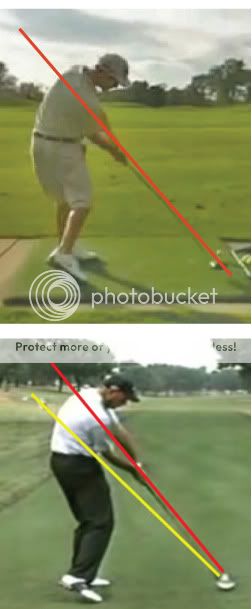 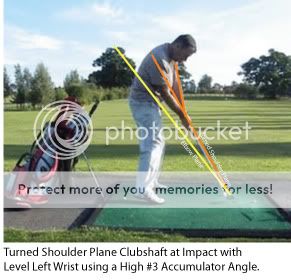 |
Quote:
I'm pretty sure this has been discussed but don't know where or when in the forum. From a geometric standpoint based on the rationale Mr. Kelley gave for the Elbow Plane in the earlier editions vs. the TSP in the later . . . .which do you believe to be more compelling and why? I'll reserve my answer . . . . |
Quote:
|
Quote:
The other two are amateurs who submit their swing videos for analysis. My guesstimate is that there are 20 Elbow Plane Swingers for every TSP Swinger. Long Drive Champs have more TSP Swingers than Elbow Plane Swingers but their videos are so "Circus" oriented that it's rare to find one that can be analyzed. |
cink looks like its shifted. does he hit a draw?
|
The second guy looks like Lehman to me, not sure.
|
Quote:
Homer abandoned the right angles thing, it would seem. I get the logic of it , I think, but keep going back to the glossaries definition of the pivot. Which to me is Hands to Pivot. Its all about getting the Right Forearm on Plane, however that is done by the Torso and all. |
Quote:
|
TSP for golfing ease and low scoring
Quote:
I actually have a question on topic. I'm sortof nervous about it so I'll give you my reference point- 10-6-D TURNING SHOULDER Locating this Plane Angle reference point geometrically is very involved but seems readily defined from a “mechanical” description. Which is this; the Arms are simply raised and lowered vertically and the Wrists are Cocked and Uncocked with Left Wrist vertical to the ground at all times in a true Single Wrist Action – no Turn or Roll (10-18-C). All this, while the Pivot is imparting the On-Plane motion to the Hands and Arms in both directions. It brings the Hands directly to a Squared Shoulder Plane location. Its Off Plane (Vertical) Loading motion tends to Feel like Clubhead Throwaway but it is the Vertical Left Wrist application of the Golfer’s Flail as shown in Sketch 2-K#5, which insures a positive Downward motion for an effective Three Dimensional Impact. The basic “Turning Shoulder Plane” procedure – (A) below – is undoubtedly the most widely used Basic Plane Angle. The player who takes the Clubhead “straight back from the ball” is using this Plane Angle. The Clubhead is also brought “straight down through the ball” for Impact. This is a dependable explanation of the “Feel” of this procedure. And this procedure brings the Club into the loaded condition on a vertical Plane instead of on the Inclined Plane. With a full Wrist Cock Stroke the Hands are “under the Club.” This calls for Single Wrist Action (10-18-C). Its most obvious feature is the vertical line of the muscular effort – an inclined plane with vertical force. It is extremely effective and dynamically correct. Study 2-L#2, 2-N-1 and 2-P. The bold highlight is mine. I think this is what I have been experimenting with and calling it a "chicken wing" or "inclined ferris wheel." I extend both arms straight back shoulder feels up and then down from an impact fix position. When my left wrist bone is elevated at the end of the swing, the ball goes far and very straight. When I attach my back elbow to the endless belt, I get the raised left wrist and power and direction. Have you ever experimented with this? Are there better golfers that use this that you are aware of. :scratch: :scratch: As a funny side note, one of the driving range pros plays in Eastern PA amateur events and is a senior in hs. He now checks this site, and he is a lefty. He asked me last evening to explain RFT. I showed him the motion and hit a pretty good 145 yard 8 iron. He smiled and said "I got it." He then hit a 200 yard 6 iron. :laughing9 I do lots of things wrong in my golf swing. It amazes me that I can understand a concept intellectually but not do it. With TSP, (my version) I hit a 155 yard 8 iron dead online. Thanks. |
Quote:
Quote:
Turning Shoulder Plane: – B Vertical Left Arm Swing Plane version. See page 156 Annika Sorenstam, http://www.youtube.com/watch?v=4KlOVPyMcBA http://www.youtube.com/watch?v=S_ZpA...eature=related |
Quote:
|
| All times are GMT -4. The time now is 03:48 AM. |
