LynnBlakeGolf Forums

LynnBlakeGolf Forums (http://www.lynnblakegolf.com/forum/index.php)
-   The Golfing Machine - Basic (http://www.lynnblakegolf.com/forum/forumdisplay.php?f=16)
-   -   Question about plane (http://www.lynnblakegolf.com/forum/showthread.php?t=6943)

Loren 09-29-2009 10:39 PM

Quote:

Originally Posted by ndwolfe81 (Post 67911)
If most tour players are double shifters then why is it that Lynn and Ted always have the TSP drawn in the amazing changes section?

And why in most photo are the hands, right forearm, sweetspot/clubshaft and right shoulder pretty much on it?

They must feel like that is a better downstroke plane, all the way to impact. And I guess they don't think shifting down to the elbow plane is worth while?

Is that the case?

Yes, that's correct.

The preferred plane angle is the turned shoulder plane, however it may be determined by the actual shoulder turn component. The reference point primarily means after a flat shoulder turn but other shoulder turns can be used for the reference point, and it says that if the former can't be reached then a steeper plane angle should be used.

"This plane angle has far better performance characteristics than any other because any plane angle shift is hazardous. This procedure does not refer to the disruptive shoulder turn takeaway."

And the plane angle variation (various shifting) specified is Zero Shift, which means both directions. (Mandatory right forearm takeaway.)

The Standard shoulder turn component is a Flat (as possible) backstroke turn and an on-plane downstroke turn.

It was changed in the 7th edition to Rotated Shoulder Turn (right angles to the spine) and we're discussing if that's possible given a Slide hip turn, because the shoulder turn seems to demand a Shiftless hip turn. The discussion really belongs in the Changes for 7th Edition thread.

Loren 09-29-2009 10:52 PM

Quote:

Originally Posted by jerry1967 (Post 67912)
When you are saying "flat back" does this mean horizontal to the ground or to the spine?

To the ground, as flat as possible. It won't actually be horizontal to the ground due to spine angle. It would be a flat turn compared to a rotated shoulder turn which is a "normal" at right angles to the spine turn.

jerry1967 09-29-2009 11:17 PM

Quote:

Originally Posted by Loren (Post 67927)
To the ground, as flat as possible. It won't actually be horizontal to the ground due to spine angle. It would be a flat turn compared to a rotated shoulder turn which is a "normal" at right angles to the spine turn.

OK after all this which is better for a swinger,flat or rotated?

Loren 09-30-2009 12:21 AM

Quote:

Originally Posted by jerry1967 (Post 67929)
OK after all this which is better for a swinger,flat or rotated?

No opinion. Preference here seems to be flat, and up to the 7th edition it was.
Reluctant to change.
But I'm not convinced the Rotated Shoulder Turn always requires a shiftless hip turn.
The wording is ambiguous. Especially since the hip turn specified is Slide.
According to rumor, it may be an unintentional change.
My body does not like rotating, at my age, but I could be doin' it wrong.
So I'm hitting, or trying to, with a flat backstroke shoulder turn, on-plane downstroke.

Don't change something that's not broken.
I wouldn't suggest ndwolfe change his, except maybe downstroke and axis tilt.

O.B.Left 09-30-2009 06:06 PM

Here is a link to the "7th edition changes" thread that covered this subject. Lynn's thoughts are, well, very Yoda like as always.

http://www.lynnblakegolf.com/forum/s...ht=7th+rotated

O.B.Left 09-30-2009 08:14 PM

Quote:

Originally Posted by O.B.Left (Post 67914)
Perhaps the confusion lies in the belief that there ideally is one singular "Plane" or one fixed Inclined Plane angle? While this may true intellectually and indeed practically for short shots, "The" Inclined Plane can and does Shift or change angles for longer shots. I cant think of golfer who hasnt shifted plane angles for full shots. Given the manner in which we define the plane anyways. (JIm Hardy's definition being a different kettle of fish, the plane of the shoulders vis a vis the left arm being one and the same etc).

From a DTL point of view, the angle formed where the Plane (picture it as a four sided rectangle along which the clubshaft or the more correctly a line between the #3 PP and the Sweetspot, travels at all times) meets the ground (the Base Line, Target LIne) can change. The club's lie angle defines the starting plane angle assuming you dont want to come into the ball toe up or down. The right forearm , or right Forearm Flying Wedge is said to be on this Plane Angle when the Right Elbow is on plane.

So "The" Inclined Plane or "The Plane" does not preclude changes in the plane angle, "shifts".

Also, Per 1-L-18 Machine Concepts. "Changing the Plane Angle has no effect on the Plane Line". Implicit in this is that Tracing the Plane Line accurately is far more critical than complying with a specific pattern of plane shifts. See Trevino, Furyk etc. There used be a really nice animation on this site that described this. If I can find it in my files Ill send it to you. It will make things clear as words sometimes fail us when describing geometry.

Yoda would, I believe, prefer the TSP in Startdown so that the Right Shoulder can get on the Inclined Plane and take the Power Package down that plane towards the ball initially. But this does not imply that he wants the clubshaft, right forearm, hands, #3 pressure point , sweetspot etc to stay on the TSP all the way to Impact. The fog will lift when you can imagine the Inclined Plane's angle changing as it shifts from a higher angle to a lower one. From say the TSP to the Elbow plane. Its the same plane of glass or plasic or whatever with different, shifting angles where it meets the ground. That is "The" Plane.

Further research has allowed me to see that I sometimes use the Hands Only Plane with no shift in total motion. Basically a wedge shot with the blade laid flat on its back, wide open and plane set super low. V.J Trollio invented this shot I believe. It takes almost all of the down out of the three dimensional impact as you scalp the ground on a severely flat Angle of Attack. The hands set below the elbow plane meaning the right forearm is no longer on plane. A super de duper lob shot. The open clubface avoids any lie angle, toe up issues given the difference between lie angle and Inclined Plane angle. A non shifting fixed plane in total motion.

As for using a fixed, non shifting Turned Shoulder Plane for full shots. Assuming the Right Forearm is on Plane at Impact, how do you reconcile the various lie angles through the bag? Would you have to bend each club so it points at the turned shoulder? I still dont see the right shoulder being on this plane at impact. Startdown only.

The Elbow Plane you could use , I think, without lie angle issues but its pretty flat aint it? There may be a specialty shot application for it but I dont see this on tv in total motion, I dont think. Even Hogan wasnt this flat.

Maybe I need more incubation time on this , sorry.

Loren 10-01-2009 02:55 AM

I think you're right, and I need more incubation time.
And it's midnight.

Daryl 10-01-2009 04:41 AM

Quote:

Originally Posted by O.B.Left (Post 67935)

As for using a fixed, non shifting Turned Shoulder Plane for full shots. Assuming the Right Forearm is on Plane at Impact, how do you reconcile the various lie angles through the bag? Would you have to bend each club so it points at the turned shoulder? I still dont see the right shoulder being on this plane at impact. Startdown only.

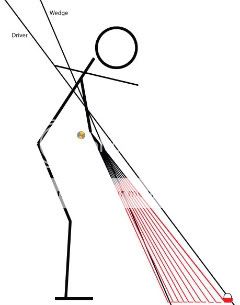
The Turned Shoulder Plane is not a Fixed Plane. It's shallower for the Driver and Steeper for a Wedge. Elbow bend and Upper Arm Angle adjust to accommodate various Club Lengths and Lie Angles as does the Forward Angle of the Right Forearm.


Remember that the Forearm “Traces” the Delivery Line.

I don't want to be Vapid so for those who want to get straight to the Point,
Quote:

So the Right Forearm must leave – and precisely return to – its own Fix Position (7-'8') “Angle of Approach”
(Rigid Power Package)

So, even the Elbow Plane has different Clubshaft Angles (Planes) for Different Clubs depending on Club Length. The Elbow Plane passes through the Waist. The Turned Shoulder Plane Passes through the Center of the Upper Right Arm (about three inches higher). With a Rigid Power Package, anyone who is on the Turned Shoulder Plane at the Top will be on the Turned Shoulder Plane at the Bottom. Those who Straighten the Right Elbow during the Downstroke, will forcibly lower the Hands to the Elbow Plane for Release.


Following is the COMPLETE topic.

Quote:

7-3 STROKES – BASIC Because of the dominant role of Accumulator #3 (6-3-B-0, 2-N, 2-P), Golf Strokes are very dependent on the Right Elbow activity deriving from its location and the nature of the subsequent Right Arm participation. The Elbow must always be someplace and as there are only three definable locations there are three Major Basic Strokes – Punch, Pitch, and Push (10-3).

Right Forearm Position at the Top differs for the Angle and Arc of Approach procedures. So their Elbow location and action differs also. For Hitting (10-19-A), the Right Forearm should be precisely in-line with – and directly opposed to – the motion of the On Plane Loading Action (7-22) of the entire Primary Lever Assembly (6-A) not just the Clubshaft, and this alignment is maintained through Impact (2-J-3, 4-D). For Swinging (10-19-C) the Right Forearm should be precisely in-line with – and directly opposed to – the motion of the On Plane Loading of the Secondary Lever Assembly (the Clubshaft) and this alignment maintained through Impact. In compliance with both 6-B-3-0-1 and 10-11-0-3. With this “in-line” relationship of Loading and Right Forearm, it is absolutely MANDATORY that, Hitting or Swinging, it is the Right Forearm – not just the Right Hand and/or Clubshaft – that must be thrown, or driven, into Impact per 7-2-3. And study 7-11. ALWAYS, for all procedures, the Right Forearm is position “On Plane” – pointing at the Plane Line as the Angle of Attack (2-N). The On Plane Right Forearm shows the precise up-and-down direction it and the Clubshaft must take throughout the Stroke (2-J-3). The “Angle of Approach” position of the Right Forearm shows the precise Cross-Line direction the Forearm must take through Impact. It, thereby, precisely locates the visual Impact Point – where the eye must direct the Pressure Point #3 – the inside-aft quadrant of the Ball. Remember, the Actual Angle of Approach of the Clubhead is determined by Ball Position (2-N) so the Cross Line position of the Right Forearm is ONLY the On Plane Forearm Thrust per 1-L-9/10/11. Even with the Pitch Basic Stroke. So the Right Forearm must leave – and precisely return to – its own Fix Position (7-8) “Angle of Approach” (regardless of the true Clubhead Angle of Approach) because both procedures will produce identical Clubhead Delivery Lines.

Furthermore, in compliance with 6-B-3-0-1, Bending and Straightening the Right Elbow will RAISE AND LOWER the Left Arm and/or COCK AND UNCOCK the Left Wrist with out Bending, Flattening or Cocking the Right Wrist. Practice this first at Impact Fix. So, the Right Elbow Action either powers and/or controls all three elements of Three Dimensional Impact (6-C-0) per 1-L-9. All this you will come to know as the MAGIC OF THE RIGHT FOREARM.

O.B.Left 10-01-2009 10:12 AM

Nice, 4.5 Yodas (Ill cut one in half). Uh oh here comes Kanye again. "Yo Daryl, Im happy for ya'll an Imna let you finish , but Beyonce had the best 7-3 post of ALL TIME"...........

Anyways:
-by fixed I meant non shifting.

-what is a "rigid" power package? Is this your vapidity or mine? Surely the right elbow bends, it being the stuff (or part of the stuff) of the "magic of the right forearm". But you make an interesting point about elbow straightening in Downstroke and shifts to lower planes.

-re 7-3. Where is the "4:30 line"? This is way off topic I know. I like the logic and geometry of the Angle of Approach as written, "determined by ball position" etc. Maybe I dont understand Lag's geometry, though I do like his writing and his actual swing when playing as opposed to practicing. The Alt Target Line is estimated, averaged out to 11 degrees on Chuck's thing amajig aid. 4;30, I reckon to be 45 degrees no? Surely thats off plane, or cross line at best. I digress.

-Is it really possible to point the butt end of the club at the turned shoulder position with every club in the bag? I will have to do some experimenting. This would make a non shifting swing possible through the entire bag. A "well I begottahel" moment.

12 piece bucket 10-01-2009 10:16 AM

The question to be answered is WHEN do you define what plane you are on when the REAL business occurs? Homer said you could clown the backstroke . . . . so you can certainly be "on-plane" in the backstroke right. . . but the IMPERATIVE is the line of compression . . . So when would you say that the plane is defined on the downstroke?

O.B.Left 10-01-2009 10:51 AM

1 Attachment(s)
Quote:

Originally Posted by 12 piece bucket (Post 67941)
The question to be answered is WHEN do you define what plane you are on when the REAL business occurs? Homer said you could clown the backstroke . . . . so you can certainly be "on-plane" in the backstroke right. . . but the IMPERATIVE is the line of compression . . . So when would you say that the plane is defined on the downstroke?

This makes good sense.

I'd add that being "on plane" in the backstroke includes any plane shifts. Making Plane Line adherence a constant and giving the golfer some latitude around the fixed , non shifting plane angle. Plane Line compliance being our prime concern.

Im thinking Plane Shifts are hazardous, for sure but;
-you can shift Plane Angles and still be "on Plane". Its the same plane its just shifted. The club still travels the same plane but the angle has shifted. Dang, I wish the 1-L-18 animation would resurface. Imagine yourself in Homers garage set up on his plane board. As you take the club back along the elbow plane Homer begins to tilt the top end of the plane board up to your TSP or whatever, then on the down swing he tilts it down as you approach the Elbow Plane again. Double Shift with your club sliding up and down the single sheet of flat plastic. One end of the club pointing at Plane Line , Base Line at all times.
-one shift is less hazardous than two , two better than three etc
-plane line compliance is the prime concern
-the plane angle through impact had best match the clubs lie angle and ideally the elbow plane for mechanical and geometric advantage. (RFFW and Tracing etc)

Look at this guy here. He is riding Homers plane with a Double Shift. Plane line compliance.

http://www.lynnblakegolf.com/forum/a...d=125440863 6

Loren 10-01-2009 11:45 AM

The Moment of Truth
 
What's missing thus far is Impact Fix.

For ndwolfe who is not TGM conversant, Impact Fix is a dress rehearsal for Impact done between Preliminary Address where you're getting ready for the shot (club selection, wind analysis, trajectory, target, practice swing), and Address with its adjustments for where you intend to start up including any waggles and forward press, usually with hands mid-body.

Key to this discussion is the right forearm on-plane with the shaft at impact. That's where we intend to return everything at the moment of truth.

Impact Fix sees the body in relatively open conditions, although the hands are still mid-body as the mid-body has shifted from where it would be at standard Address, the head height is lower, the right shoulder is lower for impact, precise amount of impact knee bend determined and impact foot loading. The grip is taken here with the clubshaft at an angle according to its lie angle and built-in clubshaft forward lean, the clubface open, square or closed according to planned hinge action to be used, trajectory and length of shot, the left wrist flat, level and vertical, the right wrist bent, level and vertical and extensor action is applied. Thus, the Flying Wedges are assembled, which is Daryl's Power Package Structure. It is this structure we want to recreate into impact reqardless of plane angle shifts, and to where the right forearm must return. The Machine is designed to do precisely that. Think full-body participation Forward Press.

Depending on how far you stand from the ball, the amount of waist bend and knee bend, the degrees of openness of the hips and shoulders, acquired axis tilt and right shoulder height at impact, it's possible to have everything lined up with the turned shoulder plane and take it away and return it precisely there with zero plane shift. The right forearm can not get on plane until the elbow does, but that does not dictate swinging on an elbow plane. It's the hands that go up and down the plane on their delivery path, and the right forearm is thrown or driven out into impact.

Hitters especially prefer to use this position as Address for startup.
Swingers adjust back to mid-body address, squaring everything except the clubface, but it's advantageous to retain head height determined at Impact Fix, and right knee bend. The hands typically are lower but need not be, the left wrist has gone bent with the right wrist now flat. From there the Power Package has to be re-assembled in the backswing, but the swinger can drag it away from here better and the #3 pressure point is in a better location for tracing the plane line (proximal phalanx of the right index finger).
Either pattern uses Right Forearm Takeaway tracing the delivery line. Hitters carry it away, swingers drag it away.

The impact fix amount of right wrist bend, and the flat left wrist will be correctly re-created with a swivel (turn) of the left wrist onto plane somewhere in the backswing with the swinger's standard wrist action. The Flying Wedges are thus assembled and it is that fixed amount of right wrist bend that should be maintained into the impact area.

Quickly posting without much editing, a memory dump, getting ready to duck the bullets, probably in re "everything lined up on the TSP".
Hope ndwolfe gets something out of it if he's still around after all this. And hope there's nothing too misleading in here for him. There are still a few terms needing definition, Level for instance, the Flying Wedges, hinge action, delivery line. How much precision do you want? All that's possible.

12 piece bucket 10-01-2009 12:54 PM

Quote:

Originally Posted by O.B.Left (Post 67942)
This makes good sense.

I'd add that being "on plane" in the backstroke includes any plane shifts. Making Plane Line adherence a constant and giving the golfer some latitude around the fixed , non shifting plane angle. Plane Line compliance being our prime concern.

Im thinking Plane Shifts are hazardous, for sure but;
-you can shift Plane Angles and still be "on Plane". Its the same plane its just shifted. The club still travels the same plane but the angle has shifted. Dang, I wish the 1-L-18 animation would resurface. Imagine yourself in Homers garage set up on his plane board. As you take the club back along the elbow plane Homer begins to tilt the top end of the plane board up to your TSP or whatever, then on the down swing he tilts it down as you approach the Elbow Plane again. Double Shift with your club sliding up and down the single sheet of flat plastic. One end of the club pointing at Plane Line , Base Line at all times.
-one shift is less hazardous than two , two better than three etc
-plane line compliance is the prime concern
-the plane angle through impact had best match the clubs lie angle and ideally the elbow plane for mechanical and geometric advantage. (RFFW and Tracing etc)

Look at this guy here. He is riding Homers plane with a Double Shift. Plane line compliance.

http://www.lynnblakegolf.com/forum/a...d=125440863 6


BEAUTIFUL . . . look at how the right arm and the right shoulder move . . . no bobbing . . . awesome . . . can you put up the next two frames?

I'm going to challenge you on that plane line compliance being of primary importance though . . . disruption in the #3 angle/plane angle shifting CAN have HUGE implications on the face vector AND the rate at which the face rotates about the sweetspot . . .


See anything here that would cause that big ole shift out to the right?


Loren 10-01-2009 01:54 PM

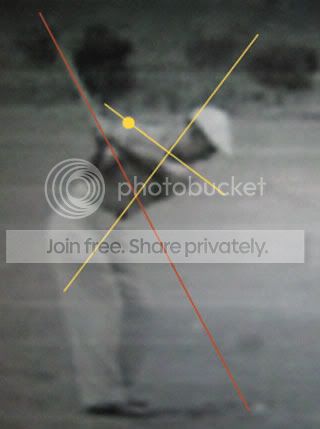
The blue line is a little too high for Turned Shoulder Plane angle.
Usually it's drawn up through the armpit at address. (10-6-B)
The Standard (flat) backstroke shoulder turn component is meant to take it back to that line and then down it.
He's not far under it.
You have it on the Squared shoulder turn, a much steeper plane. (10-6-C)
Too much knees action, weight rolled to outside of left foot.
"Plant the left heel." Harvey Pennick, paraphrased.

12 piece bucket 10-01-2009 02:36 PM

Quote:

Originally Posted by Loren (Post 67953)
The blue line is a little too high for Turned Shoulder Plane angle.
Usually it's drawn up through the armpit at address. (10-6-B)
The Standard (flat) backstroke shoulder turn component is meant to take it back to that line.
He's not far under it.
You have it at the Squared shoulder turn line, a much steeper plane. (10-6-C)
Hips too active, weight rolled to outside of left foot, loss of "left anchor", release could be delayed some more.

I don't necessarily disagree with your analysis of the line drawing . . . but I didn't draw the lines. Somebody else did . . . they were just on there from the site I pulled the pic from.

I do have a different take on the hips though . . . . look at the head . . . are the hips going forward or is the head backing up?

compare Hogan/Yoda to Graham. . . look at the tilt in the shoulders . . . Look at the difference in the straightness of the right knee . . . If you drew a plumb line from each players nose where would it meet the ground relative to the feet?


Daryl 10-01-2009 02:37 PM

Quote:

Originally Posted by 12 piece bucket (Post 67941)
The question to be answered is WHEN do you define what plane you are on when the REAL business occurs? Homer said you could clown the backstroke . . . . so you can certainly be "on-plane" in the backstroke right. . . but the IMPERATIVE is the line of compression . . . So when would you say that the plane is defined on the downstroke?

The Angle of the Clubshaft is the Plane. I think that plane angle is not important if you don't use the same angle during the release as at impact (unless you're using a Flip Release). Being able to generate clubhead speed and direct the clubhead simultaneously means you need Plane/Clubshaft Control.

Daryl 10-01-2009 02:42 PM

Quote:

Originally Posted by O.B.Left (Post 67940)
Nice, 4.5 Yodas (Ill cut one in half). Uh oh here comes Kanye again. "Yo Daryl, Im happy for ya'll an Imna let you finish , but Beyonce had the best 7-3 post of ALL TIME"...........

Anyways:
-by fixed I meant non shifting.

Oh.

Quote:

Originally Posted by O.B.Left (Post 67940)
-what is a "rigid" power package? Is this your vapidity or mine? Surely the right elbow bends, it being the stuff (or part of the stuff) of the "magic of the right forearm". But you make an interesting point about elbow straightening in Downstroke and shifts to lower planes.

From the Top, don't unbend the Right Elbow until release.

Quote:

Originally Posted by O.B.Left (Post 67940)
-re 7-3. Where is the "4:30 line"? This is way off topic I know. I like the logic and geometry of the Angle of Approach as written, "determined by ball position" etc. Maybe I dont understand Lag's geometry, though I do like his writing and his actual swing when playing as opposed to practicing. The Alt Target Line is estimated, averaged out to 11 degrees on Chuck's thing amajig aid. 4;30, I reckon to be 45 degrees no? Surely thats off plane, or cross line at best. I digress.

During Delivery when the Butt End of the Club points to the Inside-aft quadrant of the Ball. The Clockface is on the ground. 9:00 O'clock is the Target.

Quote:

Originally Posted by O.B.Left (Post 67940)
-Is it really possible to point the butt end of the club at the turned shoulder position with every club in the bag? I will have to do some experimenting. This would make a non shifting swing possible through the entire bag. A "well I begottahel" moment.

Yes..............

12 piece bucket 10-01-2009 02:52 PM

Quote:

Originally Posted by Daryl (Post 67956)
The Angle of the Clubshaft is the Plane. I think that plane angle is not important if you don't use the same angle during the release as at impact (unless you're using a Flip Release). Being able to generate clubhead speed and direct the clubhead simultaneously means you need Plane/Clubshaft Control.


Please clarify . . . not sure I'm following you . . .

The point I'm trying to make is most people aim differently when they have a side hill lie . . . ball below feet=face vector to the right+steeper clubshaft . . . also the steeper the shaft means less #3 angle which equates to more motion of the clubface for a given amount of roll. Vice versy for a ball above your feet you get a pull vector from the face and a slower rate of rotation of the face . . . . when you shift the plane angle thru the ball (release or whatever point you want to define the downstroke plane) you have created a side hill lie DYNAMICALLY.

Look at Hogan's face, clubshaft control and right arm compared to Graham in Frame 4


Face still hasn't swiveled to the plane . . .


Loren 10-01-2009 03:42 PM

Angled versus horizontal hinge action.
Hogan's probably punching it with the right arm. Default angle hinge.
Or in his mind "holding it off". Hands too low will do that also.
Graham's swinging, default horizontal hinge caused by CF.
The face won't swivel onto plane until the clubhead overtakes the hands, with a left forearm swivel into finish.
Hogan held it off. He never did swivel onto plane in finish (in this photo sequence), typical of a hitting stroke.

Hogan and Yoda look great. Heads centered, good knee and hip actions. Neither are rolling to the outside of the left foot. Yoda's squatted more but those two photos seem to be from different swings, as he's on the practice grounds and the background has changed. Not even sure about the same camera location. We know he pushes that left knee out there but seemingly not too far, accepting the weight of the required parallel slide motion. (Tomasello did the parallel slide too, b-t-w, barely perceptible at speed but evident in slow-motion, and more than it looks. Several inches. He preferred to focus on the right arm and right shoulder and let the hips react, but keep 'em out of the way.)
I'd take Yoda's hitting stroke any day now if someone would just come along and transplant it.

Graham's hips haven't moved too far but his knees have, the head's dropping down and back, nowhere near the center of the stance, too much axis tilt, hips too open at impact, hands haven't caught up, shoulders could have traveled farther and release could have been delayed more. His "line of sight to the ball" got altered significantly. And it looks like he "stood up", almost like a S&T move.
Looks a lot like Mike Austin's "Flammer" photo sequence. Said he thinks "Try to lift the right heel." Hmmph. Not advisable.

Loren 10-01-2009 04:54 PM

Angle of Approach
 
Parallel to the angle of the right forearm at impact fix transplanted to the aft-inner quadrant of the ball aiming point, a few dimples this side and aft, from the Top, PP#3. It's not all that precise either. Experimental for hitters. A "feel" thing, and it's amazing what feel can do for you if you let it.
Why the Angle of Approach? "I dunno. Satisfies the urge to 'steer', I guess." HK according to YodasLuke, hitters only.
That angle adjusts for ball placement, shaft length and lean.
The aiming point of the hands' location at impact fix is a fallback procedure (6-E-2). Just be sure the thrust is Down and Out to get there.

Weight shift motion parallel to that delivery line for cross-line procedures. Parallel to the plane line for in-line procedures.

O.B.Left 10-02-2009 02:13 PM

Quote:

Originally Posted by Loren (Post 67947)
What's missing thus far is Impact Fix.

For ndwolfe who is not TGM conversant, Impact Fix is a dress rehearsal for Impact done between Preliminary Address where you're getting ready for the shot (club selection, wind analysis, trajectory, target, practice swing), and Address with its adjustments for where you intend to start up including any waggles and forward press, usually with hands mid-body.

Key to this discussion is the right forearm on-plane with the shaft at impact. That's where we intend to return everything at the moment of truth.

Impact Fix sees the body in relatively open conditions, although the hands are still mid-body as the mid-body has shifted from where it would be at standard Address, the head height is lower, the right shoulder is lower for impact, precise amount of impact knee bend determined and impact foot loading. The grip is taken here with the clubshaft at an angle according to its lie angle and built-in clubshaft forward lean, the clubface open, square or closed according to planned hinge action to be used, trajectory and length of shot, the left wrist flat, level and vertical, the right wrist bent, level and vertical and extensor action is applied. Thus, the Flying Wedges are assembled, which is Daryl's Power Package Structure. It is this structure we want to recreate into impact reqardless of plane angle shifts, and to where the right forearm must return. The Machine is designed to do precisely that. Think full-body participation Forward Press.

Depending on how far you stand from the ball, the amount of waist bend and knee bend, the degrees of openness of the hips and shoulders, acquired axis tilt and right shoulder height at impact, it's possible to have everything lined up with the turned shoulder plane and take it away and return it precisely there with zero plane shift. The right forearm can not get on plane until the elbow does, but that does not dictate swinging on an elbow plane. It's the hands that go up and down the plane on their delivery path, and the right forearm is thrown or driven out into impact.

Hitters especially prefer to use this position as Address for startup.
Swingers adjust back to mid-body address, squaring everything except the clubface, but it's advantageous to retain head height determined at Impact Fix, and right knee bend. The hands typically are lower but need not be, the left wrist has gone bent with the right wrist now flat. From there the Power Package has to be re-assembled in the backswing, but the swinger can drag it away from here better and the #3 pressure point is in a better location for tracing the plane line (proximal phalanx of the right index finger).
Either pattern uses Right Forearm Takeaway tracing the delivery line. Hitters carry it away, swingers drag it away.

The impact fix amount of right wrist bend, and the flat left wrist will be correctly re-created with a swivel (turn) of the left wrist onto plane somewhere in the backswing with the swinger's standard wrist action. The Flying Wedges are thus assembled and it is that fixed amount of right wrist bend that should be maintained into the impact area.

Quickly posting without much editing, a memory dump, getting ready to duck the bullets, probably in re "everything lined up on the TSP".
Hope ndwolfe gets something out of it if he's still around after all this. And hope there's nothing too misleading in here for him. There are still a few terms needing definition, Level for instance, the Flying Wedges, hinge action, delivery line. How much precision do you want? All that's possible.

No bullets from me Loren. I like a good memory dump post every once in while.

If I may, Id add that the prime benefit of the mid body hands, Adjusted Address is the ability to employ a lagging takeaway from that position, Hogan style. Depending on how much the clubhead lags the pressure points (hands) going back in Startup (shot, club length personal preference dependent) the Impact Hands condition of Impact Fix (flat left , bent right) can be reassembled before the left wrist swivels onto the Inclined Plane. Yoda with an iron for instance seems to get it done about the time his hands are over his rigth thigh via CF and Standard Wrist Action Id say. ("From here your hands are done for the day", he said to me once). Hogan with a driver, anyways, gets them reassembled a little later.

Lagging Takeaway has such an amazing feel to it. Like the club is swinging very early or a rock on the end of string. I use it Swinging or Hitting for full shots, call me crazy. Give up control to gain control etc. It works nicely with Float Loading.

ndwolfe I bet, has left the building. Probably moved over to another forum, where things appear to be black and white. All of this relates to Homers assertion that there is no one best way. In cataloguing all of the ways he created some frustrated readers for sure but........ we always knew the truth to this the craziest of games would never be simple. Didnt we?

O.B.Left 10-02-2009 03:58 PM

1 Attachment(s)
Quote:

Originally Posted by 12 piece bucket (Post 67950)
BEAUTIFUL . . . look at how the right arm and the right shoulder move . . . no bobbing . . . awesome . . . can you put up the next two frames?

I'm going to challenge you on that plane line compliance being of primary importance though . . . disruption in the #3 angle/plane angle shifting CAN have HUGE implications on the face vector AND the rate at which the face rotates about the sweetspot . . .


See anything here that would cause that big ole shift out to the right?


Ok, #3, plane and clubface angle, that makes sense. That magnetic face thing really blew your mind eh? I remember someone saying that when the ball is way above your feet your clubface has more "left" than "loft". I really just meant that Id take tracing, given a shift or two over a shiftless swing without plane line compliance. There are a lot of whacky swings on tv that work wonderfully. Im thinking its good Line of Compression management despite plane angle variations or off plane meanderings. But your point is a good one, they must manage the plane through the impact interval as well.


Id say Hogan looks like he is Horizontal Hinging to my eye. While Graham is beyond horizontal. Over rolling, swivelling through impact or whatever. Hogan is employing a Hinge Action, clubface control. Graham is not. As a side note some of Graham's hang back might be an angle of attack deal given the launch characteristics of the persimmon drivers back then. Those things needed a lot of help to get the ball in the air. But yah, his head has swayed way back, my back hurts just looking at it. Maybe he should have tried teeing the ball more forward and higher?

Here is more of Hogan from the Magic Swing video, Mexico, 1953. Hard to freeze the correct frames. The camera is off angle I think, if that is his shag "person" /target in the back ground. If so his foot line is closed which wasnt unusual for him for a longer shot. He is almost back on his original plane angle in frame 3, Downswing. His plane angle is dropping fast.

http://www.lynnblakegolf.com/forum/a...d=125451343 5

O.B.Left 10-02-2009 05:21 PM

4 Attachment(s)
I shot some still bursts with my Casio of Hogan in transition. Watch his right shoulder here, the TSP, what appears to be a slight shift in transition, longitudinal acceleration, drag loading, some top of the shaft bending too along the line of the #3 at the knuckle. Its all here at Homers "cross roads".

You'll need to save them to a file on you computer and then click on them individually to turn them into a movie like animation to see whats really going on.

http://www.lynnblakegolf.com/forum/a...d=125451808 7

http://www.lynnblakegolf.com/forum/a...d=125451814 9

http://www.lynnblakegolf.com/forum/a...d=125451819 4

http://www.lynnblakegolf.com/forum/a...d=125451824 7

O.B.Left 10-02-2009 05:50 PM

2 Attachment(s)
Some Yoda posts from my files.


http://www.lynnblakegolf.com/forum/a...d=125451999 4

http://www.lynnblakegolf.com/forum/a...d=125452023 6

12 piece bucket 10-03-2009 01:23 AM

Those are some beautiful pictures . . . thanks for posting . . . any face on stuff available?

Daryl 10-03-2009 09:00 AM


This is a good example of a Rotated Shoulder Turned and Clubshaft and Hands on the Elbow Plane. His Right Forearm is significantly “Off” Plane while his Right Elbow is “On” Plane. In order for His Hands to continue down the Plane of his Clubshaft, Hogan must Unbend (lengthen) his Right Arm else, his Hands will come in above the Plane.

So, its very easy to have your Clubshaft on one plane, your hands on the same plane, your Right Elbow on the same Plane but your Right Forearm OFF Plane.

The reality of this Elbow Plane tragedy is that his hands should be about 3 inches further down the Red Plain Line so that his Right Forearm can be On Plane. If you want to Swing on the Elbow Plane, AND, have your Hands, Clubshaft, Right Elbow and RIGHT FOREARM on the same plane, you need a really short stroke.

Furthermore, Hogan Cannot Trace the same Plane line until his Hands reach Release when his Right Forearm becomes On Plane. You CANNOT Unbend the Right Elbow while Tracing the Plane Line with THE RIGHT FOREARM FLYING WEDGE. :naughty:

mb6606 10-03-2009 01:15 PM

Is it rotated sp or appears that way when using short irons and stance close to the ball?

O.B.Left 10-03-2009 02:21 PM

Yup it does appear to be a Rotated turn in that it is more perpendicular to his spine angle here, but Rotated can locate the Turned Shoulder Plane after all, per 10-13-C. So Id say he is Rotated shoulder turn going back then On Plane on the down stroke.

Great question as to whether this is a short iron thing for Hogan, I looked at a driver swing and he still appear Rotated and then On Plane to my eye but Hogan did stand in a very erect posture ,maybe given his height perhaps and so his version of Rotated is still pretty darn Flat.

O.B.Left 10-03-2009 02:23 PM

Quote:

Originally Posted by 12 piece bucket (Post 67977)
Those are some beautiful pictures . . . thanks for posting . . . any face on stuff available?


I had those on file but Im planning to get the camera and tripod out today and will shoot some more bursts, 40 frames per second bursts of stills on a Casio.

What caught my eye with those ones was the movement in his elbow in Stardown. Like a pitcher leading with his elbow sort of, but upon closer inspection I realized it wasnt an independent elbow thing of course but his Right Shoulder moving down plane and taking the bent right elbow with it. Yoda would say something like "and you spin, spin, spin, the flywheel" maybe, perhaps, kinda sorta.

O.B.Left 10-03-2009 03:16 PM

Quote:

Originally Posted by Daryl (Post 67978)


This is a good example of a Rotated Shoulder Turned and Clubshaft and Hands on the Elbow Plane. His Right Forearm is significantly “Off” Plane while his Right Elbow is “On” Plane. In order for His Hands to continue down the Plane of his Clubshaft, Hogan must Unbend (lengthen) his Right Arm else, his Hands will come in above the Plane.

So, its very easy to have your Clubshaft on one plane, your hands on the same plane, your Right Elbow on the same Plane but your Right Forearm OFF Plane.

The reality of this Elbow Plane tragedy is that his hands should be about 3 inches further down the Red Plain Line so that his Right Forearm can be On Plane. If you want to Swing on the Elbow Plane, AND, have your Hands, Clubshaft, Right Elbow and RIGHT FOREARM on the same plane, you need a really short stroke.

Furthermore, Hogan Cannot Trace the same Plane line until his Hands reach Release when his Right Forearm becomes On Plane. You CANNOT Unbend the Right Elbow while Tracing the Plane Line with THE RIGHT FOREARM FLYING WEDGE. :naughty:


D, I love ya but I think there is some stuff here that is just "plane" confusing for me. I know that is not out of the norm for me, but lets talk about which "plane" you are referring to here.

I'd say the Right Forearm, indeed the entire RFFW ideally stays "on plane", so to speak, throughout the entire swing. But this is the plane of the Right Wrist Bend not to be confused with The Inclined Plane which the right forearm rides sometimes through impact say, but not always. So at top the RFFW is not on the Inclined Plane in Total Motion. Chipping maybe. See 6-B-3-0-1.

On the other hand, Per 10-6-0. The Inclined Plane, Basic Plane Angles, clubshaft control; "Basic Plane Angles are classified according to reference points on which the Inclined Plane can be set". May I add that I believe this to mean at Address for the elbow plane, Top for the Turned Shoulder plane. Meaning if Homer set his plane board to a fixed angle that referenced the Elbow, (the Elbow Plane) the entire Right Forearm , including the elbow and the clubshaft would lay on this fixed plane angle at Address, only. Once you reach Top or End the right Elbow moves under the Inclined Plane, "Elbow Plane". see photos 10-6-A 1 and 2.

Sorry if I'm misunderstanding your post , I can be totally vapidiculous sometimes.

Daryl 10-03-2009 05:19 PM

Quote:

Originally Posted by O.B.Left (Post 67983)
Sorry if I'm misunderstanding your post , I can be totally vapidiculous sometimes.

What most seems missing is the idea that the Clubshaft Angle is the Plane Angle. Whatever the Angle of the Clubshaft, is the Plane angle. The Plane board should be set to the angle of the Clubshaft not the Clubshaft set to the Plane board. You should swing up and down the same angle of inclination of the Clubshaft. Your Hands and Grip control the Angle of the Clubshaft.

All of the various Plane Angles we talk about are reference points for the Clubshaft Angle. That Angle defines the Angle of the Plane.

Therefore, when at Impact, the Clubshaft extends through your waist where it's touched by your right elbow, then we say that the Clubshaft is on an Elbow Plane. If, at Impact, the Shaft Extends through the Location of your Right Shoulder where it was at the Top of your Backswing while using a Flat Backstroke Shoulder Turn, then we say that your Clubshaft is on a Turned Shoulder Plane.

The Quest, Nirvana, Valhalla, The Holy Grail, is to have a Swing where the Right Shoulder, Hands, Right Elbow, and Right Forearm are on the same Plane as the Clubshaft during Startdown; and at Release, the Hands Right Elbow and Right Forearm are on the same Plane as the Clubshaft for and through the Impact Interval as the Power Package Unfolds to Both Arms Straight. Curiously, this can ONLY occur if your Clubshaft angle is set to the Turned Shoulder Plane. But, unfortunately, even that’s not enough. You need a Hip Slide to help the Right Shoulder follow that plane during the Start of the Downstroke.

In the Picture above, Hogan appears to have his Clubshaft On Plane. However, it’s not the same plane he’ll have the Clubshaft on when the Ball is struck. I know this because his Right Elbow is Over-Bent and the Clubshaft Angle will flatten as he unfolds his Right Arm. Currently, his shaft is very close to the Turned Shoulder Plane. But so what? His Right Shoulder, Right Forearm, and Elbow are on Different Planes. But so What? He’s Hogan, he’ll get the ball to the target regardless of his poor geometry at this stage of his swing.

Daryl 10-03-2009 06:19 PM

Quote:

Originally Posted by O.B.Left (Post 67983)
I'd say the Right Forearm, indeed the entire RFFW ideally stays "on plane", so to speak, throughout the entire swing. But this is the plane of the Right Wrist Bend not to be confused with The Inclined Plane which the right forearm rides sometimes through impact say, but not always. So at top the RFFW is not on the Inclined Plane in Total Motion. Chipping maybe. See 6-B-3-0-1.

Ah ha. I see your problem. The Right Forearm stays aligned to the Swing Plane if you don't over bend the Right Elbow and you use a Rigid Power Package. Meaning that the Arms and Club are lifted by the Shoulder Sockets so the Alignments of the Right Forearm remain undisturbed within the Power Package after the takeaway and during the Backstroke. Then as your arms are lowered during the Hand Acceleration stage of the Downstroke, your Right Forearm comes back down to the Plane exactly how it was at the end of Startup.

O.B.Left 10-04-2009 11:52 AM

Have you any photos of this deal? Are you saying the right arm stays on the Inclined Plane or gets back on it quicker having left it at Top. The former is un golf like, a two stroke penalty in the UK, in Total Motion, no?

While your at it any photos of a golfer staying on a single non shifting fixed plane angle in total motion, un posed. I know you and Lynn say its doable, Homer wrote about it and thats all the proof I need but I cant find any photos. Moe came close but not quite. Hogan no. Brian Gay no. No point checking Johnny Miller. Mat Kutcher?

I aint trying to be a doofus, Im just thinking about all the site members in Missouri, the "show me state". They're always like this, you know.

12 piece bucket 10-04-2009 01:34 PM

Quote:

Originally Posted by Daryl (Post 67984)
What most seems missing is the idea that the Clubshaft Angle is the Plane Angle. Whatever the Angle of the Clubshaft, is the Plane angle. The Plane board should be set to the angle of the Clubshaft not the Clubshaft set to the Plane board. You should swing up and down the same angle of inclination of the Clubshaft. Your Hands and Grip control the Angle of the Clubshaft.

All of the various Plane Angles we talk about are reference points for the Clubshaft Angle. That Angle defines the Angle of the Plane.

Therefore, when at Impact, the Clubshaft extends through your waist where it's touched by your right elbow, then we say that the Clubshaft is on an Elbow Plane. If, at Impact, the Shaft Extends through the Location of your Right Shoulder where it was at the Top of your Backswing while using a Flat Backstroke Shoulder Turn, then we say that your Clubshaft is on a Turned Shoulder Plane.

The Quest, Nirvana, Valhalla, The Holy Grail, is to have a Swing where the Right Shoulder, Hands, Right Elbow, and Right Forearm are on the same Plane as the Clubshaft during Startdown; and at Release, the Hands Right Elbow and Right Forearm are on the same Plane as the Clubshaft for and through the Impact Interval as the Power Package Unfolds to Both Arms Straight. Curiously, this can ONLY occur if your Clubshaft angle is set to the Turned Shoulder Plane. But, unfortunately, even that’s not enough. You need a Hip Slide to help the Right Shoulder follow that plane during the Start of the Downstroke.

In the Picture above, Hogan appears to have his Clubshaft On Plane. However, it’s not the same plane he’ll have the Clubshaft on when the Ball is struck. I know this because his Right Elbow is Over-Bent and the Clubshaft Angle will flatten as he unfolds his Right Arm. Currently, his shaft is very close to the Turned Shoulder Plane. But so what? His Right Shoulder, Right Forearm, and Elbow are on Different Planes. But so What? He’s Hogan, he’ll get the ball to the target regardless of his poor geometry at this stage of his swing.

You're kidding right? Poor geometry? Hogan? Hogan pretty much matches the shaft plane as you have described above . . BUT . . . THE SHAFT PLANE AT ADDRESS IS FOR MOST IRRELEVANT . . . How many people actually match the shaft plane at address at impact??? You just said the be all end all was having the stuff whatever it was you said "on-plane" at start down . . .

Daryl 10-04-2009 02:46 PM

Quote:

Originally Posted by 12 piece bucket (Post 67988)
You're kidding right? Poor geometry? Hogan? Hogan pretty much matches the shaft plane as you have described above . . BUT . . . THE SHAFT PLANE AT ADDRESS IS FOR MOST IRRELEVANT . . . How many people actually match the shaft plane at address at impact??? You just said the be all end all was having the stuff whatever it was you said "on-plane" at start down . . .

Hmm? :laughing9 I said that the Clubshaft Plane at the Top of his Backswing is not the same Angle the Clubshaft will be when the Ball is struck.

Dear shocked Friend,

Maybe Poor was a bad choice of words. Let me rephrase it. "Hogans misalignment's were done on purpose."

Hogan had the best 3 inches in Golf. 1 inch before, during and after contact.

Quote:

Golf is not a game of good shots. It's a game of bad shots. Ben Hogan

Daryl 10-04-2009 03:35 PM

Quote:

Originally Posted by O.B.Left (Post 67987)
Have you any photos of this deal? Are you saying the right arm stays on the Inclined Plane or gets back on it quicker having left it at Top. The former is un golf like, a two stroke penalty in the UK, in Total Motion, no?

While your at it any photos of a golfer staying on a single non shifting fixed plane angle in total motion, un posed. I know you and Lynn say its doable, Homer wrote about it and thats all the proof I need but I cant find any photos. Moe came close but not quite. Hogan no. Brian Gay no. No point checking Johnny Miller. Mat Kutcher?

I aint trying to be a doofus, Im just thinking about all the site members in Missouri, the "show me state". They're always like this, you know.


Address the Ball. Perform your Single Wrist Action Takeaway and Stop. Now, without bending your Elbows or Wrists, or Turning your Torso, moving your Legs or Hips or changing your waist bend; Raise your Hands Vertical from only the Shoulder Joints. That’s the Backstroke. Next…Lower the “Power Package” from the Shoulders. That’s the Downstroke. Please notice that your Right Forearm returned to precisely the same position where it was at the end of the Takeaway. Also, notice that your Right Elbow had moved away from your Torso during the Upswing and back to your torso during the Downswing. Your “Power Package Components” stayed on the same Plane. Your Hands, Clubshaft, Right Forearm, and Right Elbow moved vertically, simultaneously, and down again.
When your feet, knees, hips, torso, and shoulders move during the Backstroke, all of those alignments become fuzzy.
In addition, Bending and Unbending the Right Elbow, changes the Triangle. It increases or decreases the #1 or #4 Accumulators. The amount that the Left Arm Crosses the Chest.

Here is an experiment/demonstration to show you Right Elbow participation in the Golf Swing. This is a revelation.

Step 1: Clasp your hands and extend your arms out in front of you and level to the Ground. Bend your Right Elbow a few inches. Your Hands moved to the Right and your Elbow MOVED DOWNWARD with or without Extensor Action.. That’s the Takeaway. Keep them there for a minute while you perform Step two.

Now the Fun part. Options.

Step Two: You have TWO OPTIONS to move the Left Arm closer to the Chest.

A: HOGANS WAY Move your Hands to the Right and Allow the Right Elbow to BEND, with or without Extensor Action. This pulls the Left Arm across the Chest and ends with the Elbow at your Side. Your Left Arm is across your Chest and level with or Below Your Shoulders.

B: TGM Rather than continuing to Bend Your Right Elbow, you simply Raise your Hands from the Shoulder Sockets with or without Extensor Action. This Raises the Hands, Raises the Right Elbow, does not change the Right Elbow Bend and it Moves the Left Arm Across the Chest and Hands are WAY ABOVE the Right Shoulder.

Which way does this guy use? A or B?


12 piece bucket 10-04-2009 03:38 PM

3 inches . . . dude . . . club is RIGHT ON PLANE FROM DELIVERY ALL THE WAY THRU??? look at his hands from start down the exit all most identical . . .

You been sniffin' too many markers you draw on pictures with. . . did Mike O spend the night at your crizzo and slip you a roofy or something?

Daryl 10-04-2009 03:49 PM

Quote:

Originally Posted by 12 piece bucket (Post 67994)
3 inches . . . dude . . . club is RIGHT ON PLANE FROM DELIVERY ALL THE WAY THRU??? look at his hands from start down the exit all most identical . . .

You been sniffin' too many markers you draw on pictures with. . . did Mike O spend the night at your crizzo and slip you a roofy or something?

Ok, you win. 30 inches. :laughing9

And ya, Mike O spent the night. But he wanted to sleep in the Barn with the Farm Animals. ??? He said something about "gettin closer with Nature"..

O.B.Left 10-04-2009 04:01 PM

Oh oh, here comes Kanye West again.............."Yo, Bucket , Daryl Im happy for Hogan an Imna let you finish but........Beyonce got the best 30 inches in golf OF ALL TIME".

O.B.Left 10-04-2009 04:11 PM

Quote:

Originally Posted by Daryl (Post 67993)
Address the Ball. Perform your Single Wrist Action Takeaway and Stop. Now, without bending your Elbows or Wrists, or Turning your Torso, moving your Legs or Hips or changing your waist bend; Raise your Hands Vertical from only the Shoulder Joints. That’s the Backstroke. Next…Lower the “Power Package” from the Shoulders. That’s the Downstroke. Please notice that your Right Forearm returned to precisely the same position where it was at the end of the Takeaway. Also, notice that your Right Elbow had moved away from your Torso during the Upswing and back to your torso during the Downswing. Your “Power Package Components” stayed on the same Plane. Your Hands, Clubshaft, Right Forearm, and Right Elbow moved vertically, simultaneously, and down again.
When your feet, knees, hips, torso, and shoulders move during the Backstroke, all of those alignments become fuzzy.
In addition, Bending and Unbending the Right Elbow, changes the Triangle. It increases or decreases the #1 or #4 Accumulators. The amount that the Left Arm Crosses the Chest.

Here is an experiment/demonstration to show you Right Elbow participation in the Golf Swing. This is a revelation.

Step 1: Clasp your hands and extend your arms out in front of you and level to the Ground. Bend your Right Elbow a few inches. Your Hands moved to the Right and your Elbow MOVED DOWNWARD with or without Extensor Action.. That’s the Takeaway. Keep them there for a minute while you perform Step two.

Now the Fun part. Options.

Step Two: You have TWO OPTIONS to move the Left Arm closer to the Chest.

A: HOGANS WAY Move your Hands to the Right and Allow the Right Elbow to BEND, with or without Extensor Action. This pulls the Left Arm across the Chest and ends with the Elbow at your Side. Your Left Arm is across your Chest and level with or Below Your Shoulders.

B: TGM Rather than continuing to Bend Your Right Elbow, you simply Raise your Hands from the Shoulder Sockets with or without Extensor Action. This Raises the Hands, Raises the Right Elbow, does not change the Right Elbow Bend and it Moves the Left Arm Across the Chest and Hands are WAY ABOVE the Right Shoulder.

Which way does this guy use? A or B?


D, what have you got against right elbow bending? I noticed you dont reach into your pockets much when the bill comes perhaps this all relates? An old football injury maybe?

You can not employ the Magic of the Right Forearm without bending the right elbow!!!! B is not TGM as I understand it anyways. OH and the Missourians want photos.


All times are GMT -4. The time now is 02:48 AM.