
LynnBlakeGolf Forums

LynnBlakeGolf Forums (http://www.lynnblakegolf.com/forum/index.php)
-   The Golfing Machine - Advanced (http://www.lynnblakegolf.com/forum/forumdisplay.php?f=17)
-   -   The Dividing Line... (http://www.lynnblakegolf.com/forum/showthread.php?t=6241)

Delaware Golf 11-21-2008 08:53 PM

Quote:

Originally Posted by Yoda (Post 57904)
And "Hogan's approach" is Homer Kelley's Downstroke Sequence of 6-M-1 with its Pivot Delivered Power Package per 6-K-0. Also, the On Plane, Downstroke Right Shoulder Turn Lag and Cleared Right Hip of 6-B-4-C and 7-13; and, the Hip Action of 7-15 "throwing" the Right Shoulder (with its Loaded Power Package in tow) toward Impact.

For those now interested in the amplification of what I just said and in ordering The Book from The Golfing Machine, LLC http://thegolfingmachine.com/theBook/index.php, tell'em "Yoda sent me". No discount, of course, just my own continued personal satisfaction. :)

As far as Tom Tomasello's approach goes:

[Apologies in advance to Senators Lloyd Bentsen and Dan Quayle.

http://www.youtube.com/watch?v=NRCWbFFRpnY&NR=1

I served with Tom Tomasello.

I knew Tom Tomasello.

Tom Tomasello was a friend of mine.

And any disciple (however devoted) -- I'm not referring to you, Jeff -- who attributes to Tom an uncocking right elbow from the Top . . . is no Tom Tomasello.

:(

Lynn....

Look no farther than Tommy's GI interview....lever and unlever the right forearm....it's in the interview. Someone please send Lynn a copy of the interview....I'm off to dinner with my girl....won't be back on the internet until Sunday some time.

Chao,

DG

powerdraw 11-21-2008 10:18 PM

geez....lets put this thread to bed.

Augusta Golf 11-21-2008 11:04 PM

Quote:

Originally Posted by powerdraw (Post 57916)
geez....lets put this thread to bed.

Dr. Seuss said...

Jeff 11-21-2008 11:37 PM

DG

The one thing about your approach is that you are unwilling, or unable, to describe TT"s right arm throw action in detail.

You make statements that are vague like -: "Then please tell the class why Tommy started the downstroke with everything (uncocking of the right forearm, the right shoulder, the right forearm and left forearm, the left wrist) for full golf swings per the TGM swinging procedure."

What does it mean to say that TT started the downswing with "everything"? Surely you need to explain the sequence of events in great detail?

In your last post, you stated-: "lever and unlever the right forearm." That's not a complete explanation. That's a vague statement.

Don't you think that you should offer a more detailed explanation of TT's "right arm throw action" if you want us to consider it a viable option for swinging a golf club? For example, you make statements like "throw the right arm from the top". Yoda has questioned the rationality of the idea that one can throw the right forearm from the top, and I think that he has a point. When I look at TT's right arm throw action, it reminds me of a person skipping stones. When a person skips stones, I believe that the right forearm throw action only starts after the right arm is adducted to the right side and the right elbow is wedged into the right hip area. In other words, the "right forearm throw" action only starts in earnest when the right hand reaches waist level. There must be a preceding downstroke movement that initiates the stone skipping action - for example, transferring weight to the lead leg with a pivot motion, and bringing the right elbow down to the right side by adducting the right upper arm (which involves right shoulder girdle muscles).

Also, in a stone skipping motion, the right elbow straightens and the right hand releases the stone. However, golf requires the two arms to work together because the two hands conjointly hold the grip end of the club. If the right arm throws the right hand, then the right hand must be moving the left hand because it is conjoined to the left hand at pressure point #1. Therefore, you have to explain what "effect" the right hand has on left hand movement and whether there is also a release of PA#4 via some other mechanism, and whether the right hand movement has to be coordinated with the left hand movement (secondary to the release of PA#4).

Also, here is a capture image of Tiger Woods swing - from the Nike commercial video.
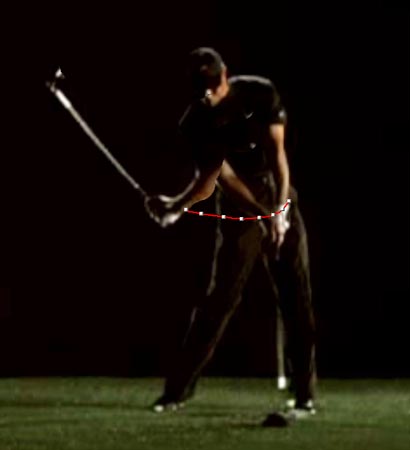


I used a spine tool in my swing analyser program to make a white dot every 10 frames and that works out to one white dot every 1/400th second (because the video frame rate was 4,000 frames/second.) Note that Tiger's left arm speed slows down just before impact, and that allows PA#3 to release completely so that the clubface can be squared at impact. In a "right arm throw" swing, how does a golfer get the hands to slow down just before impact to provide enough time for the complete release of PA#3?

Jeff.

mrose 11-22-2008 03:25 AM

Quote:

Originally Posted by Jeff (Post 57919)
DG

The one thing about your approach is that you are unwilling, or unable, to describe TT"s right arm throw action in detail.

You make statements that are vague like -: "Then please tell the class why Tommy started the downstroke with everything (uncocking of the right forearm, the right shoulder, the right forearm and left forearm, the left wrist) for full golf swings per the TGM swinging procedure."

What does it mean to say that TT started the downswing with "everything"? Surely you need to explain the sequence of events in great detail?

In your last post, you stated-: "lever and unlever the right forearm." That's not a complete explanation. That's a vague statement.

Don't you think that you should offer a more detailed explanation of TT's "right arm throw action" if you want us to consider it a viable option for swinging a golf club? For example, you make statements like "throw the right arm from the top". Yoda has questioned the rationality of the idea that one can throw the right forearm from the top, and I think that he has a point. When I look at TT's right arm throw action, it reminds me of a person skipping stones. When a person skips stones, I believe that the right forearm throw action only starts after the right arm is adducted to the right side and the right elbow is wedged into the right hip area. In other words, the "right forearm throw" action only starts in earnest when the right hand reaches waist level. There must be a preceding downstroke movement that initiates the stone skipping action - for example, transferring weight to the lead leg with a pivot motion, and bringing the right elbow down to the right side by adducting the right upper arm (which involves right shoulder girdle muscles).

Also, in a stone skipping motion, the right elbow straightens and the right hand releases the stone. However, golf requires the two arms to work together because the two hands conjointly hold the grip end of the club. If the right arm throws the right hand, then the right hand must be moving the left hand because it is conjoined to the left hand at pressure point #1. Therefore, you have to explain what "effect" the right hand has on left hand movement and whether there is also a release of PA#4 via some other mechanism, and whether the right hand movement has to be coordinated with the left hand movement (secondary to the release of PA#4).

Also, here is a capture image of Tiger Woods swing - from the Nike commercial video.


I used a spine tool in my swing analyser program to make a white dot every 10 frames and that works out to one white dot every 1/400th second (because the video frame rate was 4,000 frames/second.) Note that Tiger's left arm speed slows down just before impact, and that allows PA#3 to release completely so that the clubface can be squared at impact. In a "right arm throw" swing, how does a golfer get the hands to slow down just before impact to provide enough time for the complete release of PA#3?

Jeff.

great post Jeff. very interesting. i think my swing at the moment can be explained precisely by your insight into PA#3.

on wednesday i had one of the worst putting rounds of my life, i had 7 three putts and a 79 having hit 13 out of 14 fairways. today i had the same thing happen, on the front 9 i could not miss a fairway if i tried and was hitting it long and yet it was of no use due to complete collapse on the greens. what's my point? well, on the back nine i became very frustrated and started hitting the ball harder and harder. i then missed a couple of fairways to the right and i'm sure not allowing PA#3 to release was the culprit. i thought to myself last night that surely i would not drive this well if i was holing putts because that would just be scary. driving seems so easy sometimes when putting poorly and i think this is through not trying too hard, just letting it happen and not trying to force anything. i think someone wrote in a yellow book that rhythm is essential to a good golf stroke. would an unbending right arm from the top allow such rhythm in a swinging procedure? i doubt it.

Jeff 11-22-2008 11:50 AM

mrose

I think that you are correct.

When golfers get mad with their swing, they often try harder, and that means
that they often become switters - adding right arm power to their 4:2:3 swinging action.

Adding right arm power can produce two harmful effects as I demonstrate in this next posed photo.
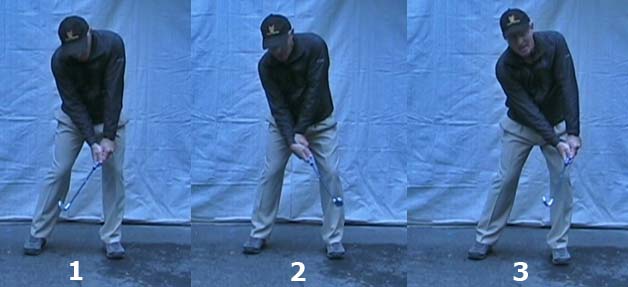


I am using a short child-iron to demonstrate two potentially harmful effects from adding right arm power to a swinger's action.

Image 1 shows the standard swinger's action. As the hands approach impact, the left wrist should be flat and the right wrist should be bent back, and the hands should lead the club into impact. If the kinetic sequencing was correct and the release timing correct, the clubface should become square at impact if PA#3 release is completed properly.

Image 2 shows a golfer trying to add right arm power by palmar flexing the right wrist as the hands approach impact. That's an obvious disaster!

Image 3 shows a golfer trying to add right arm power by actively straightening the right elbow via active right triceps muscle action when the hands reach the delivery position - that action drives the hands through the impact zone too fast and that action interferes with the timely release of PA#3 => open clubface at impact => pushed shots.

Jeff.

mrose 11-23-2008 08:45 AM

that makes a lot of sense Jeff. i also find when swinging too hard i may bend the left arm a little coming down and lead with the left elbow ever so slightly. i wonder if this is only from forcing things and adding PA#1 or a subconscious anti-hook move from going at it too hard. over acceleration is not pretty either way.

Delaware Golf 11-23-2008 05:20 PM

Quote:

Originally Posted by Jeff (Post 57919)
DG

The one thing about your approach is that you are unwilling, or unable, to describe TT"s right arm throw action in detail.

You make statements that are vague like -: "Then please tell the class why Tommy started the downstroke with everything (uncocking of the right forearm, the right shoulder, the right forearm and left forearm, the left wrist) for full golf swings per the TGM swinging procedure."

What does it mean to say that TT started the downswing with "everything"? Surely you need to explain the sequence of events in great detail?

In your last post, you stated-: "lever and unlever the right forearm." That's not a complete explanation. That's a vague statement.

Don't you think that you should offer a more detailed explanation of TT's "right arm throw action" if you want us to consider it a viable option for swinging a golf club? For example, you make statements like "throw the right arm from the top". Yoda has questioned the rationality of the idea that one can throw the right forearm from the top, and I think that he has a point. When I look at TT's right arm throw action, it reminds me of a person skipping stones. When a person skips stones, I believe that the right forearm throw action only starts after the right arm is adducted to the right side and the right elbow is wedged into the right hip area. In other words, the "right forearm throw" action only starts in earnest when the right hand reaches waist level. There must be a preceding downstroke movement that initiates the stone skipping action - for example, transferring weight to the lead leg with a pivot motion, and bringing the right elbow down to the right side by adducting the right upper arm (which involves right shoulder girdle muscles).

Also, in a stone skipping motion, the right elbow straightens and the right hand releases the stone. However, golf requires the two arms to work together because the two hands conjointly hold the grip end of the club. If the right arm throws the right hand, then the right hand must be moving the left hand because it is conjoined to the left hand at pressure point #1. Therefore, you have to explain what "effect" the right hand has on left hand movement and whether there is also a release of PA#4 via some other mechanism, and whether the right hand movement has to be coordinated with the left hand movement (secondary to the release of PA#4).

Also, here is a capture image of Tiger Woods swing - from the Nike commercial video.


I used a spine tool in my swing analyser program to make a white dot every 10 frames and that works out to one white dot every 1/400th second (because the video frame rate was 4,000 frames/second.) Note that Tiger's left arm speed slows down just before impact, and that allows PA#3 to release completely so that the clubface can be squared at impact. In a "right arm throw" swing, how does a golfer get the hands to slow down just before impact to provide enough time for the complete release of PA#3?

Jeff.

Jeff,

You wrote....Don't you think that you should offer a more detailed explanation of TT's "right arm throw action" if you want us to consider it a viable option for swinging a golf club? Homer considered it a viable optioin, I have nothing to do with it. The detailed explanation is already in the book, it's under section 7-3.

In the Tomasello interview he said to "lever and unlever the right forearm"....in TGM per 7-3 Homer said to "COCK AND UNCOCK THE RIGHT ELBOW"....it's the same thing. THE MAGIC OF THE RIGHT FOREARM...once you practice the movement it will become a very natual movement. If you're currently a golfer who attempts to generate the swinging procedure starting the club down with the lower body, starting the downswing with the uncocking of the right elbow is going to feel un-natural. In time it won't.


DG

Delaware Golf 11-23-2008 07:41 PM

Quote:

Originally Posted by Jeff (Post 57927)
mrose

I think that you are correct.

When golfers get mad with their swing, they often try harder, and that means
that they often become switters - adding right arm power to their 4:2:3 swinging action.

Adding right arm power can produce two harmful effects as I demonstrate in this next posed photo.


I am using a short child-iron to demonstrate two potentially harmful effects from adding right arm power to a swinger's action.


Image 1 shows the standard swinger's action. As the hands approach impact, the left wrist should be flat and the right wrist should be bent back, and the hands should lead the club into impact. If the kinetic sequencing was correct and the release timing correct, the clubface should become square at impact if PA#3 release is completed properly.

Image 2 shows a golfer trying to add right arm power by palmar flexing the right wrist as the hands approach impact. That's an obvious disaster!

Image 3 shows a golfer trying to add right arm power by actively straightening the right elbow via active right triceps muscle action when the hands reach the delivery position - that action drives the hands through the impact zone too fast and that action interferes with the timely release of PA#3 => open clubface at impact => pushed shots.

Jeff.

That post is TOTAL BS. :confused1 No way does the swing with the right arm action that Tom Tomasello taught create a throw-away condition like that...

DG

Jeff 11-23-2008 08:56 PM

DG- you wrote-: "That post is TOTAL BS. No way does the swing with the right arm action that Tom Tomasello taught create a throw-away condition like that..."

I never inferred that it did. I merely stated that if a swinger uses a standard 4:2:3 swing pattern that there is a danger to adding right arm push-power at some point in the mid-late downswing. I stated that if one added a very active right elbow straightening action in the late downswing it could push the hands through the impact zone too fast and not provide sufficient time for a complete release of PA#3. I also stated that if one added right arm push-power via a right wrist unbending action in the late downswing it could produce flipping. I wasn't talking about TT's right arm throw action, which is a swing style where the right arm throw starts from the top.

You also stated-: "Homer considered it a viable option, I have nothing to do with it. The detailed explanation is already in the book, it's under section 7-3."

I have read 7-3. I can see no description of TT's right arm throw action in that section. Section 7-3 first deals with the relationship of the right forearm to the left arm flying wedge package in swinger's (arc of approach style) and hitters (angle of approach style) at the top of the swing. In the second half of that section HK talks of the position of the right forearm in the late downswing (whether driven or thrown) and he states-: "ALWAYS for all procedures, the Right Forearm is positioned "On Plane" - pointing at the plane line as the angle of attack. ------- The "Angle of Approach" position of the Right Forearm shows the precise Cross-Line direction the Forearm must take through Impact."

In other words, HK was merely describing the right forearm in relationship to the standard (4:2:3) swinger's action (where the right forearm is thrown) and a standard hitting action (where the right forearm is driven). I cannot identify a description of TT's "right arm throw" action in that section.

I have personally made an attempt to describe TT's "right arm throw" action in TGM terms. I first described it as a triple barrel 1:2:3 swing action. However, Yoda stated that I was incorrect because the "1" should be reserved for a hitting action where the right arm powers the clubshaft through impact via PP#3. TT wasn't describing a hitting action, but a swinging action. I therefore modified my description and called it a RAPF4:2:3 swing action. You are free to state whether you think that my description is right or wrong, and you are free to provide your personal perspective using TGM terminology (describing TT's "right arm throw" action in terms of the loading and release of power accumulators).

Jeff.

Delaware Golf 11-23-2008 10:07 PM

Quote:

Originally Posted by Jeff (Post 57987)
DG- you wrote-: "That post is TOTAL BS. No way does the swing with the right arm action that Tom Tomasello taught create a throw-away condition like that..."

I never inferred that it did. I merely stated that if a swinger uses a standard 4:2:3 swing pattern that there is a danger to adding right arm push-power at some point in the mid-late downswing. I stated that if one added a very active right elbow straightening action in the late downswing it could push the hands through the impact zone too fast and not provide sufficient time for a complete release of PA#3. I also stated that if one added right arm push-power via a right wrist unbending action in the late downswing it could produce flipping. I wasn't talking about TT's right arm throw action, which is a swing style where the right arm throw starts from the top.

You also stated-: "Homer considered it a viable option, I have nothing to do with it. The detailed explanation is already in the book, it's under section 7-3."

I have read 7-3. I can see no description of TT's right arm throw action in that section. Section 7-3 first deals with the relationship of the right forearm to the left arm flying wedge package in swinger's (arc of approach style) and hitters (angle of approach style) at the top of the swing. In the second half of that section HK talks of the position of the right forearm in the late downswing (whether driven or thrown) and he states-: "ALWAYS for all procedures, the Right Forearm is positioned "On Plane" - pointing at the plane line as the angle of attack. ------- The "Angle of Approach" position of the Right Forearm shows the precise Cross-Line direction the Forearm must take through Impact."

In other words, HK was merely describing the right forearm in relationship to the standard (4:2:3) swinger's action (where the right forearm is thrown) and a standard hitting action (where the right forearm is driven). I cannot identify a description of TT's "right arm throw" action in that section.

I have personally made an attempt to describe TT's "right arm throw" action in TGM terms. I first described it as a triple barrel 1:2:3 swing action. However, Yoda stated that I was incorrect because the "1" should be reserved for a hitting action where the right arm powers the clubshaft through impact via PP#3. TT wasn't describing a hitting action, but a swinging action. I therefore modified my description and called it a RAPF4:2:3 swing action. You are free to state whether you think that my description is right or wrong, and you are free to provide your personal perspective using TGM terminology (describing TT's "right arm throw" action in terms of the loading and release of power accumulators).

Jeff.

Jeff,

I'm sorry you're not catching on....it's in there. Between the videos, the interview, TGM text....it's all there.

DG

Yoda 11-23-2008 10:24 PM

Time For A Right Elbow Action Summit
 
Quote:

Originally Posted by Jeff (Post 57987)

I have personally made an attempt to describe TT's "right arm throw" action in TGM terms. I first described it as a triple barrel 1:2:3 swing action. However, Yoda stated that I was incorrect because the "1" should be reserved for a hitting action where the right arm powers the clubshaft through impact via PP#3. TT wasn't describing a hitting action, but a swinging action. I therefore modified my description and called it a RAPF4:2:3 swing action.

Jeff,

Thank you for all you are doing to shine the brightest light on Homer Kelley's The Golfing Machine. After some thirty years of study, I welcome your posts and know that the work itself can withstand relentless scientific scrutiny. Moreover, the Golf World has just now become empowered with a variety of scientific tools, e.g., launch monitors, that prove just how right Homer Kelley really was.

:)

Now a question:

Do you have the Third Edition?

I ask this because, in the Third Edition, the first three (of six) Sample Stroke Patterns are relevant to your posts. Specifically, these three offer examples of One, Two and Three Accumulator Patterns, all of which employ the 1-2-3 Triple Barrel Stroke (Component #4) and the Right Arm Throw Trigger (Component #20) you earlier espoused.

With, I might add, a inconcongruence of Grip Type and Hinge Action with the later Basic Stroke Patterns of 12-1-0 and 12-2-0 in Editions 4-7. Specifically, in the Two Accumulator Pivot Stroke (12-2-0): the Strong Double Action Grip (10-2-D) and its Angled Hinge Action (10-10-C). And, in the One and Three Accumulator Strokes (12-1-0 and 12-3-0): the Right Arm Trigger coupled with Dual Horizontal Hinge Action.

Each of which is entirely consistent with Homer's original intent, i.e., "To present the solution as a Right Arm approach to the whole game" (1-F / Editions 1-3).

Anyway, this whole argument hangs on three or four sentences across the decades.

Lets take the time on this thread to get it right.

I'll do my part.

:salut:

Jeff 11-23-2008 10:36 PM

Yoda - I am very new to TGM and I only have the 7th edition.

It would be very nice if you (or someone) could post the relevant section of the 3rd edition so that I can understand what you are talking about.

You also wrote-: "With, I might add, an incongruence of Grip Type and Hinge Action with the later Basic Stroke Patterns of 12-1-0 and 12-2-0 in Editions 4-7. Specifically, in the Two Accumulator Pivot Stroke (12-2-0): the Strong Double Action Grip (10-2-D) and its Angled Hinge Action (10-10-C). And, in the One and Three Accumulator Strokes (12-1-0 and 12-3-0): the Right Arm Trigger coupled with Dual Horizontal Hinge Action."

Those sentences are well beyond my limited level of TGM understanding. I eagerly await further elucidatory/explanatory posts. The study of TGM is a fascinating endeavour and I have a lot to learn!

Jeff.

Yoda 11-23-2008 10:41 PM

Master Mind
 
Quote:

Originally Posted by Jeff (Post 57993)

Those sentences are well beyond my limited level of TGM understanding. I eagerly await further elucidatory/explanatory posts. The study of TGM is a fascinating endeavour and I have a lot to learn!

Jeff,

You have a PM.

:salut:

Delaware Golf 11-23-2008 11:12 PM

Quote:

Originally Posted by Yoda (Post 57992)
Jeff,

Thank you for all you are doing to shine the brightest light on Homer Kelley's The Golfing Machine. After some thirty years of study, I welcome your posts and know that the work itself can withstand relentless scientific scrutiny. Moreover, the Golf World has just now become empowered with a variety of scientific tools, e.g., launch monitors, that prove just how right Homer Kelley really was.

:)

Now a question:

Do you have the Third Edition?

I ask this because, in the Third Edition, the first three (of six) Sample Stroke Patterns are relevant to your posts. Specifically, these three offer examples of One, Two and Three Accumulator Patterns, all of which employ the 1-2-3 Triple Barrel Stroke (Component #4) and the Right Arm Throw Trigger (Component #20) you earlier espoused.

With, I might add, an incongruence of Grip Type and Hinge Action with the later Basic Stroke Patterns of 12-1-0 and 12-2-0 in Editions 4-7. Specifically, in the Two Accumulator Pivot Stroke (12-2-0); the Strong Double Action Grip (10-2-D); its Angled Hinge Action (10-10-C); and the Dual Horizontal Hinge Action of 12-1-0 and 12-3-0.

Each of which is entirely consistent with Homer's original intent, i.e., "To present the solution as a Right Arm approach to the whole game" (1-F / Editions 1-3).

Anyway, this whole argument hangs on three or four sentences across the decades.

Lets take the time on this thread to get it right.

I'll do my part.

:salut:

Yoda,

Thanks for bringing up Homer's original intent...."To present the solution as a Right Arm approach to the whole game". I believe that's what Tom Tomasello did in his instruction and presentation of The Golfing Machine." It totally makes sense...once you reduce variation in the system, quality goes up. I'm surprised the TGM community will not give Tommy any credit for the original intent...it's a damn shame. Is it because nobody made the connection???

DG

Yoda 11-23-2008 11:47 PM

Third Edition Accumulator Stroke Patterns . . . One / Two / Three At A Time
 
Bambam,

For this thread and its interested viewers, can you provide a scan of the Third Edition's Stroke Patterns 12-1/2/3? With full credits, of course, to TGM, LLC.

Thanks!

:salut:

Delaware Golf 11-24-2008 01:46 AM

Missing the most important stroke pattern of them ALL...
 
Quote:

Originally Posted by Yoda (Post 57999)
Bambam,

For this thread and its interested viewers, can you provide a scan of the Third Edition's Stroke Patterns 12-1/2/3? With full credits, of course, to TGM, LLC.

Thanks!

:salut:

Why not show Stroke Pattern 12-4? The most relevent pattern to this thread?

DG

Delaware Golf 11-24-2008 08:34 AM

Quote:

Originally Posted by Jeff (Post 57888)
DG wrote-: "Sorry guys that is incorrect....for a swinging stroke using 10-20-B, the golfer starts the downstroke by uncocking the right elbow through the muscles of the right forearm the pivot responds with a sliding action...then a rotational action during the release phase."

That's anatomically impossible. The right forearm muscles cannot straighten the bent/folded right elbow. That function is performed by the UPPER arm triceps muscle.

Forerarm muscles can only perform the following anatomical actions-:

1) Flex, extend, abduct or adduct the fingers and thumb.
2) Palmarflex or dorsiflex the wrist.
3) Radially deviate or ulnarly deviate the wrist.
4) Pronate or supinate the hand.

Forearm muscles cannot flex or extend the elbow joint because they are distal (peripheral) to the elbow joint.

If anybody contests my opinion, please be so kind to name the right forearm muscle which is "supposedly" capable of straightening the right elbow joint.

Jeff.

You're stuck....

Delaware Golf 11-24-2008 08:36 AM

Quote:

Originally Posted by Delaware Golf (Post 58005)
You're stuck....

I can concentrate on my right forearm all day long and swing back and forth with the muscles of the right forearm and the elbow reacts to that motion just like someone who starts the downswing with the lower body the right elbow reacts to that too. What Tommy Tomasello is saying is...the right forearm version is more efficient. I believe I sent you a copy of Tommy's 1991 Golf Illustrated interview....please re-read it. I would re-read it several times over a year or two or more.

DG

Yoda 11-24-2008 10:13 AM

Shakin' My Head Over This One
 
Quote:

Originally Posted by Delaware Golf (Post 58001)

Why not show Stroke Pattern 12-4? The most relevent pattern to this thread?

DG,

You never cease to amaze me. The first three Patterns feature the Right Arm Throw Trigger (for which you may be the most ardent advocate on the planet). The fourth employs the Left Wrist Throw Trigger.

How in the world could a Pattern that does not feature a Right Arm Throw be more relevant to this thread than one which does?

](*,)

YodasLuke 11-24-2008 11:20 AM

insert thorn in side
 
Quote:

Originally Posted by Yoda (Post 58007)
DG,

You never cease to amaze me. The first three Patterns feature the Right Arm Throw Trigger (for which you may be the most ardent advocate on the planet). The fourth employs the Left Wrist Throw Trigger.

How in the world could a Pattern that does not feature a Right Arm Throw be more relevant to this thread than one which does?

](*,)

Once again...bothersome facts. :naughty: :laughing9

Jeff 11-24-2008 11:58 AM

DG

You wrote-: "I can concentrate on my right forearm all day long and swing back and forth with the muscles of the right forearm."

You have an amazing capacity to make unsubstantiated claims, any you seem unwilling to prove any explanations. Which forearm muscles are in use during your back-and-forth swing and what are they doing from a functional perspective?

How can you expect anybody to consider your opinions seriously if you are unwilling to provide explanatory details?

Jeff.

Delaware Golf 11-24-2008 12:52 PM

Quote:

Originally Posted by YodasLuke (Post 58011)
Once again...bothersome facts. :naughty: :laughing9

Ted,

That fact is coming from a GSED who studied with the man personally. Did you study with Homer directly?

DG

Delaware Golf 11-24-2008 12:54 PM

Quote:

Originally Posted by Jeff (Post 58012)
DG

You wrote-: "I can concentrate on my right forearm all day long and swing back and forth with the muscles of the right forearm."

You have an amazing capacity to make unsubstantiated claims, any you seem unwilling to prove any explanations. Which forearm muscles are in use during your back-and-forth swing and what are they doing from a functional perspective?

How can you expect anybody to consider your opinions seriously if you are unwilling to provide explanatory details?

Jeff.

Jeff,

Muscles seem to be your area of expertise, why don't you tell me what forearm muscles I'm using?

DG

Delaware Golf 11-24-2008 01:02 PM

Quote:

Originally Posted by Yoda (Post 58007)
DG,

You never cease to amaze me. The first three Patterns feature the Right Arm Throw Trigger (for which you may be the most ardent advocate on the planet). The fourth employs the Left Wrist Throw Trigger.

How in the world could a Pattern that does not feature a Right Arm Throw be more relevant to this thread than one which does?

](*,)

The fourth employs a FOUR BARREL PATTERN....with swinging components.

DG

Mike O 11-24-2008 01:35 PM

Quote:

Originally Posted by Jeff (Post 57888)
DG wrote-: "Sorry guys that is incorrect....for a swinging stroke using 10-20-B, the golfer starts the downstroke by uncocking the right elbow through the muscles of the right forearm the pivot responds with a sliding action...then a rotational action during the release phase."

That's anatomically impossible. The right forearm muscles cannot straighten the bent/folded right elbow. That function is performed by the UPPER arm triceps muscle.

Forerarm muscles can only perform the following anatomical actions-:

1) Flex, extend, abduct or adduct the fingers and thumb.
2) Palmarflex or dorsiflex the wrist.
3) Radially deviate or ulnarly deviate the wrist.
4) Pronate or supinate the hand.

Forearm muscles cannot flex or extend the elbow joint because they are distal (peripheral) to the elbow joint.

If anybody contests my opinion, please be so kind to name the right forearm muscle which is "supposedly" capable of straightening the right elbow joint.

Jeff.

Here is one- although there are more:
Brachioradialis is a muscle of the forearm that acts to flex the forearm at the elbow. It is also capable of both pronation and supination, depending on the position of the forearm. It is attached to the distal styloid process of the radius by way of the brachioradialis tendon, and to the lateral supracondylar ridge of the humerus.

12 piece bucket 11-24-2008 05:56 PM

Quote:

Originally Posted by Mike O (Post 58018)
Here is one- although there are more:
Brachioradialis is a muscle of the forearm that acts to flex the forearm at the elbow. It is also capable of both pronation and supination, depending on the position of the forearm. It is attached to the distal styloid process of the radius by way of the brachioradialis tendon, and to the lateral supracondylar ridge of the humerus.

Oh boy . .. wonder who got dissected . . . .

Mike O 11-24-2008 06:16 PM

Quote:

Originally Posted by 12 piece bucket (Post 58025)
Oh boy . .. wonder who got dissected . . . .

Since Drewitgolf is a swinger- I took his right forearm. Let's just say a right forearm anything is now not an option for him.

Burner 11-24-2008 06:33 PM

Quote:

Originally Posted by 12 piece bucket (Post 58025)
Oh boy . .. wonder who got dissected . . . .

Lets wait and see if DG posts again. :shock: :whistle:

Yoda 11-24-2008 07:10 PM

Choose Your Poison
 
Quote:

Originally Posted by Delaware Golf (Post 58015)

The fourth employs a FOUR BARREL PATTERN....with swinging components.

And a Left Wrist Throw, not a Right Arm Throw.

:rolleyes:

YodasLuke 11-24-2008 07:40 PM

used for flexion, not extension
 
Quote:

Originally Posted by Mike O (Post 58018)
Here is one- although there are more:
Brachioradialis is a muscle of the forearm that acts to flex the forearm at the elbow. It is also capable of both pronation and supination, depending on the position of the forearm. It is attached to the distal styloid process of the radius by way of the brachioradialis tendon, and to the lateral supracondylar ridge of the humerus.

Mike O,

Please take the following with the largest grain of salt that you can find, as I am not the expert in this department.

It's my understanding that the brachioradialis aids only in flexion, not extension.

There are two muscles, the extensor digitorum and the extensor carpi ulnaris, that aid in the extending of the elbow. The extension of the elbow by these two muscles appears only to come after extension of the fingers and/or the wrist. At best, I think these muscles are subordinate to the actions of the triceps brachii and the anconeus.

Discounting the roles of the triceps brachii and the anconeus in the extending of the elbow requires intoxication. :eyes: :eyes: :eyes:

YodasLuke 11-24-2008 07:59 PM

thanks for asking...
 
Quote:

Originally Posted by Delaware Golf (Post 58013)
Ted,

That fact is coming from a GSED who studied with the man personally. Did you study with Homer directly?

DG

I've studied with Lynn, who is one of the smartest men that ever studied with Homer. And, in my opinion and of all the G.S.E.D.'s I've met, he's the purest version of TGM.

Unless you're as sharp as a bowling ball, you got the jab.

drewitgolf 11-24-2008 08:11 PM

A Repeat Performance
 
Quote:

Originally Posted by YodasLuke (Post 58035)
Mike O,

Please take the following with the largest grain of salt that you can find, as I am not the expert in this department.

It's my understanding that the brachioradialis aids only in flexion, not extension.

There are two muscles, the extensor digitorum and the extensor carpi ulnaris, that aid in the extending of the elbow. The extension of the elbow by these two muscles appears only to come after extension of the fingers and/or the wrist. At best, I think these muscles are subordinate to the actions of the triceps brachii and the anconeus.

Discounting the roles of the triceps brachii and the anconeus in the extending of the elbow requires intoxication. :eyes: :eyes: :eyes:

I once heard Bucket say the same thing.

YodasLuke 11-24-2008 08:30 PM

i'ont cair whu u ar
 
Quote:

Originally Posted by drewitgolf (Post 58038)
I once heard Bucket say the same thing.

Now that's funny!! :laughing9 :laughing9 :laughing9

Mike O 11-24-2008 09:03 PM

Quote:

Originally Posted by YodasLuke (Post 58035)
Mike O,

Please take the following with the largest grain of salt that you can find, as I am not the expert in this department.

It's my understanding that the brachioradialis aids only in flexion, not extension.

There are two muscles, the extensor digitorum and the extensor carpi ulnaris, that aid in the extending of the elbow. The extension of the elbow by these two muscles appears only to come after extension of the fingers and/or the wrist. At best, I think these muscles are subordinate to the actions of the triceps brachii and the anconeus.

Discounting the roles of the triceps brachii and the anconeus in the extending of the elbow requires intoxication. :eyes: :eyes: :eyes:

Ted,
I was only addressing the middle portion of Jeff's post:
"Forerarm muscles can only perform the following anatomical actions-:

1) Flex, extend, abduct or adduct the fingers and thumb.
2) Palmarflex or dorsiflex the wrist.
3) Radially deviate or ulnarly deviate the wrist.
4) Pronate or supinate the hand.

Forearm muscles cannot flex or extend the elbow joint because they are distal (peripheral) to the elbow joint.

Jeff."


Hopefully, that makes my post more relevant. The point is that some "forearm" muscles are able to flex the forearm and some forearm muscles are able to extend the forearm. Those are the muscles that cross the elbow joint. I wasn't posting to the degree of relevance or Bucket's drinking habits, all I was pointing out since Jeff asked was that his limited definition was not correct. Not all forearm muscles have tendon attachments that are distal to the elbow joint, as you correctly pointed out in your post with the addition of some extensor forearm muscles.

Augusta Golf 11-24-2008 09:16 PM

Please don't start with the knee bone connected to the thigh bone song.

Delaware Golf 11-24-2008 09:16 PM

Quote:

Originally Posted by Mike O (Post 58049)
Ted,
I was only addressing the middle portion of Jeff's post:
"Forerarm muscles can only perform the following anatomical actions-:

1) Flex, extend, abduct or adduct the fingers and thumb.
2) Palmarflex or dorsiflex the wrist.
3) Radially deviate or ulnarly deviate the wrist.
4) Pronate or supinate the hand.

Forearm muscles cannot flex or extend the elbow joint because they are distal (peripheral) to the elbow joint.

Jeff."


Hopefully, that makes my post more relevant.

Mike,

Then tell us why would Homer write...."and the Right Forearm is ALWAYS DRIVING." And why would Tomasello say "DRIVE that right forearm to a long right arm" while demonstrating the swinging procedure.

DG

Mike O 11-24-2008 10:03 PM

Quote:

Originally Posted by Delaware Golf (Post 58052)
Mike,

Then tell us why would Homer write...."and the Right Forearm is ALWAYS DRIVING." And why would Tomasello say "DRIVE that right forearm to a long right arm" while demonstrating the swinging procedure.

DG

Dave,
I'm not interested in getting involved in this debate, discussion - I was only commenting on a very narrow topic area within one of Jeff's post- with no intent to have it reflect on any wider issue- pro or con.

If we were to interpret my post- if anything - I would think it would lean more in the direction of supporting your "apparent" viewpoint than it would the "oppositions" - so I am perplexed at the nature of your question to me.

Part of the problem that I see with this thread or posts to this thread is one of communication. Specifically, when you are describing movement let's assume you need to define 1) What the intent is, 2) What muscles are being used, 3) What sensations you are sensing while the movement is being made, 4) What it looks like through the video camera, 5) Where your focus or awareness is while making the movement, 6) etc. - these are all very different for the same movement.

For example, If I decide to Drive my hand/fist through Buckets skull- that doesn't mean that I'm using the fist muscles to do it- that just describes my intent. The muscles that create that motion of the hand might simply be the tricep muscle but of course that would not cause much damage so I'd probably use muscles throughout my body - some for movement, some for support of movement, etc. etc. On to what sensation I might be aware of while I was making the movement - Would that be my hand? no, you'd have greater sensations other places (Bucket can elaborate on this further). Would I individually feel every single muscle that is contracting-No, although they are.

In summary, it's important to understand the context in which you are looking at the movement. For example, in case someone were to read your question and assume that both your quotes were saying the same thing- certainly they are not in this regard : The Homer quote is saying that the Forearm is always driving - that's more of a third party observer comment - as if we were measuring the acceleration rate of the forearm and the Tomasello quote is more from the 1st perspective - the mover- the intent of the mover to drive the forearm or move the forearm. I only use that example to point out the different contexts that one needs to observe- it in no way is meant to separate out one as right and one as wrong.

If one were to want to make some progress or learn during a debate- one might ask questions to clearly understand the opposing view and one might want to clearly define their view for the opposing party. That way you create a platform for agreement to move forward. Hope that helps in some way.

For some reason I feel much better after posting this post- hmm... the only thing I could possibly feel better about would be if Bucket came over to play some cards- Bucket- where are you? Come on over - let's play a friendly game of cards- I've got those candy bars you like! I've got to go now - my Doctor Augusta Golf says I shouldn't be out this long without more medication.

Scottgas2 11-24-2008 10:06 PM

The driving of the right forearm, in spite of a couple of smaller extensors
in the forearm whose tendons cross the elbow, is primarily driven by the much larger extensors of the upper arm: triceps etc.
I don't know if you can play golf, but you can still extend the elbow if the tendons to the distal extensors are cut.

I love the Deitrick (sorry about the spelling) letters and have watched them many times. They helped me figure out how to hit the ball without over-rotating the torso. Tommy actually says, "What has the lower body done? Absolutely nothing."
That and Bill Melhorn's instruction have improved my timing so that the ball actually goes toward where I want to hit it.

I was dismayed a few pages back when someone said that throwing the hands
al la TT will result in a significant loss of distance. Can this be verified?
Tommy seemed to think it would apply quite a smash to the ball.

12 piece bucket 11-24-2008 10:29 PM

Quote:

Originally Posted by drewitgolf (Post 58038)
I once heard Bucket say the same thing.

My mama heard it too . . . . got my mouth washed out with Ajax (who's gonna be the first to take pop shot at that???) too.


All times are GMT -4. The time now is 09:16 AM.